Explained
Humidifiers, Explained
After reading this, you will know which humidifier technology fits your room, your water, and your tolerance for maintenance.
In this guide
A humidifier looks like a simple appliance, but the technology inside decides almost everything about living with it: how clean the moisture is, how loud it runs, and how much you clean it. Most buyers focus on tank size and mist output when the real questions are what type it is and whether your tap water will coat the room in white dust. This guide decodes the terms so you shop by the trade-offs that actually matter.
The 30-second version
- Technology beats brand. Ultrasonic, evaporative, and warm-mist designs each have fixed trade-offs, so pick the type first and the model second.
- White dust is a water problem, not a defect. Ultrasonic units spray whatever minerals are in the tank into the air, so hard water means distilled water or an evaporative model instead.
- A humidistat is close to mandatory. Without automatic humidity control you swing between bone-dry air and condensation on the windows.
- Every design needs cleaning. Standing water grows mold within days, so easy cleaning access matters more than any headline spec.
- Match tank size to the room. A whole-house unit in a bedroom is overkill, while a tiny tank in an open plan means refilling twice a day.
The products this guide is about
Our verdict on each, with the full reasoning on the companion review.
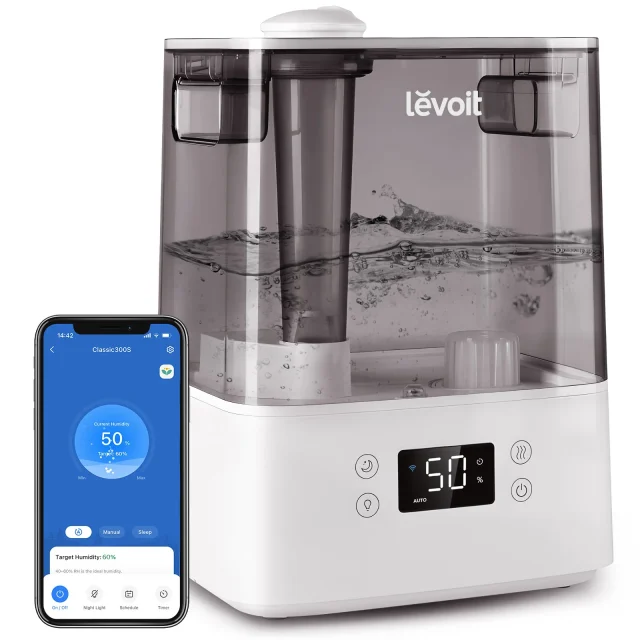
- Buy Levoit Classic 300S A quiet, app-smart ultrasonic that most bedrooms should shortlist first - if you manage water quality. Amazon
- Buy Levoit Superior 6000S A whole-house evaporative unit that adds moisture without white dust - and without distilled water. Amazon
- It depends Honeywell HEV320W A compact, no-frills evaporative that refuses to make white dust and needs no app. Amazon
- Skip Honeywell HWM705B A warm-mist steam unit whose burn risk and upkeep outweigh its cold-season comfort. Amazon
What actually matters
- Humidifier type (ultrasonic, evaporative, warm mist) - this single choice sets your dust, noise, and maintenance profile more than anything else on the spec sheet.
- Water compatibility - if your tap water is hard and you will not commit to distilled, evaporative avoids white dust entirely while ultrasonic cannot.
- Humidistat or Auto Mode - automatic humidity control keeps the room in a healthy band instead of over- or under-humidifying.
- Cleaning access - a wide top-fill opening and simple base are the biggest predictor of whether a unit stays healthy over months.
- Tank size versus coverage - the tank determines refill frequency and the coverage rating determines whether it can keep up with your room.
- Noise level - ultrasonic is near-silent, evaporative always has a fan, and this decides everything for a light sleeper.
- Ongoing costs - evaporative wants replacement wick filters and every type wants some descaling or upkeep.
The specs, in plain English
Green flags vs red flags
Green flags
- A built-in humidistat or Auto Mode so humidity holds itself in a healthy range
- A wide top-fill opening and simple base you can actually reach to wipe clean
- Evaporative design if you have hard water and want zero white dust
- Clear, honest coverage and runtime numbers that match your room
- Easy-to-find replacement filters or straightforward descaling instructions
Red flags
- An ultrasonic model marketed for hard-water homes with no mention of distilled water
- No humidistat on a unit meant to run unattended in a closed room
- A narrow tank opening or fiddly parts that make thorough cleaning impractical
- Warm-mist steam pitched for a nursery or sickroom despite the hot-base burn risk
- Mismatched size, such as a tiny tank sold for a large open-plan space
- Vague or missing coverage and runtime figures that hide real performance
Who's who: the brands
- Levoit - Popular for app-connected ultrasonic and evaporative units with Auto Mode and easy top-fill cleaning.
- Honeywell - Known for no-frills evaporative and warm-mist units with a reputation for simplicity and durability.
- Vicks - Widely sold warm-mist and cool-mist units aimed at cold and congestion relief, often with a medicated-vapor option.
- Dyson - Premium units that combine humidification with air purification and heavy marketing around hygiene.
- Crane - Recognizable for compact, design-forward cool-mist humidifiers popular in nurseries and bedrooms.
How to read a listing without getting fooled
Start at the top of the listing and find the technology before anything else, because ultrasonic, evaporative, and warm mist decide your whole experience. Read the coverage rating as a ceiling and knock it down if your room is drafty or open. Check whether the unit has a humidistat or only manual speed settings; manual means you will need a separate hygrometer to know what you are doing. Look for the words distilled water in the manual or fine print, which is a tell that the model is ultrasonic and will dust hard-water rooms. Finally, hunt for how you clean it: a wide top-fill opening and a simple base beat a clever feature list, because the unit you can clean is the unit that stays safe to breathe.
How much should you spend?
Spend based on room size and how automated you want the experience to be, not on headline mist numbers. Budget models are usually simple manual evaporative or warm-mist units that work fine if you do not mind refilling often and reading a separate hygrometer. The value sweet spot is a mid-tier cool-mist unit with a humidistat or Auto Mode and easy top-fill cleaning, which removes the two biggest daily annoyances. Paying more is worth it when you need to cover a whole floor, want app control you can trust unattended, or want purification bundled in. Paying more is not worth it for extra tank capacity you will never use in a small bedroom, or for a warm-mist premium you do not actually want given the safety and upkeep costs.
Questions, answered
What causes the white dust around my humidifier?
Only ultrasonic (cool-mist) models cause it. They vibrate water into fog and carry its dissolved minerals into the air, where they settle as fine white powder. Evaporative units trap those minerals in the wick instead, and using distilled water eliminates dust in any ultrasonic model.
Warm mist or cool mist, which is better?
Cool or evaporative mist is the safer everyday choice for most people. Warm-mist units boil water, which raises burn risk, energy use, and descaling chores, with no proven humidity benefit over cool mist. Reserve warm mist for supervised, short-term use, not a permanent bedroom fixture.
How often do I need to clean a humidifier?
Rinse and dry the tank daily and deep-clean weekly regardless of type. Standing water grows mold and bacteria within days, and any unit will spray it into the air. Evaporative models also need periodic filter changes, while ultrasonic and warm-mist units need descaling to remove mineral buildup.
What humidity level should I aim for?
Keep indoor relative humidity roughly between 40 and 50 percent in most seasons, dropping toward 30 to 40 percent in winter to avoid condensation on cold windows. A humidistat or Auto Mode holds this automatically; a manual unit needs a separate hygrometer to check.
Can I use tap water in any humidifier?
It depends on the type. Tap water is fine in evaporative units because the wick captures minerals. In ultrasonic models it produces white dust, so distilled water is strongly recommended. Warm-mist units tolerate tap water but scale up faster, forcing more frequent descaling.
Is a humidifier a substitute for medical treatment?
No. This guide is general information, not medical advice. Humidifiers can ease dry-air discomfort for some people, but if you have a respiratory condition, allergies, or persistent symptoms, consult a qualified healthcare professional before relying on one.
Or jump to the head-to-head: Levoit Classic 300S vs Honeywell HEV320W.