Explained
First Aid Kits, Explained
After reading, you'll understand what Class A and Class B actually require, what the container Types mean, why piece counts are noise, and where trauma gear fits.
In this guide
First-time buyers get tripped up by a number. Kits are sold on piece count, the counts run into the hundreds, and it feels obvious that more must be better. It is not, because nothing defines what a piece is, and one adhesive bandage counts the same as one tourniquet. There is a real list, published as a workplace standard, and once you know it exists the whole category reorganises itself into kits that name a class and kits that do not.
The 30-second version
- The class letter is the whole signal, because Class A and Class B name every required item, quantity and minimum size, and a piece count names none of them.
- The Type is about the container, so a Type IV waterproof case is not a better kit than a Type I cabinet holding the same class of contents.
- OSHA does not mandate a kit, it requires adequate first aid supplies to be readily available, and its own appendix pointing at the standard is explicitly non-mandatory.
- Trauma gear is a separate package, since the standard puts tourniquets, hemostatic bandages and chest seals in a bleeding control kit rather than in a Class A first aid kit.
- A kit is compliant as sold, and the required label says exactly that, which is why the inspection interval matters as much as the purchase.
The products this guide is about
Our verdict on each, with the full reasoning on the companion review.
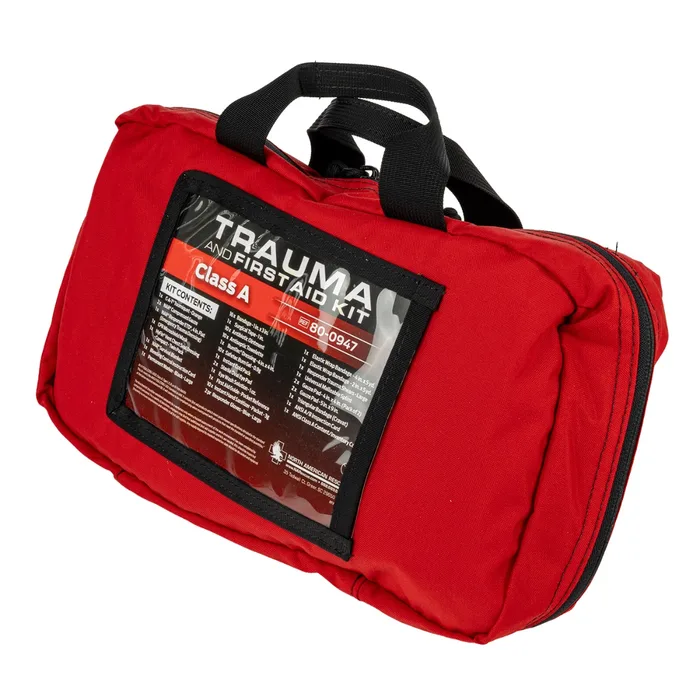
- Buy North American Rescue Trauma and First Aid Kit (TFAK) Class A, 80-0947 The only kit here that clears the Class A list and then adds the trauma items the standard puts in a separate bleeding control package. Amazon
- Buy First Aid Only 25 Person ANSI A Plastic First Aid Kit, 91324 Ninety four pieces that meet the Class A minimum fill, which is the shortest possible argument against buying a kit by its piece count. Amazon
- It depends My Medic MyFAK A soft carry-and-mount kit built around a tourniquet, with modular refills and no ANSI class named on its page. Amazon
- Skip First Aid Only American Red Cross Deluxe All Purpose First Aid Kit, 299 Pieces, 711442 A very widely sold 299 piece home kit in which 196 of the pieces are adhesive bandages and patches, and no ANSI class is claimed. Amazon
What actually matters
- Class A vs Class B - Class A is the baseline for cuts, abrasions, minor burns and eye injuries; Class B is for higher risk workplaces and adds a splint and a tourniquet on top of larger quantities of everything else. Choosing between them is a hazard question about your space rather than a budget question.
- Edition year - the current edition is ANSI/ISEA Z308.1-2021, effective 15 October 2022, and older 2015 labelled stock is still on sale. The 2021 changes are specific: a foil blanket became mandatory in both classes, hand sanitizer quantities rose, and the tourniquet definition tightened to an arterial device using a windlass or ratchet.
- Container Type - Types I to IV describe portability, mountability and water resistance, and only Type IV must pass performance tests for salt fog corrosion and impact. Pick the Type from where the kit will live, then pick the class from what could happen there.
- Minimum fill - the standard's quantities are minimums rather than targets, and larger items that meet the performance requirements count as equivalent. A compliant kit can exceed the fill in any direction and still be compliant, which is why some good kits carry far more than the table asks.
- The compliance label - a compliant kit must carry a legible, permanent label naming the edition, class and type and printing the required minimum fill. That label is a manufacturer self-declaration rather than a third-party certification, so read it as a specific claim you can check yourself.
- Maintenance - the same label says any supply past its marked expiry should be discarded and replaced, and ISEA recommends inspection at least monthly or after any incident where something was used. Refill packs are the intended way to do this, and they cost far less than a new kit.
- Bleeding control - severe external bleeding is handled by a separately packaged kit whose essential contents the standard lists as a chest seal, a compression bandage, hemostatic bandages, a thermal blanket and a tourniquet. Buying that separately is the correct move rather than a workaround.
The specs, in plain English
Green flags vs red flags
Green flags
- The case or listing prints a class letter, a Type numeral and the edition year, in the form ANSI/ISEA Z308.1-2021, Class A, Type III.
- The maker publishes the contents item by item with quantities, so you can check them against the class table before buying.
- A matching refill pack exists for the same kit, which means restocking is far cheaper and faster than replacing the case.
- The kit contains the unglamorous required items that budget kits omit: a CPR breathing barrier, an eyewash, a foil blanket, a triangular bandage and a gel soaked burn dressing.
- The Type matches where the kit will actually live, with Type III or IV for anything mounted outdoors, in a vehicle or on a boat.
Red flags
- The headline is a piece count and the words class and Z308.1 appear nowhere on the page.
- The listing claims it meets OSHA but the spec table says Not Compliant under ANSI, or says ANSI approved with no class letter and no edition year, which is not something the standard provides for.
- The label names the 2015 edition, which predates the mandatory foil blanket, the higher hand sanitizer counts and the tighter tourniquet definition.
- A very large share of the contents is adhesive bandages in several sizes, which inflates the count without adding capability.
- A tourniquet is included but described only as a band or a strap, with no windlass or ratchet, which the 2021 edition specifically distinguishes from a blood draw band.
Who's who: the brands
- First Aid Only - An Acme United brand running two clearly separate lines: workplace kits and cabinets that print the class, type and edition on the case, and consumer kits sold on piece count that name no standard at all.
- North American Rescue - A trauma equipment maker best known for the Combat Application Tourniquet, whose workplace kits are the ones here that state a Z308.1 class and then add bleeding control gear on top of it.
- My Medic - A direct-to-consumer maker of soft, trauma-forward kits built around tourniquets and MOLLE mounting, sold with a training course and a modular refill system rather than an ANSI class.
- Adventure Medical Kits - Long-established wilderness and marine kits organised around group size and trip length rather than a workplace class, with waterproof inner bags inside a water-resistant outer.
- Certified Safety Manufacturing - A long-running US manufacturer of industrial first aid kits and cabinets sold in Class A and Class B configurations, mostly through safety distributors rather than direct.
How to read a listing without getting fooled
Start at the bottom of the listing rather than the top. Ignore the piece count entirely and look for three tokens: an edition year, a class letter and a Type numeral. If all three are there, pull up the class table and read the maker's contents list against it line by line, paying particular attention to the items that are easiest to leave out, which are the CPR breathing barrier, the eyewash, the foil blanket, the triangular bandage and the gel soaked burn dressing. If the three tokens are missing, you are not looking at a checkable claim, so judge the kit purely on its published contents, and if the contents are not published item by item then there is nothing to judge. Then sanity check the Type against reality: a kit hanging in a hallway needs no more than Type I or II, a kit going in a van or on an outside wall wants Type III, and only a kit that will get properly wet needs Type IV.
How much should you spend?
Budget tier buys either a small soft consumer kit sold on piece count or a genuinely compliant Class A kit in a plain plastic case, and the second is by far the better use of the money. Mid-range buys a Class B kit with a tourniquet and a splint already inside, or a larger weatherproof Class A kit for a vehicle or a jobsite, and this is where case quality and mounting hardware start to matter. Premium is mostly trauma-forward kits that pair a compliant fill with a tourniquet, a chest seal and a hemostatic dressing, or soft direct-to-consumer kits where you are paying for the carrying system and the individual item quality rather than a class rating. Refill packs sit well below whole-kit outlay in every tier, so budget for restocking rather than replacing.
Questions, answered
Is an ANSI compliant kit certified by anyone?
No. The standard requires the manufacturer to print a permanent label naming the edition, the class and the type and listing the required minimum fill, and that label is a self-declaration. There is no third-party test house stamping first aid kits the way there is for some other safety equipment. What the label buys you is specificity: a claim precise enough that you can check it against a published table yourself.
How many kits do I need, and where should they go?
The standard's guidance points at response time rather than headcount, and so does OSHA. OSHA has long interpreted near proximity for serious injuries to mean emergency care available within three to four minutes, with up to fifteen minutes acceptable in low risk settings such as offices. Applied at home that means one kit where the sharp and hot things are, usually the kitchen or the workshop, and a second in the car, rather than one large kit in an upstairs cupboard.
My kit says Z308.1-2015. Do I have to replace it?
Not necessarily. The gap between the 2015 and 2021 fills is small and specific: a foil blanket is now required in both classes, hand sanitizer went from six to ten packets in Class A and from ten to twenty in Class B, and the Class B tourniquet must now be an arterial device using a windlass or a ratchet rather than merely being an inch wide. Several makers sell conversion packs that supply the missing items plus new labels for exactly this reason, and that is cheaper than buying a new kit.
What does a household kit need that the workplace standard does not require?
The Red Cross publishes a recommended list for a family of four that overlaps heavily with Class A but adds a few things the workplace list leaves out, including two packets of 81 mg aspirin for a suspected heart attack, two hydrocortisone packets, an oral thermometer and tweezers. The standard's own appendix treats items like low dose aspirin, antihistamines, analgesics and hydrocortisone as supplements to be added according to the hazards you actually face. Add your own regular medications and, if anyone in the house carries an allergy plan, that too.
Or jump to the head-to-head: North American Rescue Trauma and First Aid Kit (TFAK) Class A, 80-0947 vs First Aid Only 25 Person ANSI A Plastic First Aid Kit, 91324.