

Health & Wellness
The Best First Aid Kits: 4 Compared (and One to Skip)
We judged first aid kits against one public document: ANSI/ISEA Z308.1-2021, the workplace standard that sets a minimum contents list. We checked whether each kit names a class, names a container type, and actually carries what that class requires.
The short version
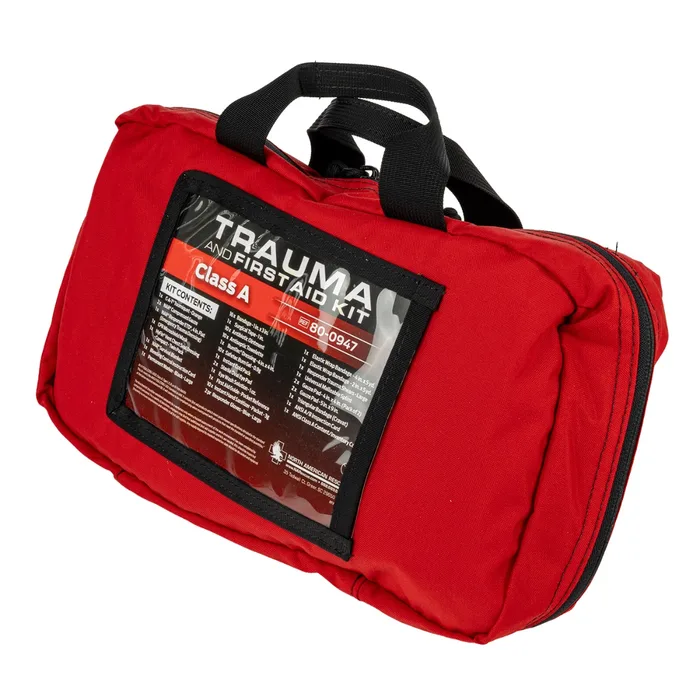
The pick is the North American Rescue Trauma and First Aid Kit (TFAK) Class A, because North American Rescue states it exceeds ANSI/ISEA Z308.1-2021 for Class A and then adds the bleeding control items the standard deliberately leaves out, including a C-A-T tourniquet, a HyFin Vent chest seal and a SAM Splint. The value pick is the First Aid Only 25 Person ANSI A Plastic First Aid Kit, which meets the Class A minimum fill in 94 pieces and the maker lists the class, the container type and the edition year. The My Medic MyFAK is the depends pick: it is the only kit here built to mount on a headrest and tear away, and My Medic sells modular refills, but it names no ANSI class, type or edition, and its Pro version is offered with a RATS tourniquet that does not appear on the CoTCCC recommended list, so choose the windlass version. Skip the American Red Cross Deluxe All Purpose First Aid Kit, 299 Pieces: 196 of those 299 pieces are adhesive bandages and patches, the page names no class, and against the Class A minimum fill it has no CPR breathing barrier, no eye wash, no hand sanitizer and no triangular bandage. Note that Class A itself requires no tourniquet at all; the 2021 standard puts that in a separately packaged bleeding control kit. Best for: anyone who wants a kit they can check against a published list instead of a number printed on a bag.
Our picks at a glance
- North American Rescue Trauma and First Aid Kit (TFAK) Class A, 80-0947 - Buy. The only kit here that clears the Class A list and then adds the trauma items the standard puts in a separate bleeding control package.
- First Aid Only 25 Person ANSI A Plastic First Aid Kit, 91324 - Buy. Ninety four pieces that meet the Class A minimum fill, which is the shortest possible argument against buying a kit by its piece count.
- My Medic MyFAK - It depends. A soft carry-and-mount kit built around a tourniquet, with modular refills and no ANSI class named on its page.
- First Aid Only American Red Cross Deluxe All Purpose First Aid Kit, 299 Pieces, 711442 - Skip. A very widely sold 299 piece home kit in which 196 of the pieces are adhesive bandages and patches, and no ANSI class is claimed.
The verdict in 30 seconds
What mattered most
- ANSI/ISEA Z308.1 class stated
- Container Type stated
- Edition named on the product
- Advertised piece count
- Adhesive bandages included
- Tourniquet
There is exactly one public yardstick for what belongs in a first aid kit in the United States, and almost nothing sold to households is measured against it. ANSI/ISEA Z308.1-2021 is a workplace standard published by the International Safety Equipment Association, and it does something no marketing page does: it names every required item, every quantity and every minimum size, then requires a compliant kit to print that list on its own label. Most consumer kits state no class at all and lead with a piece count instead. This comparison uses the class as its spine, the way our tourniquet review used the CoTCCC recommended device list, and it shows exactly what a piece count hides.
The only kit here that clears the Class A list and then adds the trauma items the standard puts in a separate bleeding control package.
Best for: Anyone buying one kit for a workshop, a vehicle or a rural home who wants the everyday supplies and the bleeding control gear in the same bag rather than in two separate purchases.
- North American Rescue states the kit exceeds ANSI/ISEA Z308.1-2021 for Class A and that it exceeds the ANSI and OSHA standards by adding bleeding control elements.
- The published contents include a C-A-T Tourniquet, a HyFin Vent Chest Seal Twin Pack, two compressed gauze rolls, a 4 inch Responder ETD emergency trauma dressing, a SAM Splint and trauma shears, none of which Class A requires.
- It ships with an inspection card and a contents inventory card, so the maintenance the standard demands has a physical prompt inside the bag.
- The soft zippered nylon bag states no ANSI container Type, so if the kit will get wet you want the hard case version, which North American Rescue says meets a Type IV container.
- The North American Rescue page lists no shelf life and no recommended inspection interval for the kit, so the inspection card is a prompt without a schedule attached.
- It sits at the premium end of this field, and a good part of that is the tourniquet, chest seal and hemostatic dressing rather than the first aid contents.
- At 14.75 by 8 by 4 inches it is a bag to hang or stow, not something to slide into a kitchen drawer.
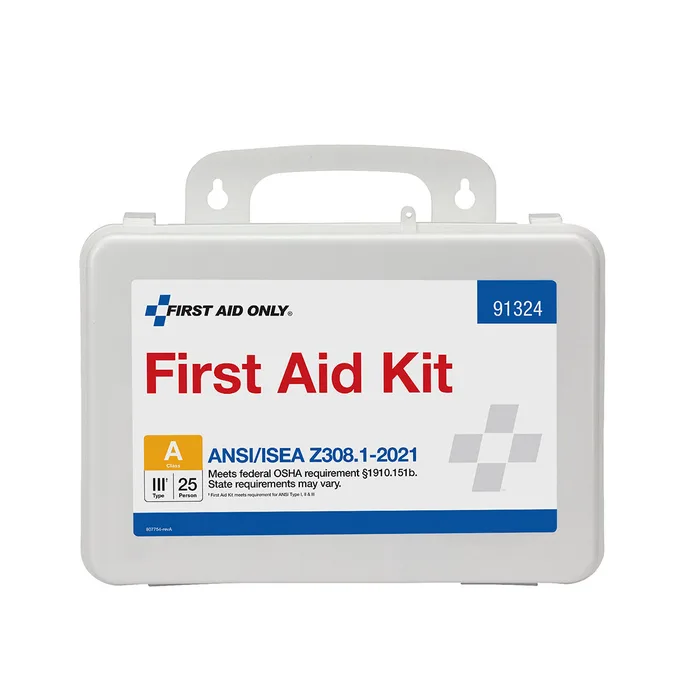
Ninety four pieces that meet the Class A minimum fill, which is the shortest possible argument against buying a kit by its piece count.
Best for: The default home, office or vehicle kit for someone who wants a verifiable baseline at the lowest sensible outlay and will add bleeding control separately.
- First Aid Only lists the kit as ANSI 2021, Class A, in a weatherproof Type III case rated for 25 people.
- First Aid Only publishes all 19 content lines with quantities, so you can tick them against the standard's Class A table before you spend anything.
- It carries the items budget kits quietly drop: a CPR face shield, a 1 oz eyewash, two sterile eye pads, a 52 by 84 inch emergency blanket, ten hand sanitizer packets and a triangular bandage.
- Class A requires no tourniquet and no splint, so a serious limb bleed or a suspected fracture is outside what this kit is built for.
- Thirty two adhesive bandages will look thin beside a 300 piece consumer kit, even though it is double the 16 the standard asks for.
- No hemostatic dressing and no pressure dressing, so you would buy a bleeding control package alongside it.
- The wall-mount shaped hard case is awkward in a backpack or under a car seat.
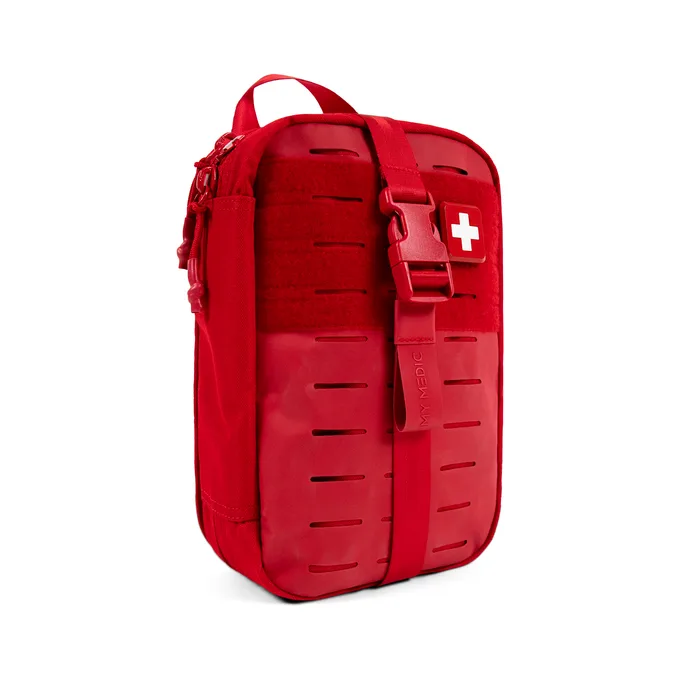
A soft carry-and-mount kit built around a tourniquet, with modular refills and no ANSI class named on its page.
Best for: Someone who wants one kit that travels, mounts to a vehicle and holds a tourniquet, and who is willing to judge the contents themselves rather than read a class off a label.
- A laser cut MOLLE panel, a tear-away backing and a folding page layout make it the only kit here designed to live on a headrest or a pack and come off in seconds.
- My Medic states the Pro version holds 164 first aid supplies and sells it with a windlass tourniquet option, which is the mechanism the 2021 standard now specifies for an arterial tourniquet.
- My Medic sells modular refills and includes a training course offer with purchase.
- The product page names no ANSI/ISEA class, no container type and no edition year, so there is no published minimum fill to audit it against.
- The Pro is also offered with a RATS tourniquet, which does not appear on the CoTCCC recommended device list our tourniquet comparison uses, so pick the windlass version.
- The soft case carries no stated water rating, which puts it outside what a Type III or Type IV container would give you on an outdoor or vehicle mount.
- At 11 by 8 by 6 inches and 3 to 4 pounds it is bulkier than a hard Class A case of comparable capability.
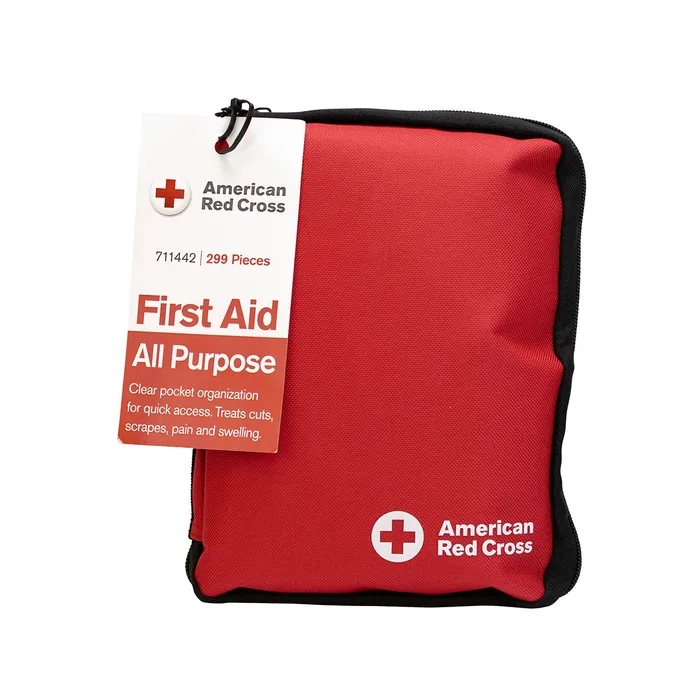
A very widely sold 299 piece home kit in which 196 of the pieces are adhesive bandages and patches, and no ANSI class is claimed.
Best for: Hard to justify as your only kit. It is a reasonable box of plasters for a glovebox if you already own something that states a class.
- First Aid Only publishes the full contents item by item, which is more than many consumer kits offer and is the only reason this analysis was possible.
- The soft nylon case is light at 1.3 pounds and packs flat.
- A few contents are worth having: an emergency blanket, one 5 by 9 trauma pad, a 2 inch conforming gauze roll, scissors, tweezers and nitrile gloves.
- 196 of the 299 advertised pieces are adhesive bandages and patches, so the headline number is mostly plasters.
- The page names no ANSI/ISEA class, container type or edition year, while the same company sells a separate line of kits that print all three on the case.
- Checked against the Class A minimum fill it has no CPR breathing barrier, no eye or skin wash, no hand sanitizer, no triangular bandage and no gel soaked burn dressing.
- It carries 6 antibiotic ointment packets where Class A requires 10, and one trauma pad where Class A requires two.
- First Aid Only's spec table has an ANSI field that reads Not Compliant on sibling consumer kits, such as its 370 piece QuickTreat; on this one the field is simply absent.
| Criteria | Trauma and First Aid Kit (TFAK) Class A, 80-0947 Top pick | 25 Person ANSI A Plastic First Aid Kit, 91324 | MyFAK | American Red Cross Deluxe All Purpose First Aid Kit, 299 Pieces, 711442 |
|---|---|---|---|---|
| Verdict | Buy it | Buy it | It depends | Skip it |
| Best for | Anyone buying one kit for a workshop, a vehicle or a rural home who wants the everyday supplies and the bleeding control gear in the same bag rather than in two separate purchases. | The default home, office or vehicle kit for someone who wants a verifiable baseline at the lowest sensible outlay and will add bleeding control separately. | Someone who wants one kit that travels, mounts to a vehicle and holds a tourniquet, and who is willing to judge the contents themselves rather than read a class off a label. | Hard to justify as your only kit. It is a reasonable box of plasters for a glovebox if you already own something that states a class. |
| Price tier | $$$ · premium | $ · budget | $$$ · premium | $ · budget |
| ANSI/ISEA Z308.1 class stated | Class A, stated as exceeding it | Class A | None stated | None stated |
| Container Type stated | None on the soft bag | Type III | None stated | None stated |
| Edition named on the product | Z308.1-2021 | Z308.1-2021 | None named | None named |
| Advertised piece count | Not published | 94 | 164 in the Pro version | 299 |
| Adhesive bandages included | 16 | 32 | Not published item by item | 196 bandages and patches |
| Tourniquet | C-A-T Tourniquet included | None | Pro version only, windlass or RATS | None |
| Other bleeding control | HyFin Vent chest seal, Responder ETD dressing, compressed gauze | None beyond two trauma pads | Not confirmed on the product page | One trauma pad |
| Splint | SAM Splint | None | Not confirmed on the product page | Two finger splint or tongue depressors |
| Restocking | Inspection and inventory cards included, no interval published | Matching ANSI A refill kit sold | Modular refill system | No refill pack listed for the kit |
Which one is right for you?
- Anyone buying one kit for a workshop, a vehicle or a rural home who wants the everyday supplies and the bleeding control gear in the same bag rather than in two separate purchases. Buy it North American Rescue Trauma and First Aid Kit (TFAK) Class A, 80-0947
- The default home, office or vehicle kit for someone who wants a verifiable baseline at the lowest sensible outlay and will add bleeding control separately. Buy it First Aid Only 25 Person ANSI A Plastic First Aid Kit, 91324
- Someone who wants one kit that travels, mounts to a vehicle and holds a tourniquet, and who is willing to judge the contents themselves rather than read a class off a label. It depends My Medic MyFAK
- Hard to justify as your only kit. It is a reasonable box of plasters for a glovebox if you already own something that states a class. Skip it First Aid Only American Red Cross Deluxe All Purpose First Aid Kit, 299 Pieces, 711442
How we judged the field
Five things decide whether a first aid kit is worth owning, and only one of them is what is inside. First, whether the product states an ANSI/ISEA Z308.1 class, because that single line turns a marketing page into a checkable list. Second, which edition it names, since the current one is Z308.1-2021, approved by ANSI in April 2022 and effective from 15 October 2022, and kits labelled 2015 are still on shelves. Third, the container Type, which describes the environment the kit lives in rather than its contents: Type I is a mountable indoor cabinet, Type II is portable indoor, Type III adds a water resistant seal for sheltered outdoor use, and Type IV is waterproof and has to survive 480 hours of salt fog plus corner drops from four feet after hot and cold conditioning. Fourth, whether the published contents actually meet the class minimum fill, which you can only test if the maker lists items and quantities. Fifth, whether the maker publishes anything about restocking, because the label the standard requires says a kit is compliant as sold and stays compliant only while it is maintained.
The field splits along the class line and almost nothing else. On one side are kits that print the standard, the edition, the class and the type, with a published fill you can audit. On the other are consumer kits that lead with a piece count and name no standard. The gap is easy to see on a single manufacturer’s site. So we picked the one kit we found that states the class and then adds the bleeding control gear the standard deliberately keeps separate, the cleanest plain Class A kit we could find, one soft trauma-forward kit that names no class but has a real reason to exist, and the most widely sold high piece count home kit with a published contents list, so the count could be tested rather than asserted.
North American Rescue Trauma and First Aid Kit (TFAK) Class A, 80-0947
Buy itThe North American Rescue TFAK Class A is the pick because it answers both halves of the question in one bag. North American Rescue states it exceeds ANSI/ISEA Z308.1-2021 for Class A and that the kits exceed the ANSI and OSHA standards by adding bleeding control elements, and the product page repeats the claim. The published contents cover the Class A list, including a CPR Microshield mask, a 1 oz eye wash, two sterile oval eye pads, a 56 by 84 survival blanket, ten hand sanitizer packets and a triangular bandage, and stop at exactly 16 flexible fabric bandages, which is the Class A minimum and a useful sanity check on what a compliant kit actually looks like. Then it adds what Class A does not require: a C-A-T Tourniquet, a HyFin Vent Chest Seal Twin Pack, two compressed gauze rolls, a 4 inch Responder ETD emergency trauma dressing, a SAM Splint and trauma shears. It also ships an inspection card and a contents inventory card. The soft nylon bag states no container Type, so buy the hard case version if it will get wet.
First Aid Only 25 Person ANSI A Plastic First Aid Kit, 91324
Buy itThe First Aid Only 25 Person ANSI A Plastic First Aid Kit is the most useful object in this comparison, because it settles the piece count argument in one number. It holds 94 pieces and it meets the Class A minimum fill. The 299 piece kit further down this page does not. First Aid Only lists it as ANSI 2021, Class A, in a weatherproof Type III plastic case that is wall mountable and has a handle, so the same box works wall mounted indoors or carried to a sheltered outdoor job. State requirements may vary, which matters because California, for example, requires first aid materials approved by a consulting physician and names no kit. The 19 published content lines include the things budget kits omit: a CPR face shield, a 1 oz eyewash, a 52 by 84 emergency blanket, ten hand sanitizer packets and a triangular bandage. What it has no answer for is a serious bleed, so treat it as the baseline and buy bleeding control separately.
My Medic MyFAK
It dependsThe My Medic MyFAK is the kit to consider when the kit has to move. It is soft nylon with a laser cut MOLLE panel and a tear-away backing, so it can live on a headrest or a pack and come off in seconds, and the folding page layout inside is genuinely quicker to search than a cabinet tray. My Medic states the Pro version holds 164 first aid supplies and sells it with a choice of tourniquet, which is where you need to pay attention: one option is a windlass, the mechanism the 2021 edition now specifies for an arterial tourniquet, and the other is a RATS, which does not appear on the CoTCCC recommended device list our tourniquet comparison treats as the line. Choose the windlass. My Medic also sells modular refills, which is a real advantage. The catch is that the page names no class, no container type and no edition, so there is no minimum fill to check it against, and the soft case carries no water rating.
First Aid Only American Red Cross Deluxe All Purpose First Aid Kit, 299 Pieces, 711442
Skip itThe American Red Cross Deluxe All Purpose First Aid Kit, 299 Pieces is made by First Aid Only, is sold almost everywhere, and is the clearest demonstration of why piece counts mislead. First Aid Only publishes the full contents, which is to its credit and is the only reason this analysis is possible. Add up the bandage lines: 75 plastic three quarter inch, 30 plastic one inch, 2 plastic two inch, 50 junior, 1 patch, 20 fabric three quarter inch, 10 fabric one inch, 4 knuckle and 4 fingertip. That is 196 of the 299 advertised pieces. Set the rest against the Class A minimum fill and the gaps are specific rather than vague: no CPR breathing barrier, no eye or skin wash, no hand sanitizer, no triangular bandage, no gel soaked burn dressing, six antibiotic packets against a required ten, and one trauma pad against a required two. The page names no class, no type and no edition, while the same company runs an entire line that names all three. First Aid Only’s spec table for its 370 piece QuickTreat kit prints ANSI, Not Compliant next to OSHA, true, which is the whole problem in two lines, because OSHA requires nothing specific. It is not a bad bag of plasters. It is not a kit measured against the only public list there is.
Sources
Specs in this review come from these pages.
- International Safety Equipment Association, First Aid worker protections and ANSI/ISEA Z308.1-2021 (safetyequipment.org)
- ISEA, Workplace First Aid Kits Require Updates to Meet Industry Standard (18 April 2022) (safetyequipment.org)
- 29 CFR 1910.151, Medical services and first aid, with non-mandatory Appendix A (ecfr.gov)
- OSHA letter of interpretation, Clarification of 1910.151 (18 April 2002) (osha.gov)
- OSHA letter of interpretation, First aid for bleeding control (19 June 2019) (osha.gov)
- American Red Cross, Make a First Aid Kit: What to Include (redcross.org)
North American Rescue Trauma and First Aid Kit (TFAK) Class A, 80-0947 vs First Aid Only 25 Person ANSI A Plastic First Aid Kit, 91324: which should you buy?
The two picks are both Class A kits and they answer completely different questions. The First Aid Only 25 person kit asks what the minimum defensible kit looks like, and answers it in 94 pieces with the class, type and edition printed on the lid. The North American Rescue TFAK Class A asks what happens when someone is bleeding badly, and answers it with a C-A-T tourniquet, a chest seal, a trauma dressing, compressed gauze and a SAM Splint on top of a compliant Class A fill. If you were going to buy a Class A kit and a bleeding control kit anyway, the TFAK is one purchase instead of two and one place to look instead of two. If you were only ever going to buy the first one, the First Aid Only kit is the right amount of money for the right amount of capability.
The second question is where the kit lives, and here the two diverge again. The First Aid Only case is Type III, which means portable, wall mountable and water resistant, and that covers a garage wall, an office corridor or a van. The TFAK’s soft nylon bag states no Type at all, which is not a defect so much as a gap in the claim; North American Rescue sells a hard case version it says meets a Type IV container, and that is the one for a truck bed or a boat. Whichever you buy, buy the matching refill rather than a replacement kit when things run out, note that First Aid Only sells a conversion pack that upgrades an older 2015 labelled cabinet to the 2021 fill, and put a monthly check in the calendar, because the standard’s own label is explicit that a kit is compliant as sold and stays compliant only while somebody maintains it.
What to look for
- Look for a class letter, not a piece count: a kit stating Class A or Class B has committed to a published list of items, quantities and minimum sizes, and one leading with 299 pieces has committed to nothing.
- Check the edition year on the label: the current standard is ANSI/ISEA Z308.1-2021, effective 15 October 2022, and kits still labelled 2015 predate the mandatory foil blanket, the higher hand sanitizer counts and the tighter tourniquet definition.
- Match the Type to where the kit lives: Type I mounts indoors, Type II is portable indoors, Type III adds a water resistant seal for sheltered outdoor use, and only Type IV is waterproof and drop tested, so pay for Type IV in a truck or on a boat and never in a hallway.
- Treat trauma gear as a separate line item: the 2021 standard puts chest seals, compression bandages, hemostatic bandages and tourniquets in a separately packaged bleeding control kit, and says that package should stand out so a responder can reach it fast.
- Insist on an item by item contents list: without quantities you cannot check a kit against the class table, and it was a published list that let us find five required item types missing from a 299 piece kit.
- Distrust Meets OSHA on its own: OSHA requires only that adequate supplies be readily available, so a kit can claim OSHA compliance and still print ANSI, Not Compliant in its own spec table, which is exactly what one 370 piece kit from a major maker does.
- Be wary of ANSI approved or ANSI certified with no letter: Z308.1 has no third-party certification scheme, the required label is a manufacturer self-declaration, and the words carrying information are the class letter, the type numeral and the edition year.
Our final take
Buy a kit that prints ANSI/ISEA Z308.1-2021 and a class letter, then read its contents list against the class table before you order. For most homes that means Class A, and 94 pieces that meet the list beat 299 that do not. If there is a saw, a blade, livestock or a long ambulance ride in your life, buy a Class A kit that already carries bleeding control, or buy the bleeding control package separately and choose the tourniquet on its own merits rather than accepting whatever came in the bag. Then diary a monthly check, because the label the standard requires is blunt about it: a kit is compliant as sold, and stays compliant only while somebody maintains it.
Questions, answered
Does OSHA actually require a particular first aid kit?
No, and the rule is vaguer than most people assume. The whole of 29 CFR 1910.151(b) on supplies reads: adequate first aid supplies shall be readily available. Appendix A to that section is explicitly non-mandatory and points at ANSI Z308.1-1998, an edition several revisions out of date, while the construction equivalent at Appendix A to 1926.50 still cites Z308.1-1978 and OSHA's own 2006 best practices guide cites the 2003 edition. An OSHA letter of interpretation dated 18 April 2002 puts it plainly: ANSI standards become mandatory OSHA standards only when, and if, OSHA adopts them, and Z308.1 was not adopted. There is a sharper corner, though. A letter of interpretation dated 19 June 2019 says OSHA interprets the adequate supplies requirement to mean general industry workplaces must carry the bleeding control items listed for Class A kits, and the Class B items including a tourniquet where there is a high risk of serious injury. And 29 CFR 1926.50(d)(2), which is mandatory for construction, does get specific: a weatherproof container, individually sealed packages for each type of item, and a check before each job and at least weekly on the job.
What is the difference between Class A and Class B, and which do I need at home?
Class A is the baseline for the most common workplace injuries: cuts, abrasions, minor burns and eye injuries. Class B is for more populated, complex or higher risk environments, and it adds two item types on top of larger quantities of nearly everything else. Those two additions are a splint and a tourniquet. In round numbers the Class A minimum fill comes to about 74 pieces across 19 item types, and Class B to about 202 pieces, which is why comparing a 210 piece Class B kit to a 299 piece consumer kit as numbers tells you nothing at all. For a house or an apartment, Class A is the sensible floor. Move to Class B, or to a Class A kit with bleeding control added, if there is a table saw, a chainsaw, an angle grinder, livestock or a jobsite in the picture.
What do Types I, II, III and IV mean? Is a Type IV kit better?
The Type describes the container and the environment it lives in, not what is inside it, so a Type IV kit is not a better kit than a Type I kit holding the same class of contents. Type I is a mountable indoor container that is not really meant to be portable, which is what most wall cabinets are. Type II is portable and indoor. Type III is portable and mountable for indoor and sheltered outdoor use and must have a water resistant seal. Type IV is portable, mountable and waterproof, and it has to pass real performance tests: 480 hours in a salt fog chamber and a set of corner drops from four feet after being conditioned hot and cold. The standard names transportation, utilities, construction and the armed forces as typical Type IV settings. If your kit lives in an open truck bed or on a boat, Type IV is the rating that earns its money.
Do first aid kit contents expire, and how often should I check?
Yes, and the dates sit on the individual supplies rather than on the kit, which is why this is a habit rather than a single diary entry. The compliance label the standard requires says it out loud: any supply beyond its marked expiration date should be discarded and replaced, and kits should be inspected frequently. ISEA puts a number on frequently, recommending inspection at least monthly or immediately after any incident where something was used, and the construction rule is stricter still at weekly on the job. The Red Cross explains why this goes beyond medicines: adhesives lose their stick, packaging can lose integrity so sterile items stop being sterile, and creams, gels and oral medicines lose potency. A kit that lives in a car sits in extreme heat, so check it more often than you would a kit in a hallway.
Should my kit have a tourniquet and hemostatic gauze in it?
Those are a separate category, not a missing feature. Class A requires no tourniquet at all, and the Red Cross recommended list for a family of four does not include one either. The 2021 edition handles severe bleeding through guidance on a separately packaged bleeding control kit, which it says should be distinctively packaged so a responder can find it fast, and whose essential contents it lists as a chest seal, a compression bandage, hemostatic bandages, a thermal blanket and a tourniquet, with gloves, shears and a permanent marker alongside. Only Class B puts a tourniquet in the first aid kit itself, and the 2021 edition tightened what counts: an arterial tourniquet using a windlass or a ratchet, where the older text asked only that it be at least one inch wide, which a blood draw band could arguably satisfy. If you are buying a tourniquet, our tourniquet comparison covers which devices appear on the CoTCCC recommended list and why that list is the line to draw.
Deciding between the top two? See our head-to-head: North American Rescue Trauma and First Aid Kit (TFAK) Class A, 80-0947 vs First Aid Only 25 Person ANSI A Plastic First Aid Kit, 91324.
More Health & Wellness reviews
 The Best Foot Massagers: 4 Compared (and One to Skip)
  The Best Foot Spas: 4 Compared (and One to Skip)
  The Best Hearing Protection: 4 Compared (and One to Skip)
  The Best Electric Heating Pads: 4 Compared (and One to Skip)
  The Best Mid-Range HEPA Air Purifiers for Allergies
  The Best Hot Water Bottles: 4 Compared (and One to Skip)