

Health & Wellness
The Best Hearing Protection: 4 Compared (and One to Skip)
We compared four hearing protectors for shooting, power tools, woodworking and mowing on their labeled Noise Reduction Rating, on what federal agencies say that number is actually worth once a real person puts it on, and on whether you will keep wearing them.
The short version
The 3M PELTOR X5A is our overall pick, with a labeled NRR of 31 dB, the highest in 3M's X Series, and a published attenuation table showing where that protection comes from. Moldex Pura-Fit 6800 foam plugs are the value pick at NRR 33 dB, the highest label figure here, though every bit of that depends on rolling them down and seating them properly. The Howard Leight Impact Sport is the depends pick: its electronics cap amplification at 82 dB and cut it when a shot goes off, which is exactly right if you need to hear a range officer or a conversation, but its labeled NRR of 22 dB is the lowest of the three protectors we recommend. Skip the Etymotic ER20XS for this job: its own user manual prints an NRR of 13 dB and states that the NRR is based on continuous noise and may not indicate protection against impulsive noise such as gunfire. Whatever you buy, treat the label as a ceiling, not a promise, because 3M itself recommends halving the NRR to estimate typical workplace protection. Best for: anyone who wants a protector chosen on published attenuation data rather than on the largest number on the packaging.
Our picks at a glance
- 3M PELTOR X5A Earmuffs - Buy. The highest rated muff in 3M's X Series, and one of the few protectors where the maker publishes the full attenuation table behind the headline number.
- Moldex Pura-Fit 6800 Uncorded Disposable Foam Earplugs - Buy. The highest labeled NRR in this comparison, from a plug that costs almost nothing per pair, provided you actually roll it down and seat it.
- Howard Leight Impact Sport Electronic Earmuff - It depends. A level-dependent muff that amplifies quiet sound up to a capped 82 dB and stops amplifying when something loud happens, at the cost of the lowest NRR of the three we would buy.
- Etymotic ER20XS High Fidelity Earplugs - Skip. A well made plug for concerts and rehearsal rooms that carries an NRR of 13 dB, which is the wrong tool for a chainsaw or a firing line.
The verdict in 30 seconds
What mattered most
- Type
- Labeled NRR
- Label figure halved, as 3M suggests
- Test method behind the label
- Powered electronics
- Lets you hear speech while worn
Hearing protection is one of the few product categories where the number on the box is set by federal rule. Every hearing protector sold in the United States carries a Noise Reduction Rating, or NRR, measured in a laboratory under a test method written in 1974. That number is real, but it describes trained subjects in a quiet booth, not you in a shop with safety glasses on. We picked four protectors that between them cover the honest range of what is available: a very high attenuation muff, a foam plug, an electronic muff that lets you hear, and one popular plug that is built for a completely different job.
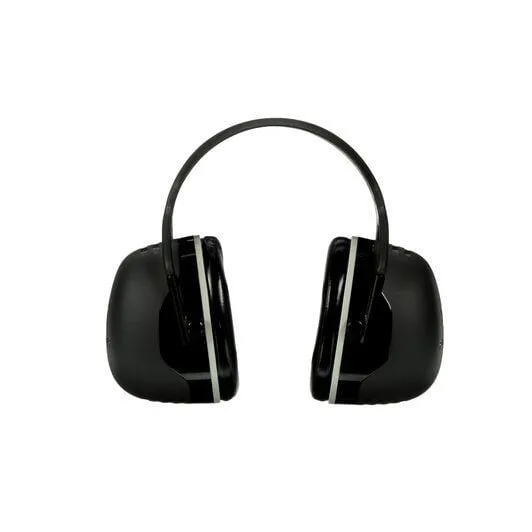
The highest rated muff in 3M's X Series, and one of the few protectors where the maker publishes the full attenuation table behind the headline number.
Best for: Someone running a chainsaw, a mower, a planer or a router who wants the most passive attenuation they can get from a headband muff.
- Labeled NRR of 31 dB, the highest in 3M's X Series headband range, with mean attenuation and standard deviation published at nine test frequencies.
- 3M publishes 41.1 dB mean attenuation at 500 Hz, which is where a lot of shop and yard noise sits and where thinner muffs give up ground.
- Cushions and foam inserts are replaceable through 3M's HYX5 hygiene kit, and 3M recommends replacing them at least twice a year to keep the seal working.
- 3M lists it at 12.38 ounces, the heaviest headband model in the X Series and noticeably more than the 6.49 ounce X1A.
- The deep cups do not clear a long gun stock the way a slim shooting muff does.
- No electronics, so you take them off to hear anything, and a muff you keep lifting is a muff that is not protecting you.
- 3M states that noise reduction may be lower when eyeglasses, goggles or respirator straps pass under the cushions.
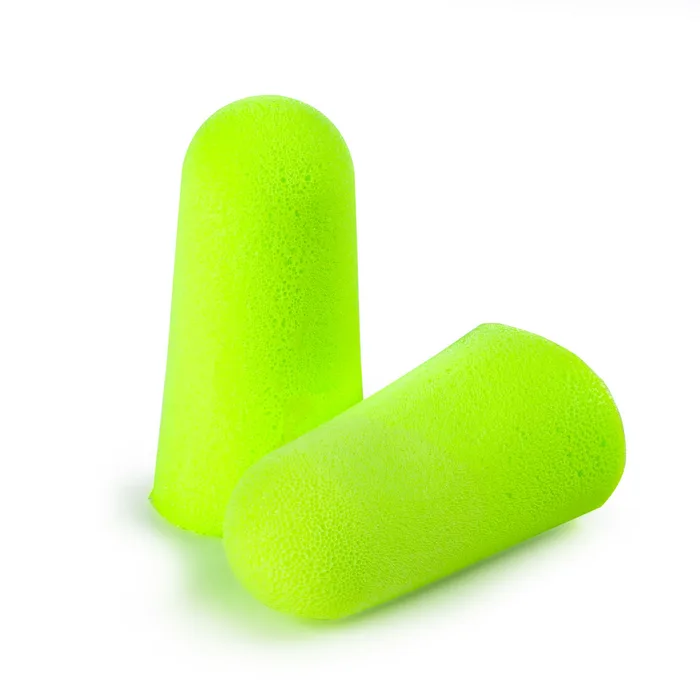
The highest labeled NRR in this comparison, from a plug that costs almost nothing per pair, provided you actually roll it down and seat it.
Best for: Anyone who wants maximum labeled attenuation for the least money, and who is willing to learn a proper roll-down insertion.
- Labeled NRR of 33 dB, higher than any muff here, and Moldex states the product meets ANSI S3.19-1974, the test method the EPA label rule requires.
- Tapered, longer body designed to slide into the canal and expand slowly, which gives you time to hold it in place while it recovers.
- Sold 200 pairs to a box with a five year shelf life, so a fresh pair is always within reach instead of a grubby pair being reused.
- Single use, so the cost per pair is low but the waste is constant.
- The whole 33 dB depends on roll-down technique, and a plug that is barely inserted can give you a fraction of the label.
- Nothing lets you hear speech, so you will pull them out to talk and then have to fit them again correctly.
- Uncorded, which means a dropped plug on a shop floor is a plug you should not put back in.
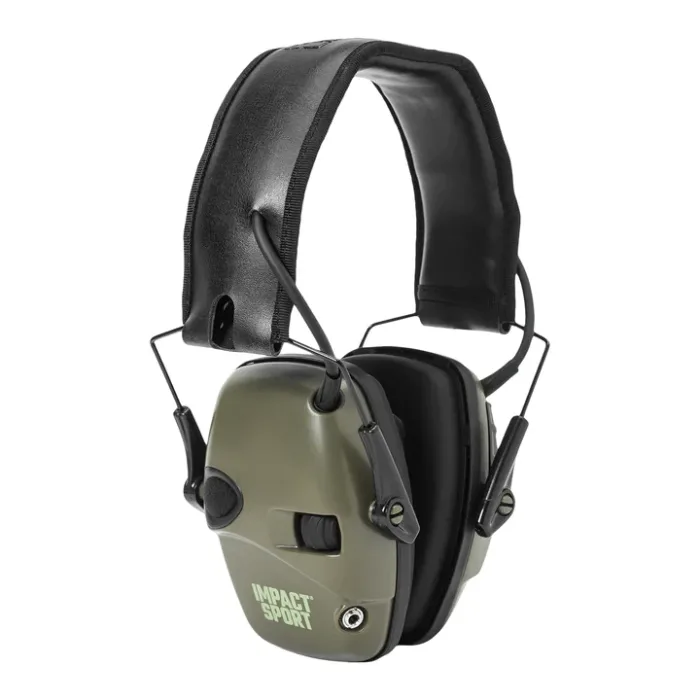
A level-dependent muff that amplifies quiet sound up to a capped 82 dB and stops amplifying when something loud happens, at the cost of the lowest NRR of the three we would buy.
Best for: Shooters, and anyone working around other people, who needs to hear speech and warnings without lifting a cup off an ear.
- Built-in directional microphones amplify ambient sound to a capped 82 dB, so range commands and conversation stay audible while the muffs stay on.
- Amplification halts automatically when ambient sound exceeds 82 dB, which is the behaviour that matters when a shot goes off mid-sentence.
- Air Flow Control gives it a slim earcup that clears a firearm stock, and the headband folds for storage.
- Around 350 hours on two AAA batteries with a four hour automatic shut-off, and a 3.5 mm auxiliary input if you want a radio feed.
- Labeled NRR of 22 dB, the lowest of the three protectors we recommend here and 11 dB below the Moldex plugs.
- The electronics limit what reaches your ears from the microphones; they do not add attenuation to the cup itself.
- The slim cup that clears a rifle stock is also the cup that gives up low frequency attenuation you would want around a mower or a planer.
- Batteries are one more thing that can be dead when you need the protector, though the muff still works as a passive muff.
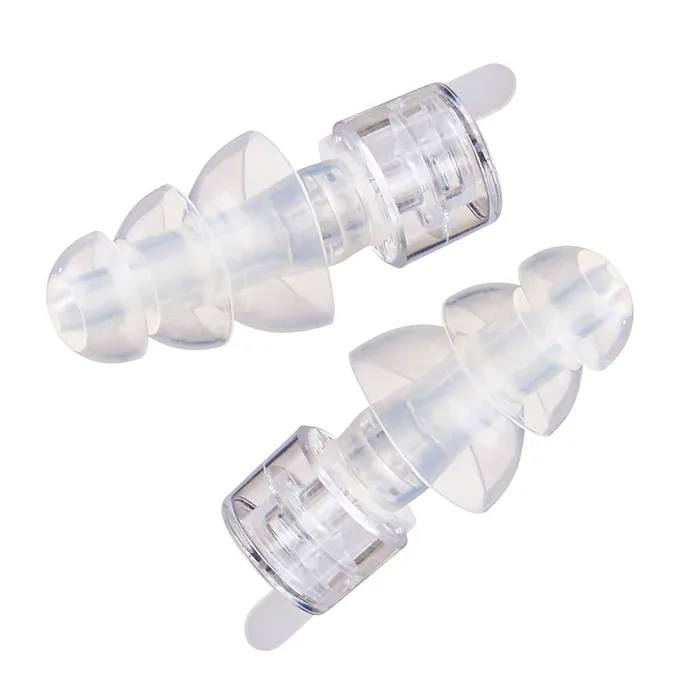
A well made plug for concerts and rehearsal rooms that carries an NRR of 13 dB, which is the wrong tool for a chainsaw or a firing line.
Best for: Live music, rehearsal and crowd noise, where you want to hear accurately at a lower level rather than block as much as possible.
- Genuinely flat attenuation by design, with Etymotic claiming roughly 20 dB of even reduction across the spectrum rather than a muffled top end.
- Reusable triple-flange silicone with a low profile, stemless body that sits inside the outer ear under a hat or a helmet.
- The user manual publishes the full attenuation table, mean and standard deviation at nine frequencies, plus SNR 17 and CSA Class C.
- The EPA label on the manual reads NRR 13 dB, the lowest figure in this comparison by a wide margin.
- Etymotic's own manual states that the NRR is based on the attenuation of continuous noise and may not be an accurate indicator of protection attainable against impulsive noise such as gunfire.
- Published mean attenuation is 14.1 dB at 125 Hz and 15.9 dB at 250 Hz, so the low frequency energy from engines and large machinery largely gets through.
- It is often bought as a general purpose earplug because it is comfortable, which is how it ends up in a workshop it was never designed for.
| Criteria | PELTOR X5A Earmuffs Top pick | Pura-Fit 6800 Uncorded Disposable Foam Earplugs | Impact Sport Electronic Earmuff | ER20XS High Fidelity Earplugs |
|---|---|---|---|---|
| Verdict | Buy it | Buy it | It depends | Skip it |
| Best for | Someone running a chainsaw, a mower, a planer or a router who wants the most passive attenuation they can get from a headband muff. | Anyone who wants maximum labeled attenuation for the least money, and who is willing to learn a proper roll-down insertion. | Shooters, and anyone working around other people, who needs to hear speech and warnings without lifting a cup off an ear. | Live music, rehearsal and crowd noise, where you want to hear accurately at a lower level rather than block as much as possible. |
| Price tier | $$ · mid-range | $ · budget | $$ · mid-range | $ · budget |
| Type | Over-the-head passive earmuff | Single use roll-down foam earplug | Over-the-head electronic earmuff | Reusable triple-flange earplug |
| Labeled NRR | 31 dB | 33 dB | 22 dB | 13 dB |
| Label figure halved, as 3M suggests | About 15 dB | About 16 dB | About 11 dB | About 6 dB |
| Test method behind the label | ANSI S3.19-1974, required by EPA rule | ANSI S3.19-1974, required by EPA rule | ANSI S3.19-1974, required by EPA rule | ANSI S3.19-1974, required by EPA rule |
| Powered electronics | None | None | Yes, two AAA cells, about 350 hours | None |
| Lets you hear speech while worn | No | No | Yes, amplification capped at 82 dB | Partly, by design it lowers everything evenly |
| Reusable | Yes, with replaceable cushions | No, single use | Yes | Yes |
| Published weight | 12.38 oz | Not published | Not published | Not published |
Which one is right for you?
- Someone running a chainsaw, a mower, a planer or a router who wants the most passive attenuation they can get from a headband muff. Buy it 3M PELTOR X5A Earmuffs
- Anyone who wants maximum labeled attenuation for the least money, and who is willing to learn a proper roll-down insertion. Buy it Moldex Pura-Fit 6800 Uncorded Disposable Foam Earplugs
- Shooters, and anyone working around other people, who needs to hear speech and warnings without lifting a cup off an ear. It depends Howard Leight Impact Sport Electronic Earmuff
- Live music, rehearsal and crowd noise, where you want to hear accurately at a lower level rather than block as much as possible. Skip it Etymotic ER20XS High Fidelity Earplugs
How we judged the field
Five things decide whether a hearing protector does its job. First, the labeled NRR, because it is the only figure every product in the United States is required to publish and it is measured to a single method. Second, what sits behind that number: a maker that publishes mean attenuation and standard deviation at each test frequency is telling you where the protection comes from, and a maker that publishes only the headline is not. Third, fit, which is the factor that decides how much of the label you actually receive and the reason 3M prints a recommendation to halve the NRR on its own datasheets. Fourth, whether you will keep it on, because a protector you lift to hear someone speak is unprotecting you at the exact moment you are still in the noise. Fifth, whether the design suits the noise, since low frequency machinery noise and impulsive gunfire ask different things of a protector.
The field splits cleanly. Passive muffs cluster between about 21 and 31 dB and give you consistency, because a headband applies roughly the same seal every time. Foam plugs go higher on the label, into the low thirties, but hand the entire result to your insertion technique. Electronic muffs sit lower on the label and buy you situational awareness instead. And then there is a fourth group, high fidelity music plugs, which are excellent products aimed at a different problem and are regularly bought for shop and range use anyway. We took the strongest example from each group: the 3M PELTOR X5A for maximum passive attenuation, Moldex Pura-Fit 6800 for the highest label at the lowest cost, the Howard Leight Impact Sport for level dependent hearing, and the Etymotic ER20XS to show why a 13 dB rating is the wrong answer to a chainsaw.
3M PELTOR X5A Earmuffs
Buy itThe 3M PELTOR X5A is the top of the X Series and the whole reason to buy it is on 3M’s own datasheet. NRR 31 dB, and behind that a table showing 23.9 dB mean attenuation at 125 Hz rising to 41.1 dB at 500 Hz and 43.0 dB at 1000 Hz. That 500 Hz figure matters more than the headline number for anyone running a mower, a chainsaw or a thickness planer, because that is where the energy is and where thin cups run out of material. The trade is bulk. 3M lists the X5A at 12.38 ounces against 6.49 for the X1A, and the cups are deep enough that they will foul a long gun stock. 3M also warns that eyeglass temples or respirator straps under the cushion will reduce the noise reduction, which is a real consideration in a shop. Cushions and foam inserts swap out with the HYX5 hygiene kit, and 3M recommends changing them at least twice a year. This is for the person who wants the most protection a headband muff can give and does not need to hear anything while wearing it.
Moldex Pura-Fit 6800 Uncorded Disposable Foam Earplugs
Buy itMoldex Pura-Fit 6800 is the highest label figure in this comparison at NRR 33 dB, and Moldex states the plug meets ANSI S3.19-1974, which is the method the EPA labeling rule requires. The plug itself is longer and more tapered than most foam, which is the point: it slides in further, and slow recovery foam gives you a few seconds to hold it while it expands against the canal wall. That is also the catch. Every decibel of that 33 depends on you rolling it thin, pulling your ear up and back, and holding it. A plug pushed in halfway with your thumb is a different product. They come 200 pairs to a box with a five year shelf life, so the practical advantage over a muff is that a fresh pair is always at hand and the cost of using a new one is negligible. They are uncorded, so a dropped plug goes in the bin. Buy these if you will take fitting seriously, and buy a muff instead if you will not.
Howard Leight Impact Sport Electronic Earmuff
It dependsThe Howard Leight Impact Sport is the one product here that solves a problem the others ignore. Its directional microphones amplify ambient sound to a capped 82 dB, so you can hear a range officer, a conversation or a machine changing note without lifting a cup. When ambient sound exceeds 82 dB the amplification stops, which is precisely the behaviour you want when a shot goes off mid-sentence. Air Flow Control keeps the cup slim enough to clear a rifle stock and the headband folds down for storage. Two AAA cells give roughly 350 hours with a four hour automatic shut-off, and there is a 3.5 mm auxiliary input. The cost of all this is the label: NRR 22 dB, the lowest of the three we would buy, and 11 dB below the Moldex plugs. Understand what the electronics do and do not do. They control what the speakers feed you; the passive shell is what stops the muzzle blast. Right protector if awareness is the priority, wrong one if raw attenuation is.
Etymotic ER20XS High Fidelity Earplugs
Skip itThe Etymotic ER20XS is a good product that keeps ending up in the wrong place. It is a reusable triple-flange silicone plug designed to lower everything by a roughly equal amount rather than smother the top end, and Etymotic describes it as delivering around 20 dB of even reduction. The problem for shooting and shop work is the regulated number. The EPA label printed in the ER20XS user manual reads NRR 13 dB. The same manual publishes the attenuation table, and mean attenuation is 14.1 dB at 125 Hz and 15.9 dB at 250 Hz, which is the low frequency range where engines and heavy machinery live. Etymotic’s manual also states that the NRR is based on the attenuation of continuous noise and may not be an accurate indicator of the protection attainable against impulsive noise such as gunfire. That is the maker telling you, on the packaging, what this plug is for. It is for concerts, rehearsal rooms and crowd noise. It is not the plug for a chainsaw or a firing line.
Sources
Specs in this review come from these pages.
- EPA, 40 CFR Part 211 Subpart B, Hearing Protective Devices (ecfr.gov)
- OSHA, Appendix B to 1910.95, Methods for Estimating the Adequacy of Hearing Protector Attenuation (osha.gov)
- NIOSH, Individual Fit-Testing Recommendation for Hearing Protection Devices, Publication 2025-104 (cdc.gov)
- OSHA, Hearing Protector Fit Testing, Safety and Health Information Bulletin (osha.gov)
- 3M, PELTOR X Series Earmuffs Technical Datasheet (multimedia.3m.com)
- EPA, Proposed Revisions to the Product Noise Labeling Regulation for Hearing Protection Devices (epa.gov)
3M PELTOR X5A Earmuffs vs Moldex Pura-Fit 6800 Uncorded Disposable Foam Earplugs: which should you buy?
The X5A and the Pura-Fit sit at opposite ends of the same question. The muff gives you 31 dB on the label and, more usefully, a consistent result: a headband applies broadly the same clamping force every time you put it on, so what you got yesterday is close to what you get today. The plugs give you 33 dB on the label and a result that swings with your technique. Under laboratory conditions the plug wins on paper. In a garage on a Saturday, the muff is the one that behaves predictably, which is why NIOSH’s old derating guidance used to penalise earplugs far harder than earmuffs before the agency replaced derating with fit testing in 2025.
Choose on how you work, not on the two numbers. If you put protection on once and leave it on for an hour of mowing or milling, take the X5A: it is faster to don, it cannot be half-fitted, and it deals better with low frequency machine noise. If you move in and out of noise all day, or you wear a hard hat, a hood or safety glasses that break a muff seal, take the Pura-Fit and learn the roll-down properly. If your noise is genuinely severe, such as an indoor range or a large planer, the honest answer is both, remembering that OSHA’s guidance for combining protectors is to add 5 dB to the higher of the two NRRs rather than to sum them.
What to look for
- Look for the attenuation table, not just the NRR: a maker that publishes mean attenuation and standard deviation at each test frequency is showing you where the protection sits, and low frequency figures are what matter around engines and large machinery.
- Assume you get less than the label: 3M prints a recommendation on its own datasheets to reduce the NRR by 50 percent to better estimate typical workplace protection, and that is the manufacturer talking, not a critic.
- Match the design to the noise, not to the biggest number: a slim electronic muff exists to clear a rifle stock, and that same slimness costs you low frequency attenuation you would want around a mower.
- Check what the electronics actually do: on level dependent muffs the circuitry caps and cuts the amplified signal, while the cup and seal do the protecting, so the NRR still describes the passive shell.
- Buy for the way you will really use it: a protector you lift off to hear someone speak gives you nothing during the seconds it is off, which is the case for level dependent muffs over higher rated passive ones.
- Plan on replacing the seal, not just the protector: 3M recommends replacing earmuff foam liners and cushions at least twice a year, because a hardened cushion leaks and a leak costs you far more than any spec difference between models.
Our final take
Hearing protection is one of the rare categories where the headline number is federally regulated and still widely misread. The NRR is a laboratory figure from a 1974 test method, and both the manufacturers and the agencies say so out loud: 3M tells you to halve it, OSHA applies a 7 dB correction for A-weighted measurements and a separate 50 percent factor when weighing engineering controls, and NIOSH now recommends measuring individual fit instead of guessing at a discount. The X5A is our pick because it publishes the most and gives the most consistent result. The Moldex plugs beat it on the label if you fit them properly. The Impact Sport trades attenuation for hearing the world. Fit beats every spec on this page.
Questions, answered
Does the NRR on the box mean I get that much protection?
No, and no federal body suggests it does. The NRR comes from a laboratory test under EPA rule 40 CFR Part 211, using the 1974 ANSI S3.19 method, with the protectors fitted under controlled conditions. 3M prints a caution on its own datasheets saying research suggests many users will receive less noise reduction than the NRR because of variation in fit, fitting skill and motivation, and it recommends reducing the NRR by 50 percent to estimate typical workplace protection. Treat the label as the best case for that design, then assume you are getting meaningfully less.
So do I subtract 7 dB and then halve it, or not?
Those are two separate rules and they exist for different reasons. OSHA's Appendix B to 1910.95 says that when you measure noise with A-weighting you subtract 7 dB from the NRR before subtracting it from the measured level, and that 7 dB is a frequency weighting correction, not a real world safety margin. The separate 50 percent safety factor appears in OSHA's hearing conservation enforcement directive and applies when the agency is deciding whether engineering controls are needed. OSHA has stated that under its current enforcement policy it uses the unadjusted NRR to assess whether a protector is adequate. So the combined NRR minus 7 divided by 2 arithmetic is a useful pessimistic estimate for your own planning, but it is not one single OSHA rule.
If I wear plugs under muffs, do the two NRR numbers add up?
They do not. OSHA's guidance for combining protectors is to take the NRR of the more protective of the two devices and add 5 dB, not to sum them. Combining a 33 dB plug with a 31 dB muff does not give you 64 dB. There is a practical ceiling because sound also reaches the inner ear by conducting through the skull, so at some point adding more protection outside the ear stops helping. Doubling up is still worth doing for very loud impulsive noise, but expect a modest gain over the better of the two, not a doubling.
Do electronic muffs actually protect against gunshots?
The protection comes from the cup and the seal, not from the circuitry. On the Howard Leight Impact Sport the microphones amplify quiet sound up to a capped 82 dB and stop amplifying when ambient sound exceeds 82 dB, so what the electronics do is avoid feeding a loud sound into your ears through the speakers. The passive shell is what stands between you and the muzzle blast, and that is what the NRR describes. It is also worth knowing that the NRR is measured with continuous noise. Etymotic states plainly in its own manual that the NRR is based on continuous noise and may not be an accurate indicator of the protection attainable against impulsive noise such as gunfire, and that caveat applies to the rating on any protector, electronic or not.
Is there a way to find out what protection I am personally getting?
Yes. Hearing protector fit testing measures the attenuation an individual actually achieves and reports it as a Personal Attenuation Rating, or PAR. Systems are built to ASA/ANSI S12.71-2018, and they come in subjective versions where you respond to test tones and objective versions that measure sound on both sides of a modified plug. In January 2025 NIOSH updated its policy to recommend individual quantitative fit testing in place of its old derating scheme, and OSHA issued an information bulletin in February 2026 describing fit testing as a best practice. It is a workplace tool rather than something you buy for a home shop, but if your employer runs a hearing conservation program it is worth asking for.
Deciding between the top two? See our head-to-head: 3M PELTOR X5A Earmuffs vs Moldex Pura-Fit 6800 Uncorded Disposable Foam Earplugs.
More Health & Wellness reviews
 The Best Electric Heating Pads: 4 Compared (and One to Skip)
  The Best Mid-Range HEPA Air Purifiers for Allergies
  The Best Hot Water Bottles: 4 Compared (and One to Skip)
  Best Humidifiers: Evaporative vs Ultrasonic vs Warm Mist, Compared
  The Best Inversion Tables: 4 Compared (and One to Skip)
  The Best Light Therapy Lamps: 4 Compared (and One to Skip)