

Health & Wellness
The Best Inversion Tables: 4 Compared (and One to Skip)
We compared four current inversion tables on ankle-lock security, rotation control, frame stability, comfort, and certifications to find the ones worth owning.
The short version
Across four current tables, the biggest real differences are the ankle-lock system and bed comfort, not the headline specs — every model here holds 300 lb, fits 4'8"–6'6", folds, and is UL certified and FDA-registered. The Teeter FitSpine LX9 is the most comfortable and adjustable, so it's our top pick if you'll use it often. The FitSpine X3 keeps the same long-handle EZ-Reach ankle lock and steady frame for less, making it the best value. The entry X1 is fine but the small step up to the X3 buys a noticeably better ankle system, so it's a 'depends.' The legacy ComforTrak EP-560 is well-made but outclassed by its newer siblings, so we'd skip it. Best for: anyone who wants controlled, secure back decompression at home and cares most about a comfortable, easy-to-lock ankle system.
The verdict in 30 seconds
What mattered most
- Weight capacity
- Height range
- Ankle lock system
- Rotation control
- Frame & comfort
- Foldability
An inversion table lives or dies on two things: how secure and comfortable your ankles feel while you're upside down, and how confidently the frame holds still. We looked at four current, buyable tables across those axes plus rotation control, foldability, and safety certifications. Two are easy recommendations, one comes down to how much you value a better ankle lock, and one is a well-built table that its own newer siblings have quietly made hard to justify.
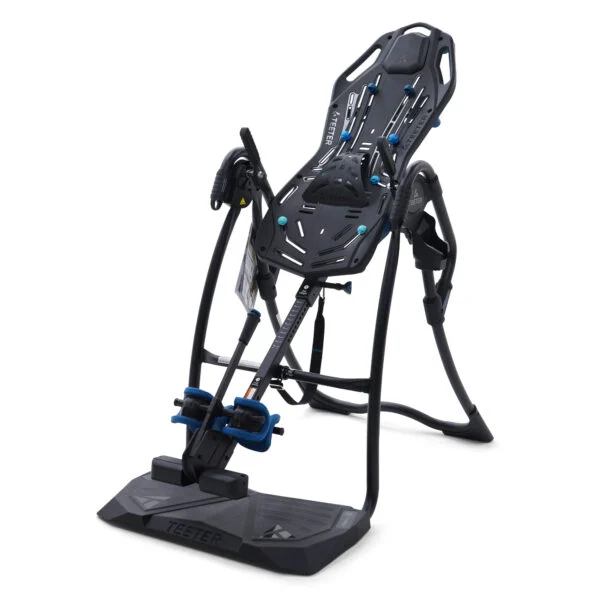
The most comfortable, most adjustable table here — the one to buy if your budget reaches premium.
Best for: Buyers who plan to use it regularly and want the most comfortable, easiest-to-adjust experience.
- Contoured, ergonomic bed is the most comfortable to hang from for longer sessions
- Deluxe EZ-Reach ankle system with a long handle and micro-adjusting closure locks ankles without a deep reach down
- Ankle Comfort Dial lets you fine-tune the fit so pressure spreads across the foot, not the arch
- UL Safety Certified and FDA-registered, with a heavy-gauge frame that owners describe as rock-steady
- Premium price for what is, mechanically, a modest step above the X3
- Heavier and bulkier folded than the entry models
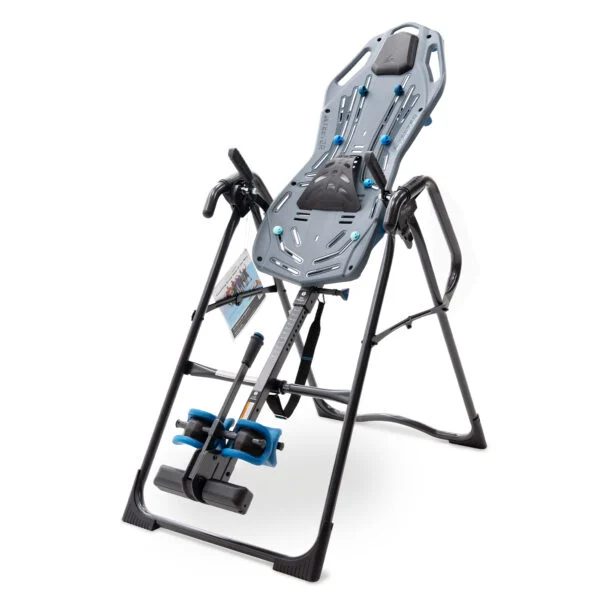
Nearly the LX9's ankle system and stability for less — the best-value pick for most people.
Best for: Most buyers who want the important stuff — a great ankle lock and a stable frame — without paying premium.
- Same Deluxe EZ-Reach long-handle ankle lock as the LX9, so securing your ankles is just as easy
- Flat FitSpine bed with acupressure nodes and a lumbar bridge for targeted stretching
- Preset EZ-Angle tether (20/40/60 degrees) makes controlled, repeatable inversion simple for beginners
- Same 300 lb capacity, UL certification, and FDA registration as the pricier model
- Flat bed is a touch less cradling than the LX9's contoured frame
- Fewer premium comfort touches than the top model
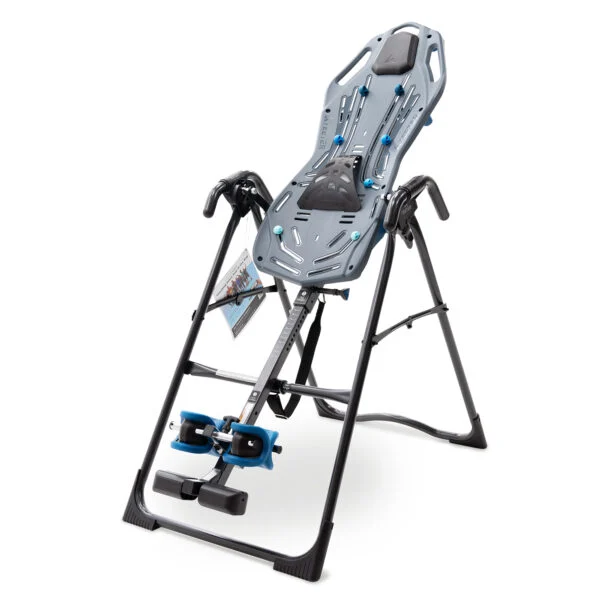
A genuinely solid entry Teeter, but the small step up to the X3 buys a much better ankle lock.
Best for: Budget-minded buyers who value Teeter's frame and certifications and don't mind the simpler ankle closure.
- Same sturdy FitSpine frame, 300 lb capacity, UL certification, and FDA registration as its siblings
- Preset angle tether gives you controlled, secure partial inversion
- Folds for storage and generally undercuts the X3 on price
- Uses a spring-loaded T-grip ankle closure that means reaching down to lock in, rather than the long-handle EZ-Reach system
- Fewer stretching accessories than the X3
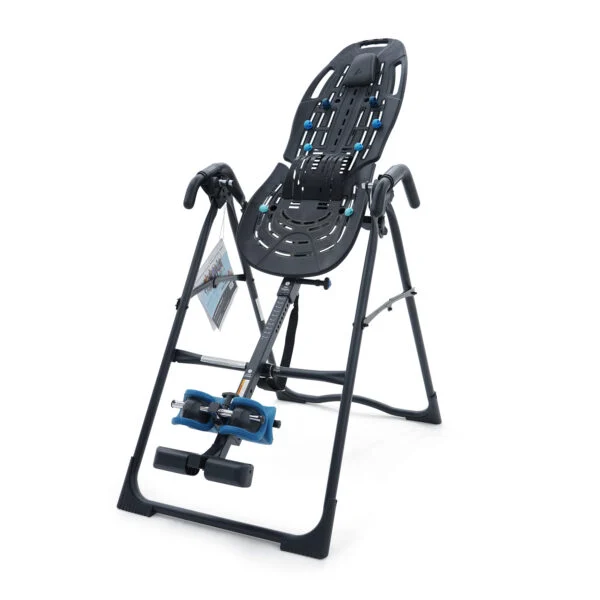
Dependable and well-built, but the legacy ComforTrak platform is outclassed by Teeter's newer X-series.
Best for: Someone who specifically wants the older ComforTrak platform — but most people are better served by the X-series.
- Same 300 lb capacity, UL Safety Certification, and FDA registration as the newer tables
- Includes an Ankle Comfort Dial and a 3-setting roller hinge for precise balance
- Folds compactly and carries Teeter's reputation for a stable frame
- Legacy ComforTrak bed is flatter and less ergonomic than the newer FitSpine frame
- Spring-loaded pin ankle closure feels more dated than the EZ-Reach long-handle system
- At its current tier it sits close to the X1/X3, which give you the newer bed and, on the X3, a far better ankle lock
| Criteria | Teeter FitSpine LX9 Inversion Table Top pick | Teeter FitSpine X3 Inversion Table | Teeter FitSpine X1 Inversion Table | Teeter ComforTrak EP-560 Inversion Table |
|---|---|---|---|---|
| Verdict | Buy it | Buy it | It depends | Skip it |
| Best for | Buyers who plan to use it regularly and want the most comfortable, easiest-to-adjust experience. | Most buyers who want the important stuff — a great ankle lock and a stable frame — without paying premium. | Budget-minded buyers who value Teeter's frame and certifications and don't mind the simpler ankle closure. | Someone who specifically wants the older ComforTrak platform — but most people are better served by the X-series. |
| Price tier | $$$ · premium | $$ · mid-range | $$ · mid-range | $ · budget |
| Weight capacity | 300 lb (136 kg) | 300 lb (136 kg) | 300 lb (136 kg) | 300 lb (136 kg) |
| Height range | 4'8"–6'6" | 4'8"–6'6" | 4'8"–6'6" | 4'8"–6'6" |
| Ankle lock system | Deluxe EZ-Reach long handle + Comfort Dial | Deluxe EZ-Reach long handle | Spring-loaded T-grip closure | Spring-loaded pin closure + Comfort Dial |
| Rotation control | Preset angle tether (20/40/60°) | Preset angle tether (20/40/60°) | Preset angle tether | 3-setting roller hinge + angle tether |
| Frame & comfort | Contoured ergonomic FitSpine frame | Flat FitSpine bed w/ acupressure nodes | Flat FitSpine bed | Legacy ComforTrak bed |
| Foldability | Folds for storage | Folds for storage | Folds for storage | Folds for storage |
| Certifications | UL certified · FDA-registered | UL certified · FDA-registered | UL certified · FDA-registered | UL certified · FDA-registered |
| Price tier | $$$ · premium | $$ · mid-range | $$ · mid-range | $ · budget |
Which one is right for you?
- Buyers who plan to use it regularly and want the most comfortable, easiest-to-adjust experience. Buy it Teeter FitSpine LX9 Inversion Table
- Most buyers who want the important stuff — a great ankle lock and a stable frame — without paying premium. Buy it Teeter FitSpine X3 Inversion Table
- Budget-minded buyers who value Teeter's frame and certifications and don't mind the simpler ankle closure. It depends Teeter FitSpine X1 Inversion Table
- Someone who specifically wants the older ComforTrak platform — but most people are better served by the X-series. Skip it Teeter ComforTrak EP-560 Inversion Table
How we judged the field
We don’t run our own lab. Instead we synthesize independent testing, manufacturer specifications, and aggregated owner reports, then weight the criteria that actually decide whether a table gets used or gathers dust. On paper, most quality inversion tables look identical — 300 lb capacity, a similar height range, a folding steel frame. So the specs that matter are the ones you feel: how secure and comfortable the ankle lock is, how confidently the frame holds still, how easy it is to set and hold a controlled angle, and how the bed supports your back while you’re inverted. We also treat safety certifications (UL) and FDA registration as table stakes, and we discount tables whose value has been eroded by newer, better siblings at a similar price.
A note on scope: this is general product information for back decompression, not medical advice. Inversion isn’t right for everyone, so treat the comfort and safety notes below as buying guidance, not a recommendation to invert.
Teeter FitSpine LX9 Inversion Table — buy
The LX9 is the most comfortable and most adjustable table in this group, and the reason is mostly the bed and the ankle system. Its contoured, ergonomic FitSpine frame cradles the back better than a flat bed, which matters if you plan to hang for more than a few seconds. The Deluxe EZ-Reach ankle system pairs a long handle with a micro-adjusting closure and an Ankle Comfort Dial, so you lock in securely without the deep reach toward your feet that puts people off cheaper tables. Controlled inversion is handled by a preset EZ-Angle tether (20, 40, or 60 degrees), and the frame is UL Safety Certified and FDA-registered. Owners consistently describe it as rock-steady. The only real knock is price: mechanically it’s a modest step above the X3, so you’re paying a premium mostly for the contoured bed and the comfort dial.
Teeter FitSpine X3 Inversion Table — buy
The X3 is the value sweet spot because it keeps the parts that matter. It uses the same Deluxe EZ-Reach long-handle ankle lock as the LX9, so the single most important comfort feature is identical — you’re not giving up ankle security to save money. Its flat FitSpine bed adds acupressure nodes and a lumbar bridge for targeted stretching, it folds for storage, and it carries the same 300 lb capacity, UL certification, and FDA registration. You lose the LX9’s contoured, cradling bed and a few premium touches, but for most buyers that’s a fair trade for a meaningfully lower price. If you’re not sure how much you’ll invert, this is the table to start with.
Teeter FitSpine X1 Inversion Table — it depends
The X1 is a genuinely good table that’s hard to place, because its nearest sibling is so strong. You get the same sturdy FitSpine frame, the same 300 lb capacity, the same UL and FDA credentials, a preset angle tether for controlled inversion, and folding storage. What you don’t get is the EZ-Reach long-handle ankle lock: the X1 uses a spring-loaded T-grip closure, which works but means reaching down toward your ankles to secure them. It also carries fewer stretching accessories. If the X1 is meaningfully cheaper for you and the ankle reach doesn’t bother you, it’s a reasonable buy. But the step up to the X3 is usually small, and it buys the better ankle system plus the extras — which is why this one lands on ‘depends’ rather than a clear yes.
Teeter ComforTrak EP-560 Inversion Table — skip
There’s nothing wrong with how the EP-560 is built. It shares the 300 lb capacity, UL certification, and FDA registration of the rest, adds an Ankle Comfort Dial and a 3-setting roller hinge for precise balancing, and folds compactly. The problem is that it’s the legacy ComforTrak platform: the bed is flatter and less ergonomic than the newer FitSpine frame, and the spring-loaded pin ankle closure feels dated next to the EZ-Reach long-handle system. At its current tier it sits close to the X1 and X3, which give you the newer bed and — on the X3 — a far better ankle lock. Unless you specifically want the older ComforTrak design, most buyers should put that money toward the X-series instead. That’s what makes this a skip rather than a knock on quality.
Teeter FitSpine LX9 vs Teeter FitSpine X3: which should you buy?
This is the decision most people actually face, and it’s closer than the price gap suggests. Both tables use the same Deluxe EZ-Reach long-handle ankle lock, the same preset EZ-Angle tether, the same 300 lb capacity, and the same UL and FDA credentials. The difference is the bed: the LX9’s contoured, ergonomic frame is more comfortable to hang from, and its Ankle Comfort Dial adds a bit more fine-tuning. If you’ll use the table often, expect longer sessions, or simply want the most comfortable experience, the LX9 earns its premium. If you want the security and stability that matter most for the least money, the X3 gives up very little and is the smarter buy for the majority of people. Put simply: LX9 if comfort is worth a premium to you, X3 if value is.
What to look for
- Ankle lock system: The most important feature. Favor a long-handle or ratcheting closure with padded cups over a simple pin or hard clamp — a secure, comfortable hold is what keeps people using the table.
- Weight and height range: Confirm you fall inside both limits (these tables cover roughly 300 lb and 4’8”–6’6”). The balance and ankle hold are designed around that window.
- Rotation control: Look for a way to set and hold a partial angle (a tether or preset roller hinge). Controlled inversion is safer and far less intimidating than free, uncontrolled rotation.
- Frame stability and foldability: A heavier-gauge steel frame wobbles less; owner reports tie cheap, light frames to unsettling flex. Check folded dimensions if storage is tight.
- Certifications: UL Safety Certification and FDA registration are worth prioritizing. Unbranded budget tables often skip them and lean on lighter frames and simpler pin ankle clamps that owners link to more wobble and looser holds.
- Bed comfort: A contoured bed is more comfortable for longer sessions; a flat bed with stretch accessories is fine for shorter, controlled use.
Our final take
Once you get past the near-identical spec sheets, buying an inversion table comes down to the ankle lock, the frame’s steadiness, and how the bed feels — and that’s exactly where these four separate. The FitSpine LX9 is our top pick because it’s the most comfortable and adjustable, ideal if you’ll use it regularly. The FitSpine X3 is the value winner: same excellent ankle lock and stable frame for less, and the right call for most people. The X1 is a fine entry point but usually worth skipping in favor of the small step up to the X3, and the legacy ComforTrak EP-560, though well-built, has simply been outclassed by its newer siblings. Whichever you choose, stay inside the weight and height limits, ease into shallow angles, and — because inversion isn’t right for everyone — treat this as general product information and check with a professional before you start.
Questions, answered
Are inversion tables safe for everyone?
No. This is general product information, not medical advice — please consult a professional before using one. Inversion raises pressure in the head and eyes and increases blood pressure, so it isn't safe for everyone: people with high blood pressure, glaucoma or other eye conditions, heart disease, or who are pregnant are commonly advised to avoid it. If you have any medical condition, get individual guidance from your doctor first.
What weight capacity and height range do these tables handle?
All four tables here are rated to 300 lb (136 kg) and fit users from about 4'8" to 6'6" (142–198 cm). Staying within both limits matters for safety and for the ankle lock and balance to work as designed, so check your height and weight against the range before buying rather than assuming one size fits all.
How much does the ankle-lock system really matter?
It's the single most important comfort-and-confidence feature. Owners consistently report that a secure, well-padded ankle hold is what makes inverting feel safe, while a loose or hard clamp is the top reason people stop using a table. The long-handle EZ-Reach system on the LX9 and X3 lets you lock in without a deep, awkward reach toward your feet, which is a meaningful upgrade over the simpler spring-loaded closures on the X1 and EP-560.
Preset angles or free rotation — which is better?
For most people, controlled preset inversion is safer and less intimidating. Every table here uses a tether or roller hinge that lets you set and hold a partial angle (commonly 20, 40, or 60 degrees) rather than swinging freely. Beginners especially benefit from easing into shallower angles; free, uncontrolled rotation can feel alarming and makes it harder to come back up smoothly.
Are these certified, and does that matter?
Yes, and it does. All four are UL Safety Certified and FDA-registered as devices. Certification isn't a promise of results, but it signals the frame and locking mechanisms were tested to recognized safety standards — worth prioritizing over unbranded budget tables that often skip it and rely on lighter frames and simpler pin ankle clamps that owner reports link to more wobble and looser holds.
More Health & Wellness reviews
 The Best At-Home IPL Hair Removal Devices: 4 Compared (and One to Skip)
  The Best Light Therapy Lamps: 4 Compared (and One to Skip)
  The Best Massage Chairs for Home: 4 Compared (and One to Skip)
  Best Massage Guns: Percussion Power vs Marketing Hype
  The Best Mattress Toppers: 4 Compared (and One to Skip)
  The Best Nebulizers: 4 Compared (and One to Skip)