Explained
Eye Wash Stations, Explained
After reading, you'll understand what ANSI/ISEA Z358.1 actually asks of an eyewash, why six gallons is the number to carry in your head, and how to tell primary equipment from supplemental at a glance.
In this guide
First time buyers shop this category on price and on the word station, and both mislead. The word is unregulated: it appears on a panel holding two bottles and on a 16 gallon tank, and nothing stops it. Meanwhile the two numbers that decide whether a product can do the job at all, flow rate and duration, are often printed a long way apart or not at all. The other thing that trips people up is that OSHA's own regulation is silent on the numbers, so buyers assume there are none, when in fact there is a consensus standard that every serious maker builds to and every inspector reads.
The 30-second version
- The standard is ANSI/ISEA Z358.1-2014, a voluntary consensus standard rather than a federal regulation, which is why OSHA's own rule text never names it.
- An eyewash must deliver 0.4 gallons per minute for 15 minutes, which is 1.5 litres per minute, and multiplies out to six US gallons of flushing fluid per incident.
- Tank capacity is not delivered volume, because gravity fed units lose head pressure as they empty, which is why Guardian's 16 gallon tank is published as delivering about eight gallons.
- Personal bottles are classed as supplemental equipment, which is the standard's own word for them, and the honest makers print that they do not meet the 15 minute flushing requirement.
- Standing water is its own hazard, with OSHA naming Acanthamoeba, Pseudomonas and Legionella as organisms that thrive in poorly maintained stations and can infect an already injured eye.
The products this guide is about
Our verdict on each, with the full reasoning on the companion review.
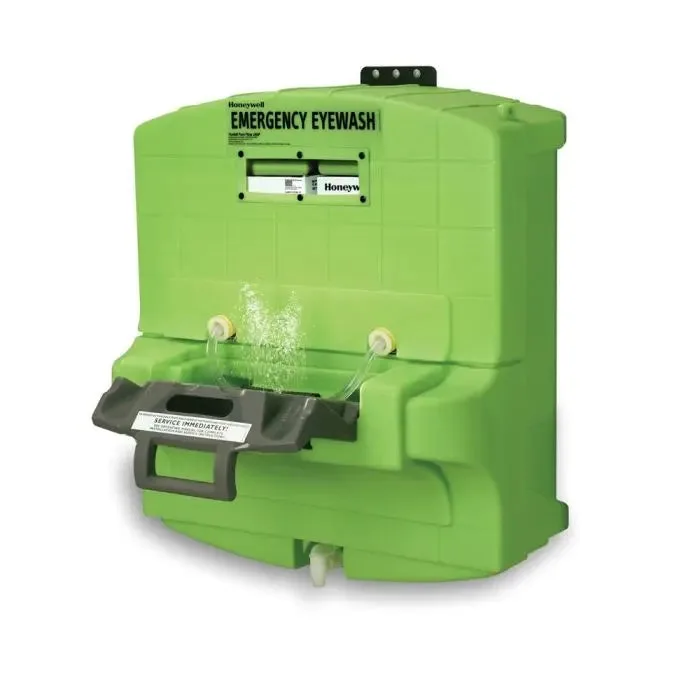
- Buy Honeywell Fendall Pure Flow 1000 The rare self-contained station that publishes the flow rate and the duration in the same sentence, running on sealed saline cartridges instead of water you pour in yourself. Amazon
- Buy Guardian Equipment AquaGuard G1540 A 16 gallon gravity fed tank whose spec sheet does the thing almost nobody else does and tells you how many gallons actually come out. Amazon
- It depends Haws 7260B-7270B AXION MSR Wall Mount Eye/Face Wash A plumbed eye/face wash whose flush never runs out and whose head is designed to sweep contaminants away from the nose rather than into it, if you have somewhere to plumb it. Amazon
- Skip Honeywell Eyesaline 32 oz Double Eyewash Wall Station Two bottles of sterile saline on a wall panel that says Wall Station, sold by a maker whose own datasheet says it does not meet the 15 minute requirement. Amazon
What actually matters
- Published duration at the required flow - this is the single claim that separates a primary eyewash from everything else. A maker who prints the gallons-per-minute and the minutes together has told you the product can do the job; a maker who prints only a tank size has told you nothing.
- Delivered volume versus tank capacity - the number moulded on the tank is what it holds, not what reaches an eye. Gravity fed stations deliver less as the water column drops, so look for a separate delivered figure and treat the capacity as a headline.
- Fluid type and preservation - sealed preserved saline needs no attention until its expiry date, while a tap filled tank needs a bacteriostatic additive and a scheduled water change. The second is cheaper and asks more of you.
- Tepid delivery - the standard's suitable range is 16 to 38 C, or 60 to 100 F, on the reasoning that fluid outside it drives people out of the flush early. Very few self-contained units control temperature at all, so where the unit lives matters.
- Nozzle geometry - the requirement is controlled flow to both eyes simultaneously at a velocity low enough to be non-injurious, with the flow pattern 33 to 53 inches above the floor and at least six inches clear of a wall. Two fixed heads do this; a squeeze bottle does not.
- Reach time - the standard asks for locations no more than 10 seconds away with an unobstructed path on the same level.
- Inspection duty - plumbed units are activated weekly, self-contained units get a weekly visual inspection instead, and everything gets a thorough annual check. Buy the one whose duty cycle your site will actually keep.
The specs, in plain English
Green flags vs red flags
Green flags
- The spec sheet states a flow rate and a number of minutes in the same sentence, not a capacity on its own.
- Delivered volume is published separately from tank capacity, which means the maker has measured the unit rather than the moulding.
- A named third party certification, such as SEI or CSA, appears next to the standard number and its edition year.
- There is a dated service obligation: a cartridge expiry, or a stated water change interval such as at least every six months.
- Two fixed nozzles with a dust cover, and a mounting instruction that puts the flow pattern 33 to 53 inches above the floor.
Red flags
- A large capacity figure with no duration attached anywhere on the page.
- The words eye wash station on a product whose entire fluid volume is quoted in fluid ounces.
- A refillable tank with no mention of a preservative, an additive or a water change interval.
- ANSI compliant as a bare phrase, with no edition year, no section and no certifying body named.
- Nozzles with no cover, since the standard asks for outlets to be protected from airborne contaminants.
Who's who: the brands
- Honeywell - Owns the Fendall and Eyesaline lines and covers both ends of the category, from sealed cartridge primary stations to the personal bottles its own datasheet labels supplemental.
- Guardian Equipment - A Chicago maker of plumbed and portable emergency equipment whose spec sheets are unusually specific, including the delivered-gallons figure most competitors leave out.
- Haws - Best known for plumbed eyewash, eye/face wash and tempering valves, and for the AXION MSR inverted flow head.
How to read a listing without getting fooled
Read the listing backwards. Skip the headline and the photograph and go looking for two numbers together, a flow rate and a number of minutes, because that pairing is the only thing that separates a primary eyewash from a shelf of saline. If you find a capacity but no duration, assume the duration was left out because it is not flattering. Next, find the standard reference and check that it has an edition year and, ideally, a certifier's name beside it, since ANSI compliant on its own is a marketing phrase rather than a claim. Then look for the maintenance sentence: an expiry interval, a water change interval, or a weekly activation instruction. A product that names its own upkeep obligation is telling you the truth about what owning it involves. Finally, look at the nozzle photograph. Two fixed heads under a cover is what the standard's both-eyes-simultaneously clause looks like in hardware; anything you have to aim is supplemental equipment wearing a station's clothes.
How much should you spend?
This category rewards spending at the point where the fluid meets the standard, and stops rewarding it quickly after. Budget tier buys you personal bottles and bottle wall stations, which are legitimate supplemental equipment and cannot be a primary eyewash whatever the packaging says, so treat that tier as an accessory budget rather than a solution. Mid-range is where the useful decisions live: a gravity fed tank with a real published duration, or a plumbed wall mounted unit, both of which will meet the flow and duration requirements if installed and maintained properly. Premium mostly buys you sealed, preserved, dated fluid and the reduced maintenance burden that goes with it, which is worth real money on a site with staff turnover or a demanding audit and much less on a two-person shop where one person owns the calendar. Budget separately for the parts that are quietly optional: a tempering valve on a plumbed unit, a thermal cover on a portable one, and the recurring cost of cartridges or additive.
Questions, answered
Can I just use a garden hose or a sink faucet?
No, and the standard is specific about why. A drench hose can only count as an eyewash or eye/face wash if it meets the same performance requirements, which most do not, and on its own it is classed as supplemental equipment. The deeper problem is the both-eyes-simultaneously requirement and the non-injurious velocity limit: a hose or tap gives you a single stream at whatever pressure the building supplies, aimed by someone whose eyes are already shut and streaming.
How often do I have to test it?
Plumbed units are activated weekly, which both confirms function and flushes the stagnant water out of the branch of pipe that feeds them. Self-contained units get a weekly visual inspection instead of activation, since running them down would empty the reserve. Everything gets a thorough annual inspection, and the annual test is meant to run the full 15 minutes so that flow, pattern and temperature are all verified across the whole cycle rather than for the first few seconds.
What about outdoor or freezing locations?
That is where self-contained stations need the most help, because few of them heat the fluid on their own. Guardian sells a thermal cover for the G1540 for areas exposed to extreme heat or sunlight. On the plumbed side, freeze-resistant and heat-traced installations plus a thermostatic tempering valve are the standard answer. Whichever route you take, the temperature question has to be solved deliberately, since the standard's tepid range is part of the requirement and not a nicety.
Does contact lens wear change anything?
It makes prompt, adequate flushing more important rather than less. Lenses can trap material against the cornea, and the contamination risk that OSHA describes in poorly maintained stations. Nothing about lenses changes what you should buy, but it strengthens the case for a station with preserved or sealed fluid over a tank of ageing tap water, and for taking the flush to the full 15 minutes rather than stopping when it stops stinging.
Or jump to the head-to-head: Honeywell Fendall Pure Flow 1000 vs Guardian Equipment AquaGuard G1540.