

Health & Wellness
The Best Eye Wash Stations: 4 Compared (and One to Skip)
We compared four eye wash stations on the number that decides everything: whether the maker publishes how long the unit holds the 0.4 gallons per minute the standard asks for, plus what fluid it holds, how long that fluid lasts and what the nozzles do.
The short version
The Honeywell Fendall Pure Flow 1000 is the overall pick because Honeywell publishes the two figures that matter together: 0.4 gpm and 15 minutes, from a 7 gallon charge of sealed, preserved saline that carries a 24 month expiry date. The Guardian AquaGuard G1540 is the value pick and the more honest spec sheet of the two, because Guardian prints its 16 gallon tank capacity and then tells you the unit actually delivers about eight gallons over the 15 minutes, which is the single most useful sentence in this category. The Haws 7260B-7270B AXION MSR is the depends pick: plumb it in and the flush never runs out and nothing expires, but it needs a supply, a 1-1/4 inch waste line, weekly activation and a tempering valve that Haws sells as an option rather than including. Skip the Honeywell Eyesaline 32 oz Double Eyewash Wall Station as a primary station, because its own Honeywell datasheet files it under Secondary/Personal Eyewash and states in plain text that it does not meet the ANSI Z358.1 15 minute flushing requirement. Two 32 oz bottles is half a US gallon, which at the required flow is about 75 seconds. It is a genuinely good thing to own as a supplement and a bad thing to own instead. Best for: anyone buying the first real eyewash for a shop, lab or site and wanting to check the claim against the standard before it is needed.
Our picks at a glance
- Honeywell Fendall Pure Flow 1000 - Buy. The rare self-contained station that publishes the flow rate and the duration in the same sentence, running on sealed saline cartridges instead of water you pour in yourself.
- Guardian Equipment AquaGuard G1540 - Buy. A 16 gallon gravity fed tank whose spec sheet does the thing almost nobody else does and tells you how many gallons actually come out.
- Haws 7260B-7270B AXION MSR Wall Mount Eye/Face Wash - It depends. A plumbed eye/face wash whose flush never runs out and whose head is designed to sweep contaminants away from the nose rather than into it, if you have somewhere to plumb it.
- Honeywell Eyesaline 32 oz Double Eyewash Wall Station - Skip. Two bottles of sterile saline on a wall panel that says Wall Station, sold by a maker whose own datasheet says it does not meet the 15 minute requirement.
The verdict in 30 seconds
What mattered most
- Type
- Published flow rate
- Published duration at that flow
- Flushing fluid on hand
- Fluid
- Shelf life or service interval
The federal rule for this category is one sentence long. OSHA 29 CFR 1910.151(c) says that where eyes may be exposed to injurious corrosive materials, suitable facilities for quick drenching or flushing of the eyes shall be provided within the work area for immediate emergency use, and it names no standard, no flow rate and no number of minutes. The number everyone actually buys against comes from ANSI/ISEA Z358.1-2014, which asks an eyewash for at least 0.4 gallons per minute, or 1.5 litres per minute, for a full 15 minutes. Do that arithmetic and it comes to six gallons of flushing fluid per incident. A large share of what is sold under the words eye wash station holds less than one.
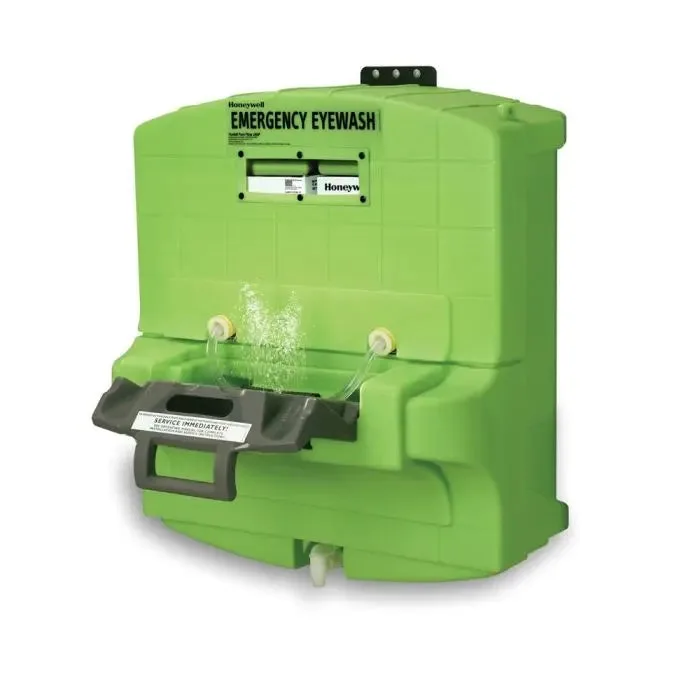
The rare self-contained station that publishes the flow rate and the duration in the same sentence, running on sealed saline cartridges instead of water you pour in yourself.
Best for: A shop, lab or plant that wants a compliant 15 minute flush with no plumbing and prefers a dated, sealed consumable over a tank somebody has to remember to empty.
- Honeywell states a constant 0.4 gpm for 15 minutes as required by ANSI Z358.1, and lists Flow Duration as 15 minutes and Capacity as 7 gallons in the same spec table.
- The fluid arrives in factory sealed cartridges of preserved, buffered saline, with a sterile option and a high humidity option, so nothing is mixed or measured on site.
- Maintenance is dated rather than guessed: a 24 month cartridge life from the date of manufacture, an expiration date printed on the activation straps, an easy view window and RFID tags on the cartridges.
- The consumable is the product. Cartridges are sold as a set of two and get replaced every 24 months whether or not the station is ever used.
- Seven gallons is only about one gallon of headroom over the six the standard implies, so there is no second flush without a fresh cartridge set.
- Honeywell publishes nothing about the delivered temperature. The unit is at whatever temperature the room is, and the standard asks for 16 to 38 C.
- Parts of Honeywell's own literature still cite the 2004 and 2009 editions of Z358.1 alongside the current one, which makes the paperwork harder to audit than it should be.
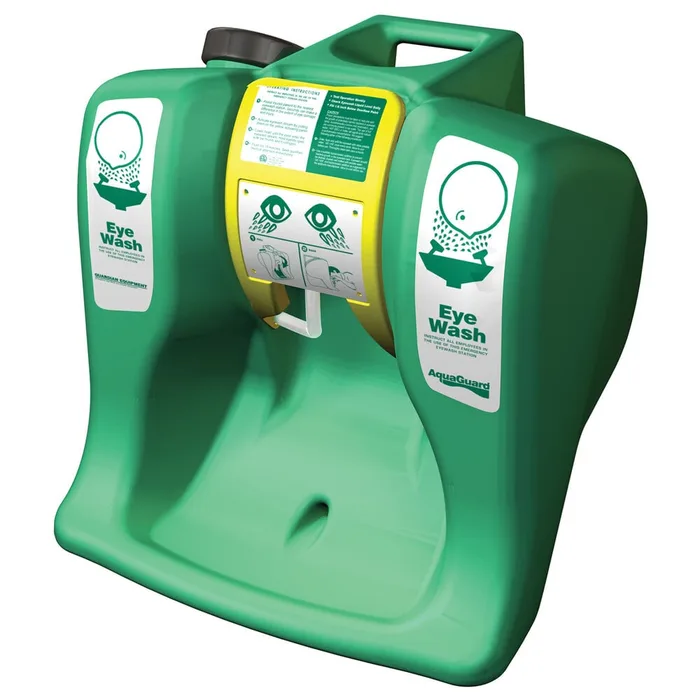
A 16 gallon gravity fed tank whose spec sheet does the thing almost nobody else does and tells you how many gallons actually come out.
Best for: Anywhere with a hazard and no water line, and anyone who would rather spend on a bigger fluid reserve than on sealed cartridges.
- Guardian's own sheet states the unit uses gravity to deliver approximately eight gallons over 15 minutes through dual spray heads, and separately gives a discharge time of over 0.5 gallons per minute for 15 minutes.
- It ships with an 8 oz bottle of bacteriostatic additive that Guardian says protects against growth of bacteria, fungus, algae and acanthamoeba, plus a wall bracket and a 3 ft drain hose.
- No plumbing, no power and no compressed air. It works on water column pressure alone, and the mounting note tells you to hang it so the flow pattern lands 33 to 53 inches above the floor, which is where the standard wants it.
- The tank is filled with potable water by a human, so the hygiene is yours to manage. Guardian says the water should be changed at least once every six months.
- Portable is relative. Guardian lists 13 lbs empty and 158 lbs full, so it moves between jobs empty and stays put once charged.
- There is no temperature control. Fluid sits at whatever the room does, and Guardian sells a thermal cover separately for areas exposed to extreme heat or sunlight.
- Half the tank never reaches an eye. The delivered eight gallons out of 16 is honest, but it means the number on the label is double what you get.
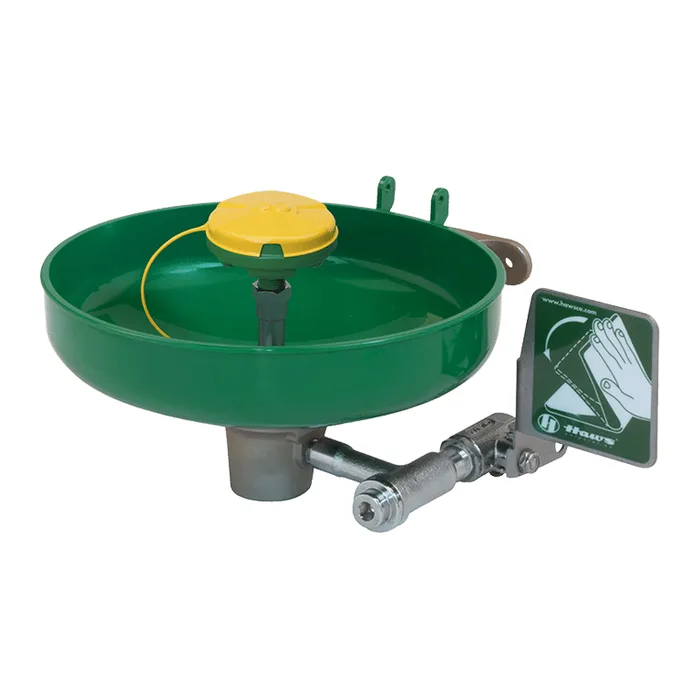
A plumbed eye/face wash whose flush never runs out and whose head is designed to sweep contaminants away from the nose rather than into it, if you have somewhere to plumb it.
Best for: A fixed lab, plant or wash-up bay that already has a tepid supply and a floor drain, and wants a station that will never expire or need refilling.
- Nothing expires. There is no cartridge, no additive and no tank, and the duration is limited only by the building supply.
- The AXION MSR head uses an inverted directional laminar flow which Haws says achieves Zero Vertical Velocity and sweeps contaminants away from the vulnerable nasal cavity, fed by an integral 3.7 gpm flow control.
- Haws names the certifying body rather than self declaring: the model is certified by CSA to meet the ANSI/ISEA Z358.1 standard, and the unit ships with a test card for recording weekly checks.
- It needs real plumbing. The sheet calls for a 1/2 inch NPT inlet and a 1-1/4 inch NPT waste, so there has to be a drain as well as a supply.
- Tepid water is an extra. The 9201EW AXION thermostatic tempering valve and the SP157A scald protection bleed valve are listed as options, not inclusions.
- At 3.7 gpm this is an eye/face wash in the 3.0 gpm class, not the 0.4 gpm eyewash class, so it consumes roughly nine times the water per minute and needs a supply that can hold that rate for 15 minutes.
- Plumbed units carry the weekly activation duty, and a line that sits still between tests is the exact condition OSHA's own infosheet warns about.
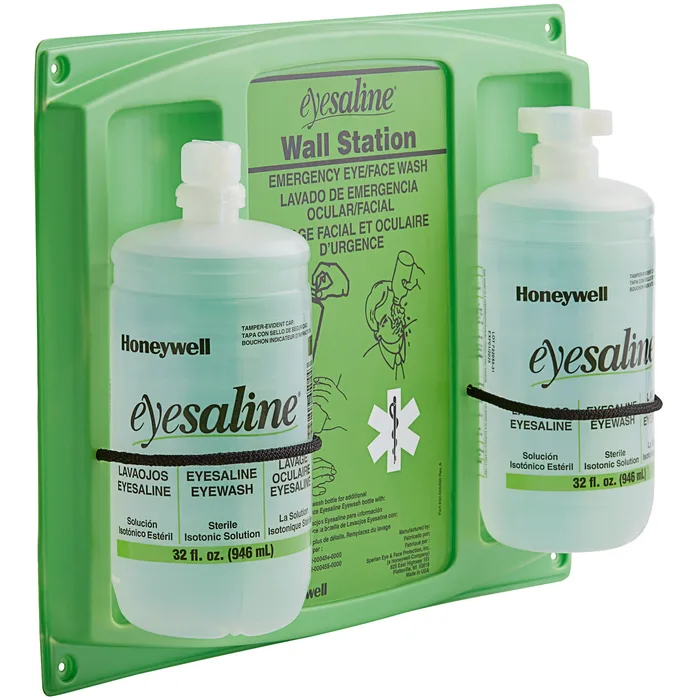
Two bottles of sterile saline on a wall panel that says Wall Station, sold by a maker whose own datasheet says it does not meet the 15 minute requirement.
Best for: Hanging next to a real eyewash, or in a vehicle, as the thing somebody grabs on the way to the real eyewash.
- The fluid is good. Honeywell describes a buffered, sterile saline in blow-fill-seal, tamper resistant FDA-grade polyethylene bottles carrying lot numbers and expiration dates.
- A 36 month shelf life from the date of manufacture is longer than any sealed cartridge or tank of treated water in this comparison.
- As supplemental equipment it does a real job. Honeywell's own use list is nuisance particles like pollen, dust, sawdust and smoke, immediate treatment en route to a primary eyewash, and continued irrigation en route to medical care after a 15 minute flush.
- Honeywell's own Eyesaline datasheet files these under Secondary/Personal Eyewash and states that they do not meet ANSI Z358.1, 15 minute flushing requirement.
- Two 32 oz bottles is 64 fluid ounces, half a US gallon. The standard's eyewash minimum works out to six gallons over 15 minutes, so this is about 75 seconds of flow.
- Both hands are busy. Each bottle is squeezed by hand, one eye at a time, so it cannot deliver controlled flow to both eyes simultaneously while the user holds the eyelids open.
- The word Station on the panel is doing an enormous amount of work, and buyers routinely mount one of these and consider the hazard covered.
| Criteria | Fendall Pure Flow 1000 Top pick | AquaGuard G1540 | 7260B-7270B AXION MSR Wall Mount Eye/Face Wash | Eyesaline 32 oz Double Eyewash Wall Station |
|---|---|---|---|---|
| Verdict | Buy it | Buy it | It depends | Skip it |
| Best for | A shop, lab or plant that wants a compliant 15 minute flush with no plumbing and prefers a dated, sealed consumable over a tank somebody has to remember to empty. | Anywhere with a hazard and no water line, and anyone who would rather spend on a bigger fluid reserve than on sealed cartridges. | A fixed lab, plant or wash-up bay that already has a tepid supply and a floor drain, and wants a station that will never expire or need refilling. | Hanging next to a real eyewash, or in a vehicle, as the thing somebody grabs on the way to the real eyewash. |
| Price tier | $$$ · premium | $$ · mid-range | $$ · mid-range | $ · budget |
| Type | Self-contained, sealed cartridge | Self-contained, gravity fed, tap filled | Plumbed wall mount eye/face wash | Personal eyewash bottles on a wall panel |
| Published flow rate | 0.4 gpm | Over 0.5 gpm | 3.7 gpm integral flow control | None published |
| Published duration at that flow | 15 minutes | 15 minutes | Continuous, limited by the supply | Honeywell states it does not meet the 15 minute requirement |
| Flushing fluid on hand | 7 gallons in two sealed cartridges | 16 gallon tank, about 8 gallons delivered | Building water supply | 64 fl oz in two bottles |
| Fluid | Preserved buffered saline, sterile option | Potable water plus bacteriostatic additive | Potable water from the supply | Sterile buffered saline |
| Shelf life or service interval | 24 month cartridge life from manufacture | Change the water at least every six months | Nothing expires, weekly activation | 36 month shelf life from manufacture |
| Both eyes at once | Two fixed nozzles, hands free | Dual spray heads on a swing-down tray | AXION MSR head, inverted laminar flow | Hand squeezed, one bottle per eye |
| Standards claim on the maker's own sheet | Meets ANSI Z358.1 15 minute flushing requirement, SEI Certified | Tested to and complies with ANSI Z358.1-2014, Listed 8116 | Certified by CSA to ANSI/ISEA Z358.1 | Stated as supplemental, does not meet the 15 minute requirement |
Which one is right for you?
- A shop, lab or plant that wants a compliant 15 minute flush with no plumbing and prefers a dated, sealed consumable over a tank somebody has to remember to empty. Buy it Honeywell Fendall Pure Flow 1000
- Anywhere with a hazard and no water line, and anyone who would rather spend on a bigger fluid reserve than on sealed cartridges. Buy it Guardian Equipment AquaGuard G1540
- A fixed lab, plant or wash-up bay that already has a tepid supply and a floor drain, and wants a station that will never expire or need refilling. It depends Haws 7260B-7270B AXION MSR Wall Mount Eye/Face Wash
- Hanging next to a real eyewash, or in a vehicle, as the thing somebody grabs on the way to the real eyewash. Skip it Honeywell Eyesaline 32 oz Double Eyewash Wall Station
How we judged the field
Five things decide whether an eye wash station is worth buying. First and above everything else, whether the maker publishes a delivery duration at the required flow, not just a tank size. A capacity figure on its own tells you nothing, because gravity fed tanks lose head as they empty and never deliver everything they hold. Second, the fluid: sealed preserved saline, tap water plus a bacteriostatic additive, or mains water, each of which carries a different maintenance burden. Third, the dated part, meaning a cartridge expiry, a water change interval or a weekly activation duty, because a station nobody services is the one OSHA writes infosheets about. Fourth, the nozzles, because the standard asks for controlled flow to both eyes simultaneously at a non-injurious velocity, which is a thing two fixed heads can do and a hand-squeezed bottle cannot. Fifth, how the compliance claim is worded, since a named certifier beats the phrase ANSI compliant every time.
The field splits by what the maker is willing to commit to in print, and the pleasant surprise is that the serious primary-eyewash brands nearly all commit. Honeywell prints 0.4 gpm and 15 minutes and a 7 gallon capacity in one table. Guardian prints over 0.5 gpm for 15 minutes and then, unusually, tells you that a 16 gallon tank delivers about eight of those gallons. Where the published duration vanishes is at the bottom of the category, on the bottle products, and the most interesting of those is honest about it in its own literature. So we picked one sealed cartridge station, one gravity fed tank, one plumbed unit, and one bottle wall station whose own datasheet argues the case against buying it as a station.
Honeywell Fendall Pure Flow 1000
Buy itThe Fendall Pure Flow 1000 is the pick because Honeywell answers the only question that matters without being asked twice. The specification table gives Flow Duration as 15 minutes and Capacity as 7 gallons, and the description states that the patented design delivers a constant flow rate and stream height and provides 0.4 gpm for 15 minutes as required by ANSI Z358.1. Seven gallons against the six the standard implies is a real, checkable margin, and it comes as two factory sealed cartridges of preserved, buffered saline so nothing is mixed, measured or exposed to airborne particles before use. The maintenance story is unusually concrete: replace the cartridge every 24 months, expiry printed on the activation straps, an easy view window, RFID tags on the cartridges and an integral reservoir that catches the waste fluid instead of putting it on the floor. Honeywell also names SEI certification rather than self declaring. The trade-off is that the fluid is a dated consumable you buy again every two years even if nobody ever pulls the handle. For a hazard with no water line, that is the right price to pay.
Guardian Equipment AquaGuard G1540
Buy itThe AquaGuard G1540 earns the value pick on a single sentence of Guardian’s own spec sheet, and it is a sentence almost nobody else writes: the unit uses gravity to deliver approximately eight gallons over 15 minutes through dual spray heads. Guardian then gives a discharge time of over 0.5 gallons per minute for 15 minutes. Read those together and you learn what the 16 gallon number on the tank hides: a gravity fed station delivers roughly half what it holds, because head pressure falls as it empties. The rest follows from being a tap filled tank. It ships with an 8 oz bottle of bacteriostatic additive that Guardian says protects against bacteria, fungus, algae and acanthamoeba, the water is meant to be changed at least once every six months, and at 158 lbs full it is portable in the sense of relocatable rather than carryable. The mounting instructions put the flow pattern at 33 to 53 inches above the floor, which is where the standard wants it, and the wall bracket, and drain hose are included. Buy it where fluid volume matters more than sealed convenience.
Haws 7260B-7270B AXION MSR Wall Mount Eye/Face Wash
It dependsThe 7260B-7270B AXION MSR is the one to buy if, and only if, there is somewhere to plumb it. The upside is that it removes the whole expiry problem: no cartridge, no additive, no tank, and a flush that lasts as long as the building supply does. The head is the interesting part. Haws feeds it through an integral 3.7 gpm flow control and shapes the pattern with an inverted directional laminar flow that it describes as achieving Zero Vertical Velocity, the point being to sweep contaminants away from the nasal cavity rather than washing them toward it. Certification is by CSA to ANSI/ISEA Z358.1, which is a stronger statement than a self declaration. The reasons it is not a straight buy are all installation. It needs a 1/2 inch NPT inlet and a 1-1/4 inch NPT waste, so a drain is not optional. It draws roughly nine times the water per minute of an eyes-only unit. And tepid delivery, which the standard treats as a requirement, arrives as the optional 9201EW tempering valve. Right answer for a fixed bay, wrong one for a truck.
Honeywell Eyesaline 32 oz Double Eyewash Wall Station
Skip itThe Eyesaline 32 oz Double Eyewash Wall Station is the skip, and the argument comes entirely from Honeywell. It is called a Wall Station and sits in retail listings beside genuine primary stations. But the Eyesaline datasheet files these under a heading reading Secondary/Personal Eyewash and states two things in a bulleted list: that personal eyewash devices are intended to supplement, not replace, primary eyewash units, and that the product does not meet ANSI Z358.1, 15 minute flushing requirement. Now do the volume. Two 32 fl oz bottles is 64 ounces, half a US gallon, against the six gallons that 0.4 gpm for 15 minutes comes to. At the standard’s own minimum flow that is about 75 seconds, and a single 16 oz bottle from the same range about 19. It is hand squeezed one bottle at a time, so it cannot give controlled flow to both eyes at once. None of which makes it a bad product. Hang it beside a real station and it earns its place. Hang it instead of one and it is the most expensive mistake in this category.
Sources
Specs in this review come from these pages.
- OSHA: 29 CFR 1910.151, Medical services and first aid (osha.gov)
- OSHA InfoSheet 3818: Health Effects from Contaminated Water in Eyewash Stations (osha.gov)
- Honeywell: Fendall Pure Flow 1000 product datasheet (prod-edam.honeywell.com)
- Honeywell: Eyesaline Personal Eyewash Bottles datasheet (prod-edam.honeywell.com)
- Guardian Equipment: G1540 AquaGuard Gravity-Flow Portable Eyewash specification sheet (gesafety.com)
- Haws: model 7260B-7270B AXION MSR Wall Mount Eye/Face Wash specification sheet (hawsco.com)
Honeywell Fendall Pure Flow 1000 vs Guardian Equipment AquaGuard G1540: which should you buy?
The Pure Flow 1000 and the G1540 both get you a compliant 15 minute flush without a water line, and the choice between them is really a choice about who does the maintenance. Honeywell sells you a sealed, dated system: the saline is preserved and buffered at the factory, the cartridges are stamped with an expiry, the RFID tags and the easy view window are there so an inspection is a glance rather than a procedure, and the replacement interval is a hard 24 months. You cannot get the fluid wrong because you never touch it. Guardian sells you a tank and a bottle of additive and trusts you to run the calendar, and in exchange gives you a much larger fluid reserve for less money.
So choose Honeywell if the station will be inspected by people who did not install it, if the site has any turnover, or if the consequence of a forgotten water change is unacceptable. Choose Guardian if there is a named person who will actually empty, clean, refill and re-dose the tank at least every six months, and if you would rather have eight delivered gallons than seven sealed ones. One practical tiebreaker: the Pure Flow’s waste reservoir catches the used fluid, while the G1540 wants a drain hose routed somewhere sensible, so the room you are putting it in may decide for you. If the room is unheated or baking, look at Guardian’s thermal cover option before assuming either unit will deliver tepid fluid on its own.
What to look for
- A duration, not just a capacity: the only claim worth anything is a flow rate and a number of minutes stated together, because a gravity fed tank delivers roughly half what it holds once the head pressure drops.
- Six gallons as the mental yardstick: 0.4 gallons per minute for 15 minutes is six US gallons of flushing fluid, so any product measured in ounces is supplemental equipment no matter what the label calls it.
- A named certifier: SEI or CSA on the spec sheet is a third party saying so, while the bare phrase ANSI compliant with no edition, section or test body is the seller saying so.
- A dated consumable or a dated interval: a printed cartridge expiry, or a maker-stated water change interval like Guardian’s six months, is what stops a station quietly becoming the thing OSHA’s contamination infosheet describes.
- Two fixed nozzles and a covered outlet: the standard asks for controlled flow to both eyes simultaneously at a non-injurious velocity, with the pattern 33 to 53 inches above the floor, and it asks for outlets protected from airborne contaminants, which is what the dust cover is for.
- An honest answer on tepid: the standard’s range is 16 to 38 C, or 60 to 100 F, and almost nothing in this category delivers it by itself, so check whether the tempering valve or thermal cover is included or sold separately.
Our final take
Buy the Honeywell Fendall Pure Flow 1000 if you want a station whose compliance claim you can read off one table and whose fluid has a printed expiry date, and accept that the cartridges are a standing cost. Buy the Guardian AquaGuard G1540 if you would rather have a bigger fluid reserve for less and you have someone who will genuinely change the water twice a year. Plumb in the Haws 7260B-7270B if there is a supply and a drain, and budget for the tempering valve too. And whatever else you do, do not let a pair of saline bottles on a wall panel be the answer to a chemical splash. Honeywell will tell you that itself, in its own datasheet, if you read past the word Station.
Questions, answered
Does OSHA actually require an ANSI Z358.1 compliant eyewash?
Not in those words. The text of 29 CFR 1910.151(c) requires suitable facilities for quick drenching or flushing of the eyes within the work area for immediate emergency use, and it stops there. It names no flow rate, no duration and no consensus standard. But OSHA's own published guidance is far more specific than the regulation: the agency's infosheet on contaminated eyewash water states that the ANSI standard for eyewashes specifies delivery of tepid flushing fluid to the eyes at not less than 1.5 litres per minute, or 0.4 gpm, for 15 minutes after a single movement and subsequent hands-free operation. So the practical answer is that the regulation is vague and the guidance is not, and Z358.1 is what an inspector, an insurer and a plaintiff's expert will all reach for.
Why is six gallons the number that matters?
Because it is what the standard's two figures multiply out to. Z358.1 asks an eyewash for a minimum 0.4 gallons per minute sustained for 15 minutes, and 0.4 times 15 is six US gallons, or 768 fluid ounces. That single figure sorts the category faster than any other test. A 7 gallon sealed charge clears it. A 16 gallon tank that delivers eight gallons clears it comfortably. A 32 oz bottle is 1/24th of it and lasts under 40 seconds. Note that this is the eyes-only class. An eye/face wash is held to 3.0 gpm, which over 15 minutes is 45 gallons, and that is why eye/face wash units are almost always plumbed.
Is the eyewash in my first aid kit enough?
No, and it is not meant to be. The eyewash you find in an ANSI/ISEA Z308.1 Class A first aid kit is a small bottle of an ounce or so, which at the eyewash standard's minimum flow lasts only seconds. Our first aid kit comparison covers what Class A fill actually includes and how to check a kit against it, so we will not repeat it here. Treat the kit bottle the same way you treat a personal eyewash bottle: useful for a speck of grit, and no part of your answer to a chemical splash.
How bad is standing water in a tank or a plumbed line?
Bad enough that OSHA published an infosheet about it. The agency names Acanthamoeba, Pseudomonas and Legionella as organisms that thrive in stagnant or untreated water in poorly maintained eyewash stations, and notes that an eye already injured by a chemical is more susceptible to infection than a healthy one. It lists eye redness, pain, tearing, blurred vision, light sensitivity and inflammation appearing several days after use of a contaminated station, and in rare cases Acanthamoeba keratitis. This is the argument for either a sealed cartridge system, or a tap filled tank with the maker's bacteriostatic additive in it and a hard calendar reminder for the water change. Guardian's interval for the G1540 is at least once every six months.
Do both eyes really have to be flushed at the same time?
Yes, and it is a design requirement rather than a technique tip. The performance clause for eyewashes and eye/face washes calls for a means of controlled flow to both eyes simultaneously at a velocity low enough to be non-injurious, and it is one of the items on the weekly test list. In practice that means two fixed nozzles set far enough apart to land on both eyes at once, at a pattern height the standard puts between 33 and 53 inches above the floor, so the user can hold both eyelids open with their hands instead of aiming a bottle. Haws makes the further argument that the direction matters too, and designs its AXION MSR head to irrigate from the inside out so contaminants are swept away from the nasal cavity rather than toward it.
Is fifteen minutes of flushing the end of it?
No. Flushing is first aid, not treatment. Z358.1 sets fifteen minutes as the flush duration for a reason, but the standard governs the equipment, not what happens afterwards, and a chemical splash still needs a medical assessment once the flush is done. Take the product name or the safety data sheet for whatever went in the eye with you, because the substance decides the follow-up and a burn from an alkali behaves very differently from an acid. Keep flushing on the way if you can, and do not stop early because the pain eased off.
Deciding between the top two? See our head-to-head: Honeywell Fendall Pure Flow 1000 vs Guardian Equipment AquaGuard G1540.
More Health & Wellness reviews
 The Best Fire Extinguishers: 4 Compared (and One to Skip)
  The Best First Aid Kits: 4 Compared (and One to Skip)
  The Best Foot Massagers: 4 Compared (and One to Skip)
  The Best Foot Spas: 4 Compared (and One to Skip)
  The Best Hearing Protection: 4 Compared (and One to Skip)
  The Best Electric Heating Pads: 4 Compared (and One to Skip)