

Health & Wellness
The Best Escape Ladders: 4 Compared (and One to Skip)
We compared portable and permanent home escape ladders on the only things that decide whether one works: the published rated load, whether the hooks actually fit your window sill, whether the ladder stands off the wall, and whether you are allowed to practice on it before the night you need it.
The short version
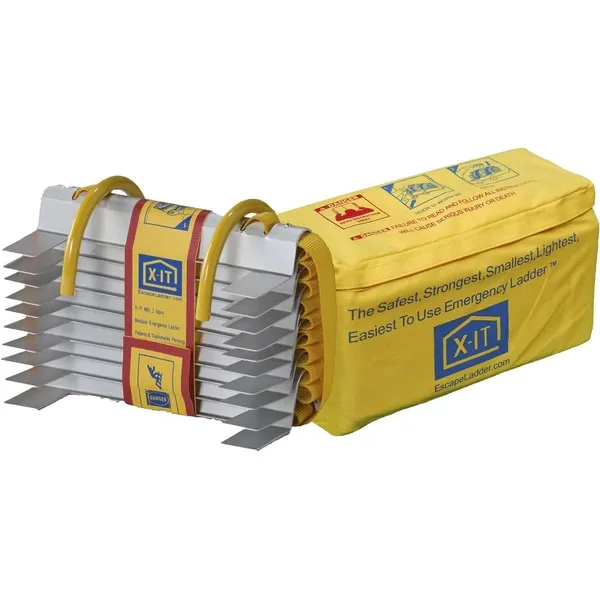
The X-IT Escape Ladder is the pick, because its own instruction sheet tells you to deploy it, climb it, and repack it, which means the ladder you own is a ladder you have actually used. Its published rated load is 333 lb for one person at a time, lower than the 1,000 lb figure the marketing leads with, and worth knowing before you buy. The First Alert Two-Story Fire Escape Ladder is the value pick at 14 feet and a 375 lb rating, with a steel stabilizer on every rung, but it only fits sills between 6 and 10 inches and its manual still cites the 2002 edition of the standard. The Rescue Ready RetroFit is the 'depends' pick: it is anchored to the studs under your window so there is nothing to find or hook in the dark, but it is a permanent install that rules out renters, slider windows, and multi window units. Skip the Kidde 2-Story Fire Escape Ladder as your only ladder, because Kidde's own manual says it is designed for one time use, tells you not to pull the release strap during practice, and instructs you to discard it after a single deployment. Buy the ladder you are permitted to rehearse with, then measure your sill before you order. Best for: anyone with a bedroom above the ground floor who wants a second way out they have personally tested.
Our picks at a glance
- X-IT Products X-IT Escape Ladder, 2 Story - Buy. The one escape ladder whose own instruction sheet tells you to deploy it, climb it, and pack it back up, which is the only way anyone ever learns to use one.
- First Alert Two-Story Fire Escape Ladder, 14 Feet - Buy. A 14 foot steel and nylon ladder with a stabilizer on every rung, repackable so you can rehearse, and cheap enough to put one in each upstairs bedroom.
- Rescue Ready RetroFit Fire Escape Ladder, 2 Story - It depends. A ladder bolted to the studs under your bedroom window, so in the dark there is nothing to find, unfold, or hook onto anything.
- Kidde 2-Story Fire Escape Ladder KL-2S - Skip. A widely sold escape ladder is, by Kidde's own printed instruction, a single use product you are told not to deploy during practice.
The verdict in 30 seconds
What mattered most
- Deployed length
- Published rated load
- Reusable, so you can practice descending
- Window fit
- Stand-offs
- ASTM F2175 claim
An escape ladder is bought once, stuffed under a bed, and never touched again. That is exactly why the specification matters more here than in almost any other category: nobody finds out their hooks do not fit the sill until they are hanging out of a smoke filled bedroom. There is one American standard for these products, ASTM F2175, and no third party certification program behind it, so every compliance claim on the box is the manufacturer's own word. We read manufacturer owner's manuals, the ASTM catalogue record, and NFPA's escape planning guidance, and we picked four ladders that split cleanly on the two questions buyers never think to ask: will it fit my window, and am I allowed to practice with it.
The one escape ladder whose own instruction sheet tells you to deploy it, climb it, and pack it back up, which is the only way anyone ever learns to use one.
Best for: The buyer who accepts that an untested escape ladder is a guess, and wants one they are allowed to rehearse with.
- The instruction sheet actively advises practice, describes two safe ways to do it, and tells you to repack the ladder as it was originally packed, with a repack video and a folding diagram supplied.
- The 2 story version weighs 6 lb, which matters because the ladder has to be carried to the window by whoever is in the room.
- X-IT states the ladder is designed to work on all window sills that allow it to attach securely to the wall structure under the sill, rather than publishing a narrow sill thickness range.
- The published rated load is 333 lb for one person at a time, the lowest of the four here, while the marketing leads with the 1,000 lb test figure.
- The ASTM F2175 compliance claim is the company's own, and the copy of the standard hosted on the site is the 2015 reapproval rather than the current 2023 edition.
- It is sold essentially direct, so you cannot walk into a store, put it in your hands, and check the hook against your own window before buying.
- The premium price means most households will buy one, when NFPA's guidance points toward every sleeping room above the main floor having a way out.
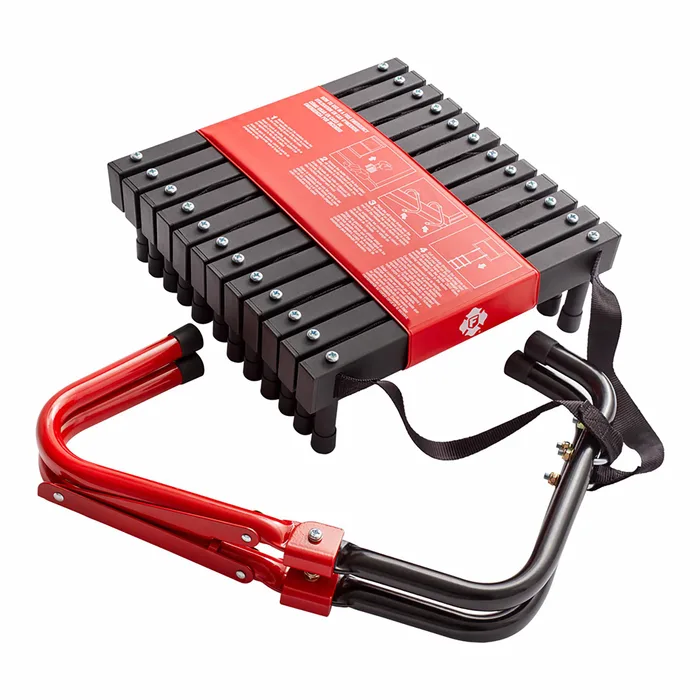
A 14 foot steel and nylon ladder with a stabilizer on every rung, repackable so you can rehearse, and cheap enough to put one in each upstairs bedroom.
Best for: A two storey house with conventional double hung windows where you want a ladder in every upstairs bedroom rather than one good one.
- Every rung carries a steel stabilizer that holds the ladder off the wall, so there is room for your hands and the toes of your shoes on the way down.
- First Alert's manual shows how to repack the ladder into its box, so a family drill does not consume the product.
- The published rated load is 375 lb, the highest single person figure of the portable ladders here, and the manual states the ladder is designed for use by one person at a time.
- The user manual states compliance with ASTM F 2175-02, three editions behind the current F2175-23.
- The sill window is narrow: First Alert specifies windowsills between 6 and 10 inches, which excludes both thin modern sills and deep masonry ones.
- The manual also requires a window opening of at least 20 inches wide by 32 inches high and warns against storm windows, which quietly rules out a lot of older houses.
- It folds rather than staying rigid, and the manual tells you to store it in its original box to stop it tangling, which is not how most people store it.
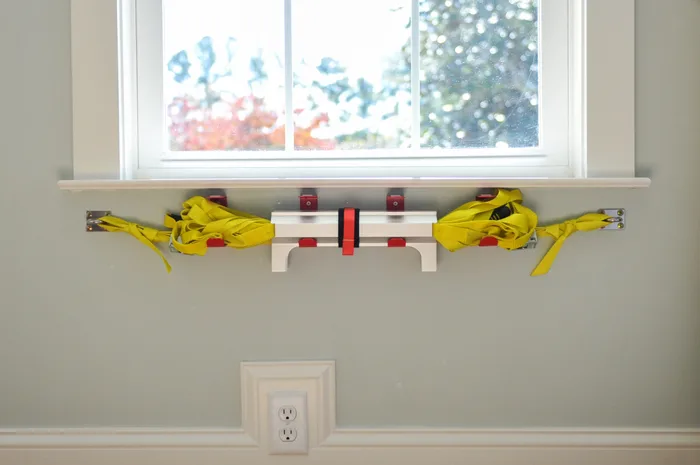
A ladder bolted to the studs under your bedroom window, so in the dark there is nothing to find, unfold, or hook onto anything.
Best for: A homeowner with a single or double hung bedroom window who would rather solve the problem once in the wall than trust a box under the bed.
- It is anchored to the jack and king studs beside the window rather than balanced on the sill, which removes the single most common failure point of a portable ladder.
- Rescue Ready publishes engineered standoffs, anti slip rungs, and an adjustable first rung height, and states the 2 story unit is roughly 13.5 feet and suits windows up to 15 feet off the ground.
- Because it stays rigged in place, a family drill does not mean unpacking and repacking anything.
- It is a permanent installation anchored into structure, so renters are out and every window you want covered is a separate purchase and a separate install.
- The company's own FAQ rules out slider windows, because the opening would sit off to one side of the installed ladder, and rules out double and triple window units that have no structural stud between them.
- Rescue Ready publishes a test figure of 750 lb but no per person rated load, so you cannot compare it directly against the 333 lb and 375 lb ratings on the portable ladders.
- Ordering runs through phone and email rather than a checkout, and the site's product page and FAQ disagree about whether a 3 story version is shipping or still in design.
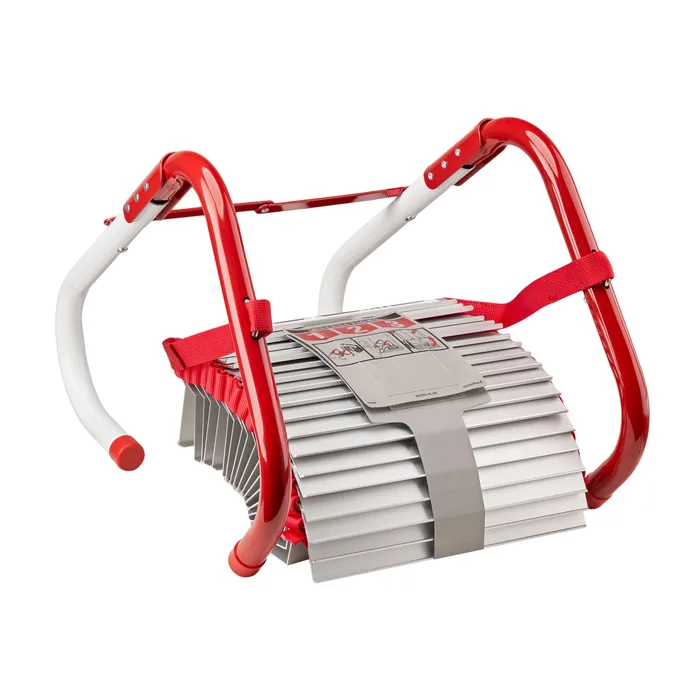
A widely sold escape ladder is, by Kidde's own printed instruction, a single use product you are told not to deploy during practice.
Best for: Almost nobody as a primary ladder, though a household that already owns a ladder it practices with could keep one as a spare in a rarely used room.
- It extends 13 feet, hooks over the sill with no tools, and Kidde states it is load tested to 1000 lb.
- Kidde publishes real window numbers: compatible with 5.5 to 11 inch sills, minimum window width 16 inches, ladder width 12.25 inches.
- It folds flat enough to sit under a bed or on a closet shelf, and Kidde's manual tells you to store it near the window it is for.
- The owner's manual states the ladder is designed for one time use only, that it should be discarded after a single use, and that repeat use could result in severe injury or death.
- The same manual instructs you not to pull the release strap during practice, so you can rehearse hooking it to the sill and nothing else. NFPA's escape planning guidance asks you to practice setting up the ladder from a first floor window.
- Neither the Kidde product page nor the owner's manual makes any ASTM F2175 claim, while all three of the other ladders here do.
- The 1000 lb figure is a cumulative limit and a test result, not a per person rating, so there is no published number telling you what one adult carrying a child is allowed to weigh.
| Criteria | X-IT Escape Ladder, 2 Story Top pick | Two-Story Fire Escape Ladder, 14 Feet | RetroFit Fire Escape Ladder, 2 Story | 2-Story Fire Escape Ladder KL-2S |
|---|---|---|---|---|
| Verdict | Buy it | Buy it | It depends | Skip it |
| Best for | The buyer who accepts that an untested escape ladder is a guess, and wants one they are allowed to rehearse with. | A two storey house with conventional double hung windows where you want a ladder in every upstairs bedroom rather than one good one. | A homeowner with a single or double hung bedroom window who would rather solve the problem once in the wall than trust a box under the bed. | Almost nobody as a primary ladder, though a household that already owns a ladder it practices with could keep one as a spare in a rarely used room. |
| Price tier | $$$ · premium | $$ · mid-range | $$$ · premium | $ · budget |
| Deployed length | 13 ft (2 story) | 14 ft | About 13.5 ft | 13 ft |
| Published rated load | 333 lb, one person at a time | 375 lb, one person at a time | Tested to 750 lb, no per person rating published | No user rating; 1000 lb cumulative limit |
| Reusable, so you can practice descending | Yes, repack instructions and video supplied | Yes, manual shows how to repack it | Yes, stays rigged in the wall | No, one time use only per the manual |
| Window fit | Any sill the hooks can reach the wall structure under | Sill 6 to 10 in, opening at least 20 x 32 in | Single or double hung, or single casement; not sliders or multi window units | Sill 5.5 to 11 in, minimum opening width 16 in |
| Stand-offs | Yes, on the steps | Steel stabilizer on every rung | Engineered standoffs | Not published |
| ASTM F2175 claim | Exceeds F2175, self declared; site posts the 2015 reapproval | Manual states compliance with F2175-02 | Meets and exceeds F2175, self declared | No ASTM claim on the page or in the manual |
| Weight to carry to the window | 6 lb (2 story) | Folds for storage; weight not published by First Alert | Nothing to carry, permanently mounted | Not published by Kidde |
| Installation required | None, hooks over the sill | None, hooks over the sill | Yes, anchored to the studs beside the window | None, hooks over the sill |
Which one is right for you?
- The buyer who accepts that an untested escape ladder is a guess, and wants one they are allowed to rehearse with. Buy it X-IT Products X-IT Escape Ladder, 2 Story
- A two storey house with conventional double hung windows where you want a ladder in every upstairs bedroom rather than one good one. Buy it First Alert Two-Story Fire Escape Ladder, 14 Feet
- A homeowner with a single or double hung bedroom window who would rather solve the problem once in the wall than trust a box under the bed. It depends Rescue Ready RetroFit Fire Escape Ladder, 2 Story
- Almost nobody as a primary ladder, though a household that already owns a ladder it practices with could keep one as a spare in a rarely used room. Skip it Kidde 2-Story Fire Escape Ladder KL-2S
How we judged the field
Five things decide whether an escape ladder works, and none of them is the picture on the box. First, can you practice with it, because a ladder nobody has ever hung on a real sill is a guess about your own house. Second, the published rated load, which is almost always a one person figure and is almost always lower than the big number in the marketing. Third, whether the hooks fit your sill, since every maker publishes a minimum and a maximum thickness and a lot of houses fall outside both. Fourth, stand-offs, because a ladder lying flat against siding leaves nowhere for your fingers or the front of your shoe, and climbing down one is genuinely hard in the dark with adrenaline running. Fifth, whether the ladder can be carried to the window and hung there by the person who will actually be in that room, which is often a child or an older adult rather than the person who bought it.
The field splits on one line: reusable or not. There is a single American standard, ASTM F2175, currently in its 2023 edition and the only active standard under ASTM’s fire ladders subcommittee, and its requirement list covers static loads, rung strength, deployment weight and time, standoff, rated load and heat aging. It says nothing about repeat use, and there is no third party certification program behind it, so a manufacturer can meet the standard with a ladder that is destroyed the first time it is deployed. That is not a hypothetical. We picked two reusable portables at different prices, one permanently installed ladder for people who would rather solve it in the wall, and the single use ladder, because the gap between what that last one promises and what its own manual permits is the most useful thing in this category.
X-IT Products X-IT Escape Ladder, 2 Story
Buy itX-IT wins on the criterion that matters most and loses on the one buyers stare at. Its instruction sheet does something no other manual here does: it advises practice, gives you two ways to do it safely, tells you to deploy the ladder from the intended window and climb up a step from the ground, and then walks you through repacking it with stand-offs facing up and the webbing folded between the rungs. There is a repack video to match. The 2 story version is 13 feet deployed and 6 lb in the hand, which is the difference between a teenager getting it onto the sill and a teenager dropping it. X-IT also declines to publish a sill thickness range, stating instead that the ladder works on any sill that lets it attach securely to the wall structure underneath. Now the catch: the site leads with a 1,000 lb test figure, but the instruction sheet rates the ladder at 333 lb for one person at a time and says not to exceed that. That is the lowest published rating of the four, and you should know it before you buy rather than after. For the household that accepts an untested ladder is a guess, this is still the one.
First Alert Two-Story Fire Escape Ladder, 14 Feet
Buy itThe First Alert Two-Story is the ladder to buy when you need three of them rather than one. It is 14 feet, steel rungs on nylon strapping, with a steel stabilizer on every single rung rather than every few, which is the detail that gets your knuckles and the balls of your feet away from the siding. First Alert’s manual shows how to repack the ladder into its box, so a family drill costs you nothing but an afternoon, and the manual gives a clean 375 lb rating with an explicit one person at a time instruction. The window requirements are where it gets picky. The manual wants a sill between 6 and 10 inches and an opening of at least 20 by 32 inches, and it warns against storm windows and anything the ladder cannot clear. It also still cites ASTM F 2175-02 as the edition it complies with, which is three revisions behind the current F2175-23, and while the underlying design has not obviously changed, it is a fair thing to notice on a life safety product. Measure the sill first; if it fits, this is the sensible workhorse.
Rescue Ready RetroFit Fire Escape Ladder, 2 Story
It dependsRescue Ready’s RetroFit answers a different question: what if there were nothing to find. The ladder is anchored to the jack and king studs beside the window and lives behind a plywood cover made to match your trim, so in a smoke filled room there is no box to locate, no folding, and no hooking anything over a sill you cannot see. The 2 story unit is roughly 13.5 feet and is specified for windows up to 15 feet off the ground, built from 5052 aluminum and polyester webbing, with engineered standoffs, anti slip rungs and an adjustable first rung height. Rescue Ready publishes a test figure of 750 lb and states the product meets and exceeds ASTM F2175. The trade-off is total commitment. It is permanent, so renters are excluded; each window is a separate purchase and install; and the company’s own FAQ rules out slider windows, because the opening ends up beside the ladder, and double or triple window units, which usually have no structural stud between them. Ordering runs by phone and email. For an owner solving one bedroom properly, it is a genuinely strong answer.
Kidde 2-Story Fire Escape Ladder KL-2S
Skip itThe Kidde 2-Story is a competent object undone by one line in its own manual. It extends 13 feet, needs no tools, is load tested to 1000 lb, and Kidde publishes better window numbers than most: compatible with 5.5 to 11 inch sills, a 16 inch minimum opening width, and a ladder 12.25 inches wide. Then the owner’s manual for the KL-2S states in capitals that the ladder is designed for one time use only, should be discarded after a single use, and that repeat use could result in severe injury or death, and it separately instructs you not to pull the release strap during practice. So the rehearsal you are allowed is hooking it on the sill and putting it away. Set that against NFPA’s guidance to practice setting up the ladder from a first floor window and you have a ladder that cannot be part of a properly rehearsed escape plan. Neither the product page nor the manual claims ASTM F2175 at all, which is conspicuous when the other three do, and the 1000 lb figure is a cumulative test result rather than a per person rating. Reasonable as a spare in a rarely used room; a poor choice as the ladder your family is counting on.
Sources
Specs in this review come from these pages.
- ASTM F2175-23, Standard Specification for Portable and Permanent Emergency Escape Ladders for Residential Use (store.astm.org)
- ASTM Subcommittee F15.47 on Fire Ladders, standards under its jurisdiction (astm.org)
- NFPA, How to make a home fire escape plan (nfpa.org)
- Kidde Escape Ladder Owner's Manual, models KL-2S and KL-3S (shareddocs.com)
- First Alert EL52 nylon/steel fire escape ladder user's manual (firstalertstore.com)
- Rescue Ready RetroFit fire escape ladder product page and FAQ (berescueready.com)
X-IT Products X-IT Escape Ladder, 2 Story vs First Alert Two-Story Fire Escape Ladder, 14 Feet: which should you buy?
Both buy picks are reusable, which is the whole reason they are here, and the choice between them is a question about your house rather than about the ladders. X-IT is lighter, is rated by its maker to work with any sill it can reach the structure under, and comes with the clearest practice and repacking instructions in the category. First Alert is the one with the higher published single person rating at 375 lb against X-IT’s 333 lb, and it puts a steel stabilizer on every rung. If you have one upstairs bedroom that matters, buy the X-IT and spend a Saturday learning it.
If you have three, the arithmetic changes. NFPA’s escape planning guidance is built around every family member being able to get out of a second floor room, and a single excellent ladder in the wrong bedroom is worth nothing at two in the morning. Three First Alerts, one per upstairs bedroom, will protect a family better than one premium ladder in the master. The condition is the sill: measure from the inside face of the wall to the outside face, and if the number falls outside 6 to 10 inches, the First Alert is off the table regardless of price and you should be looking at X-IT or a permanently anchored ladder instead. Whichever you buy, deploy it once from a ground floor window with an adult spotting, then repack it. That single afternoon is worth more than any spec on this page.
What to look for
- Reusable, in writing: the maker should describe how to repack the ladder after a practice deployment, because a ladder rated for one use can never be rehearsed and NFPA’s guidance asks you to rehearse.
- The rated load, not the test load: X-IT tests to 1,000 lb but rates the ladder at 333 lb for one person, and First Alert rates at 375 lb for one person, so look for the word ‘rated’ and assume one person at a time.
- Your sill thickness, measured before you order: published ranges have a minimum as well as a maximum, 5.5 to 11 inches for Kidde and 6 to 10 inches for the First Alert two storey, and a thin sill fails just as surely as a thick one.
- Stand-offs on the rungs, not just at the top: a ladder pressed flat against siding leaves no room for fingers or the front of a shoe, and every rung with a stabilizer is one more rung you can grip properly on the way down.
- Your window type: casements that crank outward, sliders that open sideways, security grilles and fixed storm sashes each defeat a different ladder, and Rescue Ready’s FAQ rules out sliders and multi window units explicitly.
- Who has to carry it: deployment weight is an ASTM F2175 requirement for a reason, so check the published weight against the person who will actually be in that room at night rather than the person buying the ladder.
Our final take
Escape ladders are sold on price and bought on hope, and the result is a lot of American bedrooms containing a sealed box nobody has ever opened. The single most useful thing you can do is buy a ladder you are permitted to deploy, then deploy it once from a ground floor window with someone spotting you, and repack it. That afternoon will teach you more about your own house than any specification: whether the sill is the right thickness, whether the sash opens far enough, whether the ladder clears the gutter, whether the person who sleeps in that room can lift it. Everything else is secondary. Measure the sill before you order, put a ladder in every sleeping room above the main floor rather than one good ladder in the master, and treat any product whose manual forbids a full practice deployment as a spare rather than a plan.
Questions, answered
Is ASTM F2175 a certification, and does anyone check it?
It is a voluntary consensus specification, not a certification. The current edition is ASTM F2175-23, Standard Specification for Portable and Permanent Emergency Escape Ladders for Residential Use, listed as active with a last update of December 19, 2023, and it is the only active standard under ASTM subcommittee F15.47 on Fire Ladders. Its published requirement list covers vertical and horizontal static load, rung and step strength and shear, deployment weight and deployment time, hook or attachment stability, standoff, rated load, heat deflection temperature, stress relief, and heat aging. Nothing in the standard requires an outside laboratory to sign off, and ASTM's own certification affiliate runs more than 75 certification programs covering fire and emergency services, sports, law enforcement, and industrial safety without listing an escape ladder program among them. So when a box says it meets F2175, that is the manufacturer's declaration and you are trusting the brand, not an inspector.
Why are so many escape ladders single use, and does it matter?
It matters enormously, because it makes practice impossible. Kidde's owner's manual for the KL-2S and KL-3S states the ladder is designed for one time use only, should be discarded after a single use, and that repeat use could result in severe injury or death. The reason Kidde gives is that the ladder is carefully assembled to deploy without tangling, and once the release strap is pulled it cannot be refolded the same way. The knock on effect is in the same manual: it tells you to practice mounting the ladder on the sill but explicitly not to pull the release strap. NFPA's escape planning guidance, meanwhile, tells you to practice setting up the ladder from a first floor window so you can do it correctly and quickly. A ladder that self destructs on first deployment cannot satisfy that, which is the single strongest reason to pay more for a reusable one.
Is the weight rating per person or for everyone on the ladder?
Read the manual, because the number on the box is usually not the number you are allowed to hang on it. X-IT's instruction sheet is unusually blunt: the ladder is rated for 333 lb and designed for use by one person at a time, and although X-IT tests to 1,000 lb, the sheet says not to apply a total load above the 333 lb rated load. First Alert's EL52 manual gives a 375 lb ladder load rating and states the ladder is designed for use by one person at a time. Kidde publishes a 1000 lb load test figure and a warning in the manual not to exceed 1000 lb cumulative load, but no per person rating at all. None of these ladders publishes a figure that contemplates two adults descending together, so plan on going one at a time, and note that Kidde's manual asks the parent to descend first to stabilise the ladder for children and older adults following behind.
How do I know the hooks will fit my window?
Measure the sill from the inside face of the wall to the outside face before you buy anything, because this is the most common real world failure and the ranges are narrower than people expect. First Alert specifies windowsills between 6 and 10 inches for the 14 foot two storey ladder. Kidde specifies 5.5 to 11 inches, with a minimum window opening width of 16 inches. Note that both have a minimum as well as a maximum, so a thin sill is as much of a problem as a thick one. Casement windows that crank outward, sliders that open to one side, and any window with a security grille or a fixed storm sash are separate problems again: Rescue Ready's FAQ rules out sliders outright because the opening ends up beside the ladder rather than above it.
Can a child or an older adult actually deploy one of these?
Treat that as something you test, not something you assume, and note that ASTM F2175's requirement list includes both deployment weight and deployment time for exactly this reason. Weight is the first hurdle: X-IT publishes 6 lb for its 2 story ladder, and the difference between that and a heavier chain style ladder is the difference between a ten year old sliding it onto the sill and a ten year old dropping it. Kidde's manual states the ladder is not a toy and should not be used by children unless supervised by an adult, and X-IT's says the same about instruction and supervision. NFPA's guidance is the practical answer: practice setting the ladder up from a first floor window, and let children practice only with a grown up and only from a first storey window. A permanently rigged ladder like the Rescue Ready sidesteps the carrying problem entirely, which is a real argument for it in a room used by someone who could not lift a box in the dark.
Deciding between the top two? See our head-to-head: X-IT Products X-IT Escape Ladder, 2 Story vs First Alert Two-Story Fire Escape Ladder, 14 Feet.
More Health & Wellness reviews
 The Best Essential Oil Diffusers for Home: 4 Compared (and One to Skip)
  The Best Eye Wash Stations: 4 Compared (and One to Skip)
  The Best Fire Extinguishers: 4 Compared (and One to Skip)
  The Best First Aid Kits: 4 Compared (and One to Skip)
  The Best Foot Massagers: 4 Compared (and One to Skip)
  The Best Foot Spas: 4 Compared (and One to Skip)