Explained
Earbud Tips, Explained
After reading, you'll understand which measurement decides whether a tip fits your earphones, why the seal controls how much bass you hear, and what you are actually giving up when you choose foam over silicone.
In this guide
Almost everyone buys ear tips the same way: they pick a size, it does not feel right, and they conclude the earphones are the problem. The part that gets missed is that a tip has two separate fits to satisfy, one against your earphone and one against your ear, and they are described by completely different numbers. Makers do not help by using inconsistent names for the same measurement. Once you know which number is which, buying tips stops being guesswork.
The 30-second version
- The seal controls the bass, so thin-sounding earbuds are usually a fit problem rather than a driver problem.
- Nozzle diameter decides compatibility, and it is measured on your earphone, not on your ear.
- Foam isolates more than silicone, because it expands to fill the canal instead of pressing against it at a fixed diameter.
- Foam is a consumable, and one of the few makers who publish a figure puts a pair at roughly two to three months.
- Insertion depth is a second variable, and changing it shifts the treble as well as the bass, independently of which size you chose.
The products this guide is about
Our verdict on each, with the full reasoning on the companion review.
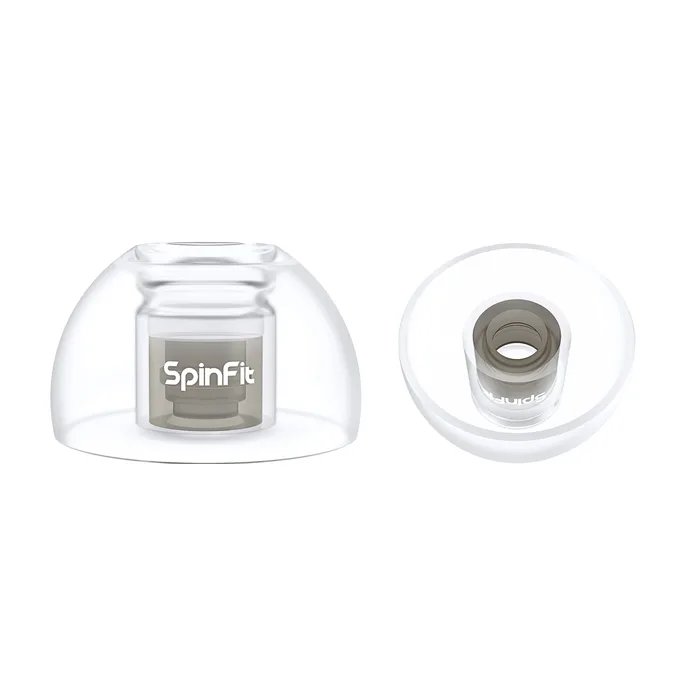
- Buy SpinFit OMNI Publishes its nozzle fit in millimetres, 4.0 to 5.5 mm, and comes in six sizes that suit both true wireless earbuds and wired IEMs.
- Buy final Type E Five sizes of two-hardness silicone, with a case and a thin-nozzle adapter in the box, from a maker that explains on its own product page why the seal changes the bass. Amazon
- It depends Dekoni Audio Mercury Bulletz 4.9 mm Memory foam that puts its bore size, 4.9 mm, in the product name, so you can check compatibility before you spend anything. Amazon
- Skip Comply 500 Core Series Memory Foam Ear Tips Good foam, but Comply's own FAQ puts a pair at roughly two to three months and the company publishes no nozzle diameter you can check against your earphones. Amazon
What actually matters
- Nozzle diameter - this is the outside width of the tube on your earphone that the tip grips. It is the single specification that determines whether a tip will stay attached, and it varies enough between earphone models that a tip which fits one pair perfectly can be dangerously loose on another.
- Tip size - S, M, L and the rest describe the dome that touches your ear canal, not the nozzle. Ear canals differ between people and between your own left and right ears, so it is normal and correct to run two different sizes.
- Acoustic seal - the completeness of the closure between the tip and your ear canal. Apple states on its own support page that when the fit is right, noise cancellation improves and music has a rich bass sound, and final's product page explains the mechanism, that low-frequency sound pressure drops when air leaks past the tip.
- Material family - silicone, memory foam, and shaped variants such as double-flange. Silicone is durable and cheap, foam isolates more and wears out, and the shaped designs try to buy comfort or a specific acoustic effect with geometry.
- Isolation - how much outside noise the tip blocks passively, before any electronics get involved. Foam wins here because it expands into the shape of your canal, which closes gaps a fixed-diameter silicone dome leaves open.
- Service life - how long a pair stays usable. Comply's FAQ gives an average of roughly two to three months per pair and tells you to replace tips when they flake, tear, or stop expanding slowly, while most silicone makers publish nothing because silicone typically lasts until it splits.
- Insertion depth - how far into the canal the tip sits. final's own page describes how a deeper fit shortens the distance to the eardrum and moves the closed-tube resonance, which raises perceived bass and softens treble, so depth is a tuning control and not just a comfort setting.
The specs, in plain English
Green flags vs red flags
Green flags
- The maker publishes a nozzle diameter or fit range in millimetres rather than only a list of compatible earphones.
- Four or more sizes are offered, ideally including something smaller than a typical small.
- An assortment pack exists so you can find your size before committing to one.
- The stem is described as a different, harder material or has grooves, both of which improve grip on the nozzle.
- The maker states a replacement interval, or at least tells you which physical signs mean a tip is finished.
Red flags
- Compatibility is described only as universal, with no diameter and no model list.
- Only one or two sizes are available, which usually means the maker has not thought hard about fit.
- A foam tip with no stated bore size, since foam is the family where a wrong-sized stem is hardest to notice until it fails.
- Listings that quote a noise reduction figure in decibels without saying how or where it was measured.
- Packs sold in a single size only, when you have not yet confirmed which size seals for you.
Who's who: the brands
- SpinFit - Maker known for a swivelling stem design and for publishing nozzle fit ranges in millimetres for its tips.
- final - Japanese earphone maker whose Type E tips are widely used as an aftermarket upgrade, and whose product pages explain the acoustics of fit in unusual detail.
- Comply - The best-known memory foam tip brand, organised around core-series numbers and a per-earphone compatibility finder rather than published diameters.
- Dekoni Audio - Maker of memory foam Bulletz tips and headphone earpads, which labels its tip lines by bore size such as 4.9 mm and 3 mm.
- Victor (JVC) - Japanese maker of the Spiral Dot silicone tip family, which uses a dotted internal surface and sells in five sizes including intermediate MS and ML steps.
How to read a listing without getting fooled
Start at the bottom of the listing, not the top. Find the nozzle diameter or bore figure, and if there is not one, find the compatibility list and check whether your exact earphone model appears on it; if neither exists, treat the listing as untested for your gear. Next, count the sizes and check whether the pack you are looking at contains one size or an assortment, because product pages frequently show an assortment in the photo and default the dropdown to a single size. Then check the material description for the word foam, since foam listings should also tell you something about lifespan or replacement, and a foam listing that says nothing about wear is leaving out the most important ownership fact. Finally, ignore any comparative sound claim that is not tied to a mechanism you can picture, such as a harder stem for grip or a lower dome to shorten the distance to the eardrum.
How much should you spend?
This is a category where budget genuinely works. A budget set of silicone tips from a reputable maker will typically include four or five sizes and often a carrying case, and for most people that is the entire solution. Mid-range silicone buys you published fit specifications, better stem grip, and design features like a swivelling dome, all of which are worth paying for if you own several earphones or if a cheap set has already failed you. Memory foam spans budget to mid-range, and the important thing is that the sticker figure is misleading, because you are buying a consumable: a mid-range foam pack replaced four times a year costs meaningfully more over two years than a mid-range silicone set you buy once. Premium tips exist, mostly premium silicone with unusual geometry or materials, and they are a refinement rather than a fix. If your earbuds sound thin, the budget tier solves that; the higher tiers are about comfort, grip and small acoustic preferences.
Questions, answered
Can I use tips from one brand on a different brand of earphone?
Usually yes, as long as the nozzle diameter matches. Aftermarket tips are made to fit the common nozzle sizes rather than any one brand's earphones, which is the whole reason the category exists. The exception is earbuds with proprietary tip mounts, where the tip clips or twists on rather than sliding over a plain tube, and those need a tip made specifically for that model.
Is it normal to need different sizes in each ear?
Yes, and it is more common than people expect. Ear canals are not symmetrical, and final's own sizing guidance suggests that changing size and mounting position between left and right may give a better result. If one side keeps working loose or sounds thinner than the other, try moving that ear up or down a size before you assume the earphone is faulty.
Do textured or patterned tip interiors actually change the sound?
Makers say they do, and they describe a mechanism rather than just asserting a benefit. Victor's Spiral Dot design arranges dots on the inner wall of the tip, which the company says diffuses reflections inside the tip and balances them against the direct sound. Whether you can hear the difference is another question, and no maker in this category publishes measurement data you can independently check, so treat these claims as plausible rather than proven.
How should I clean ear tips?
Silicone tips can be pulled off the earphone and washed in warm water with a little mild soap, then dried completely before you put them back on, which is a practical advantage silicone has over foam. Memory foam needs more care: Comply's FAQ says to rinse its foam tips in warm water, squeeze them with a soft cloth and air dry them, never to use soap, detergent or alcohol cleaners because they break down the foam, and that excessive cleaning shortens their life. Replace foam tips when they stop expanding properly. Always remove tips from the earphone before cleaning so no water gets into the nozzle. If you notice persistent irritation or discomfort, stop using them and speak to a healthcare professional.
Or jump to the head-to-head: SpinFit OMNI vs final Type E.