Explained
Electronic Drum Kits, Explained
After reading, you'll understand what each line of an electronic drum kit spec sheet means and which ones decide how the kit feels to play.
In this guide
First-time buyers tend to compare electronic kits by the number of sounds in the module, which is the least important number on the box. What you hit every day matters more: the pad surface, the pad size, the kick and the hi-hat. Many kits also leave out parts you need, such as the kick pedal or throne, so the box price is not the full price. This guide explains the jargon so you can compare kits on the things that matter.
The 30-second version
- Pads matter more than sounds, because you feel the surface every time you play and the sound library is easy to change later.
- Mesh is the quiet option, and rubber pads are firmer and louder under the stick.
- The kick design trains your foot, so a kick pad or tower struck by a beater is better practice than a pedal with a built-in pad.
- USB audio and USB MIDI are different, and only USB audio lets you record the kit's own sounds straight into a computer.
- Check what is not in the box, since thrones, pedals, headphones and mats are often sold separately.
The products this guide is about
Our verdict on each, with the full reasoning on the companion review.
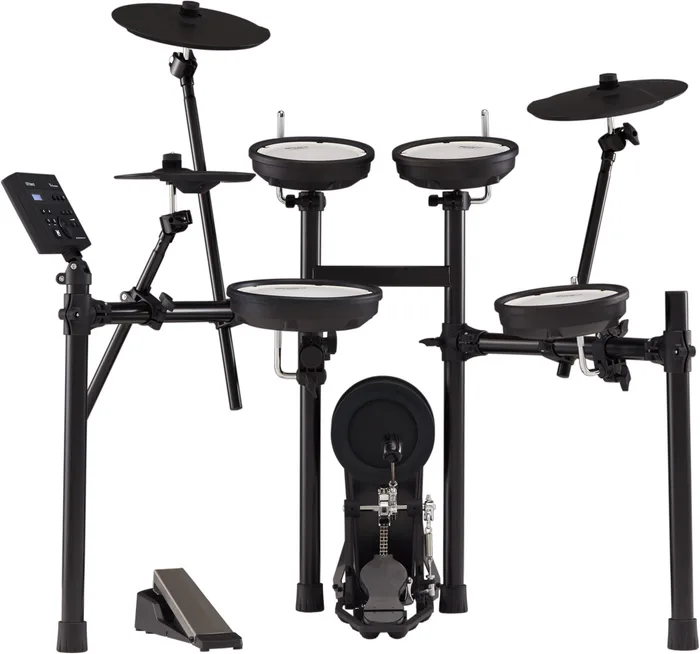
- Buy Roland TD-07KV A compact V-Drums kit with double-ply mesh heads, 12-inch crash and ride, a KD-10 kick pad and a module that records over USB.
- Buy Alesis Nitro Max An eight-piece mesh kit with a 10-inch dual-zone snare, a kick tower with pedal, Bluetooth audio and 32 BFD-sourced kits.
- It depends Yamaha DTX6K2-X A larger kit with a 3-zone TCS snare, two 13-inch crashes, a 13-inch ride and a 13-inch hi-hat on a real HS650A stand.
- Skip Simmons Titan 20 A budget mesh kit with good connectivity, let down by a small kit library and a kick pedal with a built-in pad instead of a tower.
What actually matters
- Pad surface - Mesh, silicone and rubber each feel different and make different amounts of stick noise. Mesh is the most common choice for home practice because it is quieter and has a more natural rebound.
- Snare size and zones - The snare is the drum you hit most, so a larger pad is easier to play accurately. A dual-zone or three-zone snare lets you practise rimshots and cross-sticks.
- Kick design - A kick pad or tower struck by a beater mimics an acoustic bass drum. Pedals with an integrated pad are compact but feel different and may not suit a double pedal.
- Cymbal size and choke - Larger cymbals swing and respond more like real ones. Choke lets you grab a cymbal to stop it, a basic technique on an acoustic kit.
- Hi-hat type - Most budget kits use a fixed pad plus a foot controller. A pad mounted on a real hi-hat stand moves like an acoustic hi-hat and feels more natural under the foot.
- Module features - Kit count, user slots, practice coaching and play-along tracks matter for learning. Sample import and recording matter more for experienced players.
- Connections - Bluetooth audio lets you play along with a phone, and USB audio lets you record into a computer. Check the headphone jack size if you own studio headphones.
The specs, in plain English
Green flags vs red flags
Green flags
- Mesh or silicone heads on every drum, not just the snare
- A dual-zone snare of 8 inches or larger
- A kick pad or tower struck by a beater
- Cymbals of 12 inches or more with choke listed
- USB audio and MIDI clearly stated in the spec
Red flags
- Rubber pads on the snare for a player who shares walls
- A kick pedal with a built-in pad and no tower
- Only one or two user kit slots
- No choke listed on the crash cymbal
- A spec sheet that does not say what is and is not in the box
Who's who: the brands
- Roland - Maker of the V-Drums range, known for tension-adjustable mesh heads and well-regarded modules from entry to pro level.
- Yamaha - Makes the DTX range, with its own TCS silicone pads and modules that emphasise sample import and recorded acoustic kits.
- Alesis - Focuses on budget and mid-range mesh kits that come complete, with sounds from the BFD library on the Nitro Max.
- Simmons - A long-running electronic drum name now aimed at budget and mid-range kits with app-based practice features.
How to read a listing without getting fooled
Start with the kit configuration list, not the headline features. Look at each pad in turn: surface (mesh, silicone or rubber), size in inches, and number of zones. Then read the kick line closely, since it tells you whether you get a pad or tower and whether a pedal is included. Check the cymbal sizes and whether choke is listed for the crash and ride. In the module section, look for preset and user kit counts and practice tools, then read the connectors: headphone jack size, Bluetooth audio or MIDI, and whether USB carries audio. Finally, find the footnotes. Roland, for example, uses a footnote to say the kick pedal and throne are not included.
How much should you spend?
Budget kits typically give you mesh drums, 10-inch cymbals and a basic hi-hat controller, and many include a kick pedal so you can start right away. Mid-range kits improve the pads and module, add larger cymbals with choke and better hi-hat sensing, and often add USB audio, but may leave out the pedal and throne. Premium kits add bigger three-zone cymbals, real hi-hat stands, larger toms and deeper modules with sample import. Price the complete setup, including throne, pedal and headphones, before comparing tiers.
Questions, answered
Is an electronic kit good for learning before buying an acoustic kit?
Yes, if the kit has a proper kick pad or tower and a hi-hat controller that senses position. Those two parts train your feet the way an acoustic kit does. Mesh pads give a rebound closer to a real drumhead. A kit with a pedal that has a built-in pad teaches less about real kick technique.
What headphones should I use with an electronic drum kit?
Closed-back headphones are the usual choice because they block outside sound and keep the drum sounds from leaking out. Check the module's headphone jack size first. Some kits use a 3.5 mm mini jack and others a full-size 6.3 mm jack, so you may need an adapter.
Do I need a drum mat?
A mat stops the kit from sliding and protects the floor, and some makers sell one as an option. A thick rug works too. If you live above someone, a mat or riser under the kick and hi-hat also reduces impact noise through the floor.
How much space does an electronic kit need?
Makers usually list dimensions or an average footprint. Compact kits fit in roughly a square metre and a bit, while larger kits with real hi-hat stands need more. Allow extra room for the throne and for getting on and off the kit.
Or jump to the head-to-head: Roland TD-07KV vs Alesis Nitro Max.