Explained
Dry Bags, Explained
You will be able to look at any dry bag listing and know whether it survives rain, a dunk, or a full capsize, and what you are giving up in weight to get there.
In this guide
Dry bags look nearly identical on a shelf and behave completely differently in a swamped boat. The three things that separate them are how the bag closes, how the seams are joined, and how heavy the fabric is, and almost none of that is obvious from the product photo. The other half of the problem is that the most common failure is not the bag at all: it is a roll-top that was not rolled enough times.
The 30-second version
- Three full rolls, every time. Flatten the opening so both sides lie together without wrinkles, press the air out, roll down three complete turns, then clip the buckle snug. Two rolls looks closed and leaks under pressure, and most reports of a dry bag failing trace back to a short or crooked roll rather than a defect.
- Welded seams are the real waterproof spec. Welding fuses the coating with no needle holes at all. Stitched and taped seams put tape over thread holes, and tape is what ages first. For rain and short dunks, taped is fine. For a bag pinned underwater, buy welded.
- Splash resistant and submersible are different products sold under the same word. Nearly everything is marketed as waterproof. Only a welded, airtight-closure bag is rated to be held under water and stay sealed, and the listing will usually say so in the construction details rather than the headline.
- Denier is a straight trade against weight. A 30D sack weighs almost nothing and wears through in a season of deck use. A 200D to 420D nylon body handles gravel and rope. A vinyl laminate in the 20 oz range takes years of outfitter abuse and weighs what you would expect.
- Buy a size up from your packing list. Stated volume assumes minimal rolldown, and you lose capacity with every fold. A bag stuffed to the brim physically cannot be rolled three times, which turns a sizing mistake into a sealing failure.
The products this guide is about
Our verdict on each, with the full reasoning on the companion review.
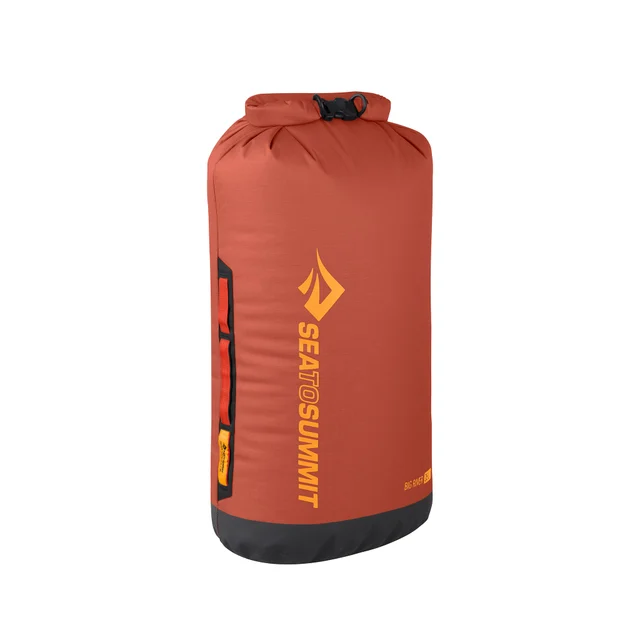
- Buy Sea to Summit Big River Dry Bag The 420D all-rounder that handles deck duty, camp organization and everything between. Amazon
- Buy NRS 65L Bill's Bag Dry Bag The outfitter standard: vinyl laminate heavy enough to outlast the boat it rides in. Amazon
- It depends Watershed Westwater Backpack Welded seams and an airtight zip seal built for submersion, if you accept the upkeep and the price.
- Skip Sea to Summit Ultra-Sil Dry Bag A superb ultralight stuff sack that keeps getting bought as a paddling dry bag, which it is not. Amazon
What actually matters
- Closure type. A roll-top is versatile, repairable and cheap to make, but it depends on you rolling it correctly. An airtight zip seal is more waterproof out of the box and removes user error, but it costs more, needs periodic lubrication, and gets stiff if you neglect it. Some roll-tops add a stiffened fold-down strip that helps the roll lie flat and seal evenly, which is a real improvement.
- Seam construction. Welded or radio frequency welded seams have no stitching to leak through and are what immersion-rated bags use. Double stitched and tape sealed seams handle rain, spray and a swim to shore perfectly well and are cheaper to make in complex shapes. Read the construction spec, not the marketing line.
- Fabric weight and coating. Denier describes thread thickness and is a decent proxy for abrasion resistance. The coating (polyurethane, TPU, silicone or a vinyl laminate) is what actually blocks water. Light silicone-coated fabrics are slippery and pack tiny; heavy laminates are stiff, grippy and nearly indestructible.
- Lash points and handles. Rigging loops, D-rings and low-profile grab handles decide whether the bag stays with the boat when things go wrong. A bag with no attachment points is a bag you can only hold onto, which is not a plan during a capsize.
- Size headroom and shape. Long narrow bags fit under deck lines; short fat ones pack easier and stand up in camp. Either way, plan on losing volume to the rolldown, and prefer one large bag plus a few small ones over a single giant one you have to unpack completely to find a headlamp.
- Repairability. Replaceable buckles, patch kits and a real warranty matter more than one extra waterproof rating. A cracked buckle on day two of a trip is otherwise a dead bag.
- Visibility. A white or light-colored interior makes finding small dark items possible. A bright exterior makes a bag that has floated free findable. Black looks good and works against you on both counts.
The specs, in plain English
Green flags vs red flags
Green flags
- The listing names the seam construction plainly, such as welded, RF welded, or double stitched and tape sealed
- A non-wicking closure strip at the roll-top lip instead of bare nylon
- Replaceable buckles or an available repair kit and patch tape
- Multiple lash loops or D-rings, not just one carry strap
- A size range across the family so you can organize a whole kit in matching bags
- A light or white interior and a visible exterior color
Red flags
- The word waterproof used everywhere with no seam or closure detail anywhere on the page
- Ultralight fabric marketed for boat and deck use, where abrasion will find the pinholes fast
- An IP rating quoted with no explanation of how it was tested, especially on generic listings
- No attachment points at all, which means the bag can only ride loose in the boat
- Photos showing a top rolled once or twice, a tell that the maker is selling looks over sealing
- Zip-seal bags sold with no mention of the lubrication the seal needs
Who's who: the brands
- Sea to Summit - Broad range from ultralight stuff sacks to abrasion-resistant paddling bags, with thoughtful details like field-replaceable buckles and non-wicking roll-tops.
- NRS - The outfitter standard for river gear. Heavy vinyl laminate bags built for rafts, guide abuse and multi-day trips rather than gram counting.
- Watershed - Radio frequency welded construction with an airtight zip seal, marketed at the submersible end of the market and used for whitewater, rescue and camera gear.
- Ortlieb - German maker known for welded waterproof construction, best known in bike touring panniers but with a solid line of roll-top dry bags.
- SealLine - Long-running paddling brand with a range spanning light packing sacks up to heavier boat bags.
- YETI - Premium dry bags with heavy laminates. Overbuilt and heavy, priced accordingly.
How to read a listing without getting fooled
Ignore the headline and go straight to the construction bullets. Find three facts: how it closes, how the seams are joined, and what the fabric is. If the page says waterproof five times but never names the seam type, assume stitched and taped, which means rain and short dunks rather than immersion. Treat any hydrostatic head number as a fabric spec only, since it tells you nothing about the seam or closure where leaks actually happen. Check the stated volume against how you pack, then mentally subtract the rolldown, because a bag advertised at a given volume gives you less once it is sealed properly. Look for attachment points in the photos, not the copy. Then check whether buckles are replaceable and whether repair tape exists for that fabric, because that is what decides whether the bag lasts five years or one bad day. On a marketplace listing with no named brand, an unexplained IP rating and a stock photo, the safest assumption is a splash bag.
How much should you spend?
The value sweet spot is the mid-range nylon roll-top with a coated body, taped seams and lash points. That tier covers kayaking, canoeing, camping and travel, and paying less usually means thinner fabric, a wicking closure lip and a buckle you cannot replace. Stepping up to heavy vinyl laminate is worth it only if the bag will ride in a raft or take repeated load-pile abuse, since you are buying weight along with the toughness. Stepping up again to a welded, airtight-seal bag costs meaningfully more and earns it in exactly one situation: when the contents cannot get wet under any circumstances, such as whitewater paddling, rescue gear, a camera body or a sleeping system on a remote trip. If your worst case is rain on a flatwater lake, that money buys nothing you will use. The cheapest option is worth avoiding entirely for water use, because the failure mode is not a refund, it is a wet phone. And in every tier, buying a family of small and medium bags beats buying one large bag, since organization is what makes a kit usable.
Questions, answered
How many times do I actually need to roll the top?
Three full folds is the minimum and it is the single most important thing you can do. Flatten the opening so the two sides lie together without wrinkles, press the excess air out, roll it down three complete turns, then clip the buckle so the roll is snug rather than loose. Two rolls looks closed and leaks under pressure. Most reports of a dry bag failing trace back to a short or crooked roll rather than a defect in the bag.
What is the difference between waterproof and submersible?
Waterproof usually means the bag keeps out rain, spray and a brief dunk. Submersible means it can be held under water and stay sealed. The difference is seams and closure. Welded or radio frequency welded seams fuse the coating with no needle holes, while stitched and taped seams rely on tape over thread holes. Both get marketed as waterproof, so read the construction spec rather than the headline.
Are welded seams really worth it over stitched and taped?
For immersion, yes. A welded seam has nothing to leak through, which is why expedition and rescue bags use it. Stitched and taped seams are cheaper to make in complex shapes and hold up fine against rain, spray and a swim to shore, but the tape is the only thing between water and the needle holes, and tape is what ages first. If your worst case is a capsize with the bag pinned underwater, buy welded. If it is a rain shower on a lake, taped is plenty.
What denier should I look for?
It depends on where the bag lives. Around 30D is right for a stuff sack inside a backpack, where nothing abrades it. Roughly 200D to 420D nylon is the general-purpose range for paddling, camping and travel, tough enough for decks, gravel and rope. Vinyl laminates quoted in ounces rather than denier are for rafts and guided trips. Higher numbers generally mean more weight and less packability, so buy for the environment, not for the biggest number.
What size dry bag should I buy?
One size larger than your packing list suggests. Stated volume assumes minimal rolldown and you give up capacity with every fold, so a bag filled to the brim cannot be rolled three times. Most paddlers end up with one large bag for a sleeping system and clothing plus two or three small ones for electronics, first aid and food, which also means you are not unpacking everything to find one item.
How do I make a dry bag last?
Rinse salt and grit off, dry it inside out before storage, and store it unrolled so the fabric does not set a permanent crease. Do not leave it packed and compressed for months, keep coated fabrics out of long sun exposure, and patch pinholes early with the manufacturer's repair tape. Zip-seal bags need periodic lubrication with a non-petroleum product, and roll-top buckles are worth replacing at the first crack rather than mid trip.
Or jump to the head-to-head: Sea to Summit Big River Dry Bag vs NRS 65L Bill's Bag Dry Bag.