Explained
Electric Coolers, Explained
After reading, you'll know what power draw means for your battery, whether you need dual zones, and which specifications makers most often leave out.
In this guide
An electric cooler is a small refrigerator built to run from a vehicle's 12 volt supply, using the same compressor and refrigerant cycle as the fridge in your kitchen rather than the thermoelectric plates in cheap car coolers. That distinction is the whole category: a compressor cooler makes cold and holds a set temperature; everything else merely slows the warming down.
The 30-second version
- Compressor, not thermoelectric, is what lets a cooler freeze rather than just chill.
- Watts convert into battery life, since 38 to 60 watts at 12 volts is roughly 3 to 5 amps while running.
- Low voltage cutoff is essential, and it is what stops the cooler stranding you.
- Dual zone means a fixed divider, so you trade packing flexibility for a freezer.
- Compressor warranty is the one to read, and it ranges from two to five years on similar products.
The products this guide is about
Our verdict on each, with the full reasoning on the companion review.
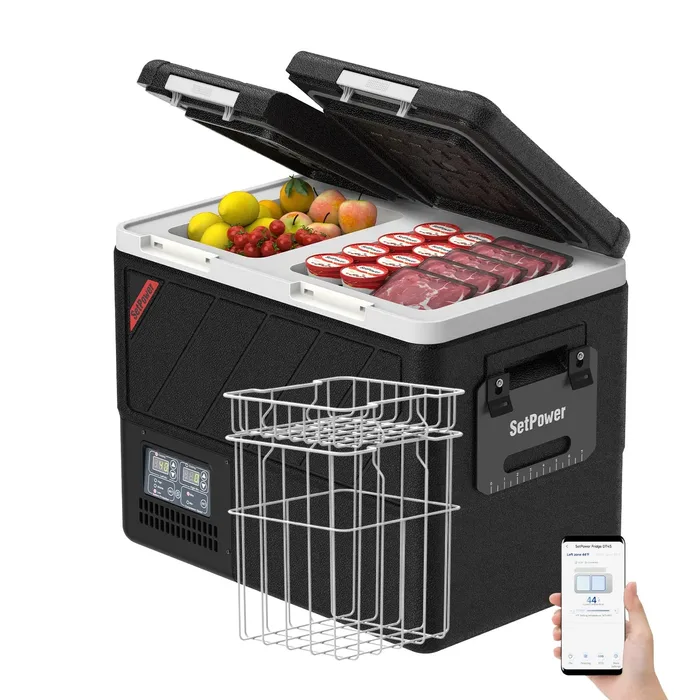
- Buy Setpower DT45 Portable Refrigerator Freezer, 48QT The widest published temperature range, the lowest power draw and the lowest noise figure here.
- Buy BougeRV CRD2 V2.0 52QT Dual Zone The one that tells you its dimensions, in three capacity units, with a solar kit option.
- It depends ICECO VL45ProS 47.5QT Single Zone A Secop compressor with a five-year warranty in a steel case, and only one temperature zone.
- Skip EcoFlow GLACIER Classic 55L The most expensive cooler here, the shortest warranty, and almost no published numbers.
What actually matters
- Temperature range - how cold it goes and how warm it will hold. Minus 4 degrees Fahrenheit is a proper freezer; a range stopping at 0 is marginal for long-term frozen storage.
- Power draw - watts in eco mode and at maximum cooling. Divide by 12 to get amps, which is what your vehicle battery and your solar setup care about.
- Noise - a decibel figure for the compressor running. 35 is unobtrusive in a van; 45 is a household fridge in a quiet room.
- Zones - single zone means one temperature throughout and flexible packing; dual zone means a fridge and a freezer at once behind a fixed divider.
- Compressor brand and warranty - Secop and similar named units carry their own reputation and often a longer warranty. The compressor warranty is usually longer than the unit warranty, and both should be stated.
- Battery protection - a low voltage cutoff, ideally with selectable sensitivity, that shuts the cooler down before the starter battery is too flat to crank.
- Case and fittings - steel or plastic, a drain hole for cleaning, tie-down clips for off-road use, and whether the lid opens from both sides.
The specs, in plain English
Green flags vs red flags
Green flags
- A published temperature range with a minimum, not just a maximum.
- Watts given for both eco and maximum modes.
- A decibel figure for the compressor.
- Compressor warranty stated separately from unit warranty.
- External dimensions and capacity in more than one unit.
Red flags
- No minimum temperature published on a product sold as a freezer.
- Quiet claimed with no decibel figure.
- Efficient claimed with no watt figure.
- No dimensions anywhere on the page.
- A warranty shorter than competitors at twice the price.
Who's who: the brands
- Setpower - Value-focused 12V refrigeration brand publishing full temperature, power and noise figures, with dual-zone models and a 3-year compressor warranty.
- BougeRV - RV and off-grid specialist offering fridges alongside matched batteries and solar kits, and the rare maker that publishes external dimensions.
- ICECO - Known for Secop-equipped coolers in steel cases with five-year compressor warranties, aimed at trucks, overlanding and hard use.
- EcoFlow - Power station company whose GLACIER coolers integrate with its battery and app ecosystem, with detailed insulation and runtime claims but few conventional specs.
- Dometic - The long-established name in mobile refrigeration for RVs and boats, generally the most expensive and the most widely serviced.
How to read a listing without getting fooled
Find the minimum temperature first. If the page only says fridge freezer without a number, treat the freezing claim as unproven, because every maker that can hit minus 4 degrees Fahrenheit says so. Then find the watt figures, ideally for both eco and maximum, and divide by 12 to get the current draw your battery will actually see. Look for a decibel number and assume the worst if there is not one. Read the warranty carefully and separate the compressor term from the unit term, since the two are usually different and the compressor is what matters. Decide on zones by asking whether you need to freeze anything, not by which sounds better. Then check the dimensions against the space you have, which is where a lot of these purchases go wrong, and look for the practical fittings: a drain, tie-downs, a lid that opens from both sides, and a socket on the side the cable can actually reach.
How much should you spend?
Electric coolers cost several times what a good hard cooler does, and the sensible mid-range is where the value sits. At that level you get a dual-zone box in the 45 to 55 quart range with published power and noise figures, app control and a three-year compressor warranty, which is everything most people need. Going cheaper usually means a single zone, an unnamed compressor and no published figures, and at that point an ice cooler may serve you better. The premium tier buys a named compressor such as a Secop, a steel case and a five-year compressor warranty, which is a rational purchase for a work vehicle or a full-time overlanding setup. The flagship tier buys ecosystem integration and design, and is worth it only if you already own the matching power stations. Budget separately for a plug-in battery, which is nearly always extra and is what makes the cooler usable with the engine off.
Questions, answered
Can I run one off a portable power station?
Yes, and it is one of the most common setups. Use the DC output rather than the AC inverter if the power station has one, because running a 12 volt appliance through an inverter and back down wastes a meaningful fraction of the energy. Work out the runtime from the watt hours: a 500Wh station running a cooler that averages 20 watts once it is cold will manage most of a day, less in hot weather because the compressor cycles more. Eco mode extends this considerably and is what it exists for.
How long does it take to get cold?
Typically an hour or two to reach fridge temperature from ambient and longer to freeze, and almost nobody publishes a figure because it depends on the starting temperature, how full the box is and whether the contents are already cold. The practical approach is to run the cooler at home on mains power the night before, loaded with food that is already cold from your kitchen fridge. Starting a trip with a warm box full of warm food is the slowest and most power-hungry way to do it.
Does it need ventilation?
Yes, and this is the most common installation mistake. The compressor and condenser sit at one end behind vents and need airflow to dump heat; packing a cooler tightly into a drawer or against a wall makes it run longer, draw more power and eventually overheat. Leave a few inches clear around the vented end, do not cover it with bags, and be careful in a closed vehicle in summer, where the ambient temperature around the cooler can be far higher than outside.
Can I use it in my house?
Yes, all of these come with or accept an AC adapter and run happily on mains, which makes them useful as an overflow fridge or freezer for a party or a large shop. It is also the right way to pre-chill before a trip. The only caution is noise: a compressor cooler is roughly as loud as a small fridge, so a 45 decibel unit in a quiet bedroom is noticeable in a way that the same unit in a van with road noise is not.
Or jump to the head-to-head: Setpower DT45 Portable Refrigerator Freezer, 48QT vs BougeRV CRD2 V2.0 52QT Dual Zone.