Explained
CPL Filters, Explained
After reading, you'll know how to use a CPL, what it costs you in exposure, and which published figures actually matter.
In this guide
Light reflected off a non-metallic surface becomes polarised, oscillating mostly in one plane. A circular polariser is a filter that can be rotated to block that plane, which removes the reflection and reveals whatever is behind it. It is the only optical effect in photography that genuinely cannot be added afterwards, and it is also the filter most likely to tint your images.
The 30-second version
- A polariser removes reflections at capture, which no editing slider can reproduce.
- Expect to lose one to two stops, and look for a published transmission percentage.
- The yellow cast comes from the film, most of which is manufactured for LCD panels.
- The sky effect peaks at ninety degrees to the sun, and goes uneven on wide lenses.
- Brass frames resist seizing, and a textured rim is what gets a stuck filter off.
The products this guide is about
Our verdict on each, with the full reasoning on the companion review.
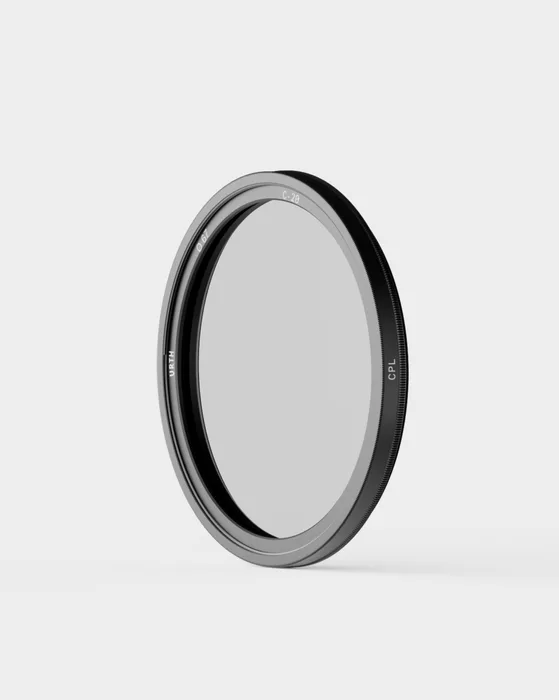
- Buy Urth CPL Filter Plus The only polariser here that tells you how much light it passes and how much it reflects.
- Buy Breakthrough Photography X4 CPL A polarising film made for cameras rather than for televisions, and the reasoning published in full.
- It depends Moment AntiGlare CPL Filter Fused silica and a frame machined so the filter grips your fingers and not your lens.
- Skip Freewell Threaded CPL Filter It reduces reflections and enhances colour, and that is the entire specification.
What actually matters
- Light transmission - the percentage of light reaching the sensor, which converts into the exposure cost. Rarely published, and the single most useful figure.
- Reflectance - how much light bounces off the filter surfaces, which predicts ghosting and flare when shooting toward a light source.
- Polarising film - the laminated layer doing the actual work. Most is generic film made for LCD panels, which causes the characteristic yellow cast.
- Substrate glass - SCHOTT B270, fused silica and similar named optical glasses, as opposed to unspecified glass.
- Coating - multi-layer anti-reflection coatings applied to both faces, typically sixteen to twenty layers on good filters.
- Frame - brass or aluminium, slim or standard profile, and whether the rim is textured for grip and removal.
- Stacking and cap compatibility - whether other filters and standard lens caps still fit once it is mounted.
The specs, in plain English
Green flags vs red flags
Green flags
- A light transmission percentage published.
- A reflectance figure published.
- The polarising film discussed, not just the glass.
- Coating layers counted and stated as dual-side.
- Frame material named, and stacking compatibility addressed.
Red flags
- No transmission or exposure loss figure of any kind.
- Colour neutrality claimed with nothing to support it.
- No glass or film named.
- No coating layer count.
- No frame material on a product you will rotate constantly.
Who's who: the brands
- Urth - Publishes light transmission and reflectance percentages alongside named SCHOTT glass and coating layer counts, with a lifetime warranty.
- Breakthrough Photography - Manufactures its own CPL film in California specifically to avoid the yellow cast of LCD-panel film, in brass traction frames.
- Moment - Fused-silica CPLs with sixteen-layer coatings and machined aerospace-grade frames designed for grip, stacking and centre-pinch caps.
- Freewell - Value filter maker with wide thread and drone coverage, publishing very little optical detail on its threaded CPLs.
- Hoya - Long-established Japanese filter manufacturer producing its own glass, and a common reference point for mid-range circular polarisers.
How to read a listing without getting fooled
Look for a light transmission percentage first, because it is the only figure that tells you what using the filter costs, and its absence is the norm rather than the exception. If it is there, convert it roughly: around 50 percent is one stop, around 25 percent is two. Then look for a reflectance figure, which predicts how the filter behaves pointed near the sun. Read carefully whether the maker discusses the polarising film separately from the glass, because the film is what causes the colour cast and a maker who addresses it has understood the actual problem. Count the coating layers and check they are described as dual-side. Then look at the frame: brass if you have ever had a filter seize, textured if you rotate a polariser constantly, and slim if you shoot wide. Finally check whether a lens cap and other filters still fit, which on some slim designs they do not.
How much should you spend?
Polarisers span a wide range and the cheap ones are cheap for a reason that shows up in every frame as a colour cast. The budget tier buys a functioning filter that will visibly cut reflections and will also tint your images, which is an acceptable way to find out whether you use a polariser enough to care. The mid-range buys named optical glass, a double-figure coating count and a well-designed frame, which is where most people should buy and is enough for essentially all work. The premium tier buys published performance figures and a lifetime warranty. The flagship tier buys a polarising film manufactured specifically for photography rather than bought in from LCD production, which is a real difference and matters most to landscape photographers whose whole output depends on colour fidelity. Buy for your largest thread size and step down.
Questions, answered
How do I use a polariser correctly?
Fit it, look through the viewfinder or at the live view, and rotate the front element slowly while watching the effect. Reflections will fade and return through roughly ninety degrees of rotation, and the sky will darken and lighten with them. Stop where the image looks right rather than at maximum effect, which often looks unnatural. Remember that the effect depends on your angle to the sun, so it changes as you turn, and that it is at its weakest shooting directly toward or away from the light.
Why does my sky look uneven?
Because the polarising effect varies with the angle to the sun and a wide-angle lens covers too wide a range of angles at once. At 16mm you can easily have part of the frame at ninety degrees to the sun, where polarisation is strongest, and part of it much closer to the sun, where it is weak, producing a dark band that looks artificial. The fix is to use the polariser at longer focal lengths, or to back off the rotation until the gradient is subtle.
Can I stack a CPL with an ND filter?
With fixed NDs, usually yes, and Moment designs its AntiGlare CPL explicitly to stack with fixed NDs, diffusion and UV. With a variable ND, no: a variable ND is already two polarisers rotating against each other, and adding a third produces unpredictable cross-polarisation. Be aware that stacking adds thickness, which brings vignetting back on wide lenses, and adds two more air-to-glass surfaces, which means more potential for flare.
How do I clean a polariser without damaging it?
Blow the dust off first, then use a lens cloth with a little cleaning fluid, working from the centre outward. Do not wipe a dry, dusty filter, since you are dragging grit across a coated surface. Be gentle with the rotating front element, which moves on a bearing and can be knocked out of true if you press hard on one side. Keep it in a case when it is off the lens, and never store two filters face to face without something between them.
Or jump to the head-to-head: Urth CPL Filter Plus vs Breakthrough Photography X4 CPL.