

Tech & Gadgets
The Best CPL Filters: 4 Compared (and One to Skip)
We compared four circular polarisers on published light transmission and reflectance, glass and film type, coating layers, frame material and warranty.
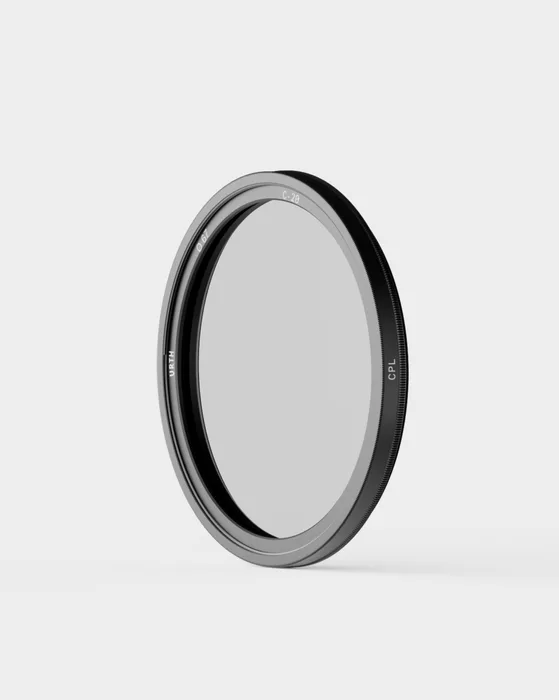
The short version
The Urth CPL Filter Plus is the one to buy: German SCHOTT B270 glass with a CoraNano 20-layer dual-side nano coating, a published light transmission of 44.91 percent and a reflectance of 0.56 percent, an ultra-slim warp-resistant aluminium frame and a lifetime warranty. Those are the only transmission and reflectance figures anyone in this comparison publishes. The Breakthrough X4 CPL is the optical specialist, built on a CPL film Breakthrough developed and manufactures in California rather than using off-the-shelf film intended for LCD panels, which it explains produces the yellow cast common to other polarisers, in a brass traction frame. The Moment AntiGlare CPL uses fused-silica optical glass with 16-layer coatings in an aerospace-grade metal frame machined with texture so it grips for micro-adjustment and does not seize on the lens. The Freewell Threaded CPL is the one to skip: it names no glass, no coating, no frame material and publishes no figures of any kind. Best for: landscape work, shooting through glass and water, and anyone whose skies come out washed out.
Our picks at a glance
- Urth CPL Filter Plus - Buy. The only polariser here that tells you how much light it passes and how much it reflects.
- Breakthrough Photography X4 CPL - Buy. A polarising film made for cameras rather than for televisions, and the reasoning published in full.
- Moment AntiGlare CPL Filter - It depends. Fused silica and a frame machined so the filter grips your fingers and not your lens.
- Freewell Threaded CPL Filter - Skip. It reduces reflections and enhances colour, and that is the entire specification.
The verdict in 30 seconds
What mattered most
- Glass or film
- Coating layers
- Light transmission
- Reflectance
- Colour neutrality
- Frame material
A circular polariser is the one filter whose effect cannot be reproduced afterwards in software. It removes reflections from water, glass and wet leaves, and deepens a blue sky, by blocking light oscillating in one plane, and nothing on a slider does that. The catch is that it also blocks light you wanted, usually a stop or two of it, and it tints what remains. Most CPLs go yellow, and one maker in this comparison explains exactly why in terms of a transmission curve. Another publishes the two numbers that describe how much light gets through and how much bounces off. The rest describe the effect and leave the physics alone.
The only polariser here that tells you how much light it passes and how much it reflects.
Best for: General landscape and travel work where you want the numbers and a warranty behind them.
- Light transmission published at 44.91 percent and reflectance at 0.56 percent, which are the two numbers that describe what a polariser actually does and which nobody else in this comparison gives.
- German SCHOTT B270 optical glass with a CoraNano 20-layer dual-side nano-coating, named to a glass type rather than described as premium.
- An ultra-slim warp-resistant aluminium frame and a lifetime warranty, which is the only lifetime cover in this group.
- Twenty coating layers, against thirty-four on Urth's own variable ND Pro, so this is not the top of its own range.
- The light loss is not expressed in stops, which is how photographers actually think about exposure.
- An aluminium frame rather than brass, which is softer and easier to cross-thread.
- No minimum focal length for vignetting-free use is published.
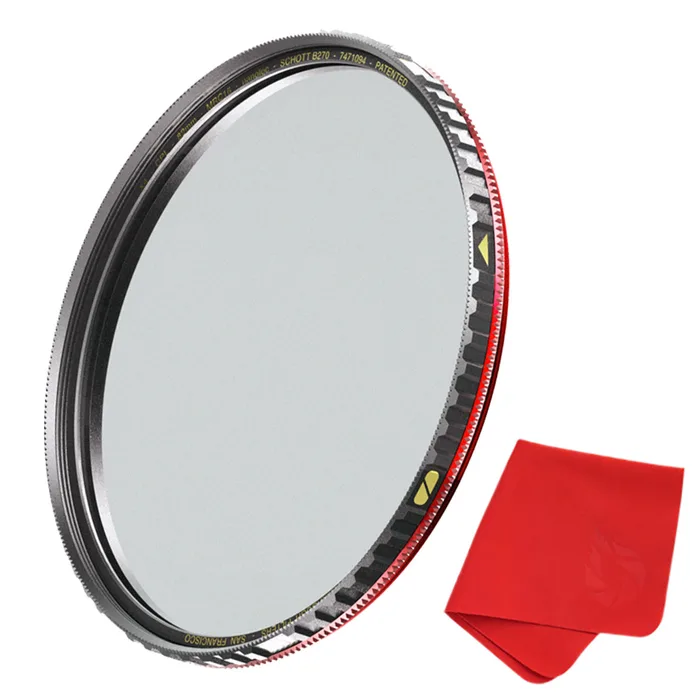
A polarising film made for cameras rather than for televisions, and the reasoning published in full.
Best for: Landscape photographers who have been fighting a yellow cast and want it solved at the film rather than in editing.
- Breakthrough develops and manufactures its own CPL film in California, rather than using off-the-shelf film which it notes is designed and intended for LCD panels rather than photographic optics.
- The technical explanation is published rather than asserted: commercially available CPL filters show a yellow cast from a transmission increase starting around 600nm and spiking from 650nm into infrared, where the X4 film gives a gradual transmission decrease from 600nm with controlled infrared behaviour.
- A brass traction frame, which resists cross-threading better than aluminium and is easier to grip and remove, including with gloves.
- No light transmission percentage and no reflectance figure are published, so the neutrality claim is argued rather than quantified.
- No coating layer count is given for the CPL specifically.
- Breakthrough's product page states no warranty term, only a warranty activation requirement; a 25 year support commitment appears in its retail listings.
- It is the most expensive filter here at any given thread size.
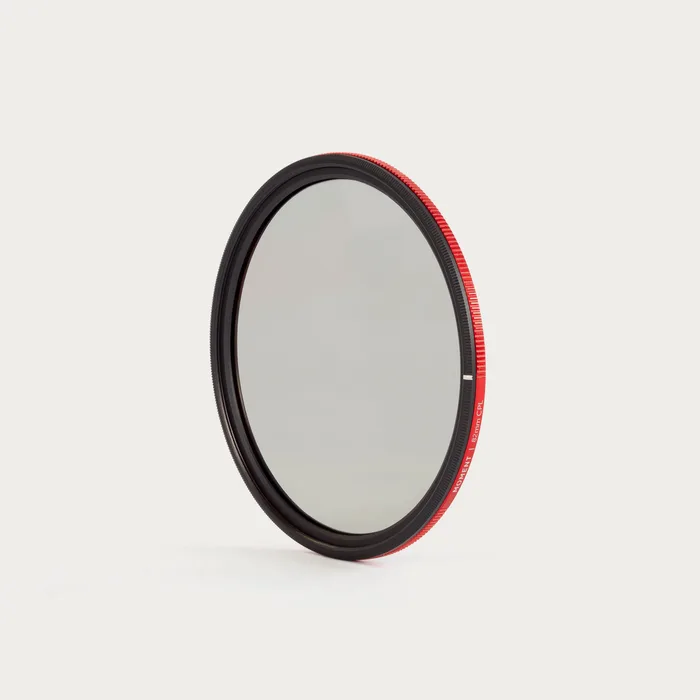
Fused silica and a frame machined so the filter grips your fingers and not your lens.
Best for: Anyone who stacks filters or has ever had a polariser seize onto a lens.
- Premium fused-silica optical glass with 16-layer coatings, which is a named substrate rather than a generic description.
- The frame geometry is designed as a feature: aerospace-grade metal with machined texturing for a physical grip, so micro-adjusting the polarisation is easier and the filter does not get stuck on the lens.
- Compatible with centre-pinch lens caps and designed to stack with fixed NDs, diffusion and UV filters, which threaded polarisers often are not.
- No light transmission or reflectance figures are published.
- Sixteen coating layers is the lowest published count among the filters here that give one.
- No warranty terms appear on the product page.
- Moment positions it as pro-grade polarisation at a fair price, which is a value claim rather than a performance one.
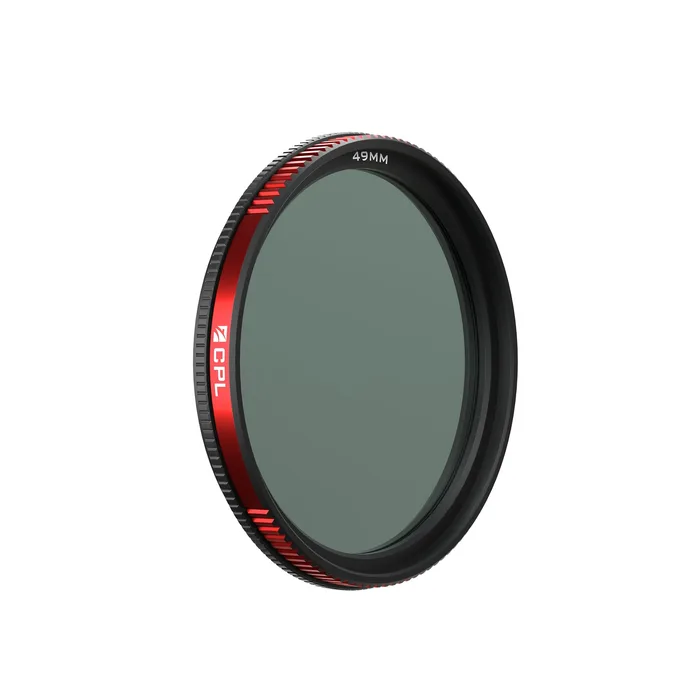
It reduces reflections and enhances colour, and that is the entire specification.
Best for: A first polariser on a lens you are not precious about, to find out whether you like the effect.
- A standard thread that fits any lens of the matching size, and Freewell's own Real Lens Hoods.
- It does the basic job, reducing reflections and increasing colour contrast and saturation.
- The least expensive way into polarised shooting in this comparison.
- No glass type or substrate is named.
- No coating is described and no layer count is given.
- No light transmission, reflectance or colour neutrality information of any kind is published.
- No frame material and no warranty terms appear on the page.
| Criteria | CPL Filter Plus Top pick | X4 CPL | AntiGlare CPL Filter | Threaded CPL Filter |
|---|---|---|---|---|
| Verdict | Buy it | Buy it | It depends | Skip it |
| Best for | General landscape and travel work where you want the numbers and a warranty behind them. | Landscape photographers who have been fighting a yellow cast and want it solved at the film rather than in editing. | Anyone who stacks filters or has ever had a polariser seize onto a lens. | A first polariser on a lens you are not precious about, to find out whether you like the effect. |
| Price tier | $$$ · premium | $$$$ · flagship | $$ · mid-range | $ · budget |
| Glass or film | SCHOTT B270 | In-house CPL film, made in California | Fused silica optical glass | Not published |
| Coating layers | 20, dual-side nano | Not published for the CPL | 16 | Not published |
| Light transmission | 44.91 percent | Not published | Not published | Not published |
| Reflectance | 0.56 percent | Not published | Not published | Not published |
| Colour neutrality | Claimed, with transmission figure | Transmission curve behaviour explained | True colour claimed | Not addressed |
| Frame material | Aluminium, ultra-slim | Brass, traction frame | Aerospace-grade metal, textured | Not published |
| Stacking | Not published | Not published | Designed to stack with ND, diffusion and UV | Not published |
| Warranty | Lifetime | 25 year support, in retail listings only | Not published | Not published |
Which one is right for you?
- General landscape and travel work where you want the numbers and a warranty behind them. Buy it Urth CPL Filter Plus
- Landscape photographers who have been fighting a yellow cast and want it solved at the film rather than in editing. Buy it Breakthrough Photography X4 CPL
- Anyone who stacks filters or has ever had a polariser seize onto a lens. It depends Moment AntiGlare CPL Filter
- A first polariser on a lens you are not precious about, to find out whether you like the effect. Skip it Freewell Threaded CPL Filter
How we judged the field
A polariser is judged on two things: how much of the light you wanted it lets through, and what colour that light is when it arrives. Both are measurable and almost nobody publishes them. We looked for a light transmission percentage, a reflectance figure, or any description of the transmission curve, and found that one maker gives the first two and another explains the third in detail while giving neither number. The other two describe the effect and stop.
After that we looked at what the filter is made of, separating the substrate from the polarising film, because those are two different components and the film is the part that produces the yellow cast most CPLs suffer from. Then coating layers, which govern flare and ghosting on a filter that will frequently be pointed near the sun. Then the frame, where brass, aluminium and machined textures are three different answers to the problem of a filter that has to be rotated constantly and removed occasionally. And finally warranty, which in this category runs from a lifetime to nothing stated.
The Urth CPL Filter Plus is the only filter in this comparison that answers the two questions a polariser should be asked. Light transmission is published at 44.91 percent and reflectance at 0.56 percent, which between them tell you how much of your exposure the filter costs and how prone it will be to ghosting and flare. Around those numbers the specification is equally concrete: German SCHOTT B270 optical glass, named to a type rather than called premium, and a CoraNano 20-layer dual-side nano coating for light control, in an ultra-slim warp-resistant aluminium frame. Behind it is a lifetime warranty, the only one in this group. The reservations are real but modest. Twenty coating layers is fewer than the thirty-four Urth puts on its variable ND Pro, so this is not the top of Urth’s own range. The transmission figure is a percentage rather than a stop value, which is not how photographers think about exposure. The frame is aluminium rather than brass. And Urth does not say how wide a lens it clears without vignetting, which on an ultra-slim frame is a claim it could reasonably make.
The Breakthrough X4 CPL makes the most substantive optical argument in this entire category, and the argument is about a component most buyers do not know exists. A polariser is a piece of polarising film laminated between glass, and Breakthrough’s point is that nearly every filter manufacturer buys that film off the shelf, where it was designed and intended for LCD panels rather than for photographic optics. That film has a transmission curve that rises gradually from around 600nm and then spikes from 650nm onward into the infrared, which is precisely why commercially available CPL filters exhibit a yellow cast. Breakthrough developed its own film and manufactures it in California, achieving a gradual transmission decrease from 600nm with controlled behaviour into the infrared instead. That is a genuine engineering answer to a genuine problem, published in detail. The frame is brass with Breakthrough’s traction pattern, which resists cross-threading and is easier to remove. What is missing is measurement: there is no transmission percentage, no reflectance figure, and no coating layer count for the CPL, so the claim is explained rather than quantified. There is also no warranty term on the page, only an activation requirement, though Breakthrough’s retail listings quote 25 year support, and it is the most expensive option here.
The Moment AntiGlare CPL is the practical choice and its best ideas are mechanical rather than optical. The glass is premium fused silica with 16-layer coatings, which is a named substrate and a stated layer count, if the lowest of the three that publish one. Where Moment has clearly spent its design effort is the frame. It is aerospace-grade metal with machined texturing, and the geometry exists for two specific reasons: to give you enough physical grip to micro-adjust the polarisation precisely, which on a smooth-rimmed filter is fiddly, and to let you get the filter off the lens without it getting stuck, which is the single most common frustration with threaded polarisers. Moment has also designed for compatibility rather than isolation, making the filter work with centre-pinch lens caps and designing it to stack with fixed NDs, Cinebloom diffusion and UV filters, which many threaded CPLs will not do without vignetting or jamming. The gaps are on the optical side: no transmission figure, no reflectance, no discussion of colour neutrality beyond a claim of true colour, and no warranty terms.
The Freewell Threaded CPL is the skip and it is a short entry because the page is a short page. Freewell tells you that the filter reduces reflections and enhances colour contrast for vibrant, clear images, that it improves colour saturation, and that the thread is a standard size compatible with all lenses of that size and with Freewell’s own Real Lens Hoods. That is the complete description. There is no substrate named, no coating described and no layer count, no light transmission percentage, no reflectance figure, nothing about colour neutrality, no frame material and no warranty. For a filter whose defining characteristic across the whole category is a tendency toward a yellow cast, saying nothing at all about colour is a conspicuous silence. It is also the cheapest option here, and as an inexpensive way to discover whether you actually use a polariser it is defensible. But three competitors at accessible prices each tell you what their filters are made of, and one of them tells you to two decimal places how much light gets through.
Urth CPL Filter Plus vs Breakthrough Photography X4 CPL: which should you buy?
Urth against Breakthrough is a choice between a measured product and an explained one. Urth publishes the numbers: 44.91 percent light transmission and 0.56 percent reflectance, on SCHOTT B270 glass with a 20-layer dual-side coating, in a slim aluminium frame with a lifetime warranty behind it. If you want to compare two filters on paper, Urth is the only page in this category that makes that possible, and the warranty removes most of the risk from the decision.
Breakthrough gives you the reason rather than the result. It identifies the actual cause of the yellow cast that affects nearly every polariser on the market, which is that the film is made for televisions, and then solves it by manufacturing its own film in California with a controlled transmission curve into the infrared. The brass traction frame is the better mechanical design too. What it will not do is put a number on any of it. Buy the Urth if you want published performance and a lifetime warranty at a sensible price. Buy the Breakthrough if colour neutrality is the specific problem you are trying to solve and you are prepared to pay flagship money for the fix.
What to look for
- A light transmission percentage: it tells you what the filter costs you in exposure, and one maker here publishes it to two decimal places.
- A reflectance figure: this predicts ghosting and flare, which matters on a filter you will point near the sun.
- What the polarising film is, not just the glass: the film is the component responsible for the yellow cast, and almost nobody mentions it.
- Coating layer count: sixteen to twenty layers is typical on good filters, and no figure at all usually means no coating worth quoting.
- Frame material and texture: brass resists seizing, aluminium is lighter and stickier, and a machined grip is what gets a stuck filter off.
- Whether it is designed to stack: many threaded polarisers vignette or jam when combined with an ND, and the ones that do not say so.
Our final take
Polarisers are the one filter you cannot replace in editing, and they are sold with less published performance data than almost any other optical accessory. The Urth CPL Filter Plus is the one to buy: SCHOTT B270 glass, a 20-layer dual-side coating, 44.91 percent light transmission and 0.56 percent reflectance on the page, and a lifetime warranty. The Breakthrough X4 CPL is the better filter for anyone fighting a colour cast, because it is the only one that identifies the cause, that off-the-shelf polarising film is made for LCD panels, and manufactures its own to fix it. The Moment AntiGlare is the sensible middle, with fused silica, sixteen coating layers and the best frame design here for stacking and for getting the thing off again. And a polariser whose maker mentions colour twice without ever addressing the cast every polariser has is one to pass over.
Questions, answered
What does a polariser actually do that editing cannot?
It removes reflected light before it reaches the sensor. Reflections off water, glass, wet roads and leaves are polarised, and rotating a CPL blocks that plane of light so you see through the surface instead of at it. No slider recovers detail that was never recorded, which is why a polariser is the one filter that still earns its place in a digital workflow. The sky-darkening effect is the same mechanism acting on scattered light, and it is strongest at ninety degrees to the sun.
How much light does a CPL cost me?
Typically one to two stops, and almost nobody prints the figure. Urth is the exception, publishing a light transmission of 44.91 percent, which is close to losing a stop and a bit. That matters because a polariser is most useful in exactly the conditions where you may already be short of shutter speed, such as under a canopy or late in the day. Factor it in: if you are shooting handheld at the edge of stability, a CPL may be the thing that pushes you over.
Why do polarisers make images yellow?
Because of what the polarising film is made for. Breakthrough explains it directly: most manufacturers buy off-the-shelf CPL film designed for LCD panels rather than for photographic optics, and that film shows a gradual transmission increase starting around 600nm which spikes from 650nm into the infrared, producing a warm cast that gets worse at longer wavelengths. Breakthrough's answer was to develop and manufacture its own film with a controlled transmission curve instead. It is the clearest technical explanation of a real problem anywhere in this category.
Can I leave a CPL on all the time?
You can, and you should not. Beyond the light loss, a polariser produces uneven sky darkening on wide-angle lenses, because the effect depends on the angle to the sun and a wide field of view covers too many angles at once, leaving a dark band across part of the frame. It also removes reflections you may want, such as the sheen on foliage or water that gives a scene depth. Fit it when you want the effect, rotate it while watching the viewfinder, and take it off when you do not.
Does frame material matter?
More than it sounds. Brass is softer against the aluminium of a lens thread in a way that resists galling, which is why Breakthrough uses it and why seized filters are less common with brass frames. Aluminium frames are lighter and cheaper and more prone to cross-threading and sticking. Moment takes a third approach, machining texture into an aerospace-grade metal frame specifically so you can grip it hard enough to get it off. If you have ever needed a filter wrench, this is the specification you were missing.
Deciding between the top two? See our head-to-head: Urth CPL Filter Plus vs Breakthrough Photography X4 CPL.
More Tech & Gadgets reviews
 The Best CPU Coolers: 4 Compared (and One to Skip)
  The Best Crimping Tools: 4 Compared (and One to Skip)
  The Best Cut-Resistant Gloves: 4 Compared (and One to Skip)
  The Best Digital Calipers: 4 Compared (and One to Skip)
  The Best Digital Photo Frames: 4 Compared (and One to Skip)
  The Best Smart Glasses With Displays: 4 Compared (and One to Skip)