Explained
Compact Cameras, Explained
After reading, you'll understand why sensor size and lens aperture matter more than megapixels, and how to tell from a spec sheet whether a compact camera will do anything your phone does not.
In this guide
First-time buyers tend to compare megapixels and zoom multipliers, because those are the biggest numbers on the box. Neither tells you how a camera behaves in a dim room. Two cameras with the same pixel count can have sensors of very different sizes, and a zoom figure can mix real optical reach with digital cropping. The specs that matter are fewer and quieter: sensor type, the lens's focal range and aperture, the kind of stabilisation and whether there is a viewfinder.
The 30-second version
- Sensor size sets the ceiling, so read the sensor type (1/2.3 inch, 1.0 type, APS-C) before the megapixel count.
- Aperture is the other half of low light, and a lower F-number at both ends of the zoom means more light reaching the sensor.
- Zoom reach costs sensor size, which is why pocket cameras with very long lenses use the smallest sensors.
- Digital is not optical, whether the word is attached to zoom or to stabilisation.
- Compare weights carefully, because some makers publish body-only figures and others include battery and card.
The products this guide is about
Our verdict on each, with the full reasoning on the companion review.
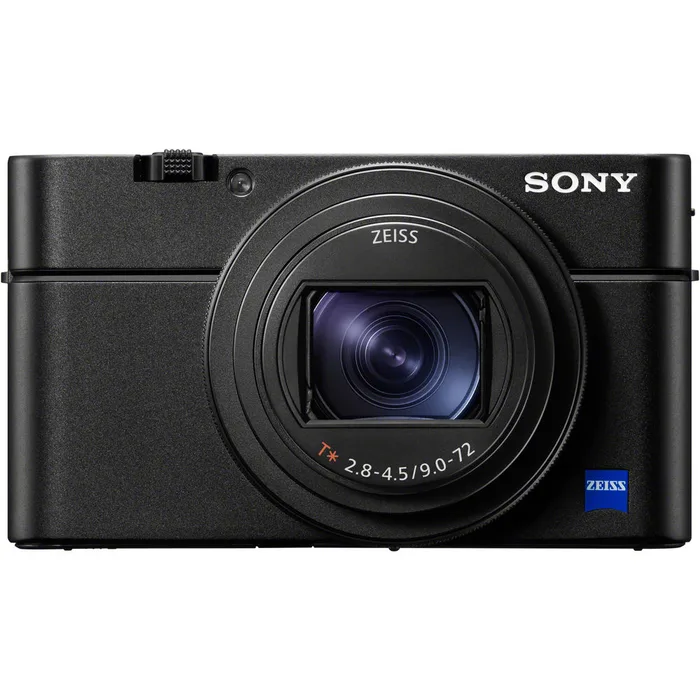
- Buy Sony RX100 VII A 1.0-type sensor, a 24-200 mm equivalent F2.8-4.5 ZEISS zoom and an electronic viewfinder in a body Sony lists at 302 g with battery and card.
- Buy Panasonic LUMIX ZS99 A 30x optical zoom reaching 720 mm equivalent in a 322 g body with USB Type-C charging, built around a small 1/2.3 inch sensor.
- It depends Fujifilm X100VI An APS-C sensor, a fixed 23 mm F2 lens (35 mm equivalent) and a hybrid optical and electronic viewfinder, with no zoom at all.
- Skip Kodak PIXPRO FZ55 A 106 g budget point-and-shoot with a 1/2.3 inch sensor, a 5x zoom at F3.9-6.3 and digital-only stabilisation.
What actually matters
- Sensor size - The sensor is the light-collecting surface, and a larger one gathers more light for the same exposure. An APS-C sensor at 23.5 x 15.7 mm has roughly three times the area of a 1.0-type sensor at 13.2 x 8.8 mm, and both are much larger than the 1/2.3 inch class.
- Maximum aperture - The F-number describes how wide the lens opens, and smaller numbers pass more light. Zoom lenses list two values, one for the wide end and one for full zoom, and the second is usually the limiting one.
- Focal range - Stated in 35 mm equivalent terms, this tells you how wide and how far the lens sees. Around 24 to 28 mm is wide, 35 to 50 mm is a natural view, and 200 mm and beyond is telephoto.
- Stabilisation type - Optical and sensor-shift systems physically counter hand shake during the exposure. Digital stabilisation processes the image instead, so check which one the spec sheet names.
- Viewfinder - An eye-level finder stays usable when the rear screen washes out in sun. Electronic finders are described by size and dot count, and some cameras have none at all.
- File formats - RAW files keep more of the sensor's data for editing later, while JPEG-only cameras fix the processing in the camera. Video codecs matter too, because older ones produce large files at lower quality.
- Weight and charging - A travel camera is carried all day, so the published weight with battery and card is the figure to compare. A USB Type-C port means one fewer cable to pack.
The specs, in plain English
Green flags vs red flags
Green flags
- The maker states the sensor type clearly, ideally with dimensions in millimetres.
- The lens aperture stays at F2.8 or brighter at the wide end.
- Stabilisation is listed as optical or sensor-shift.
- RAW capture and a USB Type-C port appear on the spec sheet.
- Weight is published with battery and card included.
Red flags
- A listing that leads with megapixels or 4K and does not state the sensor size.
- Zoom described as a combined or digital figure with no 35 mm equivalent range.
- Stabilisation described as digital, or not described.
- A rear screen listed in the low hundreds of thousands of pixels.
- No named manufacturer spec page you can check the listing against.
Who's who: the brands
- Sony - Known for the RX100 line of pocket cameras built around 1.0-type sensors.
- Fujifilm - Known for the X100 series of fixed-lens APS-C cameras with hybrid viewfinders and for its film simulation colour modes.
- Panasonic - Its LUMIX ZS travel zoom line puts long LEICA-branded zoom lenses in pocket-size bodies.
- Kodak PIXPRO - Budget point-and-shoot and bridge cameras made by JK Imaging under licence from Eastman Kodak.
How to read a listing without getting fooled
Start at the sensor line and write down the type. Next find the lens line and note three things: the 35 mm equivalent range, the F-number at the wide end and the F-number at the long end. Then look for the stabilisation entry and check whether it says optical, sensor shift or digital. Scan for a viewfinder section; if the sheet lists only a monitor, treat the camera as having no finder. Check the file formats for RAW, the port type, and whether the weight includes battery and card. Only after that look at megapixels, burst rates and video modes. If a retailer listing disagrees with the maker's page, or names a model with a different suffix or mark number, trust the maker's page for that exact model.
How much should you spend?
The budget tier is mostly 1/2.3 inch cameras with short zooms and basic screens, and that is where a current phone is hardest to beat. The mid-range tier buys long-zoom travel cameras that still use small sensors but add optical stabilisation, RAW files and 4K video. The premium tier is where 1.0-type and APS-C sensors, viewfinders and brighter lenses appear. Paying more makes sense when it buys sensor size, lens speed or a viewfinder, and makes less sense when it buys a higher pixel count or a longer list of scene modes. Decide which of zoom reach or low-light quality you need most, then spend on that.
Questions, answered
What does 1.0 type or 1-inch sensor mean?
It is a size class name, not a measurement of the sensor's width. Sony lists its 1.0-type sensor as 13.2 x 8.8 mm. The label comes from an old naming convention, so use the millimetre figures when you want to compare sensors directly.
Why do long-zoom pocket cameras use small sensors?
A larger sensor needs a physically larger lens to cover the same field of view. Reaching several hundred millimetres equivalent on a big sensor would not fit in a pocket. Using a 1/2.3 inch sensor lets a maker fit a 30x zoom into a body of a few hundred grams, at the cost of low-light performance.
Is a fixed lens a disadvantage?
Fixed lens means the lens cannot be removed, and every camera in this category has one. Some fixed lenses zoom and some, like the X100VI's, have a single focal length. A single focal length can be brighter and simpler, but you frame by moving. If you want to swap lenses, look at mirrorless systems instead.
Should a child's first camera be one of these?
A light budget compact can work for an older child, and it is the one case where a camera like the FZ55 makes some sense. For younger children, purpose-built kids' cameras are tougher and simpler. Our kids' camera comparison covers those, and our instant camera comparison covers print-on-the-spot models.
Or jump to the head-to-head: Sony RX100 VII vs Panasonic LUMIX ZS99.