Explained
Chain Breakers, Explained
After reading, you'll understand exactly which chain tool specs decide whether a tool fits your bike, and which are marketing.
In this guide
Chain tools look interchangeable and are not. The spec that decides whether one works on your bike is a single compatibility line naming chain speeds, and a second line, easy to miss, naming single-speed widths. First-time buyers usually choose on handle comfort and then discover the tool was never rated for the chain they own. The vocabulary is small, and learning it takes about five minutes.
The 30-second version
- The compatibility line is the spec, and everything else on the page is secondary to it.
- The driving pin is what breaks, so check it is sold as a replacement part before you buy.
- Peening is a Campagnolo requirement, not a general feature, and most tools cannot do it.
- Single-speed width is a separate spec, and compact tools often leave out 3/16 inch and half-link chain.
- More adjustment suits a shop, not a home mechanic breaking one chain a year.
The products this guide is about
Our verdict on each, with the full reasoning on the companion review.
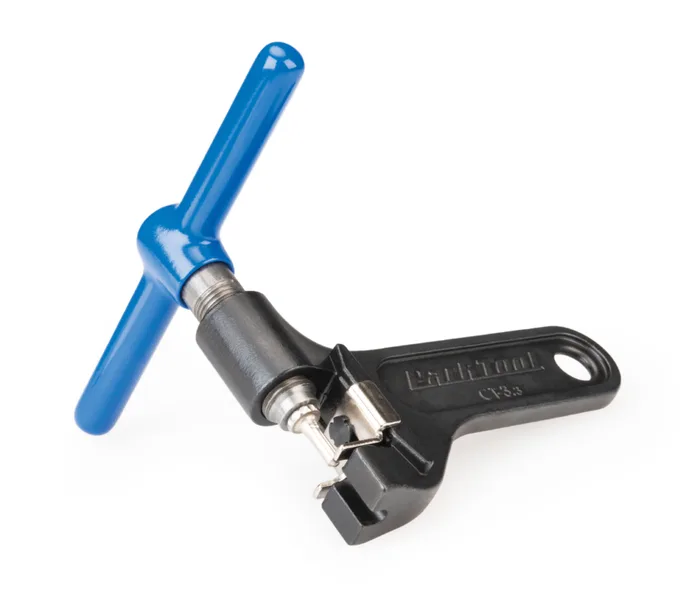
- Buy Park Tool CT-3.3 Chain Tool The bench tool that covers nearly every chain in a home workshop, with a driving pin you can buy again.
- Buy Pedro's Pro Chain Tool 3.2 The one that peens Campagnolo rivets and keeps going when drivetrains add another sprocket.
- It depends Park Tool CT-5 Mini Chain Brute Chain Tool A 77 gram tool with most of the bench tool's chain coverage, as long as you do not need the single-speed widths it leaves out.
- Skip Pedro's Tutto Chain Tool II A genuinely excellent shop tool that almost every home mechanic is buying past the point of usefulness.
What actually matters
- Chain speed range - the number of sprockets the chain is built for, which sets how wide the rivet and inner plates are. A tool rated for a wider chain can push a narrow rivet off-centre and bend its own pin.
- Driving pin - the hardened pin that presses the chain rivet. It is the part that fails, and whether the maker sells it separately decides whether a bent pin means a spare or a new tool.
- Peening - flaring the end of a connecting pin after pressing it home so it cannot migrate. Campagnolo specifies it for 11, 12 and 13-speed chains, which is why some tools include a dedicated bit.
- Bridge - the part that supports the chain plates while the rivet is pressed. A replaceable and repositionable bridge is how a maker keeps one tool current as chains narrow.
- Half-link chain - a single-speed chain built from offset links so length can be adjusted in half-inch steps. Not every tool is rated for it, and the exclusion is usually stated.
- Guide pin shear slot - a slot for snapping the guide section off a Shimano-style installation pin, which saves reaching for pliers mid-job.
- Floating locating shelf - a support that adapts to chain width rather than sitting at one fixed height, so one tool suits several chain widths.
The specs, in plain English
Green flags vs red flags
Green flags
- The page names specific modern chains such as SRAM T-Type or Flattop rather than a vague speed range
- The driving pin has its own part number and is sold separately
- Single-speed widths are listed explicitly, including the ones the tool does not cover
- The maker states limits plainly, such as which chains it will not peen
- A published weight, if you intend to carry the tool
Red flags
- A compatibility claim that stops at 10-speed on a tool sold as current
- No mention of the driving pin as a replaceable part
- Peening described vaguely without naming which chains need it
- A speed range given with no named chain brands at all
- Nothing published about single-speed widths when the tool is sold for commuter bikes
Who's who: the brands
- Park Tool - The default in most home workshops, and unusually direct about what its tools will not do.
- Pedro's - Known for shop-grade chain tools with replaceable bridges and Campagnolo peening bits included.
- Shimano - Sets the connecting pin and quick link standards that most tools are designed around.
- Campagnolo - The reason peening exists as a spec, because its 11, 12 and 13-speed chains require it.
How to read a listing without getting fooled
Start at the compatibility block and read it twice. The first line covers derailleur chains and gives a speed range, often with named chains such as SRAM T-Type or Shimano XTR 12-speed alongside it. The second line, when it exists, covers single-speed widths, and this is where two tools that look identical diverge. Then look for the driving pin part number, which tells you the pin is a consumable rather than a fixed component. Finally, check whether peening is mentioned at all. If it is absent, assume the tool cannot do it, and if you run Campagnolo assume that rules it out.
How much should you spend?
Budget buys a compact tool with a genuine speed range, and the compromise is usually leverage and single-speed coverage rather than compatibility. Mid-range is where the full bench tools sit, and it is the tier that suits almost every home workshop, because the extra spend goes into body rigidity and a broader compatibility list rather than features. Premium adds Campagnolo peening and a replaceable bridge, which are worth paying for only if you own the chains that need them. Flagship is priced for a shop breaking several chains a day, where faster setup between different chains repays itself, and that logic does not transfer to a home bench.
Questions, answered
Can I use a chain tool on any bike chain?
Only within the range the maker publishes. Chains narrow as sprockets are added, and a driving pin sized for a wider chain can sit off-centre on a narrow rivet. The tools here split between 5 to 12-speed and single through 13-speed claims, so check yours against the narrowest chain you own.
What is the difference between breaking and splitting a chain?
They describe the same action, pushing a rivet out to separate the chain. The older term is chain breaker, which is why the tools are still sold under that name, although makers increasingly say chain tool. Neither implies damage when done correctly.
Do I still need a chain tool for a new chain?
Yes. New chains are supplied longer than almost any bike needs, so sizing them means removing links before joining. This is true whether you finish with a connecting pin or a quick link.
How do I know if my tool bent a pin?
The usual signs are the pin refusing to enter a rivet squarely, visible deflection as you turn the handle, or a rivet that comes out at an angle. Replace the pin rather than persevering, since a bent pin damages chain plates as well as itself.
Or jump to the head-to-head: Park Tool CT-3.3 Chain Tool vs Pedro's Pro Chain Tool 3.2.