Explained
Chain Checkers, Explained
After reading, you'll understand what chain wear percentages mean, why gauges disagree, and which one suits your drivetrain.
In this guide
Chain wear is the one measurement that decides whether your next drivetrain bill is the price of a chain or the price of a chain plus a cassette. The vocabulary is small but slippery: chains do not stretch, percentages are not what most people assume, and two gauges on the same chain can give different answers for a reason that has nothing to do with quality.
The 30-second version
- Chains do not stretch, the pins and roller interiors wear and the gaps accumulate.
- The threshold depends on speeds, with 11 and 12-speed chains replaced earlier than 5 to 10-speed.
- Roller play distorts readings, which is why three-point gauges exist.
- Some modern chains need specific tools, and makers name them rather than implying coverage.
- Checking early saves a cassette, because a worn chain reshapes the teeth it runs on.
The products this guide is about
Our verdict on each, with the full reasoning on the companion review.
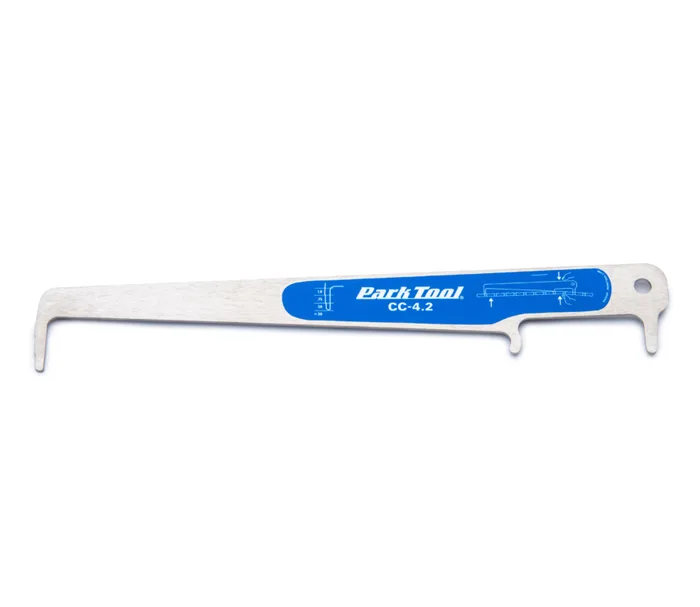
- Buy Park Tool CC-4.2 Chain Checker The gauge with the widest published chain coverage here, and the only one reading three wear thresholds.
- Buy Pedro's Chain Checker Plus II A three-point gauge that isolates roller wear, with a chain hook and a chainring nut wrench built in.
- It depends Park Tool CC-2 Chain Checker A pin-and-swing-arm gauge with a reading window, which suits a bench but leaves out SRAM's current chains.
- Skip Park Tool CC-3.2 Chain Wear Indicator A perfectly good gauge for chains that are no longer what most people are riding.
What actually matters
- Wear percentage - how much longer the chain measures than nominal, across a set span. It is the standard language of chain replacement, and the number that matters differs by drivetrain.
- Roller play - the small free movement of each roller on its pin. It is not wear that matters, but a two-point gauge resting on rollers includes it and reads pessimistically.
- Three-point measurement - a gauge geometry that supports the chain so roller play is excluded, giving a reading that reflects pin wear alone.
- Drop-in gauge - a flat tool you rest in the chain. Fast, pocketable, and gives a pass or fail against a threshold rather than a number.
- Gauge window - a scale you read after setting a tool into the chain, which gives you a position rather than a verdict and lets you track a chain over time.
- SRAM Flattop - an asymmetric chain profile used on SRAM road groupsets, which does not seat in a gauge like a conventional chain and needs a tool rated for it.
- SRAM T-Type - SRAM's transmission drivetrain chain, named separately by tool makers because older gauges were not designed around it.
The specs, in plain English
Green flags vs red flags
Green flags
- The tool reads more than one wear threshold
- Specific chains are named, such as SRAM Flattop, T-Type or Campagnolo Ekar
- The design is described as isolating roller wear or contacting the chain at three points
- The maker publishes which threshold applies to which chain speed
- A stated speed range that reaches 13-speed
Red flags
- A single threshold with no explanation of which chains it suits
- A bare speed range with no named chains in an era of asymmetric profiles
- No mention of roller play or measurement geometry
- A maker's own note directing some chain owners to a different model
- Marketing that treats chain wear as stretch without qualification
Who's who: the brands
- Park Tool - Makes most of this category and publishes unusually direct compatibility notes, including which of its tools not to buy.
- Pedro's - Known for combination gauges that isolate roller wear and add a chain hook and chainring nut wrench.
- SRAM - The chain maker whose Flattop and T-Type profiles drive most of the tool compatibility caveats.
- Shimano - Publishes its own wear limits, and its 12-speed chains are widely named on gauge compatibility lists.
How to read a listing without getting fooled
Start with the thresholds, because they tell you which of your bikes the tool covers: a gauge reading only 0.75 percent is not much use on a 12-speed drivetrain. Then look for named chains rather than a speed range. In this category a bare number is a weak claim, because the chains that cause problems are the ones with unusual profiles and makers who handle them list them by name. Next look for language about roller play or three-point contact, which tells you whether the reading is pin wear or pin wear plus slop. Finally, check the maker's own compatibility note, which is where the real exclusions live.
How much should you spend?
This is a category where the budget tier is the right answer. The best-covering tool here sits in the same bracket as the most limited one, so paying more buys a reading method rather than accuracy or compatibility. Mid-range gets you a windowed gauge you read rather than a threshold you pass or fail, which is genuinely nicer on a bench and does nothing your drivetrain notices. There is no premium tier worth chasing for a home mechanic: spend the difference on the chain you are about to need, and check it often enough that you only need one.
Questions, answered
Can I measure chain wear with a ruler instead?
You can, by measuring across twelve links and comparing to twelve inches, and it is better than not checking. It is harder to do accurately than it sounds, because you are looking for a fraction of a millimetre and holding tension by hand. A gauge in the budget tier removes the technique from the equation.
Why do two gauges give different readings on the same chain?
Usually roller play. A gauge that rests on the rollers picks up their free movement as well as pin wear, so it reads worse. A three-point design supports the chain so that movement is excluded, which is why tools describing that geometry tend to read lower and later.
Does a worn chain damage anything if I keep riding?
Yes, and that is the expensive part. An elongated chain no longer matches the tooth spacing it runs on, so it wears the cassette and chainrings into a matching profile. Once that has happened, a new chain will skip on the old cassette and both have to be replaced.
Do I need a different gauge for an e-bike chain?
Check what the tool's maker publishes, since e-bike drivetrains put more torque through the chain and often use their own chains. The thresholds themselves come from the chain maker rather than the tool, so the question is whether the gauge is rated for that chain's profile and speed count.
Or jump to the head-to-head: Park Tool CC-4.2 Chain Checker vs Pedro's Chain Checker Plus II.