Explained
Chain Whips, Explained
After reading, you'll understand how cassette removal works, why whips slip, and which tool suits your bikes.
In this guide
Cassette removal is a two-tool job that most people attempt with one and a half. The lockring socket is obvious; the holding tool is where the choices are, and where a bad purchase shows up as a slipped whip and a cut hand. The vocabulary is small: wrap, retention, cog range and lockring diameter, and once those four make sense the spec sheets become readable.
The 30-second version
- You need two tools, a lockring socket to turn and a whip to hold.
- Chain whips hold by friction, which is why wrap length and cog size decide whether they slip.
- Plier designs clamp instead, removing the dependence on wrap entirely.
- Speed coverage reflects chain width, so a whip built for 10-speed sits badly on a 13-speed cog.
- Handle length is leverage, and on a seized lockring it beats every feature.
The products this guide is about
Our verdict on each, with the full reasoning on the companion review.
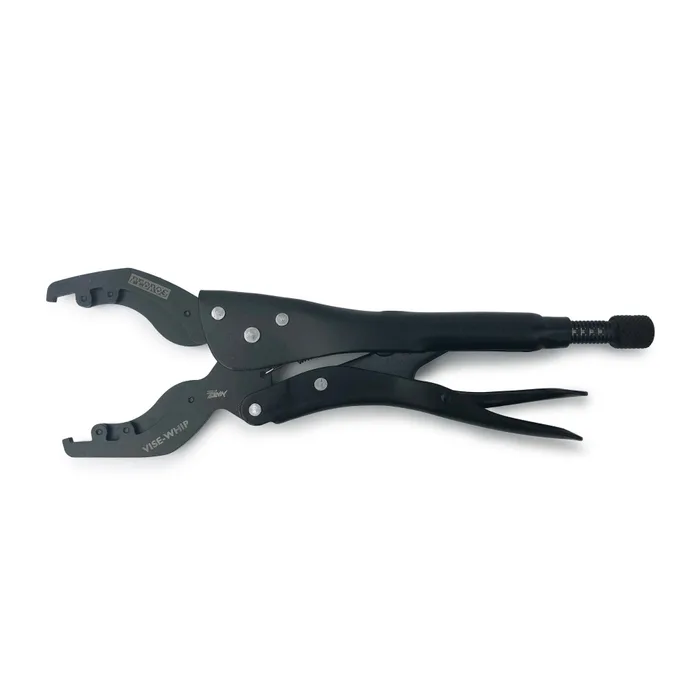
- Buy Pedro's Vise Whip II A plier that clamps the cassette instead of wrapping it, so there is nothing to slip.
- Buy Pedro's Pro Chain Whip II A traditional whip with a retention hook, a square drive for a torque wrench, and a lockring wrench built into the handle.
- It depends Park Tool SR-2.3 Sprocket Remover / Chain Whip The longest handle here, which is the whole argument for it.
- Skip Park Tool HCW-16.3 Chain Whip / Pedal Wrench A solid combination tool whose cassette coverage stops one speed short of the field.
What actually matters
- Chain wrap - how much of the cog the tool's chain encircles. More wrap means more teeth sharing the load and less chance of the chain climbing off.
- Retention hook - a hook that locks a chain whip onto the cassette so the wrap cannot open up under load. It is the chain-whip answer to slipping.
- Clamping jaw - the plier alternative, where the tool grips the cassette directly. Holding force comes from the jaw rather than from friction.
- Cog size range - the smallest and largest cogs the tool works on, given in teeth. It is a more practical limit than speed count.
- Lockring outside diameter - the size of a fixed gear or bottom bracket lockring, given in millimetres. Tools that handle these publish the range.
- Square drive - a socket fitting that lets a ratchet or torque wrench drive the tool, replacing hand force with controlled force.
- Freehub - the ratcheting body the cassette sits on. It is why a cassette spins freely in one direction and why you need a holding tool at all.
The specs, in plain English
Green flags vs red flags
Green flags
- A published cog size range in teeth, not just a speed count
- Speed coverage that reaches 13-speed
- A retention hook or a clamping jaw described explicitly
- Published lockring diameters if the tool claims a lockring function
- A stated length, since leverage is most of the job
Red flags
- Cassette coverage that stops a generation short of current drivetrains
- No cog size range anywhere on the page
- A combination tool whose second function duplicates something common
- No length published on a tool sold on leverage
- Vague claims about grip with no mechanism named
Who's who: the brands
- Pedro's - Originated the plier-style cassette tool and publishes unusually specific cog and lockring ranges.
- Park Tool - Conventional whips with long handles, and compatibility stated against named groupsets.
- Shimano - Sets the splined lockring standard that most cassette sockets are built around.
- Unior - A workshop tool maker whose cassette tools are aimed at shop rather than home use.
How to read a listing without getting fooled
Work out which design you are looking at first, because the rest of the page follows from it. A clamping tool will publish a cog size range in teeth and often lockring diameters in millimetres, which are hard limits. A chain whip will publish a speed range, which is really a statement about chain width, and may publish a retention hook rating separately. Then look for length, because on a stiff lockring that is the number that decides whether the job happens. Finally check any second function against what you already own: a fixed gear lockring wrench is a genuine addition for many people, and a 15 mm pedal wrench usually is not.
How much should you spend?
Mid-range is the sensible tier here and covers most conventional whips, including ones with retention hooks and extra functions. The money buys a head that does not deform and a handle long enough to be useful. Premium is where the plier-style tools sit, and the case for paying it is frequency: if you remove cassettes a few times a year across several bikes, removing the slip risk is worth it, and if you do it once every couple of years it is not. There is no meaningful budget tier worth recommending, because the failure mode of a cheap holding tool is a slipped chain across a sharp cassette.
Questions, answered
Can one tool remove both a cassette and a freewheel?
Not usually, because they are different mechanisms. A cassette slides onto a splined freehub and is held by a lockring; a freewheel threads onto the hub as a complete unit. Freewheels need their own splined or notched socket, and the holding tool is often unnecessary because the freewheel body resists in the right direction.
Why does my whip slip on small cogs?
Because a small cog offers less circumference to wrap, so fewer teeth carry the load and the chain is closer to climbing off. This is the clearest case for a clamping tool or a retention hook, and it is also why published cog size ranges start where they do.
Do I need a chain whip for an e-bike?
For the cassette, yes, the same as any bike. Some tools also cover e-bike chainrings, which is a separate job with its own lockring, and the Pedro's Vise Whip II publishes that compatibility. Check the tool's published ranges rather than assuming a cassette tool covers the motor side.
Is a longer handle always better?
For breaking a stubborn lockring, longer is better, and 38 cm is a lot of leverage. The trade-off is storage and control: a long tool is awkward in a small toolkit and easier to overdo on a lockring that was never that tight. Length matters most if your bikes live outside.
Or jump to the head-to-head: Pedro's Vise Whip II vs Pedro's Pro Chain Whip II.