

Outdoors & Fitness
The Best Chain Whips: 4 Compared (and One to Skip)
We compared four cassette holding tools on the cog sizes and speeds each maker publishes, whether they grip or wrap, and which ones do a second job worth having.
The short version
The Pedro's Vise Whip II is the one to buy. It clamps rather than wraps, so nothing slips, and Pedro's publishes a usable range: 9 to 23 tooth cogs and 40 to 46 mm lockrings with opposing notches, plus track cogs and e-bike chainrings. The Pedro's Pro Chain Whip II is the pick if you want a traditional whip, covering 6 to 13-speed with a chain retention hook, a 3/8 inch square drive so you can put a torque wrench on it, and an integrated fixed gear lockring wrench. The Park Tool SR-2.3 is the one to choose for leverage alone, at 38 cm and covering 7 to 13-speed including SRAM eTap AXS and Shimano XTR. Skip the Park Tool HCW-16.3: its published cassette coverage stops at 12-speed while everything else here reaches 13, and the pedal wrench it adds is a tool you probably own. Best for: anyone who has had a chain whip slip and skinned a knuckle on a cassette.
Our picks at a glance
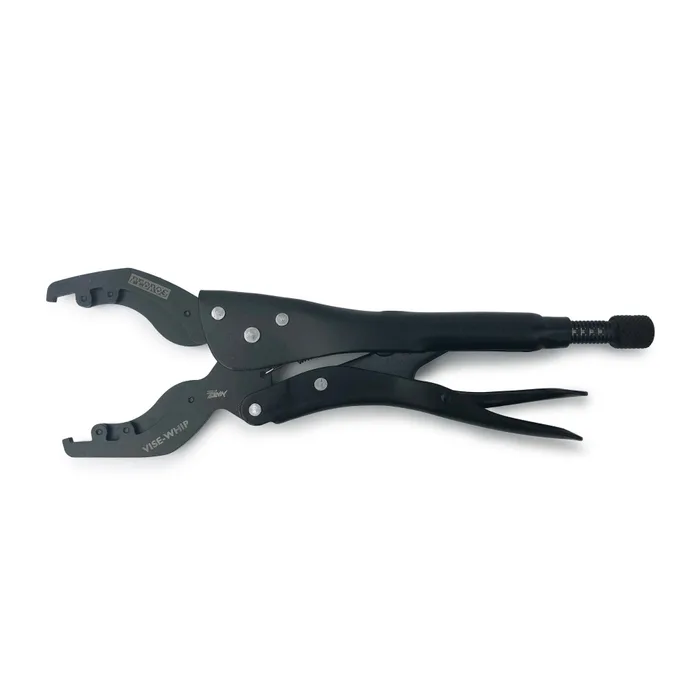
- Pedro's Vise Whip II - Buy. A plier that clamps the cassette instead of wrapping it, so there is nothing to slip.
- Pedro's Pro Chain Whip II - Buy. A traditional whip with a retention hook, a square drive for a torque wrench, and a lockring wrench built into the handle.
- Park Tool SR-2.3 Sprocket Remover / Chain Whip - It depends. The longest handle here, which is the whole argument for it.
- Park Tool HCW-16.3 Chain Whip / Pedal Wrench - Skip. A solid combination tool whose cassette coverage stops one speed short of the field.
The verdict in 30 seconds
What mattered most
- Holding method
- Published speed coverage
- Cog size range
- Lockring function
- Length
- Torque wrench drive
Removing a cassette needs two hands doing opposite things: one turning the lockring, one stopping the cassette turning with it. The second tool is the one people buy badly. A traditional chain whip holds by wrapping a length of chain around a cog, which works until the chain slips or the cog is too small to wrap. The alternative is a plier that clamps the cassette directly. We took four current tools from Park Tool and Pedro's, two of each design, and compared what the makers publish about cog sizes, speed coverage and the extra jobs some of them do.
A plier that clamps the cassette instead of wrapping it, so there is nothing to slip.
Best for: Anyone who removes cassettes often enough to be tired of chain whips slipping.
- Adjustable plier design that Pedro's says locks in place for positive engagement and prevents slippage
- Fits 9 to 23 tooth gear sizes and 40 to 46 mm outside diameter lockrings with opposing notches
- Also works on track cogs, cog and bottom bracket lockrings, and e-bike chainrings
- Adjustment knob carries a gear size indication so the current setting is readable
- The most expensive tool here, for a job the cheap whips also do
- A clamping jaw has to be set to the cog before it grips, where a chain whip is simply wrapped on
- Cogs above 23 teeth are outside the published range
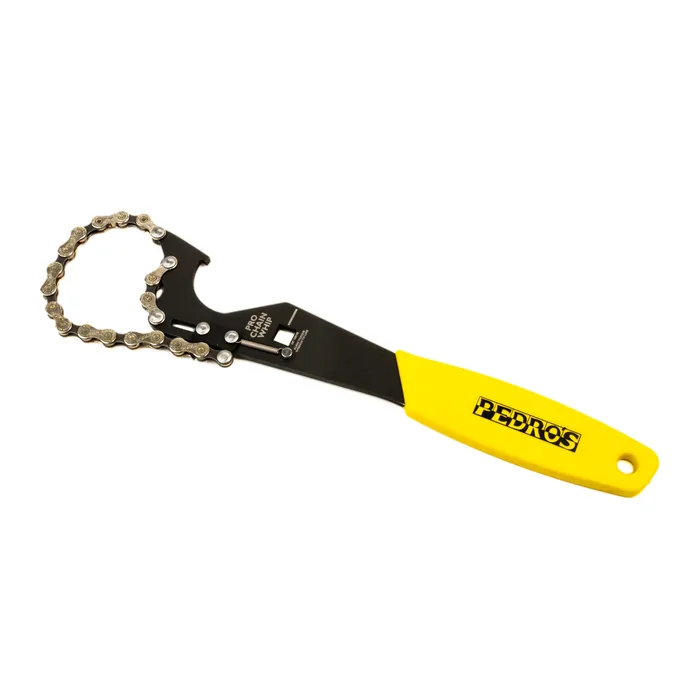
A traditional whip with a retention hook, a square drive for a torque wrench, and a lockring wrench built into the handle.
Best for: The home mechanic who wants a conventional whip that also covers fixed gear lockrings.
- Compatible with all multi-gear cassettes including 13-speed, published as 6 to 13-speed
- Chain retention hook locks the tool onto the cassette for full chain wrap, which Pedro's credits with eliminating slippage
- 3/8 inch square drive, so a torque wrench can drive it
- Integrated fixed gear lockring wrench optimised for 41 to 42 mm outside diameter lockrings
- The retention hook fits cogs up to 18 teeth, so the largest cogs are out of scope
- At 290 mm it is shorter than the Park Tool SR-2.3, which means less leverage
- Still a chain whip, so it needs enough cog to wrap
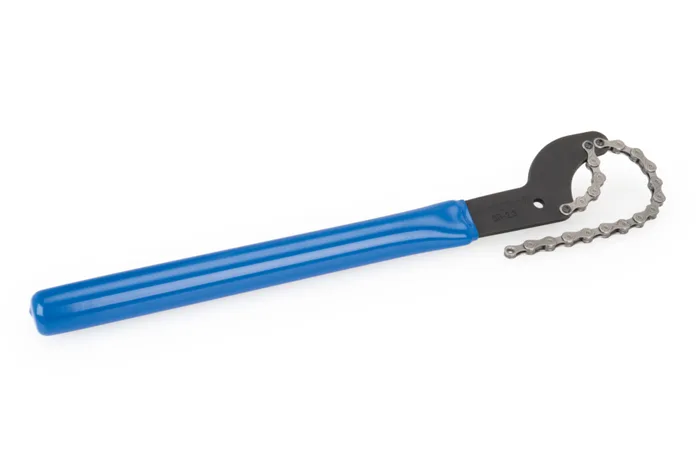
The longest handle here, which is the whole argument for it.
Best for: A stubborn lockring, where handle length does more than features.
- 38 cm (15 inches) long, the most leverage of any tool in this comparison
- Compatible with 7 to 13-speed road and mountain cassettes including SRAM eTap AXS and Shimano XTR
- Also covers single-speed cassettes with a 3/32 inch cog
- Heavy-duty heat-treated head with hardened chain retention pins
- Does one job only, where both Pedro's tools here do at least two
- No square drive, so it cannot be driven by a torque wrench
- Published coverage starts at 7-speed, where the Pedro's whip starts at 6
- A vinyl-dipped handle rather than a moulded grip
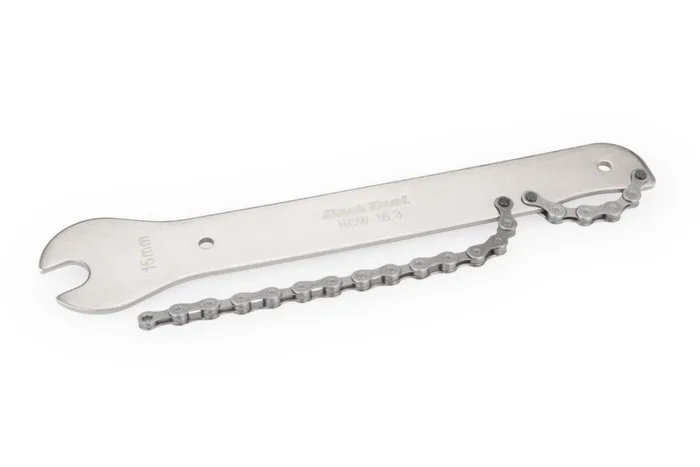
A solid combination tool whose cassette coverage stops one speed short of the field.
Best for: Someone building a first toolkit who is certain no 13-speed cassette is coming.
- E-nickel-plated steel construction
- Covers all 7 to 12-speed cassettes including SRAM AXS 12-speed systems
- Adds a pedal wrench for any pedal with 15 mm wrench flats
- Also handles single-speed cassettes with a 3/32 inch cog
- Published cassette coverage stops at 12-speed, where all three other tools here reach 13
- The pedal wrench is a duplicate for most people, since 15 mm flats are a common size
- No published length, on a tool whose usefulness is largely leverage
- Combining two jobs means the handle is a compromise for both
| Criteria | Vise Whip II Top pick | Pro Chain Whip II | SR-2.3 Sprocket Remover / Chain Whip | HCW-16.3 Chain Whip / Pedal Wrench |
|---|---|---|---|---|
| Verdict | Buy it | Buy it | It depends | Skip it |
| Best for | Anyone who removes cassettes often enough to be tired of chain whips slipping. | The home mechanic who wants a conventional whip that also covers fixed gear lockrings. | A stubborn lockring, where handle length does more than features. | Someone building a first toolkit who is certain no 13-speed cassette is coming. |
| Price tier | $$$ · premium | $$ · mid-range | $$ · mid-range | $$ · mid-range |
| Holding method | Clamping plier | Chain wrap with retention hook | Chain wrap | Chain wrap |
| Published speed coverage | All multi-gear cassettes | 6 to 13-speed | 7 to 13-speed | 7 to 12-speed |
| Cog size range | 9 to 23 tooth | Retention hook to 18 tooth | Not published | Not published |
| Lockring function | 40 to 46 mm, opposing notches | 41 to 42 mm fixed gear | None | None |
| Length | Not published | 290 mm | 38 cm (15 in) | Not published |
| Torque wrench drive | Not published | 3/8 in square drive | None | None |
| Second job | Track cogs, e-bike chainrings | Fixed gear lockrings | None | 15 mm pedal wrench |
| Named modern groupsets | Not named | 13-speed stated | SRAM eTap AXS, Shimano XTR | SRAM AXS 12-speed |
Which one is right for you?
- Anyone who removes cassettes often enough to be tired of chain whips slipping. Buy it Pedro's Vise Whip II
- The home mechanic who wants a conventional whip that also covers fixed gear lockrings. Buy it Pedro's Pro Chain Whip II
- A stubborn lockring, where handle length does more than features. It depends Park Tool SR-2.3 Sprocket Remover / Chain Whip
- Someone building a first toolkit who is certain no 13-speed cassette is coming. Skip it Park Tool HCW-16.3 Chain Whip / Pedal Wrench
How we judged the field
Five things decide whether a cassette holding tool is the right one. First is how it holds: wrapping chain around a cog, or clamping the cassette between jaws. That single choice determines whether slipping is a risk you manage or a risk you remove. Second is published speed coverage, because the chain on a whip has a width and a 13-speed cog is not a 10-speed cog. Third is cog size range, which is where the published numbers get genuinely useful: a retention hook that fits cogs up to 18 teeth tells you something a speed range does not. Fourth is leverage, which is handle length, and fifth is whether the tool does a second job worth having.
The field divides neatly by design rather than by maker. Pedro’s builds both a plier-style tool and a conventional whip and publishes unusually specific ranges for each, down to lockring diameters in millimetres. Park Tool builds two conventional whips and names the groupsets they suit, which is the more useful framing if you are matching a tool to a bike you already own. We took one of each philosophy from each maker, which puts the clamping design against three chain-wrap tools and lets the combination tool make its own case.
The Pedro’s Vise Whip II is the tool to buy if you want the job to stop being annoying. Instead of wrapping chain around a cog and hoping friction holds, it clamps the cassette between adjustable plier jaws that Pedro’s says lock in place for positive engagement. The published range is specific in a way that helps: 9 to 23 tooth gear sizes and 40 to 46 mm outside diameter lockrings with opposing notches, which means it covers not only cassettes but track cogs, cog and bottom bracket lockrings, and e-bike chainrings. The adjustment knob carries a gear size indication, so you can see what the tool is set to rather than working it out. The costs are real but modest. It is the priciest tool here, the jaws have to be set before they grip where a whip is simply thrown on, and anything above 23 teeth is outside the published range. For a tool that removes the one failure mode everyone remembers, that is a fair trade. Best for: anyone tired of whips slipping.
The Pedro’s Pro Chain Whip II is what a conventional chain whip looks like when someone has thought about why they slip. It publishes coverage for all multi-gear cassettes including 13-speed, and adds a chain retention hook that locks the tool onto the cassette so the wrap stays full, which is Pedro’s answer to the slipping problem without abandoning the chain design. Two details lift it above the plain whips. There is a 3/8 inch square drive, so a torque wrench or ratchet can drive the tool rather than your arm, and there is an integrated fixed gear lockring wrench optimised for 41 to 42 mm outside diameter lockrings, which is a genuinely separate job most people would otherwise buy a separate tool for. The limits are the hook, which fits cogs up to 18 teeth, and the length: at 290 mm it gives up leverage to the Park Tool. If your largest cog is modest and you value the extra functions, this is the better buy. Best for: a conventional whip that earns its place twice.
The Park Tool SR-2.3 makes one argument and makes it well. At 38 cm it is the longest tool here, and on a lockring that has been on for three winters, handle length is worth more than features. Compatibility is broad and named: 7 to 13-speed road and mountain cassettes including SRAM eTap AXS and Shimano XTR, plus single-speed cassettes with a 3/32 inch cog. The head is heavy-duty and heat-treated with hardened chain retention pins, which is Park Tool’s way of saying the part that takes the load is the part they spent money on. What you do not get is anything else. There is no square drive, so no torque wrench. There is no lockring function, so nothing for fixed gear or bottom bracket rings. Published coverage starts at 7-speed rather than 6, and the handle is vinyl-dipped rather than moulded. As a single-purpose tool it is a good one, and whether that is enough depends on how much leverage you need. Best for: stubborn lockrings.
The Park Tool HCW-16.3 is a decent tool that the rest of this comparison has moved past. It is E-nickel-plated steel, it covers all 7 to 12-speed cassettes including SRAM AXS 12-speed systems and single-speed cassettes with a 3/32 inch cog, and it folds in a pedal wrench for any pedal with 15 mm wrench flats. The problem is the number at the top of that list. Every other tool here publishes coverage to 13-speed; this one stops at 12. Thirteen-speed drivetrains are no longer exotic, and a holding tool is bought once and kept for a decade, which is exactly the wrong thing to buy one generation short. The second issue is the combination itself. A 15 mm pedal wrench is a common size that many people already own in some form, so the added function is often a duplicate, and combining two jobs means the handle is a compromise for both. Park Tool also publishes no length, on a tool whose value is largely leverage. Best for: a first toolkit with no 13-speed cassette in its future.
Pedro’s Vise Whip II vs Pedro’s Pro Chain Whip II: which should you buy?
The Vise Whip II and the Pro Chain Whip II come from the same maker and answer the same question two ways. The Vise Whip clamps, which means the holding force does not depend on how much cog there is to wrap or how worn the chain is. That is why it is the pick: it removes a failure mode rather than mitigating it, and its published range covers track cogs and lockrings that a chain whip cannot touch. The price is that it is the most expensive tool here and has to be set to the cog before it grips.
The Pro Chain Whip II mitigates the same problem from the other direction, with a retention hook that keeps the wrap full, and then adds two things the Vise Whip does not have: a 3/8 inch square drive for a torque wrench and a fixed gear lockring wrench. If your cassette work is occasional and your largest cog is under 18 teeth, it is the better value, because the retention hook covers most of the slipping and the extra functions are real. Choose the Vise Whip if you do this often or work on varied bikes. Choose the Pro Chain Whip II if you want one conventional tool that does more than one job.
What to look for
- Decide between clamping and wrapping first: it is the design choice that determines whether slipping is a risk you manage or one you remove.
- Check the published speed range reaches your drivetrain: three of these four cover 13-speed and one stops at 12, which matters for a tool you keep for a decade.
- Cog size range is more useful than speed count: a retention hook rated to 18 teeth tells you where the tool stops in a way a speed range does not.
- Length is leverage: on a lockring that has not moved in years, a 38 cm handle does more than any feature.
- A square drive lets a torque wrench do the work: it also gives you controlled force instead of a heave.
- Be sceptical of combination tools: a 15 mm pedal wrench is a common size, so check the second function is one you do not already own.
Our final take
Buy the Pedro’s Vise Whip II if you remove cassettes more than occasionally or work across several bikes. Clamping instead of wrapping removes the slip that makes this job unpleasant, and the published range covers track cogs, lockrings and e-bike chainrings as well as cassettes. If you want a conventional whip, the Pedro’s Pro Chain Whip II is the better one, with 13-speed coverage, a retention hook, a square drive for a torque wrench and a fixed gear lockring wrench in the handle. Take the Park Tool SR-2.3 if leverage is the thing you actually need, since at 38 cm it has the most of it. Leave the HCW-16.3 unless you are sure 13-speed is never coming.
Questions, answered
Do I need a chain whip and a lockring tool, or just one?
Both, and they work as a pair. The lockring tool is a splined socket that turns the ring holding the cassette on; the chain whip stops the cassette rotating while you turn it. Without the whip the cassette just spins with the freehub. Some tools here fold a lockring function in, but those are for fixed gear and bottom bracket lockrings, not the splined cassette lockring, so you still need the socket.
Why do chain whips slip?
Because the grip is friction from chain wrapped around a cog, and both the wrap and the friction have limits. A small cog does not give enough wrap, a worn chain sits badly on the teeth, and a stiff lockring needs more force than the wrap can hold. That is the problem the plier design removes: the Pedro's Vise Whip II clamps the cassette between jaws, so the holding force does not depend on wrap at all.
Does cassette speed really change which whip I need?
It changes the chain width the tool carries. A whip built around a 10-speed chain does not sit correctly on a 13-speed cog, which is why makers publish a speed range. Three of the four tools here cover 13-speed; the Park Tool HCW-16.3 publishes coverage to 12. If your bikes are 12-speed or below the distinction is academic, and if you expect a 13-speed drivetrain it is not.
What is the square drive on a chain whip for?
It lets you drive the tool with a torque wrench or a ratchet rather than by hand. On the Pedro's Pro Chain Whip II it is a 3/8 inch square drive. In practice this matters more for the lockring side of the job than the holding side, but it also gives you a way to apply controlled force rather than heaving on a handle.
Can I use an old chain and a bit of wood instead?
People do, and it works often enough to be a real answer. You wrap a length of old chain around a cog and hold the other end. What you give up is a handle designed for the job, a retention hook or jaw that stops the chain walking off, and any control over where your knuckles go when it slips. Given these tools sit in the mid-range tier and a cassette removal goes wrong in an expensive way, it is a false economy for anyone doing it more than once.
Deciding between the top two? See our head-to-head: Pedro's Vise Whip II vs Pedro's Pro Chain Whip II.
More Outdoors & Fitness reviews
 The Best Chainsaw Chaps: 4 Compared (and One to Skip)
  The Best Chainsaws for Homeowners: 4 Compared (and One to Skip)
  The Best Climbing Chalk: 4 Compared (and One to Skip)
  The Best Climbing Harnesses: 4 Compared (and One to Skip)
  The Best Rock Climbing Shoes: 4 Compared (and One to Skip)
  The Best Commuter Bike Helmets: Real Safety You'll Actually Wear (and One to Skip)