Explained
Handlebar Bags, Explained
After reading, you'll know what stops a bag sagging, which capacity suits your riding, and how to check one fits your bars.
In this guide
A handlebar bag is held at two points with a load hanging in between, which makes sagging the defining failure of the category. A drooping bag can contact the front tyre, press on cables and flop about on rough ground. The fix is internal structure, and it is worth looking for by name. After that the decision is capacity, which in practice separates a day bag of under three litres from a load carrier of six or more, and how wide the bag is relative to your handlebars.
The 30-second version
- Sagging is the failure to design out, and the makers worth buying from name a stiffener and say what it does.
- Weight per litre is the real comparison, and it ranges from about 68 to 95 grams per litre across good bags.
- Under three litres covers a day ride, which is why several makers converge on 2.5 to 2.8 litres.
- Bar width decides fit, since an 11 inch bag crowds narrow drop bars and can foul the lever hoods.
- The front wheel throws spray straight at it, so a bar bag needs more waterproofing than luggage further back.
The products this guide is about
Our verdict on each, with the full reasoning on the companion review.
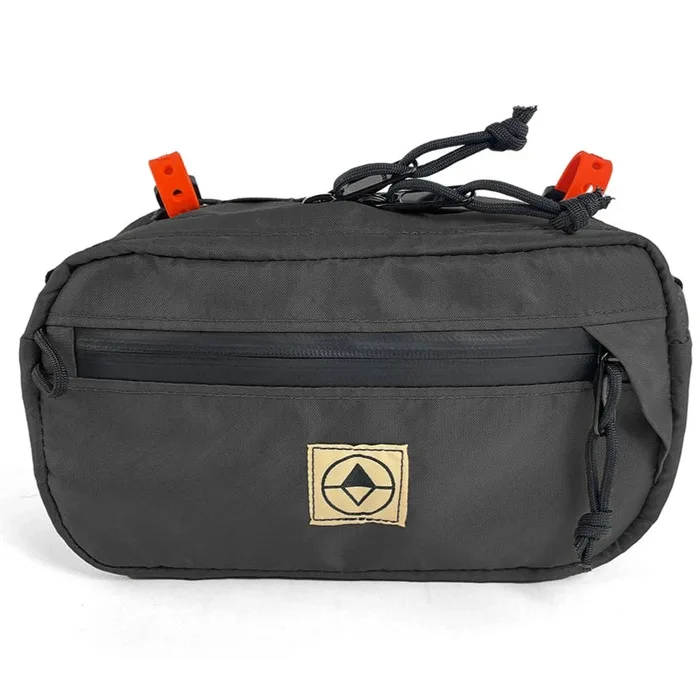
- Buy North St. Bags Handlebar Pack Under half a pound for 2.8 litres, in sailcloth, with a stiffener panel whose stated job is stopping the bag drooping.
- Buy Restrap Bar Pack, 10 Litres Ten litres in two fully waterproof roll-tops with an internal stiffener, a light mount and somewhere to put a D-lock.
- It depends Swift Industries Kestrel Handlebar Bag The lightest bag here at a stated 6 ounces, designed as one component of a cockpit system rather than as a standalone bag.
- Skip Two Wheel Gear Alpha Handlebar Bag, 6L A thoroughly specified commuter bag whose best trick happens off the bike, at the heaviest weight per litre in this comparison.
What actually matters
- Anti-sag structure - a stiffener panel, an internal frame or a rigid bracket. Without one, a loaded bag droops between its mounting points toward the tyre and cables.
- Capacity - in litres. Around 2.5 to 3 is a day bag; 6 to 10 is a load carrier that will change how the front of the bike steers.
- Weight per litre - the only fair way to compare bags of different sizes, and calculable whenever a maker publishes both figures.
- Bag width - how much of your handlebar the bag occupies. Must be checked against bar width at the tops and against lever hood position.
- Attachment method - rubber straps, webbing with buckles, or a rigid quick-release bracket. Straps are light and universal; brackets are steadier and heavier.
- Waterproofing - a roll-top with sealed seams, a coated fabric, or neither. The front of the bike is the wettest luggage position on a bicycle.
- Cable clearance - whether the bag leaves room for brake and gear cables to run without being pinched, which affects shifting.
The specs, in plain English
Green flags vs red flags
Green flags
- A stiffener or internal structure named explicitly.
- Capacity and weight both published, so weight per litre can be worked out.
- Full external dimensions, especially width.
- A described waterproofing method rather than the bare word waterproof.
- Replaceable attachment straps rather than sewn-in hook-and-loop.
Red flags
- No mention of how the bag keeps its shape.
- A capacity with no weight, or a weight with no capacity.
- No width given, on a product that has to share a handlebar with your hands and levers.
- Waterproof claimed with no closure or coating described.
- A bag wider than 10 inches sold for drop bars without a fit note.
Who's who: the brands
- North St. Bags - Portland-made sailcloth packs with published weights and capacities, and stiffener panels specifically described as anti-sag.
- Restrap - Hand-made UK bikepacking luggage in large capacities, with waterproof roll-tops, internal stiffeners and thoughtful urban details.
- Swift Industries - Light modular cockpit bags in laminated fabrics, built around PALS webbing and designed to pair with stem pouches.
- Two Wheel Gear - Commuter-focused convertible bags, fully specified and built around carrying the bag off the bike as well as on it.
How to read a listing without getting fooled
Look first for any sentence describing how the bag holds its shape, because that is the failure mode of the whole category and the makers who have solved it tend to say so. Then find the capacity and the weight together, since one without the other cannot be compared; divide to get grams per litre and you have a number that works across sizes. Check the width against your handlebar, measuring at the tops where the bag will sit rather than at the widest point of the bars, and think about where the lever hoods are. Read the waterproofing claim for a method rather than an adjective. Finally, look at the straps, because they are the part that wears and the part you will want to replace.
How much should you spend?
Budget bar bags are unstructured fabric pouches on hook-and-loop straps, and they work for light loads on smooth roads while being exactly the ones that sag. The mid-range is where stiffeners, named fabrics and published weights arrive, and it is where most riders should buy. Premium splits three ways: very light laminated bags for people counting grams, large waterproof roll-top packs for loaded riding, and modular systems where the bag is the hub for accessory pouches. Since the difference between a bag that keeps its shape and one that does not is mostly a piece of stiff board, paying up for structure is one of the better value decisions in bike luggage.
Questions, answered
Will a handlebar bag affect steering?
Yes, and more than the same weight elsewhere on the bike. Weight at the bars sits high and far forward of the steering axis, so it slows the steering and can introduce a wobble at speed if the load is heavy or badly secured. A 2 to 3 litre day bag is barely noticeable. A full 10 litre bag is, and the fix is to pack the heavy items low and close to the head tube rather than out at the front of the bag.
Can I fit a bar bag alongside a computer and lights?
Usually, with planning. The bag occupies the centre of the bar where mounts normally live, so look for a bag that provides a light mounting point itself, as Restrap does, or move the light to the fork crown or a mount that extends forward over the bag. Computers generally move outboard or onto a stem mount. Check this before buying, because discovering it afterwards usually means buying another mount.
How do I stop the bag rubbing the cables?
Route the cables over the top of the bag rather than under it where possible, and use a bag with a stiffener so it cannot settle onto them. If the cables have to run under, check for a bag with a channel or a raised base. Persistent rubbing wears cable housing and, on hydraulic systems, is worth taking seriously rather than ignoring.
Is a bar bag better than a frame bag?
They solve different problems. A frame bag carries weight low and inside the triangle, which is the best place for it and does not affect steering. A bar bag puts things where you can reach them while riding, which a frame bag cannot. Most loaded setups use both, with dense heavy items in the frame and the things you want during the ride, like snacks, a camera and a jacket, at the bars.
Or jump to the head-to-head: North St. Bags Handlebar Pack vs Restrap Bar Pack, 10 Litres.