Explained
Mountain Bike Grips, Explained
After reading, you'll understand how to choose a grip by its published diameter and hardness instead of by its colour, and why the torque figure matters more than anything else on the box.
In this guide
Almost every grip listing is written in the same excitable register about traction and control, and almost none of it helps you choose. The useful information is a handful of numbers, and brands publish them inconsistently. First-time buyers usually get tripped up in three places: assuming all grips fit all bars, assuming lock-on means better, and never once checking the diameter against their own hand. None of that is your fault. It is just that the industry talks about grip patterns far more than it talks about millimetres.
The 30-second version
- Diameter is the spec that decides comfort, so find the published millimetre figure and match it to your hand before you look at anything else.
- Lock-on buys convenience, not comfort, because the plastic liner and metal collar it needs make the rubber thinner and add a hard ring under your hand.
- Softer rubber damps better and dies sooner, and a 20A Shore A figure is about as soft as mainstream grips get.
- Clamp torque is a safety number on carbon bars, and published figures differ from grip to grip, from 2 Nm to 3 Nm across the ones covered here, so use the one for your grip.
- Wing grips are a positional tool, not a cure, and persistent hand numbness is a reason to see a clinician rather than to buy a different grip.
The products this guide is about
Our verdict on each, with the full reasoning on the companion review.
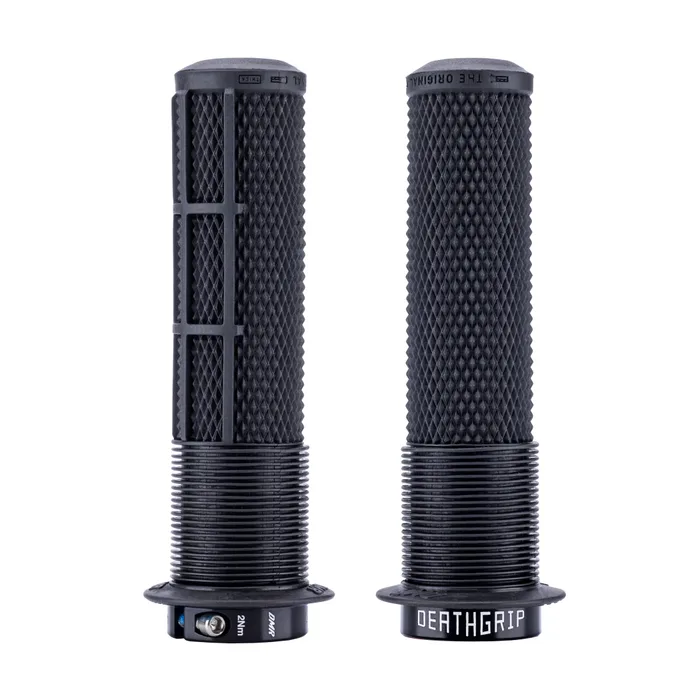
- Buy DMR Deathgrip2 Flange The best-specified lock-on grip you can buy, with published hardness, two diameters and a real torque figure. Amazon
- Buy Race Face Chester Grips A budget lock-on that publishes 20A rubber, two diameters and pair weights, which is more than most premium grips manage. Amazon
- It depends Ergon GA3 A wing-shaped grip that spreads hand load over more area, sized by glove size instead of by millimetres. Amazon
- Skip ODI Ruffian ATV/MTB Single Ply Grips A thin, single-ply slide-on that is popular because it is cheap, and feels like it. Amazon
What actually matters
- Outer diameter - the measurement across the finished grip, published by good brands in millimetres and running from under 30 mm to 36 mm or more. A larger diameter means your fingers curl less and pressure spreads over more palm, but too large for your hand and you end up squeezing harder, not less.
- Attachment type - lock-on grips clamp to the bar with a metal collar so they cannot slip and come off with a hex key, while slide-on grips are pushed on and held by friction, glue or wire. The choice determines how thick and how soft the rubber can be, because a lock-on needs a rigid liner inside it.
- Shore A durometer - the hardness scale used for rubber, where a lower number is softer. A 20A grip feels tacky and cushions well; a firmer compound feels more precise and lasts longer. Only some brands publish it, so its absence tells you something too.
- Wall thickness - how much rubber sits between your hand and the bar, which is not the same as diameter. Wolf Tooth publishes 5.5 mm of foam on its lock-on Fat Paw and 9.5 mm on the slide-on version at the same 36 mm installed diameter, which shows exactly what the liner costs you.
- Clamp torque - the tightening figure for the lock ring bolt, given in newton metres. It exists because overtightening crushes bars, and carbon bars are much less forgiving than aluminium. Published figures differ per grip, so do not carry a number over from your last set.
- Length and free bar space - the grips we compared run 125 mm to 136 mm, and the maker also states how much uncurved bar you need per side. If your shifter and brake clamps eat into that space, the grip will not seat properly no matter how much you shove it.
- Flange - the raised lip at the inboard end of some grips, which stops your hand sliding inward and gives a moto look. It also takes up bar space and gets in the way of some shifter positions, which is why most trail grips are sold in both flanged and flangeless versions.
The specs, in plain English
Green flags vs red flags
Green flags
- The listing states an outer diameter in millimetres, and ideally offers more than one.
- A Shore A durometer figure is published for the compound.
- A clamp bolt torque in newton metres is printed on the page or in a downloadable manual.
- The maker states the minimum uncurved bar space the grip needs.
- Replacement collars, bolts and bar plugs are sold separately, which means you can repair rather than rebuy.
Red flags
- No diameter anywhere in the listing, only adjectives about comfort and control.
- A single size sold as suiting everyone, with no thin or thick and no small or large option.
- No torque figure given for a lock-on collar you are expected to fit to a carbon bar.
- Claims that a grip prevents nerve damage, carpal tunnel syndrome or handlebar palsy.
- A very cheap slide-on described as an OE replacement, which usually means thin single-ply rubber and a glue-in fitting.
Who's who: the brands
- DMR - Brand whose Deathgrip helped define the modern trail grip shape, and one of the few that publishes durometer, both diameters and a torque figure.
- Ergon - Ergonomics specialist known for wing-shaped grips sized by glove size, with detailed fitting manuals and explicit torque values.
- ODI - Long-established American grip maker with a range spanning cheap single-ply slide-ons to race lock-ons.
- Race Face - Component brand whose Chester grip is the reference budget lock-on, published with durometer, two diameters and pair weights.
- Wolf Tooth - American machinist brand that publishes unusually complete grip data, including foam wall thickness and a maximum clamp torque, and sells replacement parts for its lock-on grips.
How to read a listing without getting fooled
Read a grip listing backwards. Skip the paragraph about traction and confidence and go straight to the spec block, which is usually the last thing on the page. You want four things: an outer diameter in millimetres, a length, a durometer figure and a torque value. If the diameter is there, compare it against whatever you currently ride, because that is the only meaningful reference point you have. If the length is there, check it against the straight section of your bar between your controls and the bar end. If a durometer is given, use it only to compare against another grip that also publishes one. If the torque is missing and you ride carbon bars, treat that as a reason to look at the maker's downloadable manual, and if there is no manual either, look at another grip.
How much should you spend?
Grips are one of the few components where the budget tier is not a compromise. A budget lock-on from a major brand can publish exactly the same 20A durometer rubber, the same clamp design and a wider diameter range than a mid-range option. What the mid-range tier buys you is finer diameter steps, more refined surface patterns, better end-cap durability, published torque values and, from the better brands, replacement collars and bolts so you can keep the grip going. Premium pricing tends to go on ergonomic shaping, unusual materials such as silicone foam, and hand-size-specific fitting rather than on better rubber. If money is tight, buy budget and spend the difference on getting the diameter right. If you ride long days or your hands give you trouble, the mid tier is where the sizing options live.
Questions, answered
What does 20A durometer actually mean?
Durometer is a hardness measurement, and the A scale is the one used for flexible rubbers. Twenty is near the soft end of that scale, which is why 20A grips feel tacky and slightly squishy under the thumb. Softer rubber deforms more around your hand and absorbs more high-frequency buzz, but it also abrades faster and tears more easily at the ends. Because brands rarely state how or where they measured, use a durometer figure to compare two grips that both publish one rather than as an absolute.
Do flanges actually do anything?
A flange is the raised lip at the inboard end of the grip, and it does one job: stops your hand creeping toward the stem. Riders who ride steep, rough terrain or who have had a hand slip inboard tend to like it. The costs are that it uses bar space, it can interfere with the position of a shifter or dropper lever, and it changes where your thumb naturally sits. Most popular grips are sold in flanged and flangeless versions of the identical rubber, so it is a preference, not a performance spec.
Can I use mountain bike grips with a twist shifter or on a gravel flat bar?
Yes on flat bars, with a caveat about length. Mountain bike grips are made for the standard 22.2 mm outside diameter grip section, which flat-bar gravel and hybrid bars also use, so the fit is the same. The caveat is that gravel and commuter cockpits often have less straight bar available, and many mountain grips ask for 129 mm to 130 mm per side. Twist shifters need a shorter grip, and some brands sell a dedicated short version for exactly that reason. Measure before you buy.
Are foam or silicone grips a real alternative to rubber?
They are, and they solve a specific problem. Silicone foam grips can be built much thicker at the same outer diameter because the material is lighter, which is how Wolf Tooth's 36 mm Fat Paw foam grip weighs a stated 103 g per pair. That thickness damps vibration well and suits large or gloved hands. The trade-offs are durability, since foam tears more readily than rubber if you crash on it, and feel, because some riders find foam vague compared with a tacky rubber knurl. They are worth trying if trail buzz is your main complaint.
Or jump to the head-to-head: DMR Deathgrip2 Flange vs Race Face Chester Grips.