Explained
Smart Bike Trainers, Explained
After reading this you will know why direct drive beats wheel-on, what a power accuracy percentage actually means for your training, and which specs decide whether a trainer works with the app you want.
In this guide
A smart trainer is not a piece of gym equipment you buy instead of a bike. It is a base that your own road, gravel or mountain bike bolts onto, and an app changes the resistance in real time as the virtual road tilts under you. That one fact reshapes the whole decision, and the specs that follow from it (drive type, power accuracy, simulated gradient, ERG behavior, and which wireless standards it speaks) are where first-time buyers get lost.
The 30-second version
- You supply the bike. A trainer has no saddle, bars or pedals of its own, which is what separates it from a spin bike or an upright exercise bike and why your existing fit carries straight over.
- Drive type decides almost everything else. Direct drive removes your rear wheel and measures at the hub; wheel-on presses a roller against your tire and estimates power from roller speed, which is looser, louder and harder on tires.
- The accuracy percentage is the number that matters. Within 1 to 2 percent means your indoor watts line up with a real power meter; a figure around 5 percent means your numbers only make sense against themselves.
- ERG mode is the reason to buy smart over dumb. The app sets your wattage and the trainer holds it regardless of gear or cadence, so you pedal instead of chasing a target, and better trainers hold it without surging.
- Open standards keep you free. ANT+ FE-C and Bluetooth FTMS let any major training app drive the trainer, so no purchase locks you into one company's subscription.
The products this guide is about
Our verdict on each, with the full reasoning on the companion review.
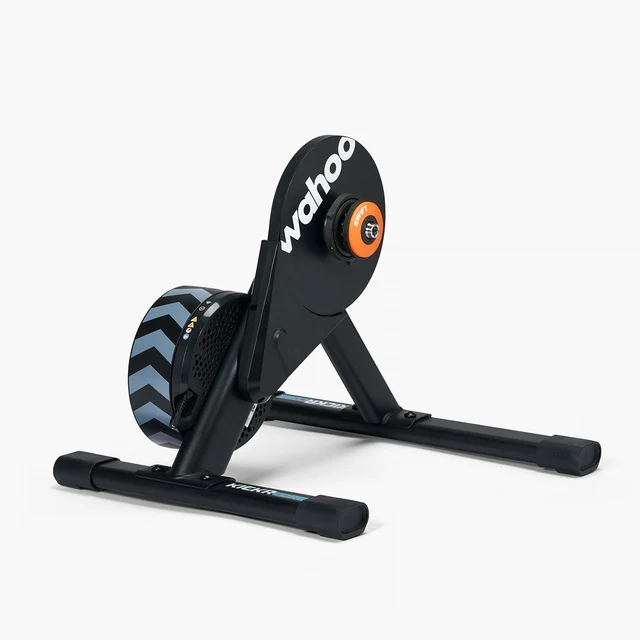
- Buy Wahoo KICKR CORE 2 with Zwift Cog and Click Direct-drive power data, virtual shifting and built-in WiFi at a mid-range price, with nothing else to buy.
- Buy Wahoo KICKR V6 Smart Trainer The flagship that gets the boring things right: 1 percent accuracy, WiFi, a cassette fitted, and it works with everything.
- It depends Garmin Tacx NEO 3M Smart Trainer The most convincing ride feel and the cleanest data of the four, sold at the highest price with the shortest feature list.
- Skip Elite Tuo Interactive Wheel-On Trainer A tidy, compact wheel-on trainer that budget direct-drive units have now made hard to justify.
What actually matters
- Direct drive versus wheel-on - direct drive bolts your bike to the unit with the rear wheel off and generates and measures resistance at the hub, giving tighter power, quieter running, steeper simulated climbs and no tire wear. Wheel-on keeps the wheel on and infers power from a roller pressed against the tire, which is cheaper and folds smaller but slips, wears rubber and reads wider.
- Stated power accuracy - the percentage a maker quotes is the band your watts are expected to fall inside. Within 1 to 2 percent means indoor and outdoor numbers agree closely enough to train and test against. Around 5 percent means the same effort can read meaningfully different day to day, so your FTP test, your intervals and your outdoor power meter all tell slightly different stories.
- ERG mode quality - every smart trainer claims ERG, but holding a target is the hard part. Good units change resistance quickly and settle on the number; weaker ones hunt above and below it, especially at low cadence or at the start of an interval. This is what you feel in every structured session.
- Maximum simulated gradient - how steep a virtual climb the trainer can imitate before the resistance runs out. It reads like a headline spec but matters less than people assume, because almost all riding happens between flat and about 10 percent.
- What is fitted in the box - a cassette (the cluster of sprockets your chain runs on) or a single-sprocket virtual-shifting cog is a real cost and a real fitting job. Confirm it is included and that it matches your drivetrain, because two trainers at the same price are not the same purchase if one needs parts.
- App freedom - ANT+ FE-C and Bluetooth FTMS are the open standards every major training app speaks. A trainer that broadcasts both works with anything you choose now or switch to later; anything that only cooperates fully inside one company's software is a long-term trap.
- Noise, flywheel weight and road feel - direct-drive units are quiet enough that your own drivetrain is the loudest thing in the room, while a roller humming against a tire carries through floors. A heavier flywheel stores more momentum and coasts more like a real bike, which is the difference between pedaling a machine and riding one.
The specs, in plain English
Green flags vs red flags
Green flags
- Direct drive with a stated power accuracy within 1 to 2 percent, so your indoor numbers agree with a real power meter
- Broadcasts on both ANT+ FE-C and Bluetooth FTMS, so any training app can read and control it
- A cassette pre-fitted, or a virtual-shifting cog and shifter in the box, with the freehub type clearly stated
- A reasonably heavy flywheel and owner reports of smooth ERG that settles on the target instead of hunting around it
- Quiet enough in owner accounts that the drivetrain is the loudest part, which matters for shared walls and early starts
- Built-in WiFi for hands-off firmware updates and faster data, now common rather than exotic
Red flags
- Power described as estimated or calculated with a tolerance around 5 percent, which will never line up with a power meter
- Maximum simulated gradient around 10 percent, a hint that resistance runs out on any real climb
- No mention of ANT+ FE-C or Bluetooth FTMS, or control that only works properly inside one brand's own app
- A direct-drive unit with no cassette included and no note of which freehub it ships with
- Wheel-on designs sold on price alone, given the tire wear, rubber dust, extra noise and per-session calibration that come with them
- Listings that lead with maximum watts, since almost nobody is limited by a trainer's top-end resistance
Who's who: the brands
- Wahoo - The KICKR line sets the mainstream benchmark for direct-drive trainers, with tight accuracy, built-in WiFi and full open-standard support across the range.
- Garmin (Tacx) - Makes motor-driven direct-drive trainers known for the most convincing road feel, surface simulation and calibration-free operation, at the top of the market.
- Elite - Long-established Italian maker spanning wheel-on and direct-drive units, generally compact and well finished, with the wheel-on models now hard to justify.
- Zwift - Primarily a training app, but also the source of the virtual-shifting cog and wireless click shifter that some trainers now ship with.
- Saris - American brand with a long history in trainers and a straightforward direct-drive lineup, often chosen on value rather than headline features.
- JetBlack - Australian maker offering direct-drive trainers with competitive accuracy claims and open-standard support at mid-market positioning.
How to read a listing without getting fooled
Start at the drive type, because it constrains every other number on the page. If the listing says wheel-on, read the power figure as an estimate no matter how confidently it is written. Next find the accuracy claim and check the exact wording: measured within a small percentage is a very different promise from estimated within a larger one. Treat maximum watts as marketing, since a trainer's top-end resistance is almost never the limiting factor, and treat maximum gradient as a tiebreaker rather than a decider, because virtually all riding happens well below 10 percent. Then hunt for the two acronyms that guarantee your freedom, ANT+ FE-C and Bluetooth FTMS, and be suspicious of any listing that talks about app compatibility without naming them. Read the box contents line closely: a cassette fitted, or a virtual-shifting cog and shifter included, is real money and a real fitting job you avoid, and if a cassette is not included you need to know the freehub type (HG, XDR or Micro Spline) and the speed count of your own drivetrain before you can compare anything fairly. Finally, check flywheel weight and any noise description for how the thing will actually feel and sound in your room, and note whether calibration is occasional, per-session, or not needed at all.
How much should you spend?
Budget around the drive type first, because that is where the money changes what you get rather than how it looks. The value sweet spot now sits in mid-range direct drive, which brings accuracy tight enough to train by, quiet running, adequate gradient and full open-standard support, and increasingly arrives with the drivetrain question already solved in the box. Spending up from there buys margin rather than capability: a tighter accuracy band, a heavier flywheel, faster resistance response and a smoother ERG hold. That upgrade genuinely earns its keep if you race indoors or live inside structured intervals, and mostly disappears into the spec sheet if your riding is steady endurance. At the very top, motor-driven units add road-surface feel and calibration-free operation, which is a real experience upgrade but a narrow one, and some ask flagship money while leaving out connectivity features cheaper rivals include. At the bottom, wheel-on trainers look like the bargain and are not, once you count tire wear, a trainer tire, the noise and the power figures you cannot trust. Also budget for the things that never appear on the trainer's price tag: a cassette and fitting if none is included, a mat, a fan, and a subscription to whichever training app you settle on.
Questions, answered
How is a smart trainer different from a spin bike or an exercise bike?
A trainer has no saddle, handlebars or pedals of its own. You bolt your own bike to it, which means your existing fit, your own contact points and your own drivetrain carry straight over, and the whole thing folds out of the way when you take the bike back outside. A spin bike or exercise bike is a standalone machine with its own frame and console, which is the better answer if you do not own a road bike or do not want to keep mounting and dismounting one. If you already ride outdoors, a trainer is usually the better fit and the better value.
Why is wheel-on power less accurate?
A wheel-on trainer never measures your effort directly. It presses a roller against your inflated rear tire and works backwards from how fast that roller is turning, applying a model of how much resistance it should be creating. Everything between your legs and that roller becomes a source of error: tire pressure, tire compound, how hard the roller is clamped on, tire wear, and slip under hard efforts. That is why stated tolerances sit around 5 percent instead of 1 to 2 percent, and why the same workout can read differently after a tire change. Direct drive skips the tire entirely and measures at the hub.
What does ERG mode actually do?
In ERG mode the app, not you, decides your wattage. You load a workout, the trainer holds whatever the interval calls for, and your gear and cadence stop mattering because the trainer adjusts resistance to compensate. You just pedal. It is the main reason to buy a smart trainer over a dumb one, and it is where quality shows: better units change resistance quickly and lock onto the target, while cheaper ones surge above and below it, particularly at low cadence or right at the start of an interval.
Do I need to buy a cassette too?
Sometimes, and it catches a lot of first-time buyers. Some direct-drive trainers arrive with a cassette already fitted, some ship with a single-sprocket virtual-shifting cog and a wireless shifter instead, and some come bare. If it comes bare you need a cassette that matches your drivetrain's speed count, plus the right freehub on the trainer: Shimano HG for most 8 to 11 speed setups, SRAM XDR for SRAM's 12-speed road groups, and Shimano Micro Spline for its 12-speed mountain bike drivetrains. Getting that wrong means buying an adapter freehub body as well, so read the box contents before you compare prices.
Will one trainer work with every app, or am I locked in?
If it broadcasts on ANT+ FE-C and Bluetooth FTMS, you are free. Those are the open standards every major training app speaks, so a single trainer covers the popular virtual-world and structured-training platforms and nothing about the purchase forces a particular subscription. The nuance is virtual shifting, where one app's cog and shifter system is supported by some trainers and not others; if that is unsupported, shifting simply stays on your real drivetrain. Treat the absence of FE-C and FTMS from a spec sheet as a hard no.
How loud is a trainer, and will my neighbors hear it?
Direct-drive trainers are quiet enough that your own chain and cassette are usually the loudest thing in the room, and the noise that does travel is low-frequency vibration through the floor rather than airborne whine. Wheel-on trainers add a distinct tire hum that gets louder as you go faster, plus rubber dust on the floor. In an apartment, a direct-drive unit on a proper trainer mat is the combination that keeps the peace. This is general information about equipment, not medical or coaching advice; if you are new to hard indoor training or have any health concerns, check with a doctor or a qualified coach before ramping up.
Or jump to the head-to-head: Wahoo KICKR CORE 2 with Zwift Cog and Click vs Wahoo KICKR V6 Smart Trainer.