Explained
Spoke Wrenches, Explained
After reading, you'll understand which spoke wrench size your wheels need and why engagement matters more than price.
In this guide
Spoke wrenches are cheap, small and unusually unforgiving. The sizes differ by fractions of a millimetre, the nipples are deliberately soft, and a wrench that is nearly right will feel like it fits right up until it rounds the flats off. Almost all of the difficulty is in two ideas: which size, and how many sides.
The 30-second version
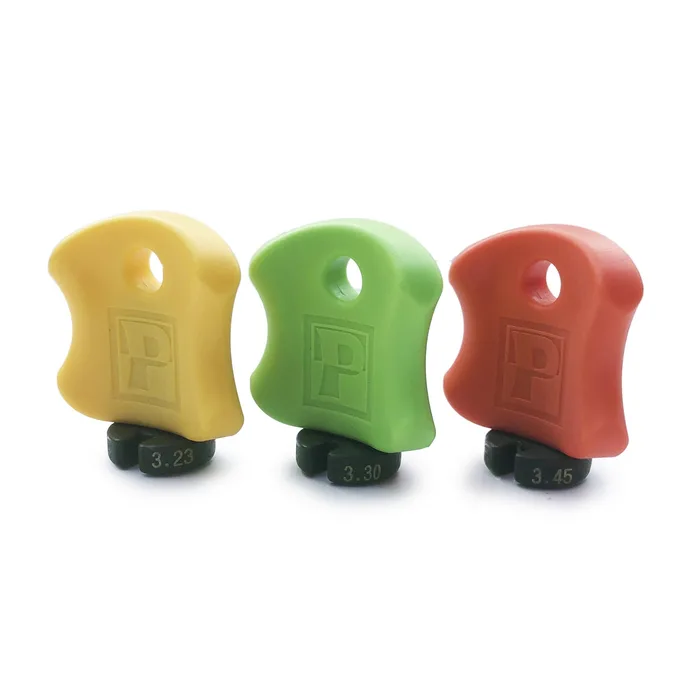
- Three sizes cover most wheels, 3.23, 3.30 and 3.45 mm, and a tool should carry all three.
- Nipples are soft on purpose, so a loose wrench damages the nipple rather than the spoke.
- Four-sided openings grip harder, which is what a stiff or corroded nipple needs.
- Bladed spokes need a holder, or you wind tension into the spoke instead of the wheel.
- Double-ended wrenches are specialists, bought for access, not for coverage.
The products this guide is about
Our verdict on each, with the full reasoning on the companion review.
- Buy Pedro's Pro Spoke Wrench - Set of 3 Three sizes, each with a 3-side and a 4-side opening on a reversible handle.
- Buy Park Tool SW-7.2 Triple Spoke Wrench The three common sizes in one flat body, and the cheapest sensible way to own all of them.
- It depends Pedro's Multi Spoke Wrench A compact unibody wrench that takes the universal design seriously for once.
- Skip Park Tool SW-9 Double-Ended Spoke Wrench A genuinely useful specialist that is the wrong tool to own first, because it leaves out the middle size.
What actually matters
- Nipple size - the measurement across the wrench flats, given in millimetres. The three common sizes differ by fractions, so close is not good enough.
- Three-sided engagement - the wrench grips three faces of the nipple. Quick to seat and unseat, which suits running around a wheel in good condition.
- Four-sided engagement - the wrench surrounds four faces. Slower to seat, but spreads the load and is what you want on anything stiff.
- Heat treatment - hardening the steel so the precision opening keeps its shape. An untreated wrench opens up over time and starts behaving like the wrong size.
- Spoke holder - a separate tool that grips a bladed spoke so it cannot twist while the nipple turns. Without one, tension goes into winding the spoke.
- Truing stand - a fixture holding the wheel with adjustable references so lateral and radial error can be seen. Useful, but secondary to a correctly sized wrench.
- Dish - whether the rim sits centred between the hub locknuts. A wheel can be perfectly true and still badly dished, which is why references matter.
The specs, in plain English
Green flags vs red flags
Green flags
- Sizes published in millimetres rather than as vague descriptions
- All three common sizes carried by one tool or one set
- Four-sided engagement offered as well as three-sided
- Heat-treated or investment-cast steel stated explicitly
- A published warranty, which is unusual and meaningful on a cheap tool
Red flags
- A tool sold as universal with no sizes listed at all
- Only two of the three common sizes, presented as general purpose
- No mention of steel treatment on a precision opening
- A wrench that rocks on the nipple when you seat it
- Any wrench that has visibly opened up at the mouth
Who's who: the brands
- Pedro's - Publishes engagement and steel treatment clearly, and offers both three and four-sided openings.
- Park Tool - The widest range of sizes and specialist shapes, including tools for Shimano, Mavic and Campagnolo nipples.
- DT Swiss - Makes wheels and nipples as well as tools, so its wrenches are matched to its own components.
- Spokey - Long associated with colour-coded three-sided wrenches sized to specific nipples.
How to read a listing without getting fooled
Look for millimetres first and treat anything else as noise. A page listing 3.23, 3.30 and 3.45 mm is telling you it covers the common range; a page saying universal without numbers is telling you nothing. Next look for how the opening engages, because three-sided and four-sided are different tools for different nipple conditions and only some makers say which they are. Then check the steel: heat-treated or investment cast are durability claims, and their absence on an otherwise detailed page is informative. Finally, work out whether the tool is a generalist or a specialist. A double-ended wrench with two sizes is almost always the latter.
How much should you spend?
This is a budget-tier category where the cheap options are genuinely good, so the question is not how much to spend but what shape to buy. A single tool carrying all three common sizes sits at the bottom of the range and is the right first purchase for most people. Mid-range buys a set of separate handled wrenches, which is worth it if you want four-sided engagement or if you true wheels often enough that ergonomics matter across an hour. Specialist wrenches for particular nipple types cost more than generalists despite covering fewer sizes, which is the trap: they are second tools priced like first ones.
Questions, answered
Can I use pliers if I do not have a spoke wrench?
You can turn a nipple with pliers exactly once, and then you will need a new nipple. Pliers grip on two points and crush the flats, which is the failure a spoke wrench exists to prevent. Given these tools sit in the budget tier, there is no scenario where pliers are the economical choice.
Which way do I turn the nipple to tighten it?
Looking down the spoke from the rim toward the hub, tightening is clockwise, the same as any right-hand thread. The confusion comes from working at the rim, where you are usually looking at the nipple from the opposite side, so the wrench appears to move the other way.
How much should I turn at a time?
A quarter turn is a normal correction and a half turn is a large one. Spoke tension changes quickly and a wheel responds to several spokes together, so small adjustments spread across a few spokes beat one big turn. Going too far also risks winding tension into the spoke rather than the wheel.
Do carbon rims need a different wrench?
The wrench is chosen by the nipple, not the rim, so the same three sizes apply. What changes is tension tolerance: carbon rims often have tighter published tension windows, so the case for measuring rather than judging by feel is stronger.
Or jump to the head-to-head: Pedro's Pro Spoke Wrench - Set of 3 vs Park Tool SW-7.2 Triple Spoke Wrench.