

Cycling
The Best Mountain Bike Grips: 4 Compared (and One to Skip)
We compared four mountain bike grips on the handful of things that are actually measurable: how they attach, the outer diameter the maker publishes, whether a rubber hardness figure exists, and the clamp torque you are supposed to use.
The short version
The DMR Deathgrip2 wins because DMR publishes the numbers other brands hide: 20A durometer rubber, a choice of 29.8 mm or 31.3 mm outer diameter, 135 mm length, and a 2 Nm collar torque. The Race Face Chester is the value pick and is specified almost as thoroughly, with 31 mm and 34 mm options, the same 20A rubber, 136 mm length and published pair weights. The Ergon GA3 is the 'depends' pick: its wing shape spreads load across more of the palm and Ergon sizes it by glove size rather than by millimetres, which suits long days and riders whose hands go numb, but the shape only works if your hands stay put on the bar. Skip the ODI Ruffian single-ply slide-on: at 29.5 mm with one thin layer of rubber and no clamp, it is a hard, harsh grip that ODI itself suggests you glue on. Diameter is the spec to match to your hand, and it is the one most buyers ignore. Best for: riders who want to stop guessing and buy a grip by its published diameter and hardness.
Our picks at a glance
- DMR Deathgrip2 Flange - Buy. The best-specified lock-on grip you can buy, with published hardness, two diameters and a real torque figure.
- Race Face Chester Grips - Buy. A budget lock-on that publishes 20A rubber, two diameters and pair weights, which is more than most premium grips manage.
- Ergon GA3 - It depends. A wing-shaped grip that spreads hand load over more area, sized by glove size instead of by millimetres.
- ODI Ruffian ATV/MTB Single Ply Grips - Skip. A thin, single-ply slide-on that is popular because it is cheap, and feels like it.
The verdict in 30 seconds
What mattered most
- Attachment
- Published outer diameter
- Published durometer
- Published length
- Published weight per pair
- Stated clamp torque
Grips are the cheapest part on a mountain bike that changes how the bike feels, and the part with the most opinion and the least published data attached to it. Most of what gets argued about online is preference. Underneath the preference there are four numbers that a buyer can actually check: attachment type, outer diameter in millimetres, rubber hardness on the Shore A scale, and the torque the clamp bolt is rated for. We picked four grips that sit at different points on those four numbers, and we say plainly where a maker publishes nothing.
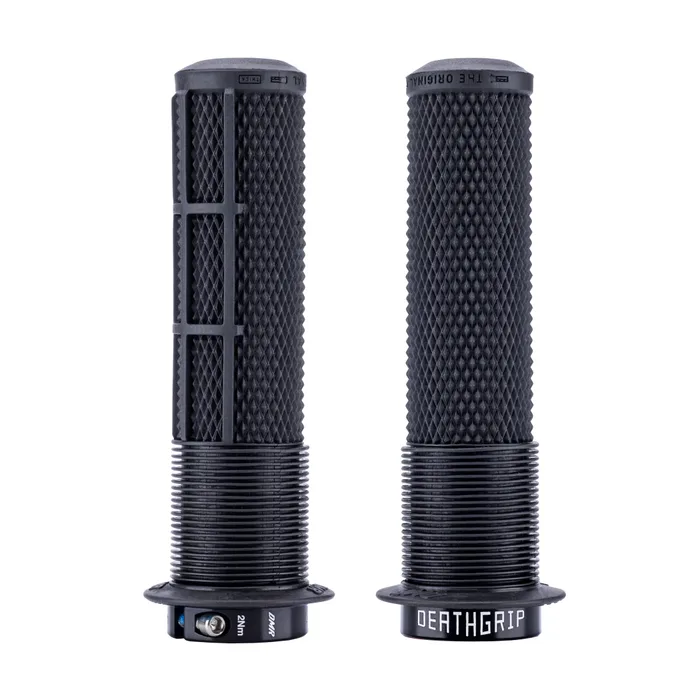
The best-specified lock-on grip you can buy, with published hardness, two diameters and a real torque figure.
Best for: Anyone who wants a trail or enduro grip they can choose by published diameter rather than by guesswork.
- DMR publishes a 20A durometer figure for the compound, which many rivals do not, plus a firmer 25A option on the Gum colour.
- Two genuine diameter options, 29.8 mm thin and 31.3 mm thick, so you can match the grip to your hand.
- A single slimline alloy lock ring with a stated 2 Nm torque and a stainless allen bolt makes install and removal simple.
- The 20A compound is soft, and soft compounds wear faster than hard ones.
- The lock ring still puts a hard alloy collar under the inboard edge of your hand.
- DMR quotes 100 g per pair but does not say which diameter that figure applies to.
- Needs at least 130 mm of clear, uncurved bar space per side, so cockpits with wide-bodied shifters may need controls moved.
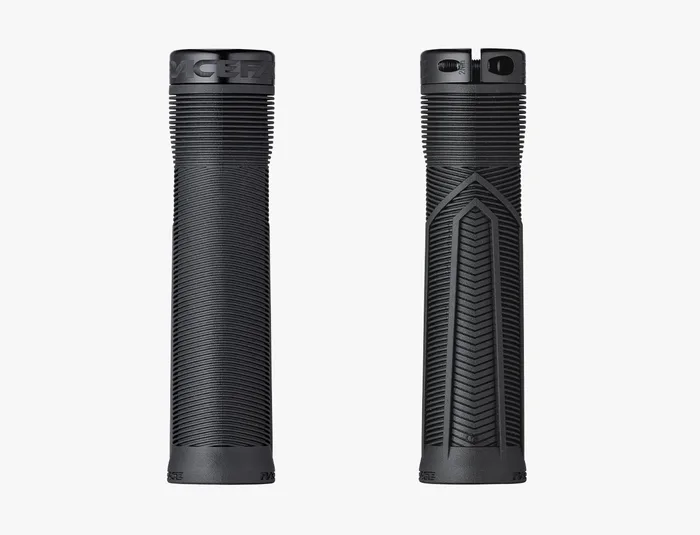
A budget lock-on that publishes 20A rubber, two diameters and pair weights, which is more than most premium grips manage.
Best for: Riders who want a large-diameter, soft lock-on grip without paying for a marquee name.
- External diameter is published as 31 mm or 34 mm, and 34 mm is a genuinely large option for big or gloved hands.
- Race Face states 20A durometer rubber, the same headline hardness as far pricier grips.
- Weights are published per pair at 112 g for the 31 mm and 135 g for the 34 mm.
- Race Face does not publish a clamp bolt torque on the product page, so you are left guessing at a number that matters.
- There is no diameter between 31 mm and 34 mm, which is a big jump if you sit in the middle.
- The perforated core puts more rubber under the palm but also means more material to compress and eventually tear.
- Some 34 mm colours were listed as sold out at the time of writing.
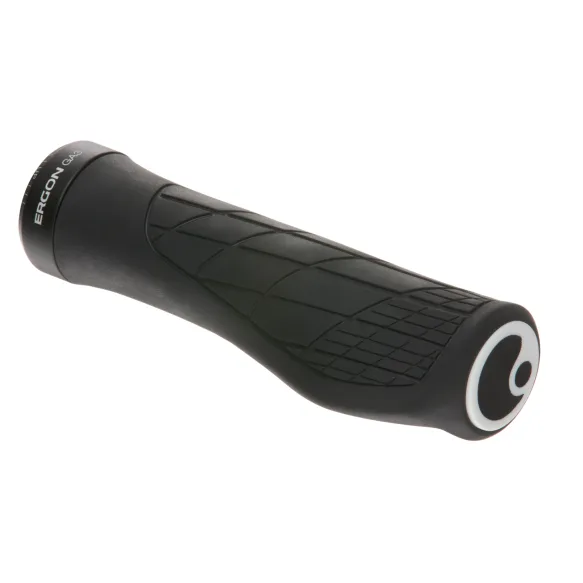
A wing-shaped grip that spreads hand load over more area, sized by glove size instead of by millimetres.
Best for: Long-distance trail, marathon and e-MTB riders whose hands go numb on a round grip and who ride in a settled hand position.
- The wing shape supports the outer edge of the palm rather than leaving all the load on a round tube.
- Ergon sizes it by hand, recommending Small for glove sizes 6.5 to 8.5 and Large for 8.5 to 10.5.
- The fitting manual gives an explicit 3 Nm clamp torque and states the bar must be approved by its maker for external clamping.
- Ergon publishes 115 g per pair and the rubber name but no outer diameter in millimetres and no durometer figure.
- A wing only works in one hand position, so it fights riders who constantly shift their hands on descents.
- It needs 129 mm of uncurved bar space per side, more than some narrow cockpits leave.
- Getting the rotational angle right takes several rides of fiddling, and a wing set wrong is worse than a round grip.
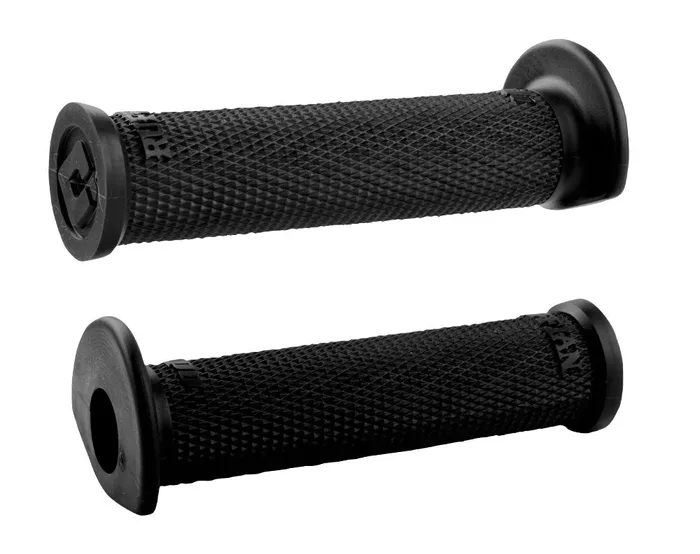
A thin, single-ply slide-on that is popular because it is cheap, and feels like it.
Best for: Dirt jump and pump track riders who want the thinnest possible bar feel and do not mind gluing grips on.
- ODI publishes the outer diameter at 29.5 mm, which is more than several premium brands do.
- With no plastic sleeve inside, the rubber sits directly on the bar in the classic slide-on way.
- A closed end means you do not need a separate bar plug.
- Single-ply construction means one thin layer of rubber between your palm and an aluminium tube, so trail buzz comes straight through.
- ODI itself recommends grip glue for adhesion and no slip in extreme conditions, which turns removal into a cutting job.
- At 125 mm it is shorter than the 135 mm DMR and 136 mm Race Face, leaving less room to move your hands.
- It is designed as an OE-style replacement, not as a comfort grip, and the slim low-profile knurl gives you no cushioning at all.
| Criteria | Deathgrip2 Flange Top pick | Chester Grips | GA3 | Ruffian ATV/MTB Single Ply Grips |
|---|---|---|---|---|
| Verdict | Buy it | Buy it | It depends | Skip it |
| Best for | Anyone who wants a trail or enduro grip they can choose by published diameter rather than by guesswork. | Riders who want a large-diameter, soft lock-on grip without paying for a marquee name. | Long-distance trail, marathon and e-MTB riders whose hands go numb on a round grip and who ride in a settled hand position. | Dirt jump and pump track riders who want the thinnest possible bar feel and do not mind gluing grips on. |
| Price tier | $$ · mid-range | $ · budget | $$ · mid-range | $ · budget |
| Attachment | Lock-on, single alloy collar | Lock-on, single anodised clamp | Lock-on, anodised aluminium clamp | Slide-on, grip glue recommended |
| Published outer diameter | 29.8 mm thin or 31.3 mm thick | 31 mm or 34 mm | Not published; Small and Large by glove size | 29.5 mm |
| Published durometer | 20A | 20A | Not published (GravityControl rubber) | Not published |
| Published length | 135 mm | 136 mm | Not published; needs 129 mm clear bar | 125 mm |
| Published weight per pair | 100 g, size not specified | 112 g at 31 mm, 135 g at 34 mm | 115 g | Not published |
| Stated clamp torque | 2 Nm | Not published on product page | 3 Nm (fitting manual) | No clamp |
| Shape | Round, flange or flangeless | Round, angled mushroom ribs | Wing profile with palm support | Round, low-profile diamond knurl |
| How you size it | Pick thin or thick | Pick 31 mm or 34 mm | Pick Small or Large by glove size | One size only |
Which one is right for you?
- Anyone who wants a trail or enduro grip they can choose by published diameter rather than by guesswork. Buy it DMR Deathgrip2 Flange
- Riders who want a large-diameter, soft lock-on grip without paying for a marquee name. Buy it Race Face Chester Grips
- Long-distance trail, marathon and e-MTB riders whose hands go numb on a round grip and who ride in a settled hand position. It depends Ergon GA3
- Dirt jump and pump track riders who want the thinnest possible bar feel and do not mind gluing grips on. Skip it ODI Ruffian ATV/MTB Single Ply Grips
How we judged the field
Five things decide whether a grip works for you, and only some of them are published. Attachment type comes first, because it sets everything else: a lock-on grip needs a rigid plastic liner and a metal collar, which caps how thick and how soft the rubber over it can be, while a slide-on grip has nothing between the rubber and the bar. Outer diameter comes second and matters most for comfort, since it decides how tightly your fingers have to curl to hold on. Rubber hardness, measured on the Shore A scale, comes third: softer damps better and wears faster. Length and required clear bar space come fourth, because a 136 mm grip does not fit a cockpit with only 125 mm of straight bar. Clamp torque comes fifth, and it is a safety spec rather than a comfort one, especially on carbon bars.
The field splits neatly along how much a brand is willing to publish. DMR and Race Face both state a 20A durometer figure, both offer two real diameter options, and both give lengths; DMR adds a torque number and a pair weight, and Race Face adds weights for each size. Ergon takes a different route, publishing weight, materials and a torque figure in its manual, but sizing its grips by glove size rather than millimetres and staying silent on durometer. At the bottom, most cheap slide-on grips publish a diameter and nothing else. We picked one grip from each of those positions, plus a genuinely popular cheap slide-on, so the comparison shows what the spec sheets actually tell you rather than what a group test says.
DMR Deathgrip2 Flange
Buy itThe Deathgrip2 is the update to the grip that set the template for the modern trail grip, and DMR has done the thing that makes it easy to recommend: published the numbers. The compound is stated at 20A durometer, the grip is 135 mm long, and you choose between a 29.8 mm thin and a 31.3 mm thick outer diameter, with or without a flange. A single slimline aluminium lock ring with a stainless allen bolt torques to 2 Nm, and DMR’s own instructions tell you not to exceed it and to tighten only enough that the grips will not rotate under force. The shape mixes a soft mushroom section under the thumb and forefinger, a diamond knurl through the middle and a waffle pattern on the underside for the fingertips. The trade-off is the usual one for a soft lock-on: 20A rubber feels excellent and does not last as long as a firmer compound, and the collar is still a hard ring sitting inboard of your hand. Fit it if you want a grip you can choose by diameter rather than by reputation.
Race Face Chester Grips
Buy itThe Chester is Race Face’s budget grip and it is specified better than plenty of grips costing considerably more. External diameter is published at 31 mm or 34 mm, the rubber is stated as 20A durometer, length is 136 mm, and weights are given as 112 g per pair in the 31 mm and 135 g in the 34 mm. Race Face lists it as a lock-on with a single anodised clamp, and the core is perforated so more rubber can sit between your hand and the bar, with the thickness concentrated under the palm. Angled mushroom ribs are the surface pattern. Two things hold it back from the top spot. The first is the gap in the range: there is nothing between 31 mm and 34 mm, which is a large step if your hand sits in the middle. The second is that Race Face does not publish a clamp bolt torque on the product page, which is exactly the figure you want before clamping anything to a carbon bar. Buy it if 34 mm suits your hands and you would rather spend the difference on tyres.
Ergon GA3
It dependsThe GA3 is Ergon’s mountain bike wing grip, and it asks you to think about grips differently. Instead of quoting a diameter, Ergon sizes it by hand: Small for glove sizes 6.5 to 8.5, Large for 8.5 to 10.5, with the reasoning that a larger hand fits a thicker grip better and a smaller hand a smaller one. It weighs a published 115 g per pair, uses what Ergon calls GravityControl rubber and an anodised aluminium clamp, and the fitting manual specifies 3 Nm on the clamp bolt plus 129 mm of uncurved bar space per side. The wing itself is the point: by widening the contact area under the outer palm, Ergon argues it reduces the pressure that a round grip concentrates on a small patch of hand. That case is coherent, and Ergon states it clearly, but the product pages do not present clinical trial evidence, and no grip should be sold as preventing nerve injury. The catch is positional. A wing helps only when your hands sit where the wing is. Riders who move their hands constantly on steep terrain will find it in the way. It suits long, seated, high-mileage riding.
ODI Ruffian ATV/MTB Single Ply Grips
Skip itThe Ruffian single-ply is a popular cheap grip, which is exactly why it is worth arguing about. ODI publishes a 29.5 mm diameter and a 125 mm length, calls it an OE replacement with a low-profile diamondised knurl, gives it a closed end so no bar plug is needed, and finishes the product page by recommending ODI Grip Glue for best adhesion and no slip in extreme conditions. Every one of those facts points the same way. Single ply means one thin layer of rubber between your palm and an aluminium tube, so there is almost nothing to absorb trail buzz. At 125 mm it is 10 mm shorter than the DMR and 11 mm shorter than the Race Face, which is less room to shuffle your hands. And a glued slide-on is a permanent fitting: you will be cutting it off with a knife. None of that is a design failure, because it was drawn as a slim, direct-feel OE-style grip for machines, not as a comfort item. It is just the wrong thing for someone shopping for a comfortable trail grip. Buy it for a dirt jump bike, not for a trail bike.
Sources
Specs in this review come from these pages.
- DMR Bikes - Deathgrip2 Flange Grips product page (dmrbikes.com)
- Race Face - Chester Grips product page (raceface.com)
- Ergon - GA3 grip product page (ergonbike.com)
- Ergon - GA3 fitting and torque manual (PDF) (ergonbike.com)
- Ergon - GP1 Evo product page, ulnar and median nerve explanation (ergonbike.com)
- ODI - Ruffian ATV/MTB Single Ply Grips product page (odigrips.com)
DMR Deathgrip2 Flange vs Race Face Chester Grips: which should you buy?
The Deathgrip2 and the Chester overlap more than their price tiers suggest. Both are single-clamp lock-ons, both state 20A durometer rubber, both are about 135 mm long, and both give you two diameters to choose from. The difference is where those diameters land and what else is published. DMR’s pair, 29.8 mm and 31.3 mm, are close together and sit in the middle of the market, so most hands will fit one of them and the choice between them is a fine adjustment. Race Face’s pair, 31 mm and 34 mm, straddle a much bigger range: 34 mm is a genuinely fat grip that suits large or gloved hands and heavy vibration, and there is nothing offered between the two.
Choose by hand size first. If you have small or medium hands, or you want the thin option, the Deathgrip2 gives you a 29.8 mm choice that Race Face does not, and DMR’s published 2 Nm torque takes the guesswork out of clamping to a carbon bar. If you have large hands, ride rough ground and want maximum cushioning on a budget, the 34 mm Chester is the more useful grip and its published pair weights let you see what that extra rubber costs you. If you are genuinely between the two, buy the Deathgrip2 in thick, because the 31.3 mm sits almost exactly where the 31 mm Chester does and the rest of the spec sheet is more complete.
What to look for
- Attachment type first: decide between a lock-on collar that cannot rotate and comes off in seconds, and a slide-on that carries thicker, softer rubber but needs glue or wire and usually has to be cut off.
- A published diameter in millimetres: it is the single spec that most changes comfort, and a brand that publishes it is letting you match the grip to your hand instead of guessing.
- A Shore A durometer figure if you can get one: DMR, Race Face and Wolf Tooth all state 20A on relevant grips, most brands state nothing, and a softer number means better damping and shorter life.
- The stated clamp torque, especially on carbon: published figures vary widely, from DMR’s 2 Nm to Wolf Tooth’s 2.5 Nm to Ergon’s 3 Nm on the GA3, so never assume one grip’s number applies to another.
- Length against your actual bar: the grips here run from 125 mm to 136 mm, Ergon’s GA3 manual asks for 129 mm of uncurved bar per side and DMR asks for 130 mm, so measure the straight section between your controls and the bar end before ordering.
- Whether the shape suits how you ride: a wing or ergonomic profile only supports your hand in one position, which helps on long seated rides and gets in the way if you constantly reposition your hands on steep descents.
Our final take
Grips are cheap enough that people buy them on colour and reputation, which is a shame, because two of the four numbers that matter are usually printed right there. Start with diameter and match it to your hand. Then decide whether you want the security and easy removal of a lock-on or the thicker, softer rubber a slide-on allows. Check the length against the straight part of your bar, and if you run carbon, find the maker’s torque figure and use a torque wrench rather than your wrist. The DMR Deathgrip2 does the most for the most people because it publishes all of that. The Race Face Chester gets you most of the way for less. Ergon’s GA3 is the specialist answer for hands that go numb on round grips, not a medical device.
Questions, answered
Lock-on or slide-on: which should I actually buy?
Lock-on grips clamp to the bar with a metal collar, so they cannot rotate and they come off with a hex key in seconds. The cost of that is real: the collar adds weight, it sits as a hard ring right under the inboard edge of your hand, and the rubber has to be moulded over a rigid plastic liner, so it is necessarily thinner than it could be. Slide-on grips have no liner, so the same outer diameter can carry noticeably more rubber and a softer feel. The trade is that they need glue, hairspray, isopropyl alcohol or safety wire to stay put, and removing them usually means cutting them off. For most trail riders the convenience and security of a lock-on is worth the small comfort penalty. If you chase maximum cushioning and do not mind the install ritual, slide-on is the better feel.
How do I pick the right grip diameter?
Diameter is the one grip spec that reliably changes comfort, and it is the one most people never check. Published outer diameters for mountain bike grips vary by several millimetres. A larger diameter means less grip force is needed to hold on, because your fingers are not curling as tightly, and it spreads pressure across more of the palm. Go too large for your hand and you get the opposite problem: you cannot wrap your fingers properly, so you squeeze harder and your forearms pump up. Smaller diameters give more precise bar feel and suit smaller hands, but transmit more vibration because there is less rubber. If you are unsure, measure the grips you already ride, note whether your hands cramp or go numb, and move one step in the corresponding direction.
Do I need to worry about torque on carbon handlebars?
Yes, and this is the one genuine safety issue in grip fitting. A lock-on collar clamps directly onto the outside of the bar, and carbon bars are far less tolerant of local crushing than aluminium ones. Makers publish real figures for exactly this reason: DMR specifies 2 Nm for the Deathgrip2 lock ring, Ergon specifies 3 Nm for the GA3, and Wolf Tooth lists 2.5 Nm for its lock-on grips. Ergon's fitting manual also states that only handlebars approved by their manufacturer for external clamping, and able to withstand the stated torque, should be used. Use a torque wrench rather than feel, tighten only enough that the grip will not rotate under force, and check your bar maker's own guidance before clamping anything to carbon.
Will ergonomic wing grips fix numb hands?
The mechanism they describe is plausible and the condition is real, but the evidence that a grip prevents it is thinner than the marketing implies. Ergon's own explanation is that a large share of your body weight rests on a small area of the grip, which can compress the ulnar nerve where it runs close to the surface near the little finger, and that a wing shape spreads that load over a wider area. Persistent numbness and weakness in the ring and little fingers from cycling is a recognised pattern sometimes called handlebar palsy. What manufacturers do not publish alongside these product pages is peer-reviewed clinical or biomechanical evidence that a specific grip shape prevents nerve injury. Treat a wing grip as one comfort variable among several, alongside bar roll, brake lever angle, glove padding and how much weight you put through your hands. If numbness lasts beyond a ride or you lose strength in your hand, see a clinician rather than buying another grip.
How do I get old grips off, and how often should I replace them?
Lock-on grips come off by loosening the collar bolt with a hex key, usually 3 mm, and pulling; a little air from a compressor or a squirt of alcohol under the liner helps if the liner has bonded. Slide-on grips are harder. If they were installed with glue you will almost certainly be cutting them off with a knife, which is why makers such as ODI recommend glue in the same breath as warning that it is permanent. Replace grips when the pattern is worn smooth, when the rubber tears or the end blows out, or when you find yourself gripping harder to keep hold in the wet. Soft compounds, roughly 20A on the Shore A scale, feel great and wear faster than firmer ones, so a soft grip may be an annual item on a bike ridden a lot.
Deciding between the top two? See our head-to-head: DMR Deathgrip2 Flange vs Race Face Chester Grips.
More Cycling reviews
 The Best Road Bikes for Beginners: 4 Compared (and One to Skip)
  The Best Spoke Wrenches: 4 Compared (and One to Skip)
  The Best Suspension Seatposts: 4 Compared (and One to Skip)
  The Best Bike Tire Levers: 4 Compared (and One to Skip)
  The Best Tubeless Sealants: 4 Compared (and One to Skip)
  The Best Tubeless Valves: 4 Compared (and One to Skip)