Explained
Hitch Bike Racks, Explained
After reading, you'll understand what your receiver size actually allows, how to read a per-bike weight limit without getting caught out, and why platform and hanging racks are not interchangeable.
In this guide
The two mistakes first-time buyers make are assuming a hitch rack fits any hitch, and assuming a weight limit is one number. Receivers come in different sizes and classes with very different ratings, and the same rack model is often rated lower in its 1.25 inch version than in its 2 inch version. Then there is the bike side: hanging racks need a straight top tube, which a lot of modern bikes simply do not have. Sorting out those three things before you shop eliminates most of the bad outcomes.
The 30-second version
- Receiver size changes the rating, so read the spec table for the exact version you are buying rather than the headline figure.
- The rack's own weight counts, because it comes off your vehicle's tongue weight allowance before any bike does.
- Platform racks carry the bike by its wheels, which is why they handle step-through, full-suspension and carbon frames without adapters.
- Adding trays lowers the per-tray limit, so a three- or four-bike setup usually carries less weight per bike than the two-bike version.
- Tilt is not universal, and the angle varies enough that some vehicles still cannot open a hatch with the rack loaded.
The products this guide is about
Our verdict on each, with the full reasoning on the companion review.
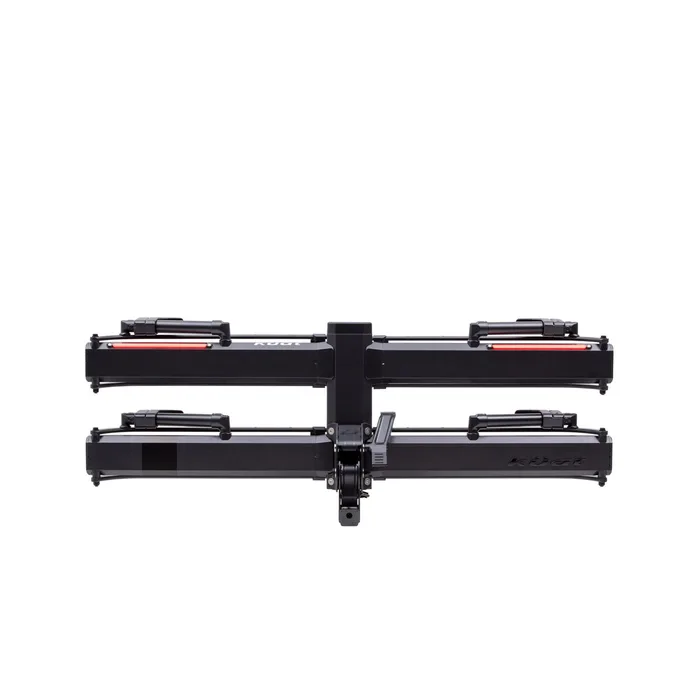
- Buy Kuat Piston Pro X A no-frame-contact platform rack with hydro-pneumatic tire arms, integrated tail lights and a 67 pound per-tray limit on a 2 inch receiver. Amazon
- Buy RockyMounts MonoRail Sixty pounds per tray in both receiver sizes on a 39 pound rack, which is the best capacity-to-weight trade in this group. Amazon
- It depends Yakima StageTwo Tiered trays and a 70 pound per bike road rating on 2 inch make it the family e-bike hauler, if your vehicle can live with 59 inches of rack. Amazon
- Skip Allen Sports Deluxe Hitch Bike Rack A cheap hanging rack rated to 35 pounds per bike, which rules out e-bikes and makes frame contact unavoidable. Amazon
What actually matters
- Per-bike weight limit - This is the number that decides whether an e-bike is allowed on the rack at all. It is published separately for each receiver size and it drops when you add trays, so check the figure for your exact configuration.
- Receiver size and class - A 1.25 inch receiver is typically a Class I or Class II hitch and a 2 inch receiver is typically Class III or higher, with much higher weight ratings. Some racks are sold only in a 2 inch version, and many add-on trays are 2 inch only.
- Tongue weight - Your hitch has a published downward-force rating, and rack plus bikes has to stay under it. Heavy racks eat a big share of a modest rating before you load anything.
- Frame contact versus wheel mount - Wheel-mount platform racks never touch the frame, which matters for carbon and for any bike without a straight top tube. Mast racks clamp the top tube and need an adapter bar for step-through and full-suspension frames.
- Wheelbase and tire width - Long e-bikes and cargo bikes can exceed a rack's wheelbase limit, and fat tires need a rack rated for the width. These are hard limits, not suggestions.
- Tilt and fold - Tilt lets you reach the back of the vehicle with the rack in place, and fold gets the rack out of the way when it is empty. Multi-position tilt gives more clearance than a single fixed angle.
- Lighting and plate visibility - A loaded rack can cover your tail lights and license plate, and rules on both vary by state. Some racks build in LED lights, but those need a trailer connector on the vehicle.
The specs, in plain English
Green flags vs red flags
Green flags
- The spec table lists a separate per-bike weight limit for the 1.25 inch and 2 inch versions rather than one number.
- Bikes are held by the wheels or tires, with no clamp touching the frame.
- The maker publishes wheelbase, tire width and wheel diameter limits, not just a bike count.
- The rack includes an anti-wobble bolt or wedge as standard rather than as an accessory.
- Locks for both the bikes and the receiver are included and keyed alike.
Red flags
- A single weight limit is quoted with no mention of which receiver size it applies to.
- The listing says 'fits most bikes' but does not publish wheelbase or tire width limits.
- An e-bike is shown in the product photos while the stated per-bike limit is below 50 pounds.
- The rack requires a frame adapter bar for common frame types and does not include one.
- Nothing is said about securing the rack to the receiver, which means the anti-theft hardware is an upsell.
Who's who: the brands
- Kuat - Known for premium platform racks with hydro-pneumatic tire arms, high per-tray weight limits and, on the Pro X, integrated LED tail lights.
- Thule - A long-established rack maker whose T2 Pro XTR platform rack publishes a 60 pound per-bike limit and a lever-operated tilt for rear access.
- Yakima - Best known for tiered StageTwo trays that stagger bikes to reduce interference, plus separate road, off-road and RV ratings for the same rack.
- RockyMounts - A brand that tends to price below the premium tier while keeping full wheel-mount capability and 5 inch tire clearance.
- Allen Sports - The dominant budget name, mostly hanging mast racks with folding arms and low per-bike weight limits.
How to read a listing without getting fooled
Start at the bottom of the listing, not the top. Find the specification table and look for four numbers: per-bike weight limit, total capacity, maximum wheelbase and maximum tire width. If the per-bike limit is quoted once with no receiver size attached, assume it is the 2 inch figure and go find the 1.25 inch number before you buy. Then check whether the limit you found applies to the two-bike configuration or the expanded one, because add-on trays lower it across the board. Cross-reference the wheelbase and tire figures against your actual bikes rather than against a category name, since 'e-bike compatible' is a marketing phrase and 53 inches is a measurement. Finally, look for what is included versus sold separately: locks, anti-wobble hardware, light boards and frame adapter bars are all sometimes accessories.
How much should you spend?
Budget-tier hitch racks are almost all hanging mast designs. They are light, they fold small, and their per-bike limits are low enough that e-bikes and heavy full-suspension bikes are out. Mid-range is where wheel-mount platform racks start, and it is the tier where most buyers should land, because the jump from frame-clamping to wheel-holding is the single biggest quality improvement available and it happens right here. Premium racks buy you higher per-bike limits, easier one-handed loading mechanisms, longer wheelbase and wider tire clearance, better locks, and occasionally integrated lighting. They also tend to weigh substantially more, which is a real cost on a vehicle with a modest tongue weight rating. If you carry two conventional bikes, mid-range is enough; if you carry an e-bike or four bikes, the premium tier stops being a luxury.
Questions, answered
Can I use a 2 inch rack on a 1.25 inch receiver with an adapter?
Adapters that step a 1.25 inch receiver up to accept a 2 inch shank exist, but they add leverage and stress at exactly the point where a loaded bike rack is already working hardest. The underlying hitch is still whatever class it was, with whatever tongue weight rating it had. If a rack is offered in a 1.25 inch version, buy that version rather than adapting the 2 inch one. If it is only offered in 2 inch, treat that as the maker telling you what the rack needs.
Do I need a hitch installed if my car does not have one?
Yes, and it is worth budgeting for properly. Aftermarket receiver hitches are available for most cars, crossovers and SUVs, and the installed class determines both the receiver size and the tongue weight rating you have to work with. On many smaller vehicles the only option is a 1.25 inch Class I or Class II hitch, which narrows your rack choices and lowers your ceiling. Confirm what class is available for your vehicle before you pick a rack, not after.
Does a hitch rack hurt fuel economy?
A loaded rack adds frontal area and drag behind the vehicle, so some effect is expected, though it is generally smaller than the effect of a roof rack carrying the same bikes. The size of the effect depends on vehicle shape, speed and how many bikes are loaded, and it is not something manufacturers publish per rack. The practical takeaway is to fold or remove the rack when it is empty, which is easier on a light rack than a heavy one.
How should I secure the rack and the bikes?
Two separate locks are doing two separate jobs. A receiver or hitch lock keeps someone from pulling the whole rack out of the hitch, and a cable lock or lock pods keep individual bikes attached to the rack. Better racks include both and key them alike so you carry one key. Treat any lock on a rack as a deterrent for opportunists rather than real security, and do not leave bikes on a rack overnight in a public lot.
Or jump to the head-to-head: Kuat Piston Pro X vs RockyMounts MonoRail.