

Cycling
The Best Hitch Bike Racks: 4 Compared (and One to Skip)
We compared four hitch-mount bike racks on the specs that decide whether your bikes travel safely: per-bike weight limit for each receiver size, how the bike is held, tilt access, fit range and locking.
The short version
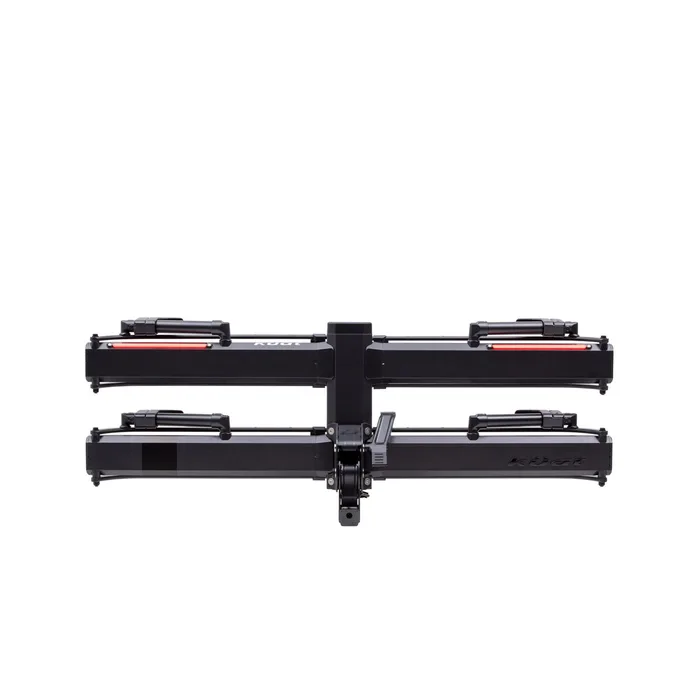
The Kuat Piston Pro X is the best overall: 67 pounds per tray on a 2 inch receiver, hydro-pneumatic arms that grab both wheels in one motion, and integrated LED tail lights nothing else here matches. The RockyMounts MonoRail is the value pick, listing 60 pounds per bike in both the 1.25 inch and 2 inch versions while weighing only 39 pounds. The Yakima StageTwo is the depends pick: it is rated to 70 pounds per bike on road with a 2 inch receiver and is the best choice for a family hauling three or four bikes behind a big vehicle, but it is 59 inches wide, 63 pounds, and rated much lower on a 1.25 inch hitch. Skip the Allen Sports Deluxe hanging rack, which tops out at 35 pounds per bike and holds bikes by the frame. Before you buy anything, check your receiver size and your vehicle's tongue weight rating, because the rack itself eats into it. Best for: anyone hauling two or more bikes regularly, especially if one of them is electric.
Our picks at a glance
- Kuat Piston Pro X - Buy. A no-frame-contact platform rack with hydro-pneumatic tire arms, integrated tail lights and a 67 pound per-tray limit on a 2 inch receiver.
- RockyMounts MonoRail - Buy. Sixty pounds per tray in both receiver sizes on a 39 pound rack, which is the best capacity-to-weight trade in this group.
- Yakima StageTwo - It depends. Tiered trays and a 70 pound per bike road rating on 2 inch make it the family e-bike hauler, if your vehicle can live with 59 inches of rack.
- Allen Sports Deluxe Hitch Bike Rack - Skip. A cheap hanging rack rated to 35 pounds per bike, which rules out e-bikes and makes frame contact unavoidable.
The verdict in 30 seconds
What mattered most
- Rack type
- Per bike, 2 inch receiver
- Per bike, 1.25 inch receiver
- Rack weight
- Max tire width
- Max wheelbase
Hitch racks split into two families that barely resemble each other. Platform (tray) racks carry each bike by its wheels on its own tray; hanging (mast) racks dangle bikes from a vertical post by the top tube. The gap between them has widened as e-bikes have gotten common, because per-bike weight limits are now the number that decides what you can actually carry. We pulled the published limits for each rack in each receiver size, since the same model is often rated lower on a 1.25 inch hitch than on a 2 inch one.
A no-frame-contact platform rack with hydro-pneumatic tire arms, integrated tail lights and a 67 pound per-tray limit on a 2 inch receiver.
Best for: Someone with a 2 inch receiver and at least one heavy bike who wants loading and locking to be effortless.
- Kuat rates the 2 inch two-bike version at 67 pounds per tray, enough for most single-battery e-bikes.
- Hydro-pneumatic arms clamp the front and rear tire in one motion, so a heavy bike goes on without wrestling straps.
- Integrated LED tail lights are built into the trays rather than bolted on, and add-on trays arrive pre-wired.
- The 1.25 inch version is rated to 60 pounds per tray, not 67, so the receiver size changes what you can carry.
- The 2 inch two-bike rack weighs 64 pounds, which makes solo mounting and off-season storage awkward.
- Add-on trays are 2 inch only, and fitting a third tray drops every tray to 50 pounds.
- The lights only work if the vehicle has flat 4-pin trailer wiring, which many cars do not.
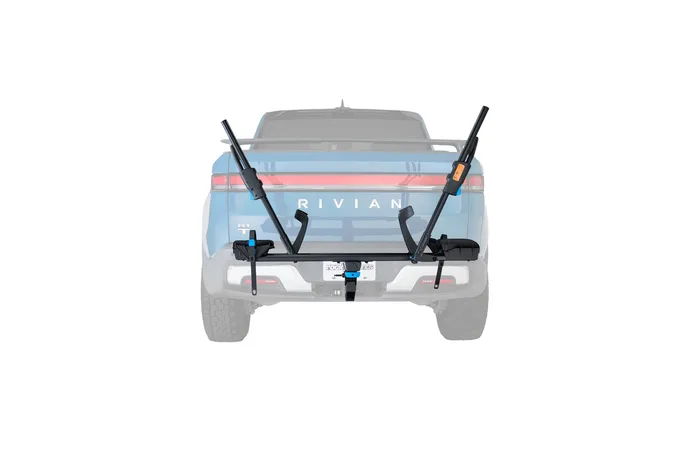
Sixty pounds per tray in both receiver sizes on a 39 pound rack, which is the best capacity-to-weight trade in this group.
Best for: The buyer who wants genuine e-bike-capable capacity without premium-tier weight or cost, especially on a 1.25 inch receiver.
- RockyMounts lists 60 pounds per bike for both the 1.25 inch and the 2 inch version, so the smaller receiver is not penalized.
- At 39 pounds it is the lightest rack here with a published weight, which matters every time you take it on or off the car.
- Takes 20 to 29 inch wheels and tires up to 5 inches wide with no separate fat bike kit.
- Wheelbase range stops at 50 inches, shorter than the Kuat and the Yakima.
- The third-tray add-on is 2 inch only and drops every tray to 45 pounds.
- The tilt is a single 30 degree position, so rear clearance is more limited than a multi-position tilt.
- There is no integrated lighting option, so the rack can obscure your tail lights with bikes on.
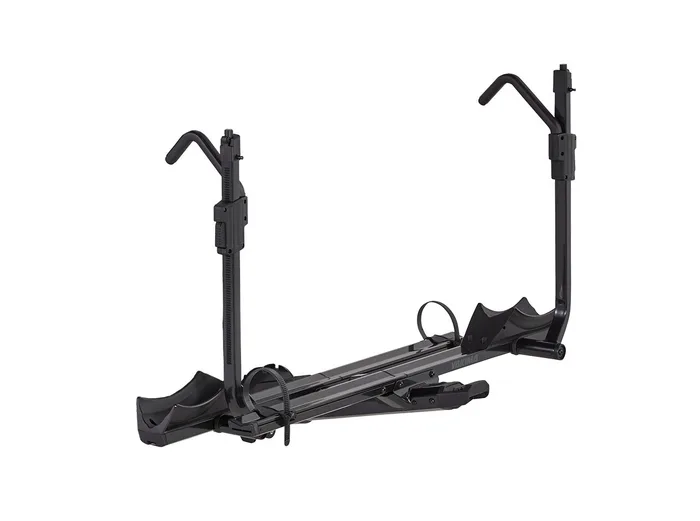
Tiered trays and a 70 pound per bike road rating on 2 inch make it the family e-bike hauler, if your vehicle can live with 59 inches of rack.
Best for: A household hauling three or four bikes, at least one of them electric, behind a full-size SUV or truck.
- Yakima rates the 2 inch version to 70 pounds per bike on road and approves it for RV use at the same figure.
- StadiumSeating tiered trays stagger the bikes so handlebars and saddles stop fighting each other.
- A remote three-position tilt lowers the rack for trunk access with the bikes still loaded.
- The 1.25 inch version is rated to 60 pounds per bike on road and 36 pounds off road, and Yakima does not approve it for RV use.
- It measures 59 inches wide and weighs 63 pounds, which is a lot of rack for a compact car or a tight garage.
- Off-road ratings drop sharply even on 2 inch, to 42 pounds per bike.
- The StageTwo +2 add-on is 2 inch only, so four-bike capability is off the table on a 1.25 inch hitch.
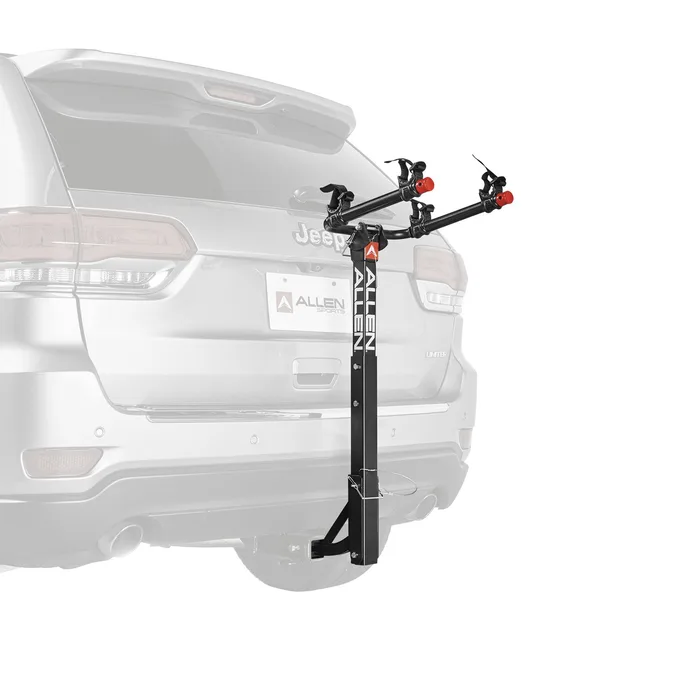
A cheap hanging rack rated to 35 pounds per bike, which rules out e-bikes and makes frame contact unavoidable.
Best for: Occasional short trips with two light, conventional-framed bikes when the alternative is leaving them home.
- Allen rates it at 35 pounds per bike, which is fine for kids' bikes and basic hybrids.
- The arms fold down and the rack tilts back for rear access, and it stores in almost no space.
- The 2- and 3-bike versions fit either a 1.25 inch or a 2 inch receiver, so it works on small cars.
- The 35 pound per bike limit excludes essentially every e-bike and many full-suspension mountain bikes.
- Bikes hang by the top tube, so step-through, sloping and full-suspension frames need an adapter bar and carbon frames should not be clamped this way.
- Bikes hang side by side and swing into each other on rough roads; the tie-down cradles reduce contact but do not eliminate it.
- The 4- and 5-bike versions require a 2 inch receiver, and locking is a separate model rather than a feature.
| Criteria | Piston Pro X Top pick | MonoRail | StageTwo | Deluxe Hitch Bike Rack |
|---|---|---|---|---|
| Verdict | Buy it | Buy it | It depends | Skip it |
| Best for | Someone with a 2 inch receiver and at least one heavy bike who wants loading and locking to be effortless. | The buyer who wants genuine e-bike-capable capacity without premium-tier weight or cost, especially on a 1.25 inch receiver. | A household hauling three or four bikes, at least one of them electric, behind a full-size SUV or truck. | Occasional short trips with two light, conventional-framed bikes when the alternative is leaving them home. |
| Price tier | $$$ · premium | $$ · mid-range | $$$ · premium | $ · budget |
| Rack type | Platform tray, no frame contact | Platform tray, no frame contact | Platform tray, no frame contact | Hanging mast, frame contact |
| Per bike, 2 inch receiver | 67 lb per tray | 60 lb per tray | 70 lb road, 42 lb off road | 35 lb per bike |
| Per bike, 1.25 inch receiver | 60 lb per tray | 60 lb per tray | 60 lb road, 36 lb off road | 35 lb per bike, 2- and 3-bike models only |
| Rack weight | 64 lb (2 in), 63 lb (1.25 in) | 39 lb | 63 lb | Not listed |
| Max tire width | 4.8 in on 18 to 29 in wheels | 5 in | 5 in | Not listed |
| Max wheelbase | 53 in on 18 to 29 in wheels | 50 in | 52 in | Not listed |
| Rear access | Foot pedal pivot | Tilts down 30 degrees | Remote three-position tilt, works with bikes loaded | Tilts back |
| Locks and extras | Cable lock plus hitch lock, integrated LED tail lights | Locking hitch bolt, cable lock and lock pods, keyed alike | Integrated SKS locks for bikes and receiver | Locking version sold as a separate model |
Which one is right for you?
- Someone with a 2 inch receiver and at least one heavy bike who wants loading and locking to be effortless. Buy it Kuat Piston Pro X
- The buyer who wants genuine e-bike-capable capacity without premium-tier weight or cost, especially on a 1.25 inch receiver. Buy it RockyMounts MonoRail
- A household hauling three or four bikes, at least one of them electric, behind a full-size SUV or truck. It depends Yakima StageTwo
- Occasional short trips with two light, conventional-framed bikes when the alternative is leaving them home. Skip it Allen Sports Deluxe Hitch Bike Rack
How we judged the field
Five things decide whether a hitch rack is right for you, and only one of them is how it looks. First is the per-bike weight limit, stated separately for each receiver size, because that is what rules an e-bike in or out. Second is how the bike is held: by the wheels on a tray, or by the frame on a mast, which determines whether step-through, full-suspension and carbon bikes can ride at all. Third is rear access, meaning whether the rack tilts far enough to open your hatch with bikes on it. Fourth is fit range, which is tire width, wheel diameter and wheelbase, and it is where fat bikes and long-wheelbase e-bikes get rejected. Fifth is what comes in the box for security and visibility: integrated locks, a locking hitch bolt, and whether the rack has lighting or leaves your tail lights covered.
The field splits along two lines. Platform racks dominate the serious end and hanging racks dominate the cheap end, and within platform racks the 1.25 inch and 2 inch versions of the same model are often rated differently. We picked four that cover the useful range: the Kuat Piston Pro X as the loaded-and-heavy specialist, the RockyMounts MonoRail as the light, honest value option that does not cut its rating on a small receiver, the Yakima StageTwo as the big-vehicle family hauler with a rating that swings hard between receiver sizes, and the Allen Sports Deluxe as the representative hanging rack, because it is the type most people buy first and the type most people should not.
Kuat Piston Pro X
Buy itThe Piston Pro X is the rack you buy when the bikes are heavy and loading should not be a chore. Each tray uses a pair of hydro-pneumatic arms that close onto the front and rear tires, so one press captures the bike without ever touching the frame. Kuat rates the 2 inch two-bike version at 67 pounds per tray, and it takes tires up to 4.8 inches and wheelbases to 53 inches on 18 to 29 inch wheels. The integrated LED tail lights are the feature nothing else here matches, though they only illuminate if your vehicle has a flat 4-pin trailer connector, and the add-on trays are pre-wired so a third bike does not mean rewiring. The trade-offs are weight and receiver size. The 2 inch rack is 64 pounds, which is a two-person job to hang on the car comfortably, and the 1.25 inch version drops to 60 pounds per tray. Add a third tray and every tray falls to 50 pounds. It is for the person with a 2 inch receiver, a heavy bike, and no patience for straps.
RockyMounts MonoRail
Buy itThe MonoRail is the value pick because it refuses to punish you for having a smaller receiver. RockyMounts lists 60 pounds per bike for both the 1.25 inch and the 2 inch version, which is unusual in a category where the smaller size is routinely rated lower. It is also the lightest rack here with a published weight, at 39 pounds, and that number matters more than people expect, because a rack you can lift off by yourself is a rack you actually take off between trips. It handles 20 to 29 inch wheels and tires up to 5 inches wide with no separate fat bike kit, holds bikes by the wheels rather than the frame, and ships with a locking hitch bolt, a cable lock and lock pods that are keyed alike. The limits are honest ones. Wheelbase tops out at 50 inches, the tilt is a single 30 degree position, and the third-tray add-on is 2 inch only and pulls every tray down to 45 pounds. For two bikes, including most single-battery e-bikes, it is enough rack.
Yakima StageTwo
It dependsThe StageTwo is very good and also a serious commitment of vehicle real estate. On a 2 inch receiver Yakima rates it to 70 pounds per bike on road and approves it for RV use at the same figure, the highest road rating in this group. Its StadiumSeating trays sit at staggered heights so two bikes stop trading paint at the bars and saddles, and a remote three-position tilt drops the whole rack for hatch access with the bikes still loaded. Then read the fine print, because this is the clearest example of why receiver size matters. On a 1.25 inch receiver the rating falls to 60 pounds per bike on road and 36 pounds off road, and Yakima does not approve that version for RV use. The rack is 59 inches wide and weighs 63 pounds, which is more than a small crossover or a narrow garage wants to deal with. Buy it if you are hauling three or four bikes behind something big. Look elsewhere if your vehicle or your storage is tight.
Allen Sports Deluxe Hitch Bike Rack
Skip itThe Allen Sports Deluxe is the rack most people meet first, and it is the one to walk past. It hangs bikes from a vertical mast by their top tubes, and Allen rates it at 35 pounds per bike. That figure is the whole story: it excludes essentially every e-bike, most full-suspension mountain bikes and plenty of heavier commuters. Frame contact is the second problem. Step-through frames, sloping compact frames and full-suspension bikes have no straight top tube to hang from, so you need an adapter bar, and carbon frames should not be clamped this way at all. Bikes also hang side by side and swing into each other on rough pavement, and while the individual tie-down cradles reduce that contact they do not remove it. The 4- and 5-bike versions require a 2 inch receiver, and locking is not a feature of this model, since Allen sells a locking version separately. If your bikes are light, old and conventional, it will get them there. Otherwise the money is better spent once.
Sources
Specs in this review come from these pages.
- Kuat, Piston Pro X product page and specifications (kuat.com)
- RockyMounts, MonoRail Hitch Bike Rack product page (rockymounts.com)
- Yakima, StageTwo Platform Hitch Bike Rack product page (yakima.com)
- Allen Sports, Deluxe Hitch Bike Rack product page (allen.bike)
- Thule, T2 Pro XTR 2-bike hitch rack specifications (thule.com)
- CURT Manufacturing, Types of Trailer Hitches and Hitch Classes (curtmfg.com)
Kuat Piston Pro X vs RockyMounts MonoRail: which should you buy?
The Piston Pro X and the MonoRail are both no-frame-contact platform racks that will carry a typical e-bike, and the honest difference between them is not capability but effort. The Kuat’s hydro-pneumatic arms mean you lift the bike into the tray and press one arm down; the rack does the clamping. It carries 7 more pounds per tray on a 2 inch receiver, takes a 53 inch wheelbase instead of 50, and has tail lights nothing else here offers. It is also 25 pounds heavier than the MonoRail, and every one of those pounds counts twice: once against your hitch’s tongue weight rating, and once every time you want the rack off the car.
Choose the Piston Pro X if you have a 2 inch receiver, you load heavy bikes often, and the rack is going to live on the vehicle most of the season. The lights alone justify it if your bikes routinely cover your tail lights. Choose the MonoRail if you have a 1.25 inch receiver, since it is the one platform rack here that does not cut its rating for the smaller size, or if you take the rack on and off frequently, or if you simply do not need the last 7 pounds of tray capacity. If you are carrying two conventional bikes and one modest e-bike, the MonoRail does the job and leaves you money for the hitch install.
What to look for
- Check the rating for your receiver size, not the headline number: the same model is often rated lower on a 1.25 inch hitch than on a 2 inch one, and the number on the marketing page is usually the 2 inch figure.
- Add the rack’s own weight to your math: a 63 pound rack consumes a large share of a modest tongue weight rating before you put a single bike on, so look up your vehicle’s rating and subtract.
- Prefer wheel-holding trays over frame clamps: wheel-mount platforms carry step-through, full-suspension and carbon frames without an adapter bar, and they keep clamping force off the frame entirely.
- Match wheelbase and tire width to your actual bikes: long-wheelbase e-bikes and cargo bikes exceed the 50 to 53 inch limits on some racks, and fat tires need a rack rated for 5 inches or a separate kit.
- Confirm the rack tilts far enough for your rear hatch: a single fixed tilt angle is less useful than a multi-position tilt, and some vehicles need a swing-away adapter regardless.
- Plan for lights and plate visibility: integrated tail lights need a 4-pin trailer connector on the vehicle, and if the rack has none you may need a light board or plate relocation bracket to stay legal.
Our final take
If you are carrying anything heavier than a basic hybrid, buy a platform rack and buy it for your actual receiver size. The Kuat Piston Pro X is the best of these four if you have a 2 inch hitch and want the loading to be nearly automatic, and its integrated lights solve a problem most racks ignore. The RockyMounts MonoRail is the smarter buy for most households, because it holds the same 60 pounds per bike whether your receiver is 1.25 or 2 inches and weighs 25 pounds less. The Yakima StageTwo earns its place only behind a big vehicle. The Allen Sports Deluxe is cheap for a reason: 35 pounds per bike and frame contact are limits you will run into fast.
Questions, answered
Do I need a 2 inch receiver to carry an e-bike?
Not always, but it helps more than any other single factor. Several racks publish a lower per-bike rating on the 1.25 inch version of the identical model: the Kuat Piston Pro X drops from 67 to 60 pounds per tray, and the Yakima StageTwo drops from 70 to 60 pounds per bike on road. A few racks do not penalize the smaller size at all, and the RockyMounts MonoRail lists 60 pounds per bike for both. The other half of the equation is your vehicle: a 1.25 inch receiver is usually a Class I or Class II hitch with a much lower tongue weight rating than a 2 inch Class III. Look up the published rating for your exact receiver size and subtract the rack's own weight before you count the bikes.
How do I know whether the rack plus bikes is too heavy for my hitch?
Add the rack's weight to the total weight of the bikes and compare that number to your vehicle's tongue weight rating, which is listed in the owner's manual and usually stamped on the hitch itself. This is where heavy racks bite you: a 63 or 64 pound rack has consumed a large share of a modest tongue weight rating before a single bike is on it. That is one reason the 39 pound RockyMounts MonoRail is easier to live with on smaller vehicles. Also respect the rack's own per-bike and total limits, which are separate numbers from the hitch rating. Whichever limit is lowest is your real limit.
Platform or hanging: which one should I actually buy?
Buy a platform rack unless budget is the only consideration. Platform racks hold each bike by its wheels on its own tray, which means no clamping force on the frame, no adapter bar for step-through or full-suspension bikes, and far less bike-to-bike contact. Hanging racks suspend bikes from a mast by the top tube, so any frame without a straight horizontal top tube needs a separate adapter bar, and carbon frames should not be clamped this way. Hanging racks are also where the low weight limits live: the Allen Sports Deluxe is rated at 35 pounds per bike. If you have an e-bike, a carbon frame, a step-through, or a full-suspension mountain bike, the decision is already made.
Can I open my hatch or tailgate with bikes on the rack?
Usually, but the amount of clearance varies a lot and you should check it against your specific vehicle. Yakima describes a remote three-position tilt on the StageTwo that lowers the rack for rear access with bikes loaded. Kuat's Piston Pro X uses a foot pedal pivot to fold the rack up or down. RockyMounts specifies a 30 degree tilt on the MonoRail for hatch access, which is less travel than a multi-position system. On a vehicle with a big rear-hinged hatch and a long swing arc, even a good tilt may not be enough, which is why swing-away hitch adapters exist as a separate purchase.
Will the rack block my tail lights and license plate?
It can, and that is a real legal exposure in some states. A loaded rack sitting behind the bumper often obscures the plate and can partially cover the tail lights, and requirements for plate visibility and lighting vary by state. The Kuat Piston Pro X addresses this directly with integrated LED tail lights in the trays, but they need a flat 4-pin trailer connector on the vehicle to work, and many cars do not have one from the factory. Most other racks solve it with an accessory light board or a plate relocation bracket. Check your own state's rules and budget for the accessory if your rack does not have lighting built in.
Deciding between the top two? See our head-to-head: Kuat Piston Pro X vs RockyMounts MonoRail.
More Cycling reviews
 The Best Mini Bike Pumps: 4 Compared (and One to Skip)
  The Best Entry & Mid-Level Mountain Bikes: 4 Compared (and One to Skip)
  The Best Mountain Bike Grips: 4 Compared (and One to Skip)
  The Best Road Bikes for Beginners: 4 Compared (and One to Skip)
  The Best Spoke Wrenches: 4 Compared (and One to Skip)
  The Best Suspension Seatposts: 4 Compared (and One to Skip)