

Outdoors & Fitness
The Best Chain Checkers: 4 Compared (and One to Skip)
We compared four chain wear gauges on the wear percentages each one reads, which modern chains the maker says it covers, and whether the design isolates pin wear from roller play.
The short version
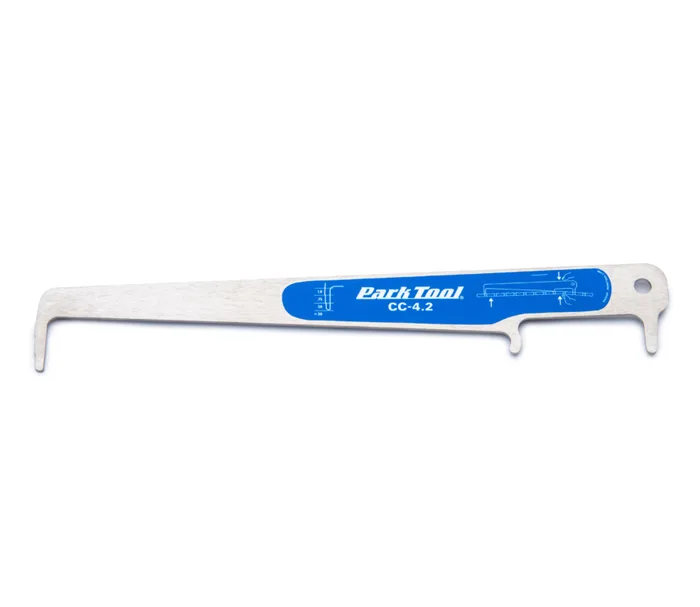
The Park Tool CC-4.2 is the one to buy. It reads 0.5, 0.75 and 1.0 percent wear, covers any 5 to 13-speed derailleur chain plus single-speed, and names the awkward modern ones including SRAM T-Type, SRAM Flattop, Shimano XTR 12-speed and Campagnolo Ekar 13-speed. The Pedro's Chain Checker Plus II is the better buy if you want more than a gauge, reading 0.5 and 0.75 percent with a three-point design that isolates pin wear from roller wear, and adding a chain hook and a chainring nut wrench. The Park Tool CC-2 is a pin-and-swing-arm gauge with a reading window that suits a workbench, but Park Tool directs Flattop and T-Type owners elsewhere. Skip the Park Tool CC-3.2 unless you know your chains are older: it stops at 12-speed and its own product page sends SRAM Flattop and T-Type owners to the CC-4.2. Best for: anyone who wants to stop replacing cassettes because they checked the chain too late.
Our picks at a glance
- Park Tool CC-4.2 Chain Checker - Buy. The gauge with the widest published chain coverage here, and the only one reading three wear thresholds.
- Pedro's Chain Checker Plus II - Buy. A three-point gauge that isolates roller wear, with a chain hook and a chainring nut wrench built in.
- Park Tool CC-2 Chain Checker - It depends. A pin-and-swing-arm gauge with a reading window, which suits a bench but leaves out SRAM's current chains.
- Park Tool CC-3.2 Chain Wear Indicator - Skip. A perfectly good gauge for chains that are no longer what most people are riding.
The verdict in 30 seconds
What mattered most
- Wear thresholds read
- Published speed coverage
- SRAM Flattop
- SRAM T-Type
- 13-speed
- Isolates roller wear
A chain checker is a cheap tool that decides an expensive question: replace a chain now, or replace a cassette and chainrings later. The catch in 2026 is that several well-regarded gauges predate the chains people are riding. Park Tool publishes a note on two of its own checkers telling SRAM Flattop and T-Type owners to use a different model, which is unusually candid and exactly the kind of limit that never appears on a packet. Park Tool makes most of this category, so three of the four here carry its name, and the fourth is the Pedro's tool that SRAM has approved for Eagle and Flattop chains.
The gauge with the widest published chain coverage here, and the only one reading three wear thresholds.
Best for: Anyone who owns a 12 or 13-speed drivetrain, or expects to soon.
- Indicates 0.5, 0.75 and 1.0 percent wear, so it suits modern and older chains from one tool
- Park Tool states it works on any 5 to 13-speed derailleur chain plus single-speed chains
- Names the difficult chains explicitly: SRAM T-Type, SRAM Flattop, Shimano XTR 12-speed and Campagnolo Ekar 13-speed
- A drop-in laser-cut gauge that contacts the chain in three places
- Park Tool does not publish a material for it
- A drop-in gauge is a reading you take rather than a measurement you can log over time
- Does nothing else, where the Pedro's tool includes two more functions
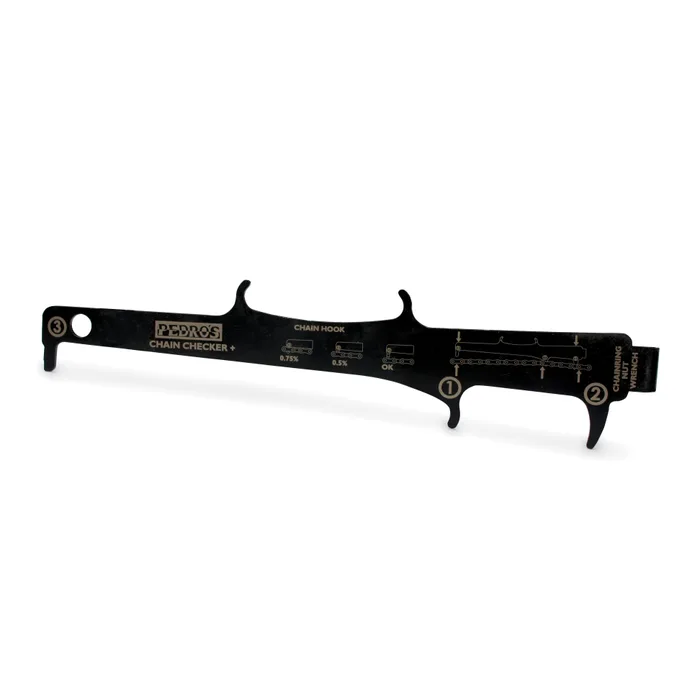
A three-point gauge that isolates roller wear, with a chain hook and a chainring nut wrench built in.
Best for: The home mechanic who would rather carry one tool that does three jobs.
- Precision laser-cut design measuring 0.5 and 0.75 percent chain wear
- Pedro's states the three-point design isolates pin wear from roller wear, which is where simple gauges overstate wear
- Approved by SRAM for use on Eagle 12-speed and Flattop chains
- Adds a chain hook tool and a chainring nut wrench, so one tool covers three jobs
- Reads two thresholds rather than the three on the CC-4.2
- No published coverage for 13-speed chains
- The SRAM approval is named for Eagle and Flattop, with nothing stated about T-Type
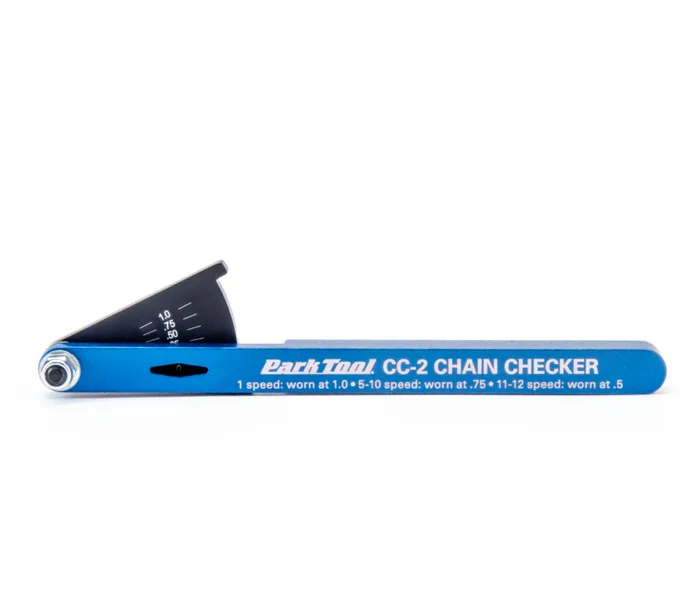
A pin-and-swing-arm gauge with a reading window, which suits a bench but leaves out SRAM's current chains.
Best for: A bench where you want a readable gauge rather than a pass or fail drop-in, and no SRAM Flattop or T-Type in the stable.
- Reads through a gauge window after the pins are inserted and the swing arm is pressed, rather than by feel
- Park Tool publishes replacement thresholds by chain type: 0.75 percent for 5 to 10-speed, 0.5 percent for 11 to 12-speed, 1 percent for single-speed
- Works with most single-speed and derailleur chains including Shimano XTR 12-speed
- Park Tool recommends the CC-4.2 instead for SRAM Flattop and T-Type 12-speed chains
- The most expensive tool here, for a job the cheap gauges also do
- No published material
- A bench tool in shape and size, where the drop-in gauges live in a jersey pocket
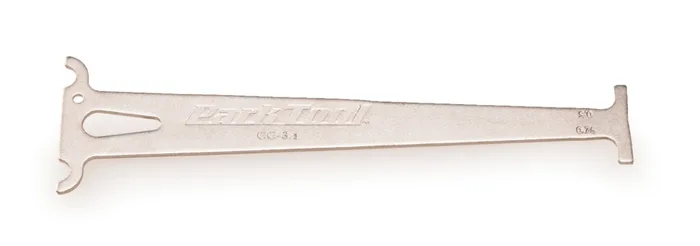
A perfectly good gauge for chains that are no longer what most people are riding.
Best for: A stable of 5 to 11-speed bikes with no SRAM Flattop or T-Type chain anywhere in it.
- Reads 0.5 and 0.75 percent wear, the two thresholds most chain makers publish
- Park Tool gives clear guidance on which threshold applies: 0.75 percent for 5 to 10-speed, 0.5 percent for 11 to 12-speed
- The cheapest way into measuring chain wear properly
- Park Tool's own page tells SRAM Flattop and T-Type 12-speed owners to use the CC-4.2 instead
- Published coverage stops at 12-speed, where the CC-4.2 reaches 13
- Reads two thresholds where the CC-4.2 reads three for a similar outlay
- The limits are invisible on the packet and only appear in the maker's own compatibility note
| Criteria | CC-4.2 Chain Checker Top pick | Chain Checker Plus II | CC-2 Chain Checker | CC-3.2 Chain Wear Indicator |
|---|---|---|---|---|
| Verdict | Buy it | Buy it | It depends | Skip it |
| Best for | Anyone who owns a 12 or 13-speed drivetrain, or expects to soon. | The home mechanic who would rather carry one tool that does three jobs. | A bench where you want a readable gauge rather than a pass or fail drop-in, and no SRAM Flattop or T-Type in the stable. | A stable of 5 to 11-speed bikes with no SRAM Flattop or T-Type chain anywhere in it. |
| Price tier | $ · budget | $ · budget | $$ · mid-range | $ · budget |
| Wear thresholds read | 0.5, 0.75, 1.0 percent | 0.5 and 0.75 percent | 0.5, 0.75, 1.0 percent by chain type | 0.5 and 0.75 percent |
| Published speed coverage | 5 to 13-speed plus single-speed | Not stated as a speed range | Most single-speed and derailleur chains | 5 to 12-speed |
| SRAM Flattop | Named as covered | SRAM approved | Use CC-4.2 instead | Use CC-4.2 instead |
| SRAM T-Type | Named as covered | Not stated | Use CC-4.2 instead | Use CC-4.2 instead |
| 13-speed | Campagnolo Ekar named | Not published | Not published | Not published |
| Isolates roller wear | Three contact points | Stated explicitly | Pin and swing arm gauge | Not published |
| Reading method | Drop-in gauge | Drop-in gauge | Gauge window | Drop-in gauge |
| Extra functions | None | Chain hook, chainring nut wrench | None | None |
Which one is right for you?
- Anyone who owns a 12 or 13-speed drivetrain, or expects to soon. Buy it Park Tool CC-4.2 Chain Checker
- The home mechanic who would rather carry one tool that does three jobs. Buy it Pedro's Chain Checker Plus II
- A bench where you want a readable gauge rather than a pass or fail drop-in, and no SRAM Flattop or T-Type in the stable. It depends Park Tool CC-2 Chain Checker
- A stable of 5 to 11-speed bikes with no SRAM Flattop or T-Type chain anywhere in it. Skip it Park Tool CC-3.2 Chain Wear Indicator
How we judged the field
Four things separate chain gauges, and price is not one of them. First is which wear thresholds the tool reads, because 5 to 10-speed chains are usually replaced at 0.75 percent and 11 to 12-speed chains at 0.5, and a tool that reads only one of those covers only some of your bikes. Second is published chain compatibility, which in 2026 means whether the maker names SRAM Flattop, SRAM T-Type and 13-speed chains rather than giving a bare speed range. Third is whether the design isolates roller play, since a gauge that rests on rollers reads worse than the chain actually is. Fourth is the reading method, which decides whether you get a pass or fail or a number.
The field is unusual in being dominated by one maker, so three of the four tools here are Park Tool and we have said so rather than padding the list with a brand we could not verify. What makes that workable is that Park Tool publishes compatibility notes against its own products, including telling SRAM Flattop and T-Type owners that two of these tools are not for them. The fourth is the Pedro’s Chain Checker Plus II, which approaches the roller problem explicitly and carries a SRAM approval for Eagle and Flattop chains.
The Park Tool CC-4.2 is the gauge to buy, and the reason is coverage rather than cleverness. It indicates three thresholds, 0.5, 0.75 and 1.0 percent, which means one tool suits an 11-speed road bike, a 9-speed commuter and a single-speed without you having to remember which number applies to which. Park Tool states it works on any 5 to 13-speed derailleur chain plus single-speed, and then does the thing that makes this category navigable: it names the chains that give gauges trouble, listing SRAM T-Type, SRAM Flattop, Shimano XTR 12-speed and Campagnolo Ekar 13-speed. It is a laser-cut drop-in gauge that contacts the chain in three places, which is the geometry that keeps roller play out of the reading. The limits are modest. Park Tool publishes no material for it, and a drop-in gauge gives you a threshold rather than a number you can track across a season. For a tool in the budget tier that covers every chain most people will own for years, neither matters much. Best for: any modern drivetrain.
The Pedro’s Chain Checker Plus II makes a different argument, which is that a chain gauge should not be the only thing in your hand. It measures 0.5 and 0.75 percent with a precision laser-cut design, and Pedro’s is explicit that the three-point geometry isolates pin wear from roller wear, naming the failure mode rather than leaving you to infer it. It carries a SRAM approval for Eagle 12-speed and Flattop chains, which is worth more than a generic speed range given how much trouble Flattop causes elsewhere in this comparison. Then it adds a chain hook, for holding a chain together while you work, and a chainring nut wrench, for the slotted nuts behind a chainring bolt that nothing else in a toolkit fits. Against the CC-4.2 it reads one fewer threshold and publishes nothing about 13-speed or T-Type. If your bikes are 12-speed or below, that gap is theoretical and the two extra tools are not. Best for: one pocket tool covering three small jobs.
The Park Tool CC-2 is the bench instrument of the group and the one whose appeal is tactile. Instead of dropping a gauge into the chain, you insert its pins into two links, press a swing arm, and read the result through a gauge window. That is a more deliberate measurement than a pass or fail drop-in, and it suits anyone who wants to see where a chain sits rather than whether it has crossed a line. Park Tool publishes the thresholds by chain type, 0.75 percent for 5 to 10-speed, 0.5 percent for 11 to 12-speed and 1 percent for single-speed, and states compatibility with most single-speed and derailleur chains including Shimano XTR 12-speed. The catch is the same one that sinks the CC-3.2: Park Tool recommends the CC-4.2 instead for SRAM Flattop and T-Type. It is also the priciest tool here, which is hard to justify when the CC-4.2 covers more chains for less. Best for: a bench with no SRAM Flattop or T-Type in the stable.
The Park Tool CC-3.2 is a good tool aimed at a drivetrain landscape that has moved. It reads 0.5 and 0.75 percent, Park Tool gives clear guidance on which threshold applies to which chain, and it is the cheapest honest way to measure chain wear rather than guess. The problem is written on its own product page. Published coverage stops at 12-speed, where the CC-4.2 reaches 13, and Park Tool directs SRAM Flattop and T-Type 12-speed owners to the CC-4.2 instead. That is not a small carve-out: Flattop is on SRAM’s current road groupsets and T-Type is its transmission chain, so between them they cover a lot of new bikes. For a similar outlay the CC-4.2 reads three thresholds instead of two and names every chain this one excludes. The only scenario where the CC-3.2 is the right purchase is a household of older bikes you are confident about. Best for: 5 to 11-speed drivetrains, and nothing newer.
Park Tool CC-4.2 Chain Checker vs Pedro’s Chain Checker Plus II: which should you buy?
The CC-4.2 and the Chain Checker Plus II are both cheap, both accurate in the way that matters, and they differ on what else you want in your hand. The Park Tool reads a third threshold at 1.0 percent and publishes the broadest compatibility in this comparison, reaching 13-speed and naming Campagnolo Ekar alongside both awkward SRAM chains. If your drivetrain is new, or you want one gauge that will still be right in five years, that is the safer buy.
The Pedro’s answers a more practical question. It measures the two thresholds nearly everyone needs, states plainly that its three-point design keeps roller play out of the reading, and holds a SRAM approval for Eagle and Flattop. Then it adds a chain hook and a chainring nut wrench, neither of which you own and both of which you will want eventually. For a 12-speed bike or older, it is arguably the better value, because the coverage you give up is coverage you will not use and the tools you gain are ones you would otherwise buy separately. Pick the Park Tool for breadth, the Pedro’s for utility.
What to look for
- Check which thresholds it reads: 5 to 10-speed chains are usually replaced at 0.75 percent and 11 to 12-speed at 0.5, so a single-threshold tool only covers some bikes.
- Look for named chains, not a speed range: SRAM Flattop and T-Type behave differently in a gauge, and makers who handle them say so by name.
- Three contact points beat two: a gauge resting on rollers includes roller play in the reading and tells you the chain is worse than it is.
- Read the maker’s own compatibility note: Park Tool sends Flattop and T-Type owners away from two of its own tools, which no packet would tell you.
- Decide if you want a number or a verdict: drop-in gauges give a threshold, a windowed gauge gives you something you can track.
- Combination tools earn their place: a chain hook and a chainring nut wrench are things you will need and are unlikely to buy on their own.
Our final take
Buy the Park Tool CC-4.2. It is a budget-tier tool that reads three wear thresholds, covers 5 to 13-speed plus single-speed, and names every chain that gives other gauges trouble, including both SRAM chains that its own siblings cannot handle. If your drivetrain is 12-speed or older and you would rather have three tools than one, the Pedro’s Chain Checker Plus II is the better buy, with a design that explicitly isolates roller wear and a SRAM approval for Eagle and Flattop. Take the CC-2 only if you want a readable gauge on a bench and own no SRAM Flattop or T-Type. Leave the CC-3.2 unless you know every chain in the house is 11-speed or older.
Questions, answered
What does 0.5 percent chain wear actually mean?
It is how much longer the chain has become than its nominal length, measured across a set number of links. Chains do not literally stretch; the pins and the insides of the rollers wear, and the gaps add up. At 0.5 percent a worn chain has started to sit differently on the cassette teeth, which is why 11 and 12-speed makers set replacement there while 5 to 10-speed chains are usually given until 0.75 percent.
Why do some gauges overstate wear?
Because a simple two-point gauge rests on the rollers, and rollers have play of their own that is not pin wear. Push the gauge in and the roller moves, and the reading includes that movement. A three-point design supports the chain so roller play is taken out of the measurement, which is what Pedro's describes on the Chain Checker Plus II and what Park Tool's three contact points on the CC-4.2 are doing.
Does my SRAM chain really need a different gauge?
Park Tool says so on its own product pages, which is the clearest answer available. Both the CC-2 and the CC-3.2 pages direct SRAM Flattop and T-Type 12-speed owners to the CC-4.2 instead. Flattop in particular has an asymmetric profile that does not sit in a gauge like a conventional chain. If you run either, buy a tool whose maker names it.
How often should I check?
Often enough that you catch 0.5 percent rather than discover 1 percent. For most riders that means every few hundred miles, or any time the drivetrain starts skipping under load. The check takes seconds, which is the point of owning a gauge: chains are cheap and cassettes and chainrings are not, and a chain left past its threshold wears the teeth it runs on.
Is a checker worth it if I only have one bike?
Yes, and arguably more so. Replacing a chain on time costs a chain. Replacing it late costs a chain, a cassette and sometimes chainrings, because a worn chain reshapes the teeth it meshes with. The gauges here sit in the budget tier, so one avoided cassette pays for the tool several times over.
Deciding between the top two? See our head-to-head: Park Tool CC-4.2 Chain Checker vs Pedro's Chain Checker Plus II.
More Outdoors & Fitness reviews
 The Best Chain Lubes: 4 Compared (and One to Skip)
  The Best Chain Whips: 4 Compared (and One to Skip)
  The Best Chainsaw Chaps: 4 Compared (and One to Skip)
  The Best Chainsaws for Homeowners: 4 Compared (and One to Skip)
  The Best Climbing Chalk: 4 Compared (and One to Skip)
  The Best Climbing Harnesses: 4 Compared (and One to Skip)