Explained
Chain Lube, Explained
After reading, you'll understand what separates the five chain lube families, why drivetrain efficiency and drivetrain wear are different results, and what a new chain needs before any lubricant will work properly.
In this guide
Almost everything that goes wrong in this category goes wrong before the bottle is opened. New chains arrive coated in a thick factory grease, most lubricants cannot get through it, and applying a good product on top of it produces a mixture that does neither job. The second trap is reading marketing watt claims as though they were wear claims. They are not the same measurement, they come from different machines, and a lubricant can look excellent on one and terrible on the other. The third is assuming a wet lube is the safe all-rounder, when in dusty conditions it is the one thing you should not use.
The 30-second version
- Strip the chain first, because factory grease blocks almost every lubricant from reaching the pin and roller surfaces that actually need it.
- Wear and efficiency are two tests, and a lube that measures fast in a clean lab run can still be the one destroying your cassette.
- Wet lube is a specialist tool, brilliant at surviving rain and terrible at anything dusty, because it collects grit and keeps hold of it.
- Immersion wax wins on wear, because a hot bath resets contamination every time, which no amount of dripping can replicate.
- Cure time is part of the product, so the wax family generally means lubing after your ride rather than fifteen minutes before the next one.
The products this guide is about
Our verdict on each, with the full reasoning on the companion review.
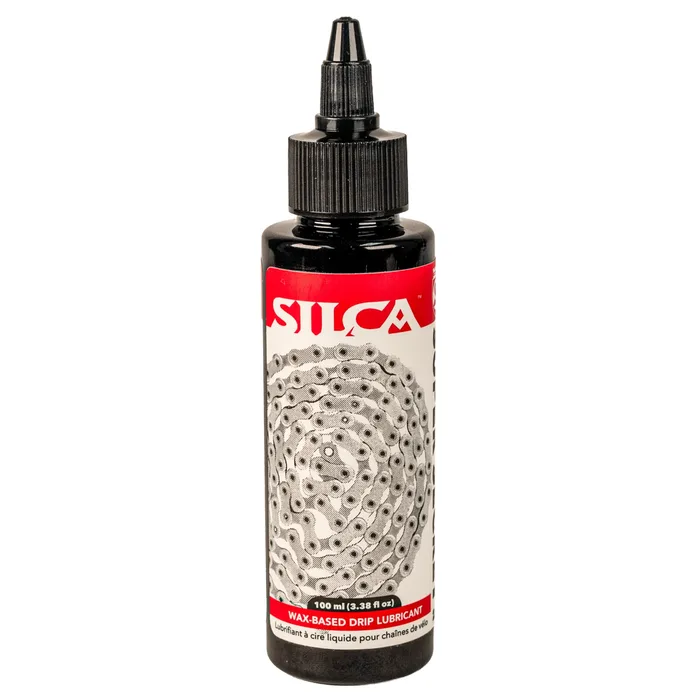
- Buy SILCA Super Secret 2.0 Chain Lube A drip-on wax coating with tungsten disulfide that behaves like hot melt wax without the pot, provided you strip the chain first and give it time to cure. Amazon
- Buy Squirt Cycling Products Long Lasting Chain Lube The original wax and water emulsion: cheap, clean, biodegradable, and a genuine step up from the oil-based dry lubes it sits next to on the shelf. Amazon
- It depends Molten Speed Wax MSPEEDWAX 1.15 lb (520 g) Immersive hot melt paraffin with tungsten disulfide and molybdenum disulfide, which produces wear results well ahead of the drip lubes here, at the cost of a genuine process. Amazon
- Skip Muc-Off C3 Dry Weather Ceramic Lube A very widely stocked premium-priced dry lube with UV dye in the formula, which the independent long-duration wear data does not support. Amazon
What actually matters
- Chain preparation - Factory grease is a shipping and storage lubricant, not a performance one, and independent wear testing has it running several times the wear rate of a top drip lube even on a clean test block. Every lubricant maker in this guide instructs you to fully degrease before first use.
- Contamination resistance - The thing that wears a drivetrain is not the lubricant, it is the abrasive grit suspended in it. The best long-duration test protocol deliberately never cleans the chain, so the wear result reflects how well the lubricant refuses to become grinding paste.
- Drivetrain efficiency - Measured in watts of loss on a purpose-built rig, usually at 250 watts of input. Differences between good lubricants on a clean chain are typically two or three watts, which matters to racers and almost nobody else.
- Treatment lifespan - How far one application lasts before friction and wear start climbing. It varies enormously by conditions, and the honest makers publish a range or a distance rather than a single flattering number.
- Reset ability - Whether you can get contamination back out once it is in. Immersion wax resets completely at every re-wax; drip products need an off-the-bike solvent flush through several baths, which is why almost nobody does it.
- Application effort - Cure time, whether the chain comes off the bike, and whether special equipment is needed. This is the factor that most often decides whether someone actually keeps up the routine.
- Conditions match - Dusty, wet and mixed riding punish different families differently, and the single most common mistake is running a wet oil year-round on a bike that mostly sees dry dirt.
The specs, in plain English
Green flags vs red flags
Green flags
- The maker publishes a reapplication interval in miles or kilometres rather than just saying 'when needed'.
- The instructions tell you to fully degrease the chain before the first application, which means the formula is designed to bond to bare metal.
- The product family matches your conditions: wax or coating drip for dusty riding, and a plan for resetting contamination if you ride wet.
- The friction figures quoted come from an independent lab rather than the manufacturer's own rig.
- The maker states a cure or set time, which is a sign the coating is actually forming rather than just sitting there wet.
Red flags
- Marketing that quotes a large watt saving without naming who measured it or under what protocol.
- A premium-priced dry lube with no published reapplication interval at all.
- Claims that a lubricant 'cleans as it lubricates' or 'repels dirt and grime' with no wear data behind them.
- Advice to leave factory grease on a new chain, which no lubricant maker's own instructions support.
- Waxing instructions that tell you to soak a chain in solvent without mentioning that some chain makers warn against cleaning baths.
Who's who: the brands
- SILCA - Builds a full wax system, from a hot melt blend and a waxing pot to the Super Secret drip coating and dedicated chain strippers for factory grease.
- Squirt Cycling Products - Maker of the original wax and water emulsion drip lube, with a separate low-temperature version for riding below freezing.
- Molten Speed Wax - Specialist that sells essentially one thing, immersive hot melt paraffin with solid lubricant additives, plus the pots and tools to use it.
- Muc-Off - The most visible brand in bike care, with a very broad chain lube range and heavy marketing, including UV dye in the formula for checking coverage.
- Finish Line - Long-established maker covering the whole spread, from classic wet and dry oils to wax products.
How to read a listing without getting fooled
Start by working out which family a product belongs to, because the label rarely says plainly. 'Dry' on a bottle usually means a thin oil, not a wax, so read the description for words like emulsion, coating, paraffin or hot melt. Next, look for a stated reapplication interval in distance; a range like 30 to 300 miles is honest about how much conditions matter, while no figure at all is a gap worth noticing. Then check the preparation instructions, because if a maker asks for a full degrease you know the formula needs bare metal, and you should budget for that before your first ride. Finally, separate the two performance claims. A watt figure describes friction on a clean chain in a lab; it says nothing about how the lubricant behaves once grit gets in. If a page quotes watts but nothing about wear or contamination, you have only been told half of the story.
How much should you spend?
Budget bottles buy you a wax emulsion or a conventional oil, and at this tier the emulsion is the better buy because it does not build abrasive paste. Mid-range covers the mainstream branded dry and ceramic lubes, along with a bag of hot melt wax, and it is the tier where price correlates worst with independent results: some of the most expensive-feeling dry lubes sit near the bottom of the wear tables. Premium is where the chain coating drip waxes live, and they are only worth it if you have a drivetrain expensive enough that extending its life pays for the bottle several times over. The genuinely useful way to think about cost is per kilometre of drivetrain life rather than per bottle, because cassettes and chainrings cost far more than any lubricant, and a cheap bottle that halves your chain life is not cheap. Immersion waxing sits oddly in this framing: the wax itself is inexpensive per treatment, but you are also buying a slow cooker and spending the time.
Questions, answered
Can I switch brands or mix lubricants?
You can switch, but you should not layer. Wax and oil do not mix, and putting an oil-based lube on a waxed chain contaminates the wax coating and turns it into a sticky dirt magnet. When changing families, strip the chain fully with solvent first and start clean. Some chain coating drip waxes are deliberately formulated to be compatible with hot melt wax, so those two can be used together as a system.
Is soaking a chain in solvent safe? SRAM says not to.
This is a genuine conflict, and it is worth knowing before you start. SRAM's chains user manual says to clean the chain with biodegradable cleaners only, and carries a warning marked CRASH HAZARD: do not use alkaline or acidic solvents, and do not soak or store the chain or cassette in a bath of any cleaning product, because the parts can become brittle and break under load. That is broader than the usual prep advice, which uses neutral organic solvents such as mineral spirits or white spirits followed by denatured alcohol, none of which are alkaline or acidic. KMC publishes no comparable warning and describes thoroughly degreasing a new or used chain as the normal first step for hot waxing. The practical read: on a SRAM chain you are choosing between following the manufacturer and stripping it anyway, and if you do strip, use neutral organic solvents, keep soak times short, and never leave a chain sitting in a cleaner.
How do I tell a worn chain from a merely dry one?
A dry chain announces itself with noise and rough shifting, and a fresh application fixes it. A worn chain does not get better with lubricant, and only a wear gauge or a ruler will tell you. 11 to 13-speed chains are usually considered finished at 0.5 percent elongation, and 5 to 10-speed at 0.75 percent, and running past that point starts transferring the wear into the cassette and chainrings. Checking every few hundred kilometres is cheap insurance, because replacing a chain on time is far less expensive than replacing everything it meshes with.
Are e-bikes and single-speeds different?
E-bike drivetrains apply much higher torque through the same chain, which shortens every treatment interval and accelerates wear, and several makers now sell e-bike specific formulas with high-pressure additives. Single-speeds have no rear derailleur, so the chain sees less articulation and generally lasts longer, but the lubrication principles are unchanged. In both cases the family choice matters more than the specific bottle: dusty riding still argues against wet oil, and a clean chain still outperforms a dirty one with better lube on it.
Or jump to the head-to-head: SILCA Super Secret 2.0 Chain Lube vs Squirt Cycling Products Long Lasting Chain Lube.