

Outdoors & Fitness
The Best Chain Breakers: 4 Compared (and One to Skip)
We compared four bicycle chain tools on the chain speeds each maker actually lists, whether the pin and bridge can be replaced, and which ones can peen a Campagnolo rivet.
The short version
The Park Tool CT-3.3 is the one to buy for most home workshops. It covers 5 to 12-speed derailleur chains including SRAM T-Type and Flattop, adds single-speed widths the mini tools leave out, and its driving pin is a replaceable part. The Pedro's Pro Chain Tool 3.2 is the pick if you run Campagnolo or want headroom, because it includes a peening bit and backer for Campagnolo 11, 12 and 13-speed chains that the Park Tool explicitly cannot peen, and its bridge is replaceable too. The Park Tool CT-5 Mini Chain Brute is the one to carry rather than the one to own, at 77 grams with the same 5 to 12-speed coverage but no 3/16 inch or half-link support. Skip the Pedro's Tutto Chain Tool II unless you are running a shop, because the CT-3.3 does what almost every home mechanic needs for a lot less tool. Best for: anyone who has bent a driving pin and wants to know which tool will not do it again.
Our picks at a glance
- Park Tool CT-3.3 Chain Tool - Buy. The bench tool that covers nearly every chain in a home workshop, with a driving pin you can buy again.
- Pedro's Pro Chain Tool 3.2 - Buy. The one that peens Campagnolo rivets and keeps going when drivetrains add another sprocket.
- Park Tool CT-5 Mini Chain Brute Chain Tool - It depends. A 77 gram tool with most of the bench tool's chain coverage, as long as you do not need the single-speed widths it leaves out.
- Pedro's Tutto Chain Tool II - Skip. A genuinely excellent shop tool that almost every home mechanic is buying past the point of usefulness.
The verdict in 30 seconds
What mattered most
- Derailleur chain speeds
- Single-speed widths
- Named modern chains
- Peens Campagnolo rivets
- Replaceable driving pin
- Replaceable bridge
A chain tool is the one workshop tool that fails in a way you notice immediately: a bent or snapped driving pin, usually on a chain the tool was never rated for. Drivetrains have moved to 12 and 13 speeds while plenty of tools on shelves still describe themselves in 10-speed terms, so the compatibility line on the maker's own page matters more here than the feel of the handles. We looked at what Park Tool and Pedro's publish for four current tools, and at two things owners only discover later: whether the driving pin is a replaceable part, and whether the tool can peen a Campagnolo rivet at all.
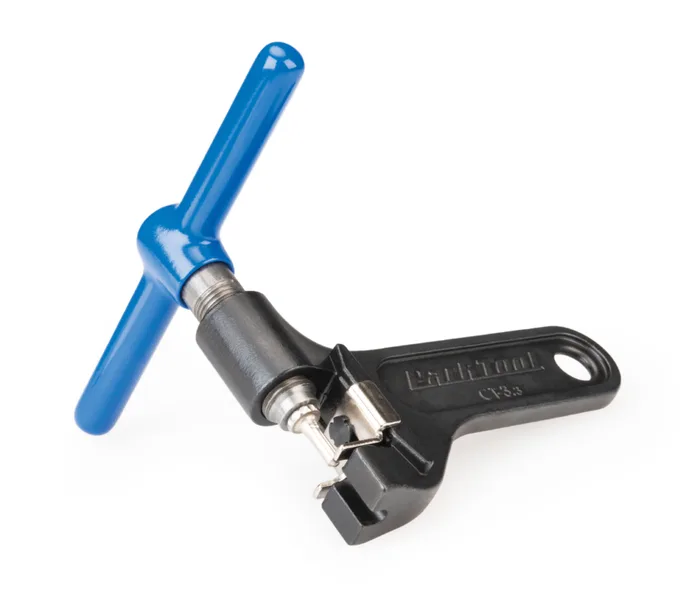
The bench tool that covers nearly every chain in a home workshop, with a driving pin you can buy again.
Best for: The home mechanic who wants one chain tool on the bench and does not run Campagnolo.
- Park Tool lists compatibility with all 5-speed to 12-speed chains including SRAM T-Type, SRAM Flattop and Shimano XTR 12-speed
- Also covers single-speed chains in 1/8 inch, 3/16 inch and half-link, which the mini tools in this comparison do not
- Replaceable driving pin sold as part CTP, so a bent pin is a spare rather than a new tool
- A floating locating shelf that Park Tool says suits any width of chain
- Park Tool states it will install and remove but not peen Campagnolo 11, 12 and 13-speed rivets
- No weight published, and the cast body is a bench tool rather than something to carry
- Nothing published about handling 13-speed chains, where the Pedro's tools claim coverage
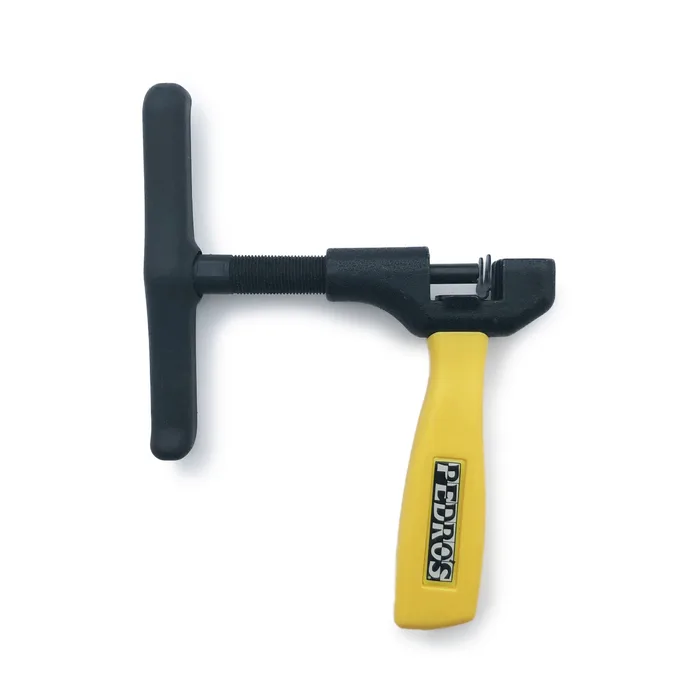
The one that peens Campagnolo rivets and keeps going when drivetrains add another sprocket.
Best for: Anyone running Campagnolo, or a mechanic who does not want to buy again when drivetrains move on.
- Includes a peening bit and backer for installing Campagnolo 11, 12 and 13-speed chains
- Pedro's states the replaceable bridge and adjustable bridge positioning cover single to 13-speed chains including SRAM Flattop
- Patented retracting pin guide, which Pedro's credits for the tool's reliability
- Integrated guide pin shear slot for removing the guide section from an installation pin
- More tool than a rider on a single drivetrain standard needs
- No weight published, and the ergonomic handles make it a bench tool
- The replaceable bridge is another consumable to source when it wears
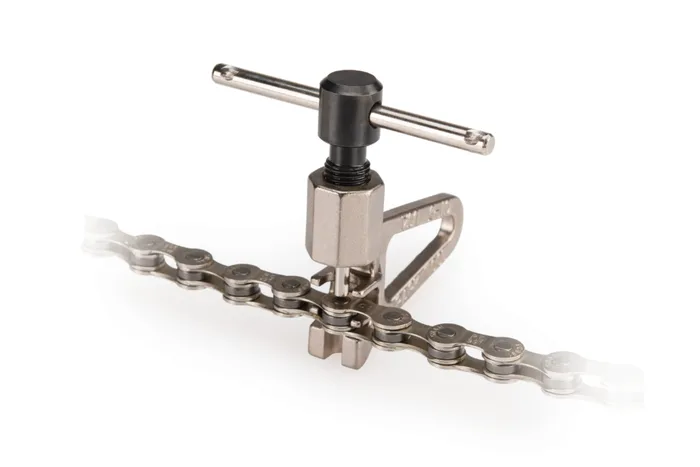
A 77 gram tool with most of the bench tool's chain coverage, as long as you do not need the single-speed widths it leaves out.
Best for: The rider who wants a chain tool in the seat pack rather than a second tool on the bench.
- Park Tool publishes a weight of 77 g, small enough for a saddle bag or a tool roll
- Covers all 5-speed to 12-speed chains including SRAM T-Type, SRAM Flattop and Shimano XTR 12-speed
- Replaceable pin, part CTP, with replacements sold as the CTP-C
- Park Tool states it does not work with 3/16 inch or half-link single-speed chains
- No material published, unlike the cast steel body named for the CT-3.3
- A compact body gives less leverage than fold-out or full-length handles
- Nothing published about Campagnolo peening
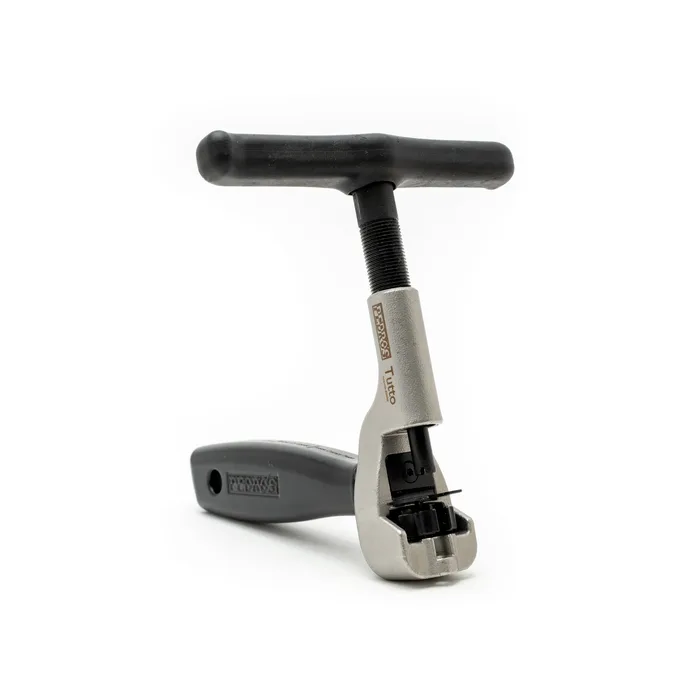
A genuinely excellent shop tool that almost every home mechanic is buying past the point of usefulness.
Best for: A working shop breaking chains daily, where setup time and adjustment range genuinely pay back.
- Patented Fit Dial and retracting pin guide, the most adjustment of any tool here
- Replaceable bridge covering single to 13-speed chains including SRAM Flattop
- Includes a peening bit for Campagnolo 11, 12 and 13-speed assembly
- Ships with an EVA foam storage insert
- The CT-3.3 covers the same chains almost every home mechanic owns for far less tool
- The Fit Dial solves a setup problem that matters across a day of chains, not across one a year
- The Pro Chain Tool 3.2 from the same maker already includes the Campagnolo peening bit
- Flagship pricing for a tool most owners will use a handful of times
| Criteria | CT-3.3 Chain Tool Top pick | Pro Chain Tool 3.2 | CT-5 Mini Chain Brute Chain Tool | Tutto Chain Tool II |
|---|---|---|---|---|
| Verdict | Buy it | Buy it | It depends | Skip it |
| Best for | The home mechanic who wants one chain tool on the bench and does not run Campagnolo. | Anyone running Campagnolo, or a mechanic who does not want to buy again when drivetrains move on. | The rider who wants a chain tool in the seat pack rather than a second tool on the bench. | A working shop breaking chains daily, where setup time and adjustment range genuinely pay back. |
| Price tier | $$ · mid-range | $$$ · premium | $ · budget | $$$$ · flagship |
| Derailleur chain speeds | 5 to 12-speed | Single to 13-speed | 5 to 12-speed | Single to 13-speed |
| Single-speed widths | 1/8 in, 3/16 in, half-link | Not separately stated | 3/32 in and many 1/8 in, not 3/16 in or half-link | Not separately stated |
| Named modern chains | SRAM T-Type, SRAM Flattop, Shimano XTR 12-speed | SRAM Flattop | SRAM T-Type, SRAM Flattop, Shimano XTR 12-speed | SRAM Flattop |
| Peens Campagnolo rivets | No, stated explicitly | Yes, bit and backer included | Not published | Yes, peening bit included |
| Replaceable driving pin | Yes, part CTP | Yes, pins sold separately | Yes, part CTP | Yes, pins sold separately |
| Replaceable bridge | Not published | Yes, adjustable positioning | Not published | Yes |
| Published weight | Not published | Not published | 77 g | Not published |
| Body material | Investment cast steel | Not published | Not published | Not published |
Which one is right for you?
- The home mechanic who wants one chain tool on the bench and does not run Campagnolo. Buy it Park Tool CT-3.3 Chain Tool
- Anyone running Campagnolo, or a mechanic who does not want to buy again when drivetrains move on. Buy it Pedro's Pro Chain Tool 3.2
- The rider who wants a chain tool in the seat pack rather than a second tool on the bench. It depends Park Tool CT-5 Mini Chain Brute Chain Tool
- A working shop breaking chains daily, where setup time and adjustment range genuinely pay back. Skip it Pedro's Tutto Chain Tool II
How we judged the field
Five things decide whether a chain tool is the right one. First is the published chain range, because a driving pin sized for a wider chain can sit off-centre on a narrow rivet and bend. Second is single-speed coverage, which is a separate line on the spec sheet and is where the compact tools give ground. Third is whether the driving pin is a stocked replacement part, since the pin is the part that fails. Fourth is whether the tool can peen, which is a hard requirement for Campagnolo 11, 12 and 13-speed chains and irrelevant for everything else. Fifth is whether the bridge, the part that supports the chain plates, can be replaced or repositioned.
The field splits cleanly on two of those. Park Tool and Pedro’s both publish their chain ranges, and the Park Tool pages are unusually direct about limits: the CT-3.3 page states outright that it will not peen Campagnolo rivets, and the CT-5 page names the single-speed widths it does not handle. Pedro’s answers the other half, with a peening bit on both of its tools here and a replaceable bridge that carries the claim out to 13-speed. We picked two bench tools that cover those two positions, one 77 gram tool for the seat pack, and one flagship shop tool to explain why more adjustment is not automatically a better buy.
The Park Tool CT-3.3 is the tool most home workshops should own, and the reason is coverage rather than refinement. Park Tool lists it for all 5-speed to 12-speed chains and names the awkward modern ones specifically, including SRAM T-Type, SRAM Flattop and Shimano XTR 12-speed, so there is no guessing about whether your drivetrain is in scope. It then adds the single-speed widths that the compact tools skip, covering 1/8 inch, 3/16 inch and half-link chain, which matters if there is a track bike or a commuter in the stable. The body is investment cast steel with a floating locating shelf Park Tool says suits any chain width, and the driving pin is a stocked part, CTP, so bending one is an inconvenience rather than a replacement. The limit is stated plainly on Park Tool’s own page: it will install and remove Campagnolo 11, 12 and 13-speed rivets but will not peen them. For anyone outside Campagnolo, that limit never comes up. Best for: one bench tool covering nearly every chain in the house.
The Pedro’s Pro Chain Tool 3.2 exists for the job the Park Tool names as out of scope. It ships with a peening bit and backer for installing Campagnolo 11, 12 and 13-speed chains, which turns a hard compatibility limit into a non-issue. Pedro’s describes it as a screw type tool with a patented retracting pin guide, and pairs a replaceable bridge with adjustable bridge positioning to claim coverage from single speed through 13-speed, including SRAM Flattop. There is also an integrated guide pin shear slot, which is a small thing that saves fiddling with pliers when you snap the guide section off an installation pin. What you are buying beyond the Park Tool is headroom: a drivetrain standard you do not own yet, and a chain brand that needs a step the cheaper tool cannot perform. If neither applies, this is more tool than the job. Best for: Campagnolo owners, and anyone who would rather not buy a chain tool twice.
The Park Tool CT-5 Mini Chain Brute is the answer to a different question, which is what to carry rather than what to own. At a published 77 grams it goes in a seat pack without being noticed, and it carries the same 5 to 12-speed derailleur coverage as its bench sibling, again naming SRAM T-Type, SRAM Flattop and Shimano XTR 12-speed. The pin is replaceable, part CTP with the CTP-C sold as the replacement, which is unusual at this size. The catch is in the single-speed line: Park Tool states it does not handle 3/16 inch or half-link chain, so it is not a straight substitute for the CT-3.3 if you own a single-speed. A compact body also gives less leverage than a full handle, which you notice on a stiff rivet at the roadside in the cold. Read it as a second tool that lives in a bag, not the only one in the house. Best for: the rider who wants chain repair in the seat pack.
The Pedro’s Tutto Chain Tool II is a better tool than either of our picks and still the wrong purchase for most people reading this. It carries a patented Fit Dial alongside the same retracting pin guide as the Pro 3.2, a replaceable bridge covering single through 13-speed including SRAM Flattop, a peening bit for Campagnolo 11, 12 and 13-speed, and an EVA foam storage insert. Every one of those is real. The problem is what they are for: the Fit Dial speeds up setup between different chains, which pays back across a day of customer bikes and returns almost nothing across one chain a year. The Campagnolo peening that justifies the step up from the Park Tool is already on the Pro Chain Tool 3.2 from the same maker. That leaves a flagship tool whose remaining advantage is adjustment range a home mechanic will rarely reach for. Best for: a working shop, where setup time is money.
Park Tool CT-3.3 Chain Tool vs Pedro’s Pro Chain Tool 3.2: which should you buy?
The choice between the CT-3.3 and the Pro Chain Tool 3.2 comes down to one question, and it is not build quality. Do you run Campagnolo, or do you expect to? Campagnolo specifies a peened connecting pin on its 11, 12 and 13-speed chains, and Park Tool states on its own page that the CT-3.3 will not peen them. That is a hard stop, not a preference, and the Pedro’s tool removes it with an included bit and backer.
If the answer is no, the Park Tool is the better buy and it is not close on value. It covers the same 5 to 12-speed derailleur chains almost everyone owns, names the difficult modern ones explicitly, and adds single-speed widths in 1/8 inch, 3/16 inch and half-link that the Pedro’s pages do not break out. The one place the Pedro’s pulls ahead for a non-Campagnolo rider is future headroom, since its replaceable bridge carries a claim to 13-speed while Park Tool publishes nothing past 12. If you replace tools rarely and drivetrains keep adding sprockets, that is worth something. If you buy a tool for the bikes you own now, it is not.
What to look for
- Read the speed range, not the price: every maker here publishes the chain speeds covered, and the ranges genuinely differ between tools that look alike.
- Check the single-speed line separately: it is a different spec from derailleur chain coverage, and the CT-5 covers 3/32 inch and many 1/8 inch chains while excluding 3/16 inch and half-link.
- Confirm the driving pin is a stocked part: the pin is what fails, and both Park Tool tools here name it as part CTP.
- Only pay for peening if you run Campagnolo: it is required for Campagnolo 11, 12 and 13-speed assembly and irrelevant to every other chain.
- A replaceable bridge is about longevity, not performance: it is what lets Pedro’s claim coverage out to 13-speed and beyond as standards move.
- Match the tool to the narrowest chain you own: the widest chain will forgive a slightly off driving pin, and the narrowest one will not.
Our final take
Buy the Park Tool CT-3.3 unless you have a specific reason not to. It covers the chains a home workshop actually contains, from 1/8 inch single-speed to 12-speed SRAM T-Type, it is honest on its own page about the one thing it will not do, and its driving pin is a part you can buy rather than a reason to replace the tool. The Pedro’s Pro Chain Tool 3.2 is the right answer instead if you run Campagnolo, where peening is not optional, or if you want a bridge that can be replaced as drivetrains keep narrowing. Add the 77 gram CT-5 to the seat pack if you ride far from home, remembering it leaves out 3/16 inch and half-link chain. Leave the Tutto II to shops.
Questions, answered
Do I need a chain tool if my chain has a quick link?
You still do, and for two reasons. A quick link joins the chain but does not size it, so a new chain almost always needs links removed before the quick link goes in. Quick links are also directional and reusable only a limited number of times depending on the maker, and a damaged one has to come out somehow. A chain tool is what turns a new chain in a box into a chain the right length for your bike.
What actually breaks on a chain tool?
The driving pin. It is the thin hardened pin that pushes the chain rivet, and it bends or snaps if it goes in misaligned or if the tool is used on a chain narrower than it was designed for. This is why a replaceable pin matters more than it sounds: Park Tool sells the pin for both tools here as part CTP, and Pedro's sells pins for its tools separately. A tool without a replaceable pin becomes scrap the first time you bend one.
Why can some tools not peen a Campagnolo chain?
Campagnolo specifies that its 11, 12 and 13-speed chains are joined with a connecting pin that has to be peened, which means flaring the end of the rivet after it is pressed home so it cannot migrate. That needs a dedicated anvil or bit, not just a driving pin. Park Tool states plainly that the CT-3.3 will install and remove but not peen those rivets. Both Pedro's tools here include a peening bit for exactly this.
Is a mini chain tool enough as my only chain tool?
It can be, but check the single-speed line before you decide. The CT-5 covers the same 5 to 12-speed derailleur chains as the bench tool and weighs 77 grams, which is why it works in a seat pack. What it does not cover is 3/16 inch or half-link single-speed chain, which the CT-3.3 does. If you own a single-speed or a track bike, the mini tool leaves a gap the bench tool fills.
Does chain speed really change which tool I need?
Yes, because the rivet and the inner plate spacing get narrower as sprockets are added, and a driving pin sized for an older chain can push a modern rivet off-centre. Every tool here names the speeds it covers, and the range varies: two say 5 to 12-speed and two claim single through 13-speed. Match the tool to the narrowest chain you own rather than the one you ride most, because that is the chain that will bend a pin.
Deciding between the top two? See our head-to-head: Park Tool CT-3.3 Chain Tool vs Pedro's Pro Chain Tool 3.2.
More Outdoors & Fitness reviews
 The Best Chain Checkers: 4 Compared (and One to Skip)
  The Best Chain Lubes: 4 Compared (and One to Skip)
  The Best Chain Whips: 4 Compared (and One to Skip)
  The Best Chainsaw Chaps: 4 Compared (and One to Skip)
  The Best Chainsaws for Homeowners: 4 Compared (and One to Skip)
  The Best Climbing Chalk: 4 Compared (and One to Skip)