Explained
Carbon Monoxide Alarms, Explained
After reading, you'll understand what UL 2034 requires of every US alarm, why these devices expire on a clock of their own, how to read the chirps, and what a digital display can and cannot tell you.
In this guide
Most people buy a CO alarm once, mount it, and assume it works forever. Two facts break that assumption. The sensor inside has a finite service life measured in years, not decades, and the alarm is required to tell you when it is over by making a noise most owners misread as a flat battery. Almost everything else about these devices is fixed by a single standard, which is why the shelf looks so confusing while the products behave so similarly.
The 30-second version
- Every listed US alarm hits the same targets, because UL 2034 fixes when it must alarm at 70, 150 and 400 ppm and when it must stay silent.
- The sensor expires on its own schedule, with manufacturers publishing different service lives depending on the model, up to ten years.
- An end of life signal has been mandatory since 2009, for every CO alarm produced after August 1 of that year.
- The end of life chirp can legally sound like a trouble chirp, so the reliable test is whether a fresh battery makes it stop.
- A display cannot show you low level CO, because the standard does not permit an indication below 30 ppm.
The products this guide is about
Our verdict on each, with the full reasoning on the companion review.
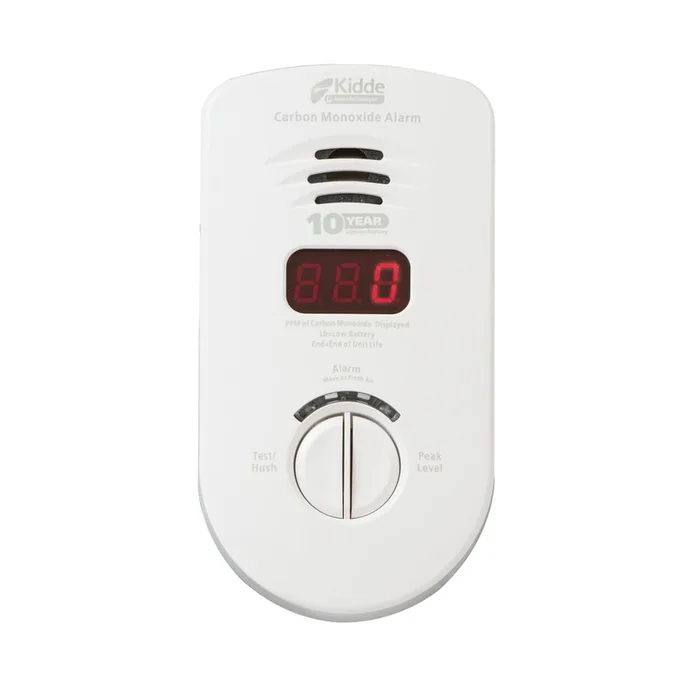
- Buy Kidde KN-COP-DP-10YL Worry-Free Plug-in CO Alarm A plug-in alarm with a sealed 10 year lithium backup and an LED ppm readout, backed by a full published spec sheet. Amazon
- Buy First Alert CO710 Carbon Monoxide Alarm with 10-Year Battery A tabletop alarm with a sealed 10 year lithium battery and a backlit display that shows CO in ppm, a recent peak and the room temperature.
- It depends X-Sense XC01-R Standalone Carbon Monoxide Alarm A small freestanding alarm with a real-time LCD and a user replaceable lithium cell, which is exactly right for a camper and slightly wrong for a house.
- Skip Kidde COB AA Battery Powered CO Alarm The no frills AA battery alarm: it sounds at dangerous CO levels and gives you little else to work with. Amazon
What actually matters
- UL 2034 listing - this is the standard that defines what a residential CO alarm has to do, including the response times and the false alarm resistance. Without it you are holding a device with no independent testing behind it.
- Published alarm life - the electrochemical cell degrades on its own timetable regardless of use. Kidde publishes seven to ten years depending on model, and other brands publish their own figures, so the number varies by product and you have to look it up.
- End of life behaviour - the alarm has to signal when it is finished, but the standard permits that signal to share a pattern with other faults. A model that spells End or Err on a display removes the ambiguity entirely.
- Sealed versus replaceable battery - a sealed 10 year pack means no chirps to silence and no cell to remove, which closes off the most common route to a disabled alarm. A replaceable cell is only better if the alarm needs to travel.
- Peak level memory - the live reading is throttled by the standard, but a stored maximum tells you what happened overnight or while you were away, and gives responders a number to work from.
- Backup power - CO incidents cluster around outages, because that is when generators and unvented heaters come out. A plug-in with no backup battery is offline exactly when the risk peaks.
- Placement per the manufacturer's instructions - CO mixes with room air, so mounting height is flexible, but the listing is based on the installation booklet and the EPA's advice is to follow it exactly.
The specs, in plain English
Green flags vs red flags
Green flags
- The listing to UL 2034, or an ETL mark against it, is printed on the device rather than only claimed in the listing text.
- The manufacturer publishes a service life for the alarm itself, separate from any battery life claim.
- A manufacture date is printed on the back of the unit where you can find it years later.
- The end of life warning is described specifically, ideally as a display code rather than only a chirp interval.
- The spec sheet names the sensor as electrochemical and states the alarm loudness, typically 85 dB at 10 feet.
Red flags
- The seller quotes a battery life but never states how long the alarm itself is rated to work.
- The product claims to detect or display carbon monoxide at very low levels while also claiming a UL 2034 listing, which the standard's display rules do not allow.
- The listing describes the CO sensor with smoke alarm vocabulary such as ionization or photoelectric, which suggests copy written by someone who does not know the product.
- No manufacturer product page or data sheet exists for the exact model number you are being sold.
- The alarm is certified only to a European standard such as EN 50291, which is a valid mark in the UK and Ireland but is not the US listing.
Who's who: the brands
- Kidde - The most thoroughly documented mainstream range in the US, publishing full data sheets with sensor type, response windows and end of life behaviour, and stating a seven to ten year alarm life depending on model.
- First Alert - The other US mainstream brand, with a broad ladder from basic 9V units to sealed 10 year alarms, and public guidance on chirp patterns. Its CO710 tabletop alarm lists an electrochemical sensor, a non-replaceable 10 year lithium battery and listing to UL 2034.
- X-Sense - A newer direct to consumer brand built around LCD readouts, interconnection options and portable formats. Check the listing mark on the model you are buying.
- Universal Security Instruments - A long established US maker leaning toward plug-in combination CO and natural gas alarms, with listing marks that you should confirm on the exact model.
- Ei Electronics - An Irish manufacturer, sold as Aico in the UK, whose CO alarms are approved to the European EN 50291 standard rather than UL 2034, so they belong in a UK or Ireland home rather than a US one.
How to read a listing without getting fooled
Start at the bottom of the listing, not the top. Find the model number and check that it exists on the manufacturer's own site, because retailer copy for CO alarms is unusually prone to mixing up smoke alarm and CO alarm vocabulary. Then look for three numbers in this order: the listing standard, the alarm's rated service life, and the battery arrangement. A listing that shouts about a 10 year battery but never says how long the alarm lasts is hiding the more important figure. Ignore any claim about detecting low or trace levels of CO on a UL 2034 alarm, because the standard's display rules do not permit indication below 30 ppm, and treat a live ppm readout as a magnitude rather than a measurement given that manufacturers publish accuracy tolerances around plus or minus 30 percent. Finally, check whether the manufacture date is printed on the back, because that is the number you will need in seven or ten years.
How much should you spend?
This is a category where the budget tier is genuinely compliant, so you are not buying safety with money, you are buying convenience and longevity. A budget alarm from a mainstream brand typically gets you a UL 2034 listing and an electrochemical sensor, and gives up the display, the sealed battery and some service life. The mid-range tier is where sealed 10 year batteries, LED or LCD readouts with peak memory, and plug-in power with battery backup all appear, and it is the tier we would buy because it removes the maintenance that causes alarms to end up disabled. The premium tier mostly adds connectivity, voice location announcements, interconnection between units and combination sensing, which are worth it in a larger house with several levels and worth very little in a one bedroom apartment. Spread across a seven to ten year replacement cycle, the gap between tiers is smaller than it looks on the shelf.
Questions, answered
What does UL 2034 actually test?
Two opposite things. It tests that the alarm sounds fast enough at dangerous concentrations, with the sensitivity test points requiring an alarm at 70 ppm within 60 to 240 minutes, at 150 ppm within 10 to 50 minutes, and at 400 ppm within 4 to 15 minutes. It also tests that the alarm resists nuisance activation, so it must not alarm at 30 ppm across 30 days of exposure, or at 70 ppm within the first 60 minutes. Those test points are plotted against a 10 percent carboxyhaemoglobin curve, which is why the standard is dose based rather than a single trigger level.
Why did my alarm not sound when I felt unwell?
Because UL 2034 alarms are deliberately built to ignore low concentrations. The standard requires that a listed alarm does not sound at 30 ppm even after 30 days, and does not sound at 70 ppm inside the first hour. That threshold is set around acute risk, not around long term low level exposure or individual sensitivity. Kidde's own product documentation notes that individuals with medical problems may consider using warning devices that provide audible and visual signals for carbon monoxide concentrations under 30 ppm, which is a separate class of low level monitor. If you have symptoms you associate with your home, that is a conversation with a doctor and a heating engineer, not a spec sheet.
Do I need a CO alarm in every bedroom?
The common floor is one per level and one in the vicinity of the sleeping areas. The EPA states that each floor of a home needs a separate detector, and that if you are buying a single detector it should go near the sleeping areas and be loud enough to wake you. Building codes typically require alarms outside each separate sleeping area in dwellings with fuel fired appliances or an attached garage, and requirements vary by jurisdiction, so check locally. Beyond that, the manufacturer's installation booklet governs, because the listing is based on it.
What is the difference between a CO alarm and a low level CO monitor?
A CO alarm is a UL 2034 listed life safety device designed to warn you before an acute dose, which is why it stays quiet below 30 ppm and will not display anything under that level. A low level monitor is a different product intended to indicate concentrations well below the alarm thresholds, typically for people who are more vulnerable to chronic exposure or for tracing an intermittent fault. They are complements rather than substitutes: the monitor gives you early information, the alarm gives you the loud, standardised warning that gets everyone out of the house.
Or jump to the head-to-head: Kidde KN-COP-DP-10YL Worry-Free Plug-in CO Alarm vs First Alert CO710 Carbon Monoxide Alarm with 10-Year Battery.