

Health & Wellness
The Best Carbon Monoxide Detectors: 4 Compared (and One to Skip)
We compared four currently sold CO alarms on the things that decide whether one saves you: the UL 2034 listing, the published sensor life, how the end of life warning behaves, and what the display can legally tell you.
The short version
The Kidde KN-COP-DP-10YL is the pick: it plugs into an outlet, carries a sealed 10 year lithium backup so a power cut does not blind it, shows CO in ppm plus a peak reading, and Kidde publishes a full spec sheet including the UL 2034 response windows. The First Alert CO710 is the runner-up, a sealed 10 year battery unit listed to UL 2034 with a ppm and peak display that sits on a nightstand or shelf with no wiring, which makes it an easy alarm for a renter to own. The X-Sense XC01-R suits a camper, a boat or a trip, where a fixed alarm is not an option and a user replaceable battery is a feature rather than a chore. Skip the Kidde COB: it meets the same standard, but it runs on 2 AA batteries that need changing, it has no readout, and Kidde says it is not approved for RV or boat use. The single fact that matters more than any model choice is that these devices expire, and every alarm made after August 1, 2009 is required to signal when it does. Best for: anyone with a fuel burning appliance, an attached garage, or a generator in the shed.
Our picks at a glance
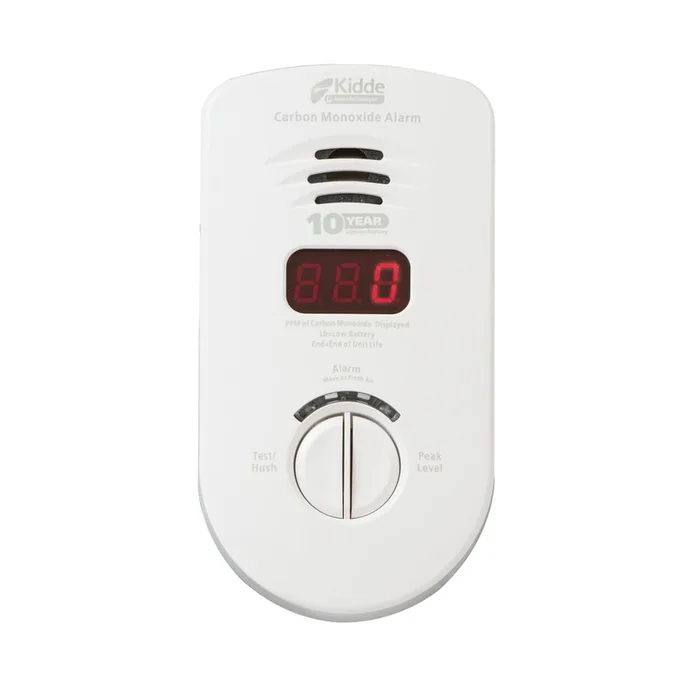
- Kidde KN-COP-DP-10YL Worry-Free Plug-in CO Alarm - Buy. A plug-in alarm with a sealed 10 year lithium backup and an LED ppm readout, backed by a full published spec sheet.
- First Alert CO710 Carbon Monoxide Alarm with 10-Year Battery - Buy. A tabletop alarm with a sealed 10 year lithium battery and a backlit display that shows CO in ppm, a recent peak and the room temperature.
- X-Sense XC01-R Standalone Carbon Monoxide Alarm - It depends. A small freestanding alarm with a real-time LCD and a user replaceable lithium cell, which is exactly right for a camper and slightly wrong for a house.
- Kidde COB AA Battery Powered CO Alarm - Skip. The no frills AA battery alarm: it sounds at dangerous CO levels and gives you little else to work with.
The verdict in 30 seconds
What mattered most
- Power
- Digital display
- Sensor
- Stated alarm life
- End of life signal
- Listing
A carbon monoxide alarm is the rare purchase where the box tells you almost nothing useful. Every listed alarm in the US has to hit the same response times under the same standard, so the horn and the sensitivity are not where models differ. What differs is how long the sensor is rated to last, whether the battery is sealed in or your problem, and how clearly the unit tells you when it is finished. We picked a plug-in with a sealed backup, a sealed 10 year battery unit, a portable, and a basic AA battery alarm.
A plug-in alarm with a sealed 10 year lithium backup and an LED ppm readout, backed by a full published spec sheet.
Best for: Someone who wants one alarm per level, permanently powered, that they never have to maintain or think about again.
- Kidde's data sheet states an electrochemical fuel cell sensor, 85 dB at 10 feet, a 10 year limited warranty, and listing by UL to the UL 2034 standard.
- The sealed lithium backup keeps it running through a power cut and cannot be borrowed for the TV remote.
- A peak level button recalls the highest CO concentration recorded since the last reset, which Kidde notes is useful for medical responders.
- The display shows nothing until CO reaches 30 ppm, which is a UL 2034 rule rather than a Kidde choice, so a blank screen is not evidence of clean air.
- Kidde specifies display accuracy of plus or minus 30 percent, so read the number as a magnitude rather than a measurement.
- The display switches off when AC power is removed unless more than 100 ppm is detected or the unit is alarming.
- At 10 years the whole thing goes in the bin, sealed backup battery included.
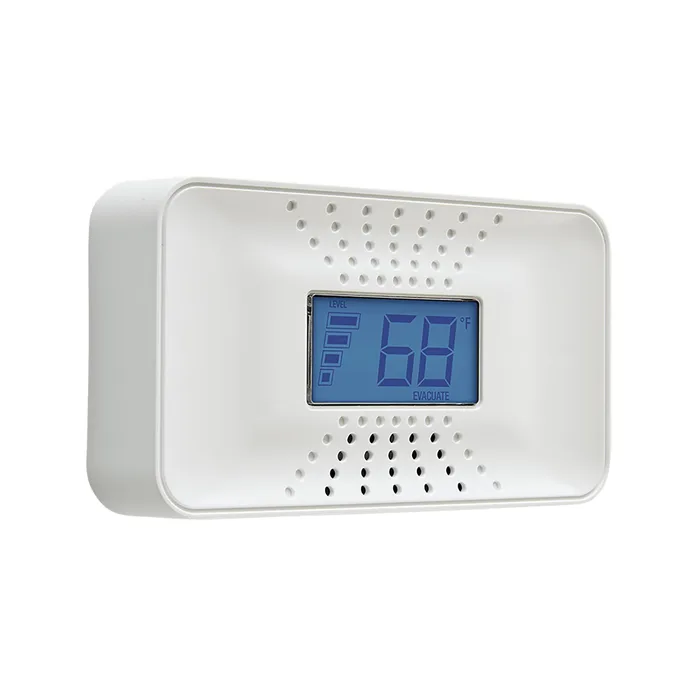
A tabletop alarm with a sealed 10 year lithium battery and a backlit display that shows CO in ppm, a recent peak and the room temperature.
Best for: Renters, dorm rooms, and anyone adding a bedside alarm on a nightstand or shelf without wiring or drilling anything.
- First Alert's spec table lists an electrochemical sensor, 85 dB at 10 feet, a 10 year limited warranty, and listing to the UL 2034 standard.
- The built-in 10 year lithium battery is listed as not replaceable, so there are no battery changes or low battery chirps over the life of the alarm, and an end of life warning tells you when to replace it.
- First Alert says the display can show current CO concentration and recent peak levels in ppm, and that the stored peak can help emergency or hospital staff.
- First Alert describes it as intended to sit on a tabletop or shelf with no installation, so it is not the alarm to fix to a hallway wall.
- The product page lists an end of life warning but does not describe the signal pattern, so keep the manual.
- Interconnection is not listed on the product page, so plan on it warning only the room it is in.
- The battery is built in, so you replace the entire unit at 10 years.
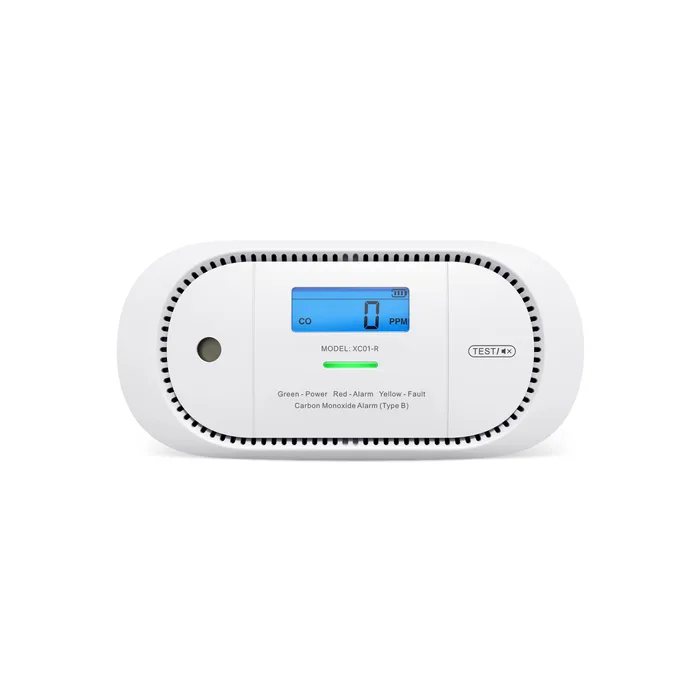
A small freestanding alarm with a real-time LCD and a user replaceable lithium cell, which is exactly right for a camper and slightly wrong for a house.
Best for: A camper, boat, cabin, or trip, where a permanently mounted alarm is not an option and portability is the whole point.
- X-Sense lists it as a standalone alarm with a real-time LCD.
- X-Sense specifies a Figaro CO sensor and a replaceable battery.
- It stands on a shelf and runs on a cell you can change, so it moves with you to a rental, a boat, or a hotel room.
- The battery is a replaceable cell, so you need to keep the right spare on hand.
- Low battery and fault chirps vary by model, so read the manual before you diagnose a chirp.
- This model is sold as a standalone alarm, so it protects one room rather than a house.
- Check the listing mark on the label, since we could not confirm it from the maker page.
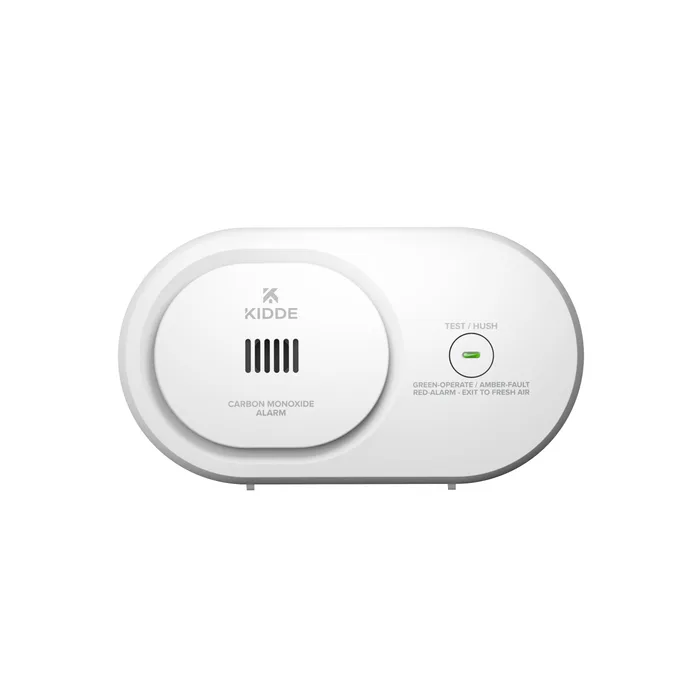
The no frills AA battery alarm: it sounds at dangerous CO levels and gives you little else to work with.
Best for: A genuine stopgap in a room with no alarm at all, where something today beats something better next month.
- Kidde's data sheet states an electrochemical sensor, 85 dB at 10 feet, and that it meets UL 2034 at the date of manufacture, which is the part that actually has to work.
- It ships with 2 AA batteries and Kidde says it can sit on a counter, go on a wall, or travel in a suitcase.
- The data sheet lists a 10 year limited warranty on the alarm and an end of life notice 10 years after it is powered.
- It runs on 2 AA batteries that Kidde's page says need changing about once a year, and the data sheet says not to use lithium cells, so there is a battery to buy and a low battery chirp to answer.
- The data sheet describes LED patterns only, so there is no readout and no peak level to hand a responder.
- Kidde states it is not approved for RV or boat use and is for conditioned spaces only, with a 40 to 100 degrees F range, so a garage or camper is out.
- Interconnect is listed as not applicable, so it warns only the room it is in.
| Criteria | KN-COP-DP-10YL Worry-Free Plug-in CO Alarm Top pick | CO710 Carbon Monoxide Alarm with 10-Year Battery | XC01-R Standalone Carbon Monoxide Alarm | COB AA Battery Powered CO Alarm |
|---|---|---|---|---|
| Verdict | Buy it | Buy it | It depends | Skip it |
| Best for | Someone who wants one alarm per level, permanently powered, that they never have to maintain or think about again. | Renters, dorm rooms, and anyone adding a bedside alarm on a nightstand or shelf without wiring or drilling anything. | A camper, boat, cabin, or trip, where a permanently mounted alarm is not an option and portability is the whole point. | A genuine stopgap in a room with no alarm at all, where something today beats something better next month. |
| Price tier | $$ · mid-range | $ · budget | $ · budget | $ · budget |
| Power | Plug-in, sealed 10 year lithium backup | Sealed 10 year lithium battery, not replaceable | Replaceable battery | 2 AA batteries, replaceable |
| Digital display | LED, ppm plus peak level | Backlit, ppm plus recent peak, temperature | LCD, real-time ppm | None listed, LED patterns only |
| Sensor | Electrochemical fuel cell | Electrochemical | Figaro | Electrochemical |
| Stated alarm life | 10 years | 10 year battery life, end of life warning listed | Check the label | End of life notice 10 years after power-up |
| End of life signal | Beep every 30 seconds, display reads END or ERR | End of life warning listed, pattern not on the product page | Not published on the product page | Amber LED blinks twice with two chirps every 60 seconds |
| Listing | UL listed to UL 2034 | Listed to UL 2034 | Check the label | Data sheet says it meets UL 2034 |
| Loudness | 85 dB at 10 ft | 85 dB at 10 ft | Check the label | 85 dB at 10 ft |
| Warranty | 10 year limited | 10 year limited | Check the label | 10 year limited, batteries excluded |
Which one is right for you?
- Someone who wants one alarm per level, permanently powered, that they never have to maintain or think about again. Buy it Kidde KN-COP-DP-10YL Worry-Free Plug-in CO Alarm
- Renters, dorm rooms, and anyone adding a bedside alarm on a nightstand or shelf without wiring or drilling anything. Buy it First Alert CO710 Carbon Monoxide Alarm with 10-Year Battery
- A camper, boat, cabin, or trip, where a permanently mounted alarm is not an option and portability is the whole point. It depends X-Sense XC01-R Standalone Carbon Monoxide Alarm
- A genuine stopgap in a room with no alarm at all, where something today beats something better next month. Skip it Kidde COB AA Battery Powered CO Alarm
How we judged the field
Five things decide whether a CO alarm does its job. First, the listing: a US alarm should be listed or ETL listed to UL 2034, because that standard fixes the response windows every unit must hit, alarming at 70 ppm somewhere between 60 and 240 minutes, at 150 ppm between 10 and 50 minutes, and at 400 ppm between 4 and 15 minutes, while refusing to alarm at 30 ppm for 30 days so it does not cry wolf at furnace startup. Second, published service life, because the sensor ages whether or not it ever sees gas. Third, how the end of life signal behaves and whether the unit tells you plainly that it is finished rather than just chirping. Fourth, power: sealed batteries remove the two most common ways an alarm ends up dead, a flat cell and a borrowed one. Fifth, what the display can honestly tell you, which is less than most buyers assume.
Kidde KN-COP-DP-10YL Worry-Free Plug-in CO Alarm
Buy itKidde’s KN-COP-DP-10YL is the alarm we would fit first, mainly because Kidde documents it properly. The published data sheet gives an electrochemical fuel cell sensor, 120VAC power with a 3V sealed lithium backup, 85 dB at 10 feet, a 10 year limited warranty, and listing by UL to UL 2034, and it prints the response windows the sensor has to meet. The sealed backup is the quiet win: it runs through the power cut that often accompanies the generator that produces the CO in the first place, and nobody can pull it out to shut it up. The LED readout is bright enough to read across a hallway and dims itself at night, and the peak level button recalls the highest concentration since the last reset, which Kidde specifically frames as information for medical responders. The trade-off is honest and worth knowing: the display goes dark when AC power is lost unless more than 100 ppm is present, Kidde rates its accuracy at plus or minus 30 percent, and the whole unit is disposable at ten years. For most homes, one per level, done.
First Alert CO710 Carbon Monoxide Alarm with 10-Year Battery
Buy itThe First Alert CO710 does the same core job without a socket and asks very little of you. First Alert’s spec table lists an electrochemical sensor, an 85 dB alarm at 10 feet, a 10 year limited warranty, and listing to the UL 2034 standard. The lithium battery is built in, rated for 10 years and listed as not replaceable, so from purchase to retirement there is nothing to buy or change, and an end of life warning tells you when the unit is done. The backlit display can show current CO concentration and recent peak levels in ppm, or the room temperature, and First Alert notes the stored peak can help emergency or hospital staff. First Alert designs it to sit on a tabletop or shelf with no installation, which is why it is the alarm we would hand a renter or a student: set it on a nightstand near the bedroom door and it is doing what the EPA suggests if you only have one. The limits are real though. It is not meant for a wall, the product page does not describe the end of life signal pattern or any interconnection, and the whole unit goes at ten years. If you want an alarm fixed in place on mains power, buy the plug-in instead.
X-Sense XC01-R Standalone Carbon Monoxide Alarm
It dependsThe X-Sense XC01-R is the one that suits a specific person very well and everyone else moderately. X-Sense specifies a Figaro CO sensor, and the LCD gives a real-time reading rather than an indicator light. What makes it different is the power: a user replaceable battery rather than a sealed pack, in a small freestanding body. That combination is exactly what you want in a camper, a boat, a cabin, or a suitcase, because generator and propane appliance poisoning happens disproportionately in those settings and a mains alarm is not an option. In a house it is a weaker choice. The battery is something you have to go and buy, the model is sold as a standalone alarm, and you should check the listing mark on the label before relying on it. Buy it because it travels, not because it is cheap.
Kidde COB AA Battery Powered CO Alarm
Skip itThe Kidde COB is a perfectly serviceable alarm that we would still leave on the shelf. Nothing about it is defective: the data sheet gives an electrochemical sensor, an 85 dB horn, and says it meets UL 2034 at the date of manufacture. The problem is the ownership arithmetic. It runs on 2 AA batteries that Kidde’s own page says need changing about once a year, the data sheet says not to use lithium cells, and the low battery alert is a chirp every 60 seconds, which is the single most common reason a household ends up with a disconnected alarm on a kitchen counter. The data sheet describes LED patterns only, so there is no readout and no peak level for responders. Kidde also states it is not approved for RV or boat use and is for conditioned spaces only, with a 40 to 100 degrees F range. Useful as a stopgap or a suitcase alarm for a hotel room. Not the one to standardise on.
Sources
Specs in this review come from these pages.
- UL 2034, Standard for Single and Multiple Station Carbon Monoxide Alarms (shopulstandards.com)
- UL Solutions, Carbon Monoxide Alarm Considerations for Code Authorities (ul.com)
- CPSC meeting log, UL 2034 Standards Technical Panel task group on digital displays, February 2025 (cpsc.gov)
- Kidde, KN-COP-DP-10YL product data sheet (kidde.com)
- First Alert, CO710 product page and specifications (firstalert.com)
- Kidde, COB product data sheet (brand.kidde.com)
- Kidde support, When should I replace my carbon monoxide alarm (kidde.com)
- US EPA, Where should I place a carbon monoxide detector (epa.gov)
Kidde KN-COP-DP-10YL Worry-Free Plug-in CO Alarm vs First Alert CO710: which should you buy?
Both buys give you a 10 year life and UL 2034 behind them, so the choice comes down to where the alarm needs to live, how it is powered, and how much the display tells you. The Kidde KN-COP-DP-10YL is the better permanent fixture. It occupies an outlet, keeps working through a blackout on its sealed backup, and its LED readout with peak memory is the one you want by the furnace or at the top of the basement stairs. The First Alert CO710 is the better bedside and rental alarm. It needs no wiring, runs on a sealed 10 year lithium battery, and First Alert designs it to sit on a tabletop or shelf, so it can move from apartment to apartment. It also shows ppm and a recent peak, so the plug-in’s real advantages are mains power and a fixed home on the wall socket.
A sensible household buys both rather than choosing. Put the plug-in on each level near the fuel burning appliances and the attached garage, and put the battery unit in or just outside the bedroom, because that is the one that has to wake you. If you can only buy one, buy for the sleeping area first: the EPA’s guidance is that a single detector should go near the sleeping areas and be loud enough to wake you. And whichever you buy, write the install date on the back in marker, because in seven to ten years the chirp you hear will be the alarm telling you its time is up, and you will want to know without guessing.
What to look for
- A UL 2034 or ETL listing: this is the only claim on the box that means the alarm has been tested to alarm at 70, 150 and 400 ppm within defined windows and to stay quiet at 30 ppm for 30 days.
- A published service life, not just a battery life: a 10 year battery in a seven year alarm is marketing, so look for the manufacturer stating how long the alarm itself is rated to run.
- A sealed battery if the alarm will be mounted and forgotten: it removes the flat cell and the borrowed cell, the two most common reasons an alarm is not working when it is needed.
- An end of life indicator you can actually read: UL 2034 allows the end of life chirp to sound identical to a trouble chirp provided there is a visual indicator, so a display that spells End or a dedicated LED is worth having.
- Peak level memory rather than a live number: the current reading is capped by the standard at 30 ppm and up, but a stored peak tells you and a paramedic what happened while you were out.
- A manufacture date printed on the back: you cannot manage a replacement schedule you cannot look up, and this is the field people most often wish they had checked.
Our final take
Buy the Kidde KN-COP-DP-10YL for the places an alarm should be permanent, and the First Alert CO710 for the bedroom or a rental. Both run 10 years, and neither needs a battery change. Take the X-Sense XC01-R only if the alarm has to travel. Leave the Kidde COB alone unless you need something in a bare room tonight, because an AA battery alarm with no readout costs you more attention than the units beside it. Then do the one thing almost nobody does: write the install date on the back, and treat the chirp at year seven or ten as the alarm doing its job, not failing at it.
Questions, answered
Do carbon monoxide alarms really expire?
Yes, and this is the single most useful thing to know about them. The electrochemical cell inside degrades whether or not it ever sees carbon monoxide, so the alarm has a service life independent of its battery. Kidde states that its CO alarms have a proven life of seven to ten years depending on the model, and that all Kidde CO alarms made from 2013 onward are 10 year units with a few named exceptions. Kidde's current battery models state an end of life notice 10 years after they are powered. Since the February 2008 edition of UL 2034, every CO alarm produced after August 1, 2009 has been required to produce an end of life signal when it reaches that point.
My alarm is chirping. Is that the battery or is the alarm finished?
It could be either, and this is where people go wrong and disable a working device. UL 2034 does not require the end of life signal to sound different from other trouble signals: it may be a distinct signal or the same signal as a trouble alarm, as long as the unit carries a visual indicator showing that it is end of life. In practice the brands do differentiate. Kidde says a low battery (on its combo alarms) chirps once every 60 seconds while end of life chirps every 30 seconds, and a Kidde digital alarm shows END or ERR on the display. Kidde's DETECT battery alarms use an amber LED with two chirps every 60 seconds for end of life, and other brands use their own patterns, so check your manual. The reliable test is simple: if you fit a fresh battery and the chirping continues, the alarm is done and needs replacing, not silencing.
Is a digital display actually worth paying for?
It is worth it for the peak memory, not for the live number. UL 2034 does not permit a listed alarm to indicate carbon monoxide concentrations below 30 ppm, which is why Kidde's spec sheet says its display identifies levels in ppm once the level reaches 30 ppm. So a display reading nothing, or reading zero, tells you only that CO is under 30 ppm, not that it is absent. What the display adds is the peak level button: Kidde notes the highest recorded reading is useful for checking conditions while you were away and for assisting medical responders. Kidde also states display accuracy of plus or minus 30 percent, so treat the figure as a rough magnitude. If you want alerting below 30 ppm, that is a separate class of low level monitor and not a UL 2034 alarm.
Where should a CO alarm go, and how high on the wall?
Carbon monoxide mixes with room air rather than settling or rising, so height is far less critical than it is for combustible gases. Placement on a wall or ceiling is generally treated as equivalent, so follow your manual. The EPA's guidance is that each floor of the home needs a separate detector, and that if you are only getting one, you should place it near the sleeping areas and make certain the alarm is loud enough to wake you. NFPA 720, the old standalone CO installation standard, was withdrawn in 2018 and its requirements were folded into NFPA 72, the National Fire Alarm and Signaling Code, starting with the 2019 edition. Whatever else you do, follow the installation instructions in the manufacturer's booklet, because that is what the listing is based on.
Should I buy a combination smoke and carbon monoxide alarm?
Only if the combined unit is rated for the same life on both counts, which the good ones now are. The real risk with combining sensors is mismatched service lives: if the CO half is a seven year sensor and the smoke half is good for ten, the end of life chirp forces you to bin a perfectly serviceable smoke alarm three years early. A sealed 10 year combination unit avoids that, because both halves retire together. The other consideration is that a combination alarm makes you choose one mounting spot for two jobs, and while CO can go at any height, smoke alarms want to be high. If you already have smoke alarms on a good replacement schedule, separate CO alarms keep the two clocks independent.
Deciding between the top two? See our head-to-head: Kidde KN-COP-DP-10YL Worry-Free Plug-in CO Alarm vs First Alert CO710 Carbon Monoxide Alarm with 10-Year Battery.
More Health & Wellness reviews
 The Best Cold Plunge Tubs: 4 Compared (and One to Skip)
  The Best Combustible Gas Detectors: 4 Compared (and One to Skip)
  The Best Pneumatic Compression Boots: 4 Compared (and One to Skip)
  The Best Compression Socks: 4 Compared (and One to Skip)
  The Best CPAP Cleaning Supplies: 4 Compared (and One to Skip)
  The Best Digital Thermometers: 4 Compared (and One to Skip)