

Health & Wellness
The Best Combustible Gas Detectors: 4 Compared (and One to Skip)
We compared four currently sold combustible gas products on the things that decide whether one helps you: the marked alarm threshold in percent LEL, whether it is a fixed alarm or a handheld leak finder, published sensor life, and whether it warns you when it is finished.
The short version
The DeNova Detect ML-310ES is the fixed alarm we would fit first, because it conforms to UL 1484 at a 10 percent LEL threshold rather than the 25 percent maximum the installation standard still permits, and it announces its own end of life out loud in English and Spanish. The Nexelec VIGAS K987GL does the same job at the same threshold with a sealed 10 year battery instead of six years, so it is the pick if you would rather not think about it again for a decade. The Klein Tools ET120 is a leak finder, not an alarm: a gooseneck wand that resolves down to about 50 ppm so you can walk a gas line and find the fitting, which is genuinely useful and genuinely not protection. Skip the Kidde KN-COEG-3 combination carbon monoxide and explosive gas alarm, because its own manual tells you the two hazards want the unit mounted at opposite ends of the wall, it alarms only before 25 percent LEL, and it drops explosive gas sampling to once every eight minutes on battery backup. Both fixed picks are natural gas only, so a propane home needs an LP listed alarm mounted low instead. Best for: anyone with a gas appliance who wants a fixed alarm that is marked 10 percent LEL, plus a wand if they also do their own gas work.
Our picks at a glance
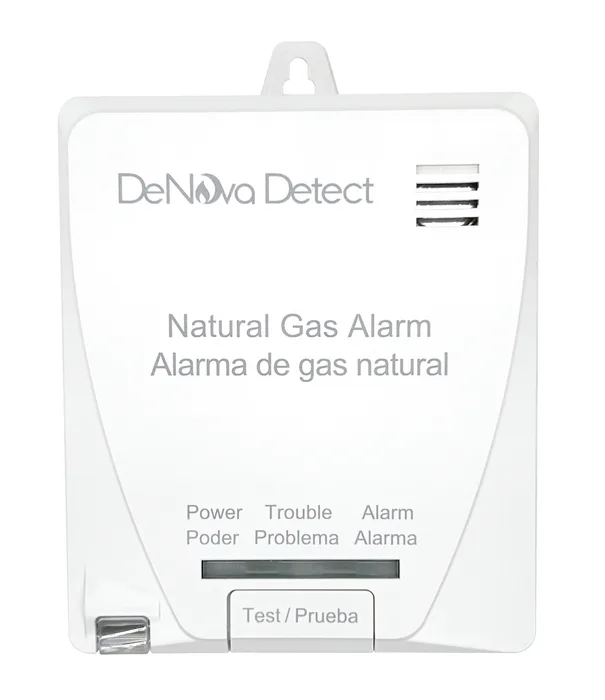
- DeNova Detect Natural Gas Alarm ML-310ES - Buy. A battery powered fixed methane alarm conforming to UL 1484 at a 10 percent LEL threshold, with spoken end of life and alarm announcements in English and Spanish.
- Nexelec VIGAS Natural Gas Alarm K987GL - Buy. The same 10 percent LEL methane threshold in a sealed ten year package, aimed at buyers who want one install and no maintenance calendar.
- Klein Tools ET120 Combustible Gas Leak Detector - It depends. An 18 inch gooseneck wand that finds which fitting is leaking, reading in parts per million rather than percent LEL, and it is not an alarm.
- Kidde KN-COEG-3 AC Plug-in Carbon Monoxide and Explosive Gas Alarm - Skip. A popular two in one that its own manual quietly explains cannot be mounted correctly for both hazards at once, and that alarms only at the older, higher threshold.
The verdict in 30 seconds
What mattered most
- Type
- Gases covered
- Alarm threshold
- What it reports
- Sensor
- Published life
Two completely different products get sold under the phrase gas detector, and buying the wrong one is the most common mistake in this category. One is a fixed alarm listed to UL 1484 that watches a room and screams at a set fraction of the explosive limit. The other is a handheld wand that sniffs a joint you already suspect and reads in parts per million. They do not substitute for each other, and neither box says so clearly. We picked two fixed alarms, one wand, and the combination unit most people reach for by accident.
A battery powered fixed methane alarm conforming to UL 1484 at a 10 percent LEL threshold, with spoken end of life and alarm announcements in English and Spanish.
Best for: A natural gas household that wants the lower alarm threshold and an end of life warning nobody can misread as a low battery chirp.
- DeNova publishes a 10 percent LEL alarm threshold, which is half the 25 percent maximum NFPA 715 still allows a listed alarm to use.
- The end of life warning is spoken, not just chirped: the yellow trouble LED blinks twice every ten seconds, the unit beeps every 60 seconds, and it says please replace detector once an hour.
- It runs on its own battery with no outlet and no wiring, so you can put it where the standard wants it rather than where an outlet happens to be.
- Six year product life, backed by a five year warranty, so it is a shorter replacement cycle than the ten year sealed alarms in this category.
- Natural gas only. DeNova states it does not detect smoke, fire or carbon monoxide, and it is not an LP alarm.
- DeNova does not publish a test procedure using real gas, so the test button confirms the electronics and sounder rather than the sensor.
- The nuisance alarm claim rests on chemical testing the maker cites rather than a figure printed in the listing standard.
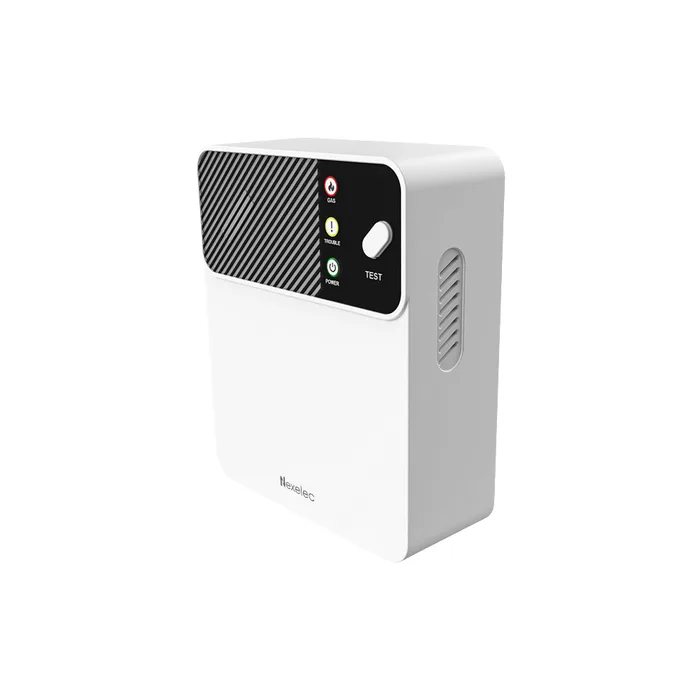
The same 10 percent LEL methane threshold in a sealed ten year package, aimed at buyers who want one install and no maintenance calendar.
Best for: Someone who wants the lower threshold fitted once and forgotten for a decade, in a rental or a second home nobody maintains closely.
- Ten year designed service life on a sealed lithium battery, with no outlet, wiring or battery changes.
- Nexelec publishes a 10 percent LEL alarm threshold for methane and an ETL listing by Intertek to UL 1484.
- An 85 dB alarm at 10 feet and LED indicators for normal, alert, fault and maintenance states, per Nexelec.
- Methane only. Nexelec is explicit that it does not detect propane, carbon monoxide or smoke.
- Covered by a 2-year limited warranty, and Nexelec states the 10 year service life is not a 10 year warranty.
- Sealed construction means the whole alarm is disposable at end of life, with nothing serviceable inside.
- Marketed heavily around one city's local law, which makes it harder to find general availability information than for the more widely stocked brands.
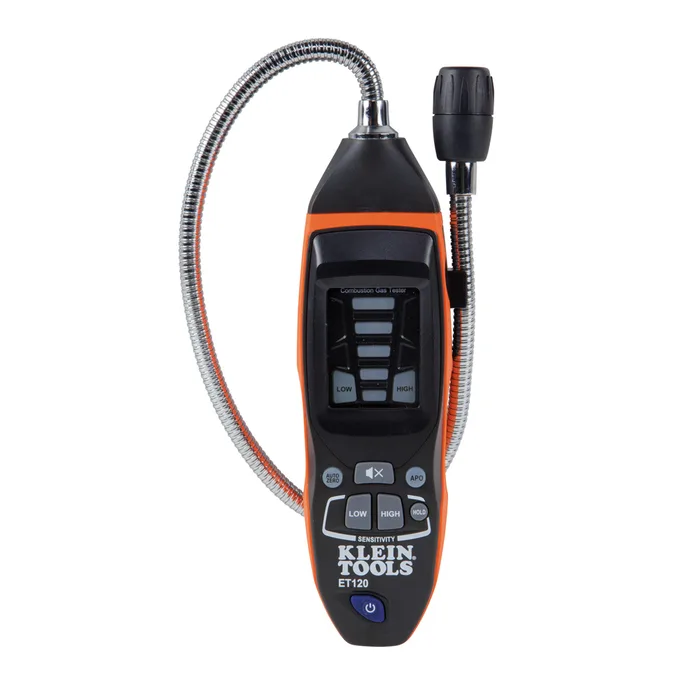
An 18 inch gooseneck wand that finds which fitting is leaking, reading in parts per million rather than percent LEL, and it is not an alarm.
Best for: Someone who already suspects a leak, does their own gas appliance work, or wants to confirm a fitting after a repair, alongside a fixed alarm rather than instead of one.
- Klein publishes a range of roughly 50 to 10,000 ppm across two sensitivity modes, so it resolves leaks far below anything a fixed alarm reacts to.
- An 18 inch flexible probe, which is what makes it possible to trace a run of pipe joint by joint.
- Klein publishes an electrochemical sensor with up to 7 years of life.
- It is a leak finder, not life safety. Klein states it is not intended for use as personal protective equipment, and it powers itself off after ten minutes of inactivity.
- Klein describes five red LEDs and 85 dB audible alerts that rise with concentration, so you get relative strength rather than a reading you can write down.
- It auto zeros at power up, so switching it on inside the leak makes the leak the new zero and it reads low.
- Reading in ppm invites the wrong comparison: 10,000 ppm sounds enormous but is only about 20 percent of the lower explosive limit for methane.
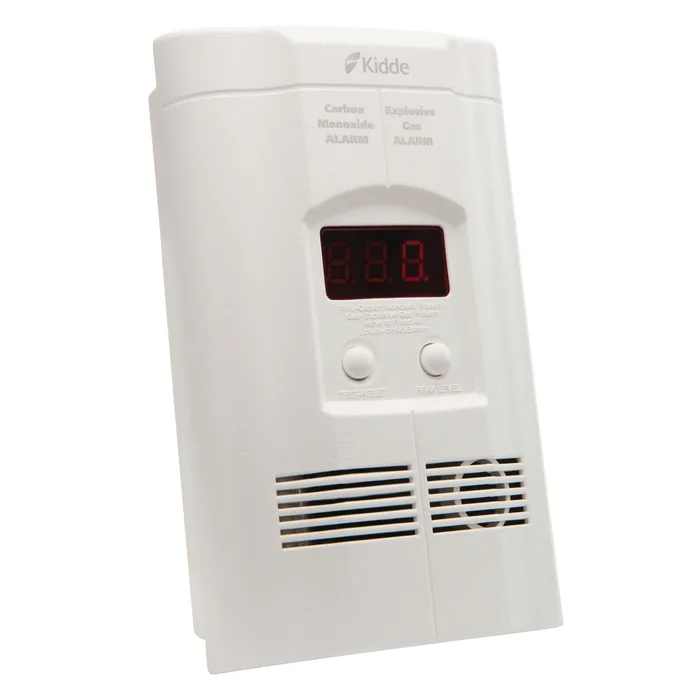
A popular two in one that its own manual quietly explains cannot be mounted correctly for both hazards at once, and that alarms only at the older, higher threshold.
Best for: Almost nobody as a primary gas alarm. If you want both hazards covered, two separate alarms at their two correct heights is the honest answer.
- One device, one outlet, and a digital display with peak level memory covering both hazards.
- Kidde publishes real numbers: an electrochemical carbon monoxide sensor, a metal oxide gas sensor, and the CO response windows the listing requires.
- Nine volt battery backup keeps the carbon monoxide side running through a power cut.
- Kidde's own manual tells natural gas users to mount it high, no closer than six inches from the ceiling, and propane users to mount it near the floor. A plug-in alarm cannot be in both places, and an outlet is in neither.
- The gas side alarms before 25 percent LEL, the older maximum, rather than the 10 percent threshold NFPA 715 recommends where equipment is available.
- On battery backup, after four minutes it samples for explosive gas only once every eight minutes, and Kidde states gas could be present during that window without the unit alarming.
- Carbon monoxide takes priority. If it is alarming for gas and then senses alarm level CO, it stops the gas alarm and switches to the CO pattern, so one signal masks the other.
Amazon had no buyable listing for this when we last checked. The link still works if it returns.
Check price on Amazon Read our detailed assessment| Criteria | Natural Gas Alarm ML-310ES Top pick | VIGAS Natural Gas Alarm K987GL | ET120 Combustible Gas Leak Detector | KN-COEG-3 AC Plug-in Carbon Monoxide and Explosive Gas Alarm |
|---|---|---|---|---|
| Verdict | Buy it | Buy it | It depends | Skip it |
| Best for | A natural gas household that wants the lower alarm threshold and an end of life warning nobody can misread as a low battery chirp. | Someone who wants the lower threshold fitted once and forgotten for a decade, in a rental or a second home nobody maintains closely. | Someone who already suspects a leak, does their own gas appliance work, or wants to confirm a fitting after a repair, alongside a fixed alarm rather than instead of one. | Almost nobody as a primary gas alarm. If you want both hazards covered, two separate alarms at their two correct heights is the honest answer. |
| Price tier | $$ · mid-range | $$ · mid-range | $ · budget | $ · budget |
| Type | Fixed alarm, battery powered | Fixed alarm, sealed battery | Handheld leak finder with gooseneck probe | Fixed combination alarm, AC plug-in |
| Gases covered | Natural gas (methane) only | Natural gas (methane) only | Methane, propane, butane | Carbon monoxide plus natural gas or propane |
| Alarm threshold | 10 percent LEL | 10 percent LEL | No alarm threshold, indicates from about 50 ppm | Before 25 percent LEL |
| What it reports | Alarm state only | Alarm state only | Five LED bargraph, no numeric value | Carbon monoxide in ppm, or the word GAS |
| Sensor | MEMS | MEMS semiconductor | Electrochemical, per Klein | Metal oxide for gas, electrochemical for CO |
| Published life | 6 year product life | 10 year service life | Up to 7 years sensor life | Replace 7 years after first power up |
| End of life signal | Yellow LED plus spoken please replace detector | End of life warning sounds, pattern not described on the page | Fault indication only, no dated end of life | Beeps every 30 seconds and displays End |
| Power | Battery, no wiring | Sealed lithium, no wiring | 4x AAA, auto power off after 10 minutes | 120 VAC with 9 volt backup |
Which one is right for you?
- A natural gas household that wants the lower alarm threshold and an end of life warning nobody can misread as a low battery chirp. Buy it DeNova Detect Natural Gas Alarm ML-310ES
- Someone who wants the lower threshold fitted once and forgotten for a decade, in a rental or a second home nobody maintains closely. Buy it Nexelec VIGAS Natural Gas Alarm K987GL
- Someone who already suspects a leak, does their own gas appliance work, or wants to confirm a fitting after a repair, alongside a fixed alarm rather than instead of one. It depends Klein Tools ET120 Combustible Gas Leak Detector
- Almost nobody as a primary gas alarm. If you want both hazards covered, two separate alarms at their two correct heights is the honest answer. Skip it Kidde KN-COEG-3 AC Plug-in Carbon Monoxide and Explosive Gas Alarm
How we judged the field
Five things decide whether a combustible gas product helps you. First, the marked alarm threshold in percent LEL, because a UL 1484 listing on its own permits anything up to 25 percent and the difference between 10 and 25 is real time. A 2018 study cited in the NFPA 715 record found a 10 percent threshold could identify a gas concentration about 11 minutes sooner than a 25 percent threshold. Second, whether the thing is a fixed alarm or a handheld finder, because the two are sold under the same words and only one of them watches the house while you sleep. Third, the mounting height the gas actually requires, which for natural gas means the ceiling and for propane means the floor, and which rules out entire form factors. Fourth, published sensor and product life, plus whether there is a clear end of life signal at all. Fifth, what the display can and cannot tell you.
The field splits cleanly along the fixed versus handheld line, and then again along threshold. Fixed household alarms in the United States are almost all natural gas units using a semiconductor or MEMS sensing element, and a growing number of them are now marked at 10 percent LEL rather than 25. Handheld wands are a separate tool class, reading in parts per million, with no listing that makes them protection. We took the two fixed alarms that publish a 10 percent LEL threshold and a real end of life story, one wand that publishes its sensor life when most competitors do not, and the combination carbon monoxide and explosive gas alarm that sells in volume and that we think most people should not buy. The propane side of the household market is thin, which is itself worth knowing before you shop.
DeNova Detect Natural Gas Alarm ML-310ES
Buy itThe DeNova Detect ML-310ES is the alarm we would fit first in a natural gas house, and the reason is the threshold on the label. DeNova publishes a 10 percent LEL alarm threshold and states conformance to UL 1484, on a MEMS sensing element. That is half the maximum NFPA 715 still permits, and the standard’s own annex recommends a 10 percent detector where one is available. The second reason is end of life behaviour, a failure mode that is easy to miss: when the sensor is done, the yellow trouble LED blinks twice every ten seconds, the unit beeps every 60 seconds and it speaks the words please replace detector once an hour, in English and Spanish. That is harder to mistake for a low battery chirp. It runs on its own power with no outlet or wiring, which matters because the standard wants it within 12 inches of the ceiling and outlets are not there. The trade-off is a six year product life against the ten year units, and it is natural gas only, so no propane and no carbon monoxide. For a methane household that wants the lower threshold and an unmistakable warning, this is the one.
Nexelec VIGAS Natural Gas Alarm K987GL
Buy itThe Nexelec VIGAS K987GL is the same argument with a longer clock. It publishes a 10 percent LEL alarm threshold for methane, ETL listed by Intertek and conforming to UL 1484, on a MEMS semiconductor sensor, and it runs a designed ten year service life on a sealed lithium battery with no wiring and no battery changes. Four extra years over the DeNova is not a small thing when the realistic failure mode here is a household forgetting a replacement date. Follow the placement rule in the user guide: no more than 12 inches from the ceiling when wall mounted, and 3 to 10 feet horizontally from the appliance, per NFPA 715. The limits are honest ones. It is methane only, explicitly not propane, carbon monoxide or smoke. You rely on the self test and the listing for a decade, and the sealed build makes the whole alarm disposable when the clock runs out. Best for a place nobody maintains closely.
Klein Tools ET120 Combustible Gas Leak Detector
It dependsThe Klein Tools ET120 is the tool half of this category, and understanding what it is not is most of its value. It is an 18 inch gooseneck wand with a range of roughly 50 to 10,000 ppm across two sensitivity modes, high covering about 50 to 1,000 ppm and low covering about 1,000 to 10,000 ppm, detecting methane, propane and butane. Klein lists an electrochemical sensor with up to 7 years of life. That sensitivity sits far below anything a fixed alarm reacts to, which is why it is good at walking a gas line and telling you which fitting is weeping. It is also why it is not protection: Klein states it is not intended for use as personal protective equipment, and it powers off after ten minutes of inactivity. Klein describes five LEDs and audible alerts that rise with concentration rather than a numeric reading, and it auto zeros at power up, so switching it on inside the leak makes the leak the new zero.
Kidde KN-COEG-3 AC Plug-in Carbon Monoxide and Explosive Gas Alarm
Skip itThe Kidde KN-COEG-3 is the product this comparison exists to warn about, and the case against it comes entirely from Kidde’s own manual. It is a real plug-in with an electrochemical carbon monoxide sensor, a metal oxide gas sensor, a digital display and nine volt backup, and Kidde documents it better than most. That documentation is the problem. The manual instructs natural gas users to mount it high on the wall, no closer than six inches from the ceiling, and propane users to mount it near the floor. A unit that plugs into an outlet is at neither height, and NFPA 715 requires combination fuel gas and carbon monoxide alarms to be sited by the fuel gas rules precisely because carbon monoxide disperses more evenly. The gas side alarms before 25 percent LEL, not 10. On battery backup, after four minutes it samples for gas only once every eight minutes, and Kidde states gas could be present in that window without an alarm. Carbon monoxide also takes priority, so a live gas alarm stops if alarm level carbon monoxide appears.
Sources
Specs in this review come from these pages.
- UL Standards and Engagement, UL 1484 Fuel Gas Alarms, Edition 6 (published 2025-02-28) (shopulstandards.com)
- NFPA 715 Second Revisions, Fuel Gases Warning Equipment technical committee (alarm threshold and mounting height language) (docinfofiles.nfpa.org)
- NFPA 715 Public Comment responses (25 percent versus 10 percent LEL, committee statements) (docinfofiles.nfpa.org)
- DeNova Detect, ML-310ES natural gas alarm specifications (denovadetect.com)
- Nexelec, VIGAS natural gas alarm product page and FAQ (nexelec.us)
- Klein Tools, ET120 Combustible Gas Leak Detector specifications (kleintools.com)
DeNova Detect Natural Gas Alarm ML-310ES vs Nexelec VIGAS Natural Gas Alarm K987GL: which should you buy?
The DeNova ML-310ES and the Nexelec VIGAS agree on everything that matters most. Both are fixed methane alarms conforming to UL 1484 at a 10 percent LEL threshold, both use a MEMS sensing element, both run on internal power so you can put them where the standard wants them, and both are explicitly not propane, carbon monoxide or smoke alarms. So the choice is not about detection. It is about which failure mode you are more worried about.
Pick the DeNova if the alarm will live in a house where somebody is paying attention. Six years is a shorter cycle, but the spoken end of life announcement in English and Spanish is a clear replacement prompt, and a spoken instruction is much harder to misread as a dying battery than a chirp is. Pick the Nexelec if the alarm will live somewhere nobody is paying attention, a rental, a second home, a basement utility room, because ten years on a sealed battery removes the maintenance conversation entirely and the placement rule is printed where you will actually read it. If your house runs on propane rather than natural gas, neither of these is your alarm. You need a unit listed for LP gas, mounted on the wall within 18 inches of the floor, and you should expect the 10 percent LEL option to be harder to find, because NFPA’s own annex notes that LP alarms at that threshold are not as readily available as natural gas ones.
What to look for
- Read the marked threshold, not just the listing: NFPA 715 permits a listed alarm to trip anywhere up to 25 percent LEL and recommends 10 percent where available, so a UL 1484 mark alone tells you nothing about sensitivity.
- Match the gas to the mounting height: natural gas alarms belong on the ceiling or within 12 inches of it, propane alarms belong on the wall within 18 inches of the floor, and a form factor that cannot reach the right height is the wrong product.
- Keep the distance rule in mind: the detector should sit more than 3 feet but no more than 10 feet in a horizontal flow path from a permanently installed gas burning appliance, and not in the airstream of a supply or return register.
- Check that an end of life signal exists and how it sounds: the useful ones are unmistakable, either a spoken instruction or a distinct pattern with a display code, because a chirp that reads as a low battery gets silenced instead of replaced.
- Decide up front whether you want an alarm or a finder: a fixed alarm reports percent LEL and watches the room, a handheld wand reports parts per million and finds the fitting, and a wand that powers itself off after ten minutes is not protection.
- Treat a combination carbon monoxide and gas unit sceptically: the two hazards want different mounting heights, the sensors are different types on one shared retirement date, and some models let the carbon monoxide alarm silence the gas alarm.
Our final take
This is a category where the marketing and the standard disagree, and the standard is the one that matters. Buy a fixed alarm listed to UL 1484, look for 10 percent LEL printed on the unit rather than settling for the 25 percent the standard still permits, and mount it at the height your gas requires: high for natural gas, low for propane. The DeNova ML-310ES is our first pick because it pairs that threshold with an end of life warning you cannot ignore, and the Nexelec VIGAS is the better fit where nobody will track a replacement date. Add a handheld wand only if you do your own gas work, and understand it is a finder rather than a guard. If one box promises both carbon monoxide and explosive gas, check where its manual wants it mounted first.
Questions, answered
Is the alarm threshold 10 percent LEL or 25 percent LEL? I have seen both.
Both are current, and that is the confusing part. NFPA 715, the installation standard, sets a maximum fuel gas detection threshold of 25 percent LEL and accepts listed alarms with lower thresholds, including 10 percent LEL. A public comment asking to make 10 percent mandatory was rejected, and the technical committee changed 10 to 25 throughout the document on the reasoning that UL 1484 had to change first. The committee said in writing that it intends to move to 10 percent in a later edition and that a 10 percent level gives significantly higher safety, and the annex recommends using a 10 percent LEL detector when one is available. So a UL 1484 listing alone does not tell you the threshold. Read the number marked on the alarm and the box, and prefer 10 percent.
Why do the mounting instructions for propane and natural gas point in opposite directions?
Because the gases behave differently once they escape. NFPA 715 requires a natural gas detector on the ceiling, or on a wall with the top of the detector within 12 inches of the ceiling, in the same room as a permanently installed gas burning appliance. For propane and LP gas it requires the entire detector on the wall within 18 inches of the floor. Both must sit more than 3 feet but no more than 10 feet from the appliance in a horizontal flow path, and not directly in the airstream of a supply or return register. This is the sharpest contrast with carbon monoxide alarms, which our carbon monoxide detector comparison covers: carbon monoxide has a density close to air and disperses fairly evenly, so height matters far less there. With fuel gas, height is most of the decision.
Can I bump test a household gas alarm the way industrial monitors are tested?
Not in the industrial sense, and it varies by manufacturer. There is no consumer equivalent of a certified span gas bump test with a documented pass record. The test button on a household alarm generally exercises the electronics and the sounder rather than the sensing element. Follow each maker's own test instructions rather than introducing uncontrolled quantities of gas near the device. At the other end, MTI Industries prints the opposite in the manual for its Safe-T-Alert propane alarms: the test button only tests the alarm circuit, not the sensor, and you may use propane or butane gas to test the sensor. So check the manual for your specific model before you try anything, and never use an open flame or a large release.
Why does the handheld read in ppm when the fixed alarm talks about percent LEL?
They are answering different questions. Percent LEL is a fraction of the concentration at which the gas becomes flammable, which is what a life safety alarm cares about. Parts per million is an absolute concentration, which is what you want when you are hunting for the source of a leak. The two convert, and the conversion is worth doing once. NFPA notes that natural gas is odorized so it is detectable by smell at about one fifth of its lower explosive limit, roughly 1 percent gas in air or 20 percent LEL, which puts methane's LEL at about 5 percent gas in air, or 50,000 ppm. So 10 percent LEL is about 5,000 ppm and 25 percent LEL is about 12,500 ppm. The Klein ET120 tops out around 10,000 ppm, which is under 20 percent LEL, so a wand pegged at full scale is already in territory a fixed alarm would be shouting about.
Does a combination carbon monoxide and explosive gas alarm make sense?
Rarely, and the reasons are structural rather than about any one brand. NFPA 715 requires a combination fuel gas and carbon monoxide alarm to be located according to the requirements for the fuel gas being sampled, and the technical committee explained why: carbon monoxide disperses more uniformly than fuel gases do. That means the combination unit gets pushed to the ceiling in a natural gas house or to the floor in a propane house, which is not where you would place a carbon monoxide alarm on its own. A plug-in combination unit lands at outlet height, which suits neither. Add that the two sensor types are different, that the whole unit is retired on one date, and that at least one popular model stops alarming for gas the moment it senses alarm level carbon monoxide, and two separate alarms at their two correct heights is usually the better buy.
Deciding between the top two? See our head-to-head: DeNova Detect Natural Gas Alarm ML-310ES vs Nexelec VIGAS Natural Gas Alarm K987GL.
More Health & Wellness reviews
 The Best Pneumatic Compression Boots: 4 Compared (and One to Skip)
  The Best Compression Socks: 4 Compared (and One to Skip)
  The Best CPAP Cleaning Supplies: 4 Compared (and One to Skip)
  The Best Digital Thermometers: 4 Compared (and One to Skip)
  The Best Ear Wax Removal Kits: 4 Compared (and One to Skip)
  The Best Earplugs for Sleeping: 4 Compared (and One to Skip)