Explained
Combustible Gas Detectors, Explained
After reading, you'll understand what percent LEL means on a label, why the same house can need an alarm at the ceiling and another at the floor, and when a handheld wand is the right tool instead of an alarm.
In this guide
First time buyers get tripped up by one word doing two jobs. Detector describes both a fixed alarm bolted to a wall and a battery wand you wave at a pipe, and the listings, the numbers and the purpose are different for each. The second trap is the number on the box. Two alarms can both carry the same listing mark and trip at concentrations that differ by more than double. The third is placement, which is not a preference in this category but a physics problem with a published answer.
The 30-second version
- Percent LEL is the number that matters, and a listing mark alone does not tell you whether an alarm trips at 10 percent or 25 percent.
- Natural gas rises and propane sinks, so the correct mounting height is opposite for the two, and no single position serves both.
- A fixed alarm and a handheld wand are different products, one watches a room in percent LEL and the other hunts a fitting in parts per million.
- End of life signalling is the real reliability question, because a sensor that expires quietly leaves a house that thinks it is protected.
- Combination carbon monoxide and gas alarms inherit the fuel gas mounting rule, which usually puts them somewhere you would never place a carbon monoxide alarm on its own.
The products this guide is about
Our verdict on each, with the full reasoning on the companion review.
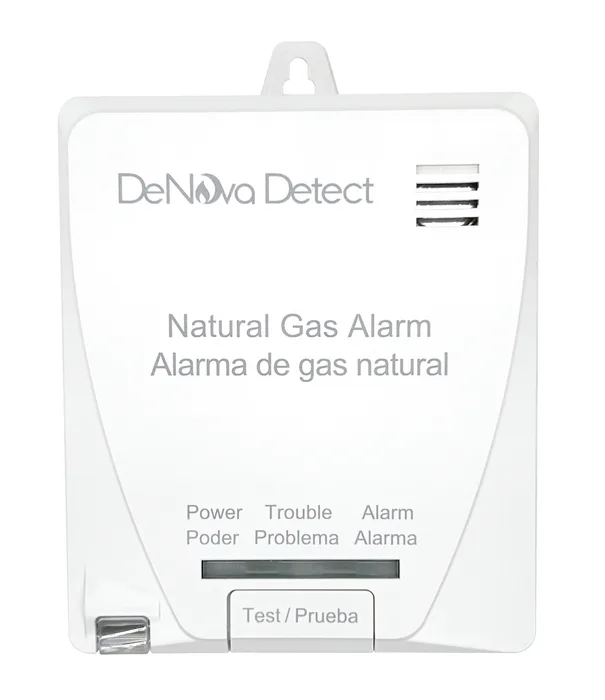
- Buy DeNova Detect Natural Gas Alarm ML-310ES A battery powered fixed methane alarm conforming to UL 1484 at a 10 percent LEL threshold, with spoken end of life and alarm announcements in English and Spanish.
- Buy Nexelec VIGAS Natural Gas Alarm K987GL The same 10 percent LEL methane threshold in a sealed ten year package, aimed at buyers who want one install and no maintenance calendar.
- It depends Klein Tools ET120 Combustible Gas Leak Detector An 18 inch gooseneck wand that finds which fitting is leaking, reading in parts per million rather than percent LEL, and it is not an alarm. Amazon
- Skip Kidde KN-COEG-3 AC Plug-in Carbon Monoxide and Explosive Gas Alarm A popular two in one that its own manual quietly explains cannot be mounted correctly for both hazards at once, and that alarms only at the older, higher threshold.
What actually matters
- Alarm threshold in percent LEL - This is the fraction of the flammable concentration at which the alarm trips. NFPA 715 permits up to 25 percent and its annex recommends 10 percent where equipment is available, so the same listing covers alarms that differ by more than a factor of two in how early they speak.
- Gas type coverage - Most household alarms sold in the United States are methane only and say so plainly. Propane households need an alarm listed for LP gas, and the record notes that LP alarms at the lower threshold are harder to find than natural gas ones.
- Mounting height - Natural gas alarms go on the ceiling or within 12 inches of it, propane alarms go on a wall within 18 inches of the floor. A plug-in form factor is stuck at outlet height and cannot satisfy the natural gas rule at all.
- Distance from the appliance - More than 3 feet and no more than 10 feet in a horizontal flow path from a permanently installed gas burning appliance, and out of the airstream of supply and return registers.
- Sensor type - Household alarms use semiconductor or MEMS elements. Catalytic bead and infrared sensing belong to industrial and portable instruments, and each has different weaknesses worth knowing about if you ever move up to that class of tool.
- Published service life and end of life signal - Six to ten years is the normal range for a household alarm, and the signal that announces the end of it is what determines whether the alarm gets replaced or silenced.
- Whether it is an alarm at all - Handheld leak detectors carry no life safety listing, often power themselves off after a few minutes, and may state in the manual that they are not personal protective equipment.
The specs, in plain English
Green flags vs red flags
Green flags
- The alarm threshold is printed as a percentage of LEL on the unit itself, the packaging and the instructions, and it reads 10 percent.
- The listing standard is named on the product, with a testing laboratory behind it such as UL or Intertek.
- The maker publishes a service life in years and describes exactly what the end of life signal looks and sounds like.
- The mounting instructions distinguish natural gas from propane and give a height in inches, not a vague suggestion.
- A handheld model publishes its sensor life expectancy and its detection range with the sensitivity modes broken out.
Red flags
- The listing is claimed but no threshold appears anywhere, which leaves room for the higher 25 percent setting.
- One product promises to cover carbon monoxide, explosive gas and sometimes smoke from a single position on the wall.
- A plug-in unit is sold for natural gas detection with no mention that the standard wants the detector near the ceiling.
- A handheld leak finder is described in language that implies continuous protection, despite an automatic power off timer.
- The specification sheet gives a detection range in ppm for a fixed alarm, or a percent LEL figure for a wand, which usually signals a spec sheet copied from the wrong product class.
Who's who: the brands
- DeNova Detect - Battery powered residential natural gas alarms built around MEMS sensing, marketed on a 10 percent LEL threshold and spoken English and Spanish alerts.
- Nexelec - Sealed ten year natural gas alarm, the VIGAS, marketed around New York City Local Law 157.
- Kidde - Residential alarms, including the KN-COEG-3 combination carbon monoxide and explosive gas plug-in reviewed here.
- Klein Tools - Makes the ET120 gooseneck combustible gas leak finder, aimed at tracing leaks rather than standing watch.
- MTI Industries (Safe-T-Alert) - Propane and LP gas alarms for recreational vehicles, boats and 12 volt installations, a corner of the market the mains powered brands mostly leave alone.
How to read a listing without getting fooled
Start at the bottom of the spec sheet, not the top. Find the listing standard and the laboratory, then find the alarm threshold expressed as a percentage of LEL, and if that number is missing assume the higher end of what the standard allows. Next find the gases named, and treat the absence of propane as meaning the unit does not cover it. Then find the service life in years and the description of the end of life behaviour, because those two lines decide whether the alarm is still working in year seven. Finally, read the mounting section before you read anything about features, since a unit that physically cannot sit at the height your gas requires is disqualified regardless of how good the rest of the sheet looks. If the sheet gives you a detection range in ppm, you are holding a leak finder, not an alarm, and it should be judged on its sensitivity floor, its response time and its sensor life instead.
How much should you spend?
Fixed residential gas alarms sit in a narrow band. The budget tier is dominated by combination carbon monoxide and explosive gas plug-ins, which look like good value until you read where their manuals want them mounted. The mid-range tier is where the standalone natural gas alarms live, and that is where the 10 percent LEL threshold and the six to ten year sealed designs are found. Paying up within that tier mostly buys service life rather than sensitivity, since the better six year and ten year units share the same threshold. Handheld leak finders start at the budget tier and stay useful there, because the specification that matters, a sensitivity floor around 50 ppm with a published sensor life, does not require a premium instrument. Spending into the premium tier generally moves you into professional and industrial equipment with catalytic or infrared sensing, calibration schedules and bump testing, which is more instrument than a household needs.
Questions, answered
Do I need a gas alarm if I already have carbon monoxide alarms?
They cover different hazards. A carbon monoxide alarm detects an incomplete combustion product that poisons people, and a combustible gas alarm detects unburned fuel that can explode. Neither substitutes for the other, and the manuals we read say so explicitly. If you have gas appliances, gas piping or a propane tank, the two are separate purchases.
How long do household gas alarms last?
Six to ten years is the normal published range, and the number is a property of the sensor rather than the battery. The alarm is disposable at that point in almost every consumer design, since there is nothing serviceable inside. Write the replacement date on the unit when you install it, and treat the end of life signal as a hard instruction rather than a nuisance.
Will a gas alarm go off from a stove burner or a pilot light?
It should not, if it is placed according to the standard. That is part of why the installation rules keep the detector more than 3 feet from a permanently installed gas burning appliance, out of the airstream of supply and return registers, and away from the space directly above a doorway. Makers also test against common household chemicals for nuisance alarms. If you get repeated alarms with no leak, check placement before you assume the unit is faulty.
Can I smell a leak before an alarm would catch it?
Often yes, and that is deliberate. Utility gas is odorized so that a leak is detectable by smell at roughly one fifth of the lower explosive limit, which is about 20 percent LEL for natural gas. An alarm marked at 10 percent LEL is therefore designed to speak before the average nose does, while a 25 percent alarm may not. Smell is not a substitute for an alarm, because people sleep and some people cannot detect the odorant.
Or jump to the head-to-head: DeNova Detect Natural Gas Alarm ML-310ES vs Nexelec VIGAS Natural Gas Alarm K987GL.