Explained
Camera Straps, Explained
After reading, you'll know which carry style suits your shooting, how to judge attachment hardware, and what a good strap page should tell you.
In this guide
A camera strap is a length of material and two connectors, and almost all of the risk lives in the connectors. Almost all of the comfort lives in the width, the lining and whether the length can be changed while you are wearing it. Those two sentences cover most of what separates a strap you keep from one you replace.
The 30-second version
- Attachment hardware is the safety-critical part, and a published load rating is rare and valuable.
- Sling carry beats neck carry for weight, because the load moves off your cervical spine.
- Width spreads load, and matters above roughly a kilogram of camera and lens.
- Quick adjustment changes how you can carry, where a fixed length commits you to one position.
- Stretch damps shock and reduces control, which suits light bodies and hinders heavy ones.
The products this guide is about
Our verdict on each, with the full reasoning on the companion review.
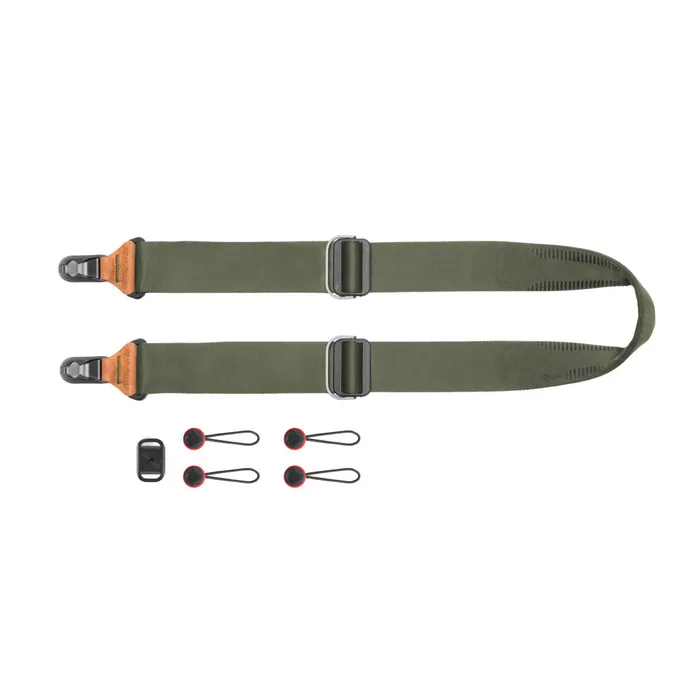
- Buy Peak Design Slide The only strap here with a published load rating, and the only one that adjusts in one pull.
- Buy HoldFast Gear HF Classic Strap Two widths, three lengths, and a leather shroud that keeps the metal clasp off your camera.
- It depends Langly Paracord Camera Strap 550 pound paracord that stretches on purpose, in one length and a lot of colours.
- Skip Moment Adjustable Leather Camera Neck Strap A nice leather strap described in two sentences.
What actually matters
- Attachment system - anchors on a cord, quick-detach clasps, split rings or webbing threaded directly through the lugs. Check what is included and what it fits.
- Load rating - the weight a connector is rated to hold, ideally published per connector. Rare in this category and the most useful number when present.
- Adjustment - quick-adjusters that work one-handed while wearing, buckles with fixed stops, or no adjustment at all.
- Width - typically half an inch to nearly two inches. Wider spreads the load across the shoulder; narrower is lighter and less conspicuous.
- Material and lining - nylon webbing, leather or paracord, and what sits against skin, which is usually microfibre, suede or a padded section.
- Length - stated in inches or centimetres, and whether the range covers neck carry at the short end and cross-body at the long end.
- Hardware finish - whether any metal component contacts the camera body, and whether it is shrouded or coated to prevent marking.
The specs, in plain English
Green flags vs red flags
Green flags
- A load rating published per connector.
- Attachment hardware named, with what is included listed.
- Width and weight both published.
- Length or adjustment range given in real units.
- A stated lining material where the strap touches skin.
Red flags
- No description of how the strap attaches to the camera.
- No length or adjustment range on an adjustable strap.
- Leather described only as leather, with no grade or thickness.
- No weight anywhere on the page.
- Quick release claimed with no load figure behind it.
Who's who: the brands
- Peak Design - Built the Anchor Link system that most quick-swap straps are now compared against, and publishes widths, weights, load ratings and a lifetime warranty.
- HoldFast Gear - American leather maker best known for the MoneyMaker dual-camera harness, using stainless quick-detach clasps under leather shrouds.
- Langly - Camera bag and accessory brand whose paracord straps trade static support for shock absorption, in a single length and many colours.
- Moment - Mobile and camera accessory brand with a small line of leather straps and slings, documented lightly compared with its lens range.
- BlackRapid - Originator of the sling strap that runs across the body with the camera sliding along it, still the reference for fast one-handed carry.
How to read a listing without getting fooled
Start at the connectors and do not move on until you know what they are. A good page names the hardware, says what comes in the box, and ideally gives a load figure; a page that shows a photograph of a strap and never mentions attachment has skipped the only part that can drop a camera. Then look at adjustment and be honest about how you shoot: if you move between carrying and shooting constantly, quick-adjusters are worth more than any material choice, and if you carry one camera one way, a fixed length is simpler and often nicer. Check the width against your heaviest lens, and read what the lining is where it crosses your neck. Look for a weight, which tells you whether the padding is foam or something better. Finally check whether any metal touches the camera, because that is where baseplate marks come from, and read the warranty, which in this category varies from a lifetime to nothing at all.
How much should you spend?
Straps are cheap relative to what hangs from them, so buying on price is a false economy that ends with a camera on concrete. The mid-range buys a well-made strap in leather, webbing or paracord from a specialist, and for most people that is enough and the choice between them is about material preference and carry style rather than quality. The premium tier buys published specifications, rated connectors, quick-adjust hardware and, in one case here, a lifetime warranty, and it is worth the difference if the strap is on a camera you use for work. Leather from a dedicated maker sits at similar money and buys longevity and appearance rather than adjustability. What is never worth buying is an unbranded strap with no published attachment detail, because the saving is a few pounds and the exposure is the price of a camera.
Questions, answered
Can I use a strap with a tripod plate fitted?
Usually yes, and it depends on where the strap attaches. Straps that connect to the side lugs leave the baseplate clear, so an Arca-style plate fits normally. Straps that anchor to the tripod socket itself conflict directly with a plate, which is why some systems sell a combined plate with a strap connection built in. If you use a tripod often, check that the strap's connection point is not the socket, or budget for the combined plate.
Will a strap mark my camera?
Metal hardware will, over time, which is why the better designs cover it. HoldFast shrouds its stainless clasp in leather specifically to keep the metal away from the camera body. Split rings are the usual culprit, gradually wearing the finish around the lugs, and a small silicone or leather washer solves it cheaply. Anchors on a cord avoid the problem entirely because nothing rigid sits against the body.
How do I set the length correctly?
For neck carry, short enough that the camera sits at mid-chest rather than swinging at your stomach. For sling carry, long enough that the camera rests at your hip with the lens pointing backwards and rises to your eye without the strap pulling at your neck. HoldFast's guidance is the useful version of this: its 38 inch strap is the shortest and best for neck carry, with the longer 42 and 46 inch lengths intended for cross-body. If a strap is adjustable, set it while wearing the coat you shoot in.
Is a wrist strap enough on its own?
For a small body and short outings, often yes, and it is far less conspicuous than a neck strap. The limitation is that a wrist strap keeps the camera in your hand, so your hand is occupied for the whole time you are carrying it, and it offers nothing if you want to walk any distance. Many people carry both: a sling or neck strap for moving between locations and a wrist strap for working. Most makers here sell one, including Peak Design's Cuff and HoldFast's Camera Leash.
Or jump to the head-to-head: Peak Design Slide vs HoldFast Gear HF Classic Strap.