

Tech & Gadgets
The Best Camera Straps: 4 Compared (and One to Skip)
We compared four camera straps on attachment system and rated load, width and weight, whether the length adjusts at all, materials and warranty.
The short version
The Peak Design Slide is the one to buy: 4.5 centimetres of tubular seatbelt-style nylon webbing with an embedded shoulder pad, 148 grams, aluminium adjustment hardware, and four Anchor Link connectors each rated to hold well over 90 kilograms or 200 pounds, backed by a lifetime warranty. The HoldFast HF Classic is the leather alternative and the better-thought-out one, in a 1 inch wide version that tapers toward the camera for heavier bodies or a half-inch skinny version, with a leather shroud covering a stainless steel quick-detach clasp so the metal never touches the camera body, in 38, 42 and 46 inch lengths. The Langly Paracord Camera Strap uses 550 pound test paracord whose natural stretch damps the shocks of moving over rough ground, with nylon webbing and a suede lining, in a single 42 inch length. The Moment Adjustable Leather Camera Neck Strap is the one to skip: microfibre-lined leather with ten-stop buckles is all Moment tells you, with no length, no width, no weight, no attachment method and no warranty. Best for: anyone still using the branded strap that came in the box.
Our picks at a glance
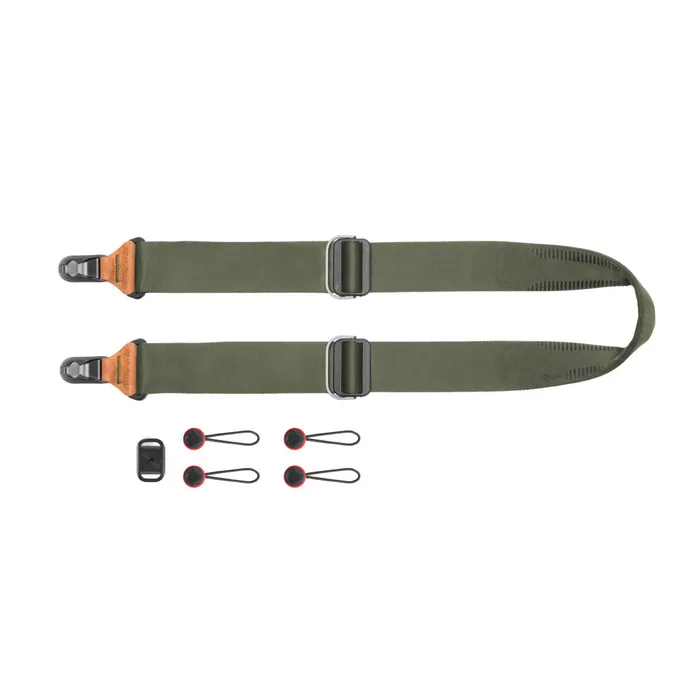
- Peak Design Slide - Buy. The only strap here with a published load rating, and the only one that adjusts in one pull.
- HoldFast Gear HF Classic Strap - Buy. Two widths, three lengths, and a leather shroud that keeps the metal clasp off your camera.
- Langly Paracord Camera Strap - It depends. 550 pound paracord that stretches on purpose, in one length and a lot of colours.
- Moment Adjustable Leather Camera Neck Strap - Skip. A nice leather strap described in two sentences.
The verdict in 30 seconds
What mattered most
- Material
- Attachment
- Load rating
- Width
- Weight
- Length
A camera strap carries something expensive by two small lugs, which makes the attachment hardware the most important part of it and the part least often described. After that, the decisions are about how you wear it. A strap that adjusts in a single pull lets you sling a camera at your hip and then raise it to your eye without stopping. A fixed-length leather strap does one thing well and cannot be persuaded to do anything else. And paracord behaves differently from webbing under a heavy body, in ways that are a feature for some people and an irritation for others.
The only strap here with a published load rating, and the only one that adjusts in one pull.
Best for: Working shoots where you move between hip carry and eye level constantly, and want the hardware rated.
- Four Anchor Link connectors are included and each is rated to hold well over 90 kilograms or 200 pounds, which is the only load figure published by any maker in this comparison.
- Premium tubular seatbelt-style nylon webbing with an embedded PVC shoulder pad, 4.5 centimetres wide and 148 grams, with custom aluminium strap adjustment hardware.
- Hypalon accents that Peak Design states are vegan, and a lifetime warranty.
- The Anchor Link system is proprietary, so committing to it means every camera and strap in your kit ends up on Peak Design hardware.
- At 4.5 centimetres it is the widest and most conspicuous strap here.
- Nylon webbing rather than leather, which some people simply prefer against a shoulder.
- No adjustment range in centimetres is published on the product page.
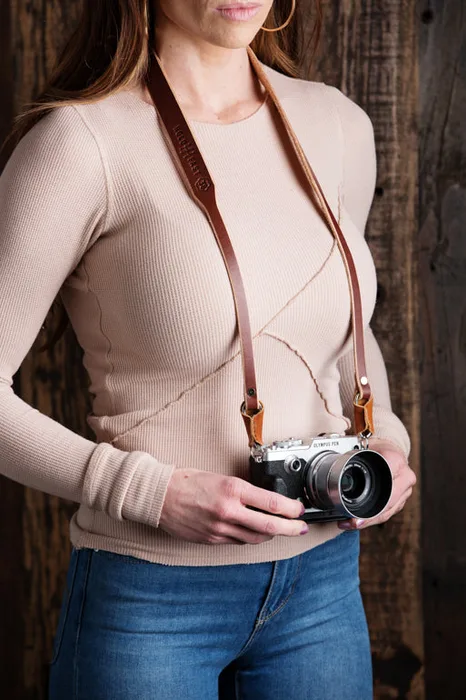
Two widths, three lengths, and a leather shroud that keeps the metal clasp off your camera.
Best for: One camera, one way of carrying it, and a strap that will look better in five years than it does today.
- A leather shroud covers the stainless steel clasp, keeping the metal away from the camera body while adding a second layer of security over the quick-detach mechanism.
- Two widths with a purpose: the 1 inch version disperses the weight of a heavier camera across the shoulder and then tapers toward the camera connection, while the half-inch skinny version is the streamlined option for a light body.
- Made from the same leathers as HoldFast's MoneyMaker harnesses, with quick-detach clasps so a camera moves between the two, split rings included, and step-by-step installation instructions published.
- There is no adjustment buckle at all, so the length is a purchase decision made from 38, 42 and 46 inches.
- No weight, no leather type and no thickness are published.
- No load rating and no warranty terms appear on the page.
- HoldFast notes the shroud is stiff at first and needs breaking in.
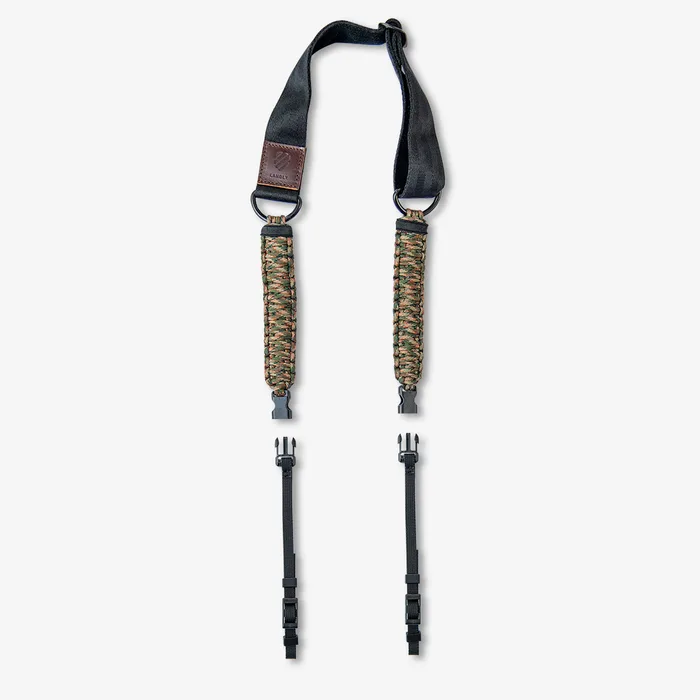
550 pound paracord that stretches on purpose, in one length and a lot of colours.
Best for: Hiking and travel with a lighter body, where absorbing movement matters more than holding it still.
- Built from 550 pound test paracord, the material originally used in the suspension lines of US parachutes, which Langly notes flexes without breaking.
- That flex is the point: the natural suspension damps the shocks of a camera bouncing while you move over rough terrain, which webbing and leather do not.
- Sturdy nylon webbing with a soft suede lining against the neck, in a wide choice of colours.
- One length only, at 42 inches, with no adjustment described.
- No width, no weight and no attachment hardware are specified.
- The stretch that damps shock also means a heavy body moves more than it would on webbing, which some people find distracting.
- No load rating for the finished strap and no warranty terms are published.
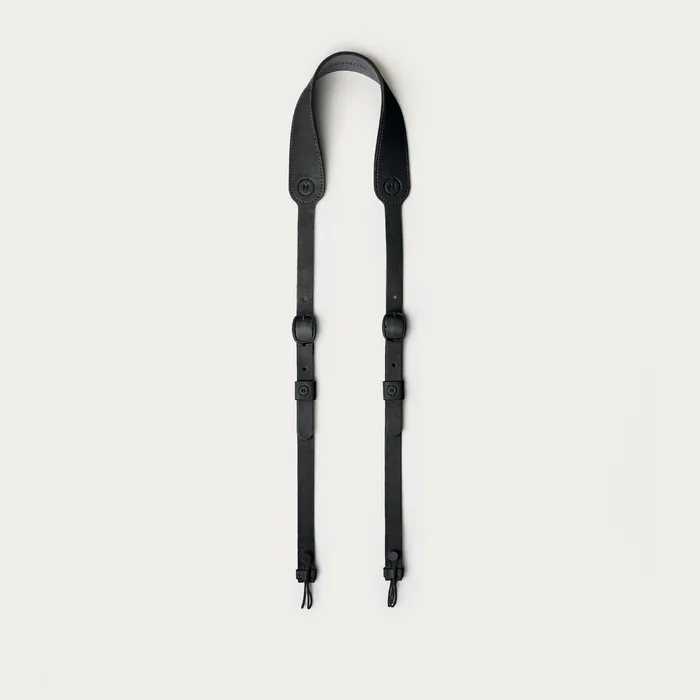
A nice leather strap described in two sentences.
Best for: Someone who wants a good-looking leather strap from a brand they trust and does not need the numbers.
- The neck section is lined with microfibre, which is the part of a leather strap that becomes uncomfortable first.
- Ten-stop matte black buckles adjust easily and are long enough to allow cross-body wear as well as neck carry.
- Offered in natural and black leather, both of which will age well.
- No length, no adjustment range, no width and no weight are published.
- The leather is not named or graded, and its thickness is not given.
- The attachment method is not described at all, which is the most important part of any strap.
- No load rating and no warranty terms appear on the page.
| Criteria | Slide Top pick | HF Classic Strap | Paracord Camera Strap | Adjustable Leather Camera Neck Strap |
|---|---|---|---|---|
| Verdict | Buy it | Buy it | It depends | Skip it |
| Best for | Working shoots where you move between hip carry and eye level constantly, and want the hardware rated. | One camera, one way of carrying it, and a strap that will look better in five years than it does today. | Hiking and travel with a lighter body, where absorbing movement matters more than holding it still. | Someone who wants a good-looking leather strap from a brand they trust and does not need the numbers. |
| Price tier | $$$ · premium | $$$ · premium | $$ · mid-range | $$ · mid-range |
| Material | Tubular nylon webbing, PVC pad | Leather with leather shroud | 550 lb paracord, nylon webbing, suede lining | Leather, microfibre lined |
| Attachment | Anchor Link, 4 anchors included | Stainless quick-detach clasp, split rings included | Not published | Not published |
| Load rating | Over 90 kg / 200 lb per anchor | Not published | 550 lb cord, strap not rated | Not published |
| Width | 4.5 cm / 1.8 in | 1 in or 0.5 in | Not published | Not published |
| Weight | 148 g / 5.2 oz | Not published | Not published | Not published |
| Length | Quick adjust, range not published | 38, 42 or 46 in, fixed | 42 in, fixed | Adjustable, range not published |
| Adjustment | Dual quick-adjusters | None | None described | Ten-stop buckles |
| Warranty | Lifetime | Not published | Not published | Not published |
Which one is right for you?
- Working shoots where you move between hip carry and eye level constantly, and want the hardware rated. Buy it Peak Design Slide
- One camera, one way of carrying it, and a strap that will look better in five years than it does today. Buy it HoldFast Gear HF Classic Strap
- Hiking and travel with a lighter body, where absorbing movement matters more than holding it still. It depends Langly Paracord Camera Strap
- Someone who wants a good-looking leather strap from a brand they trust and does not need the numbers. Skip it Moment Adjustable Leather Camera Neck Strap
How we judged the field
Attachment comes first, because it is the only part of a camera strap that can fail expensively. We looked for what the strap connects with, whether the connectors are included, and above all whether any load figure is published. Exactly one maker here publishes one. That is a remarkable state of affairs for a category of product whose entire job is holding something heavy above a hard floor, and it is the single clearest way to separate these four.
After that we looked at adjustment, which determines how you can carry rather than how comfortable it is. A strap with quick-adjusters can be slung, shortened to the chest and lengthened again in one movement; a fixed-length strap is bought at one length and stays there, which is a legitimate choice made deliberately by one maker here and by omission elsewhere. Then width and weight, since a wide strap spreads load and a heavy one adds to it, and only one maker publishes either. Then material, including the lining that touches your neck, and finally warranty, which in this category ranges from a lifetime to nothing stated at all.
The Peak Design Slide is the only strap in this comparison that tells you what it can hold. Four Anchor Link connectors come in the box and each is rated to hold well over 90 kilograms or 200 pounds, which is a specification rather than a reassurance, and the anchors are what make the rest of the system work: once they are on a camera, any Peak Design strap clips on and off in a second. The webbing is premium tubular seatbelt-style nylon with an embedded PVC shoulder pad, 4.5 centimetres wide, and the whole strap weighs 148 grams. The adjustment hardware is custom aluminium rather than plastic, the accents are Hypalon which Peak Design states is vegan, and the whole thing carries a lifetime warranty. What you give up is neutrality: the Anchor system is proprietary, and once your bodies are wearing anchors you are effectively in the ecosystem. At 4.5 centimetres it is also the most visible strap here, which matters if you are trying not to look like a photographer, and it is nylon rather than leather, which for some people settles the question on its own.
The HoldFast HF Classic Strap is leather done thoughtfully, and its best idea is one nobody else here has. The stainless steel quick-detach clasp is covered by a leather shroud, which keeps the metal from touching the camera body and at the same time adds a second physical barrier over the release mechanism, so it cannot be knocked open. The line is offered in two widths for two different jobs: the 1 inch version is wider across the shoulder to disperse the weight of a heavier body and then tapers toward the camera connection, while the half-inch skinny version is the minimal option for a light setup. It uses the same leathers as HoldFast’s MoneyMaker harnesses, and the quick-detach clasps mean a camera moves between the two without rethreading anything. Split rings are included and installation instructions are published step by step. The honest limitation is stated openly on the page: there is no adjustment buckle, so you choose 38, 42 or 46 inches and live with it, with 38 being the shortest for neck carry and the longer lengths for cross-body. HoldFast also publishes no weight, no leather grade, no load rating and no warranty, and notes the shroud is stiff until broken in.
The Langly Paracord Camera Strap is built around one material decision and explains it well. The strap uses 550 pound test paracord, the same cord originally used in the suspension lines of US parachutes during the Second World War, chosen because it flexes without breaking. Langly is clear that the flex is the point rather than a side effect: the natural suspension shields the camera from shocks when you are moving through rough terrain, which is genuinely different from what webbing or leather do. Around the cord is sturdy nylon webbing with a soft suede lining where it sits on the neck, and it comes in a wide range of colours. Whether that suits you depends almost entirely on your camera. On a light mirrorless body over a long hike, the give is pleasant. On a heavy body with a fast zoom, a strap that stretches means the camera swings further and takes longer to settle, and it is harder to find by feel in the same place twice. The documentation is thin beyond the cord itself: one fixed 42 inch length, no width, no weight, no attachment hardware described, and no warranty.
The Moment Adjustable Leather Camera Neck Strap is a skip on information rather than on quality. What Moment publishes is two sentences: the neck is lined with microfibre, and the ten-stop matte black buckles are easy to adjust for wearing cross-body. Both of those are good things, and the microfibre lining in particular addresses the first thing that becomes uncomfortable on a leather strap. There are two finishes, natural and black leather. That is the whole page. There is no length and no adjustment range, so you cannot tell whether it will actually reach for cross-body carry on your frame. There is no width, which decides comfort under weight, and no weight. The leather is not named, graded or measured. Most importantly there is no description of how it attaches to the camera at all, which is the one component whose failure costs you a camera, and no load rating and no warranty to fall back on. Three straps at similar money each tell you more.
Peak Design Slide vs HoldFast Gear HF Classic Strap: which should you buy?
Peak Design against HoldFast is a choice between a system and an object. The Slide is the better tool: it publishes a width, a weight and a load rating, its aluminium quick-adjusters let you move from hip sling to eye level without breaking stride, and the Anchor Link connectors mean the strap comes off in a second when you put the camera on a tripod. The lifetime warranty is the strongest in the group by a wide margin, and 148 grams for a padded 4.5 centimetre strap is light.
The HF Classic is the better thing to own. It is leather from a maker whose harnesses are the reference in this space, it comes in two widths chosen for two genuinely different camera weights, and the shrouded stainless clasp is a more elegant solution to the metal-against-camera problem than anything else here. It will also look considerably better after five years of use, which nylon webbing will not. Buy the Slide if you shoot for work or move a lot while carrying. Buy the HF Classic if you carry one camera one way and want the strap to be part of the pleasure.
What to look for
- A published load rating on the connectors: this is the safety-critical part, and only one maker here states a figure.
- Whether attachment hardware is included: anchors, split rings or clasps, and whether they fit your camera’s lugs.
- Adjustment, and how fast: quick-adjusters change how you carry mid-shoot, and a fixed length is a decision you make once.
- Width against your camera’s weight: wider spreads load, narrower is discreet, and over about a kilogram you want width.
- A lining where it touches you: microfibre, suede or a padded section is what stops a strap becoming unpleasant after an hour.
- Whether any metal touches the camera body: a shroud or a soft cover prevents the marks that otherwise appear on the baseplate.
Our final take
Camera straps are judged on the two centimetres of hardware nobody photographs. The Peak Design Slide is the one to buy: four Anchor Link connectors each rated well over 90 kilograms, 4.5 centimetres of padded webbing at 148 grams, aluminium adjusters that change your carry in one pull, and a lifetime warranty. The HoldFast HF Classic is the leather strap to own instead, with two widths for two camera weights and a shrouded stainless clasp that keeps metal off the body, provided you are content to pick a length and keep it. The Langly Paracord is the right answer for lighter bodies on rough ground, where a strap that gives is a feature rather than a fault. And a strap that will not tell you how it attaches to your camera is asking for a lot of faith on the only part that matters.
Questions, answered
What should I actually check before buying a strap?
The attachment hardware, first and last. Everything else is comfort, and the hardware is the part holding a camera above a pavement. Look for what it connects to, whether split rings or anchors are included, and whether any load figure is published. Peak Design rates each Anchor at over 90 kilograms, which is the only number in this comparison; HoldFast describes a stainless clasp with a leather shroud over it; the other two say nothing about attachment at all, which for the most safety-critical component is a real gap.
Neck, shoulder or sling?
Neck carry puts the whole weight on your cervical spine and is the least comfortable for anything heavier than a small body, which is why the strap in the box is the first thing most people replace. Shoulder carry moves the load to one side and is fine for short periods. Sling carry runs the strap across your body so the camera rides at your hip, which is far more stable when walking and lets you raise the camera without unhooking anything. A strap that adjusts quickly lets you do all three; a fixed-length strap commits you to one.
Does strap width matter?
For heavier setups, considerably. A wider strap spreads the same load over more shoulder, which is why Peak Design uses 4.5 centimetres and why HoldFast offers a 1 inch version that tapers toward the camera rather than staying wide all the way. A narrow strap is less conspicuous, lighter and perfectly comfortable with a small mirrorless body, and it will dig in under a full-frame body with a fast zoom. If your camera and lens together are over about a kilogram, buy width.
Why do some straps stretch?
Because stretch absorbs shock. Langly builds its strap around 550 pound paracord specifically for the natural suspension it gives, which damps the jolts of a camera bouncing while you walk over rough ground. The trade is that a stretchy strap lets the camera move more, which on a heavy body can feel less controlled and makes the camera harder to locate by feel. Webbing and leather are comparatively static, which is why working photographers generally prefer them.
Are quick-release systems safe?
The good ones are, and they are worth the small amount of trust because switching straps otherwise means threading webbing through lugs every time. The things to check are a published load figure, whether the release requires a deliberate two-stage action rather than a single press, and whether any metal part rubs against the camera body. HoldFast covers its stainless clasp with a leather shroud for exactly that second reason. Inspect the connectors periodically, and replace anything showing wear on a system that carries a camera all day.
Deciding between the top two? See our head-to-head: Peak Design Slide vs HoldFast Gear HF Classic Strap.
More Tech & Gadgets reviews
 The Best Camera Tripods: 4 Compared (and One to Skip)
  The Best Video Capture Cards: 4 Compared (and One to Skip)
  The Best Caulk Guns: 4 Compared (and One to Skip)
  The Best Chromebooks: 4 Compared (and One to Skip)
  The Best Circuit Breaker Finders: 4 Compared (and One to Skip)
  The Best Circular Saws: 4 Compared (and One to Skip)