Explained
Network Cable Testers, Explained
After reading, you'll understand what each tier of cable tester really measures, why a split pair is the fault that matters most, and which tier your job actually calls for.
In this guide
Most first time buyers assume a cable tester tells them whether a cable is good. It does not. It tells them whether a cable is connected, and those are different questions with different price tags attached. The word "tester" covers everything from a nine LED continuity checker to an instrument that measures crosstalk across a two gigahertz sweep and issues a pass or fail against a published standard. Knowing which one you are looking at is most of the buying decision.
The 30-second version
- Three tiers, not one category, so decide between verification, qualification and certification before you compare models.
- A wiremap pass is not a speed guarantee, because a correctly connected cable can still fail to carry gigabit reliably.
- Split pair detection is the feature to check, since it is the fault a very cheap tester misses and the one that breaks gigabit.
- Certification is measured against TIA or ISO, and Fluke Networks lists Cat 5e, 6, 6A and 8 among the categories its DSX copper certifier tests.
- Only a certifier backs a warranty, so if a cabling manufacturer's warranty is on the line, no verification tester will do.
The products this guide is about
Our verdict on each, with the full reasoning on the companion review.
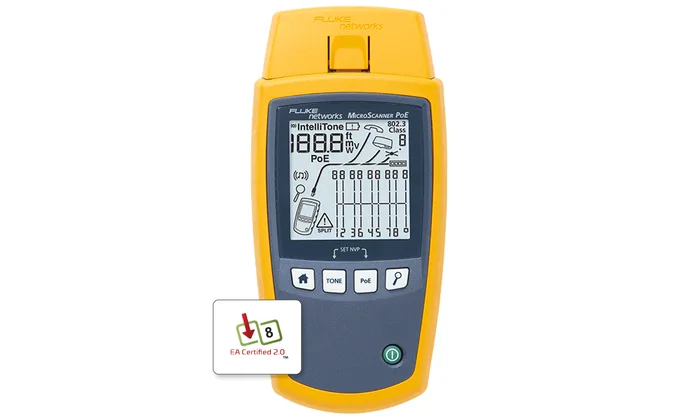
- Buy Fluke Networks MicroScanner PoE Cable Verifier The verification tester that answers the most questions per press of the button, including the ones about the switch at the far end. Amazon
- Buy Klein Tools Scout Pro 3 Tester with Test + Map Remote Kit (VDV501-853) The best value if you are wiring a house, because it tests data, telephone and coax and comes with six remotes so you can map six drops in one trip to the panel. Amazon
- It depends Pockethernet 2 A pocket sized analyzer that hands the screen job to your phone and, in exchange, tests the network as well as the cable.
- Skip NOYAFA NF-468 Network/Telephone Cable Tester The classic nine LED continuity tester: it will tell you the wires are connected, and almost nothing else you actually wanted to know.
What actually matters
- Wiremap - the map of which conductor lands on which pin at both ends of the run. It catches opens, shorts, reversals and miswires, and it is the baseline capability every tester in the category claims.
- Split pair - a wiring error where one leg of a pair terminates on a pin belonging to a different pair. Fluke Networks notes the conductors still line up one to one at both ends, so only a tester that looks for the resulting crosstalk will see it.
- Length and distance to fault - how long the run is and how far along it the problem sits. Testers get this by time domain reflectometry, and accuracy is usually specified as a percentage plus a fixed offset.
- Far end unit - the remote, adapter or terminator that completes the circuit at the other end of the run. Numbered remotes turn a tester into a mapping tool by letting you identify several drops in one visit to the patch panel.
- Tone generation - putting a signal on a cable so a probe can find it inside a wall or a bundle. Digital toning cuts through interference better on data cabling; analog toning suits voice grade cable, coax and alarm wire.
- PoE detection - whether the tester can solicit power from the switch and report what it found. The useful versions name the standard, af, at or bt, and the class, which tells you how much power a device can actually draw.
- Standards accuracy level - the grade a certifier itself must meet, defined in ANSI/TIA-1152-A and IEC 61935-1. Fluke's DSX cites Level 2G and Level VI accuracy to 2000 MHz, which is why certifiers cost what they cost.
The specs, in plain English
Green flags vs red flags
Green flags
- Split pairs and shield faults appear by name in the fault list, not just opens and shorts.
- The spec sheet states a length range with an accuracy figure, such as a percentage plus a fixed offset.
- The manufacturer publishes a real specification table rather than a bullet list of adjectives.
- The kit contents are itemised, so you know whether remotes, adapters and a probe are included.
- Far end capability is described precisely, naming the PoE standards and port speeds it can detect.
Red flags
- The listing says "tests Cat6" or "tests up to 1000 Mbps" without saying what it measures to reach that claim.
- The word "certify" or "certification" appears on a tester with no parameter list and no accuracy level.
- The fault list stops at continuity, opens, shorts and crossed pairs, with no mention of split pairs.
- No model number, no manufacturer product page, and specifications that differ between retailer listings.
- Tone generation is advertised but no probe is included and no compatible probe is named.
Who's who: the brands
- Fluke Networks - The reference point for cable test, from pocket verifiers up to the DSX certifiers that contractors use to claim manufacturer warranties, and the publisher of the clearest explanations of the three tiers.
- Klein Tools - Trade focused voice, data and video testers, usually sold as complete kits with remotes and adapters, aimed at electricians and low voltage installers rather than network engineers.
- Pockethernet - A small German maker of a single pocket sized, smartphone driven analyzer that combines cable testing with link and network layer diagnostics.
- NOYAFA - A high volume Chinese manufacturer whose range runs from the ubiquitous LED continuity testers up to multifunction and TDR units, sold under its own name and rebadged widely.
How to read a listing without getting fooled
Start at the fault list and read it literally. If it says continuity, open, short and crossed pairs, that is a continuity tester no matter what the title says, and split pairs will pass it. If it says split pairs and shield, you have a real wiremap tester. Next find the length specification and check for an accuracy figure, because a range without accuracy is marketing. Then read the cable types line rather than the headline: "tests Cat6" tells you the connector fits, while a line listing UTP, FTP and SSTP, or CAT3 through CAT7 plus RG59 and RG6, tells you what it genuinely supports. Check the far end section for named standards, af, at, bt, and named speeds. Finally read the box contents, because remotes, coax adapters and tone probes are where a cheap looking tester becomes an expensive one, and a probe sold separately is the most common surprise in the category.
How much should you spend?
Budget buys a continuity tester with LEDs and a simple remote, and that is about all it buys. Mid-range is where wiremap testers with a screen, split pair detection, length measurement and a set of numbered remotes live, and it is the right tier for almost every home and small office buyer. Premium in this article means a verification tester with detailed far end and PoE reporting, or a pocket analyzer that also tests the link layer. Above all of that sits the certification tier, which is a different order of expense entirely and is bought by contractors who need a warranty backed report rather than by individuals. The most common budgeting mistake is not the tester itself but the accessories: a tone probe, extra remotes and coax adapters can add a meaningful fraction of the tester's price, so compare complete kits rather than bare units.
Questions, answered
What is the difference between a tone generator and a wiremap tester?
They solve different problems and are often sold together. A tone generator puts a signal on a cable so that a separate probe, waved along a wall or over a bundle, can find that cable. A wiremap tester checks that the conductors inside the cable land on the right pins at both ends. Several testers here do both, but note that the probe is usually a separate purchase even when the tester generates tone.
Can I test a cable while it is plugged into a live switch?
Not for wiremap. A wiremap test needs both ends of the run free so the tester can drive one end and a remote or adapter can answer at the other. What better testers do instead is offer a separate mode that reports what is at the far end: the Fluke MicroScanner reports the advertised port speed and solicits PoE, and the Klein Scout Pro 3 can blink the switch port so you can find it. Use those modes on live links and save the wiremap test for when the drop is unplugged.
How accurate is the length reading on a mid-range tester?
Accurate enough to find a fault, not accurate enough to bill by the foot. Klein specifies the Scout Pro 3 at plus or minus 5 percent, and Fluke specifies the MicroScanner series at 4 percent plus 0.3 m with 0.3 m resolution. Both depend on the cable's nominal velocity of propagation, which varies between cable types, so a tester set for the wrong NVP will read consistently long or short. Treat the number as a strong hint about where to start looking.
Do I need a different tester for shielded cable?
Not a different tester, but do check that shield testing is listed. Fluke specifies the MicroScanner series for UTP, FTP and SSTP twisted pair, Klein lists shielded or unshielded CAT3 through CAT7 and includes shield in the Scout Pro 3 fault list, and Pockethernet says it tests the shield for continuity. A tester that ignores the shield will happily pass a shielded run whose drain wire is not bonded, which defeats the point of paying for shielded cable in the first place.
Or jump to the head-to-head: Fluke Networks MicroScanner PoE Cable Verifier vs Klein Tools Scout Pro 3 Tester with Test + Map Remote Kit (VDV501-853).