

Tech & Gadgets
The Best Network Cable Testers: 4 Compared (and One to Skip)
We compared four network cable testers on what they actually measure, whether they catch split pairs, the media they support, and what comes in the box.
The short version
The Fluke Networks MicroScanner PoE is the pick if you want results you do not have to second guess: a graphical wiremap, split pair detection, per pair length, and a readout of what the far end switch is offering, including PoE class 0 to 8. The Klein Tools Scout Pro 3 kit is the value choice, since it covers coax and telephone as well as data and ships with six numbered remotes for mapping a whole house in one pass. Pockethernet 2 suits the person who also wants link layer answers, running DHCP, LLDP, PoE and error rate tests from a phone app, but it has no display of its own and that is a real trade for some buyers. Skip the NOYAFA NF-468 style LED tester: its own description covers continuity, opens, shorts and crossed pairs, and says nothing about split pairs, which is exactly the fault that quietly breaks gigabit. None of these four certify cabling to a standard, so if a contract or a manufacturer warranty requires certification you need a certifier such as a DSX class instrument instead. A wiremap tester is the right purchase for confirming you crimped a plug correctly, and it cannot tell you why a run is slow. Best for: homeowners and IT generalists who need to prove a run is wired right, not prove it meets Cat6A.
Our picks at a glance
- Fluke Networks MicroScanner PoE Cable Verifier - Buy. The verification tester that answers the most questions per press of the button, including the ones about the switch at the far end.
- Klein Tools Scout Pro 3 Tester with Test + Map Remote Kit (VDV501-853) - Buy. The best value if you are wiring a house, because it tests data, telephone and coax and comes with six remotes so you can map six drops in one trip to the panel.
- Pockethernet 2 - It depends. A pocket sized analyzer that hands the screen job to your phone and, in exchange, tests the network as well as the cable.
- NOYAFA NF-468 Network/Telephone Cable Tester - Skip. The classic nine LED continuity tester: it will tell you the wires are connected, and almost nothing else you actually wanted to know.
The verdict in 30 seconds
What mattered most
- Tester class
- Split pair detection
- Wiremap display
- Length measurement
- Cable types
- Far end unit
"Cable tester" covers three very different instruments, and the cheap one proves far less than most buyers assume. Verification testers check that the eight conductors reach the right pins and are not shorted or split. Qualification testers go further and tell you whether a link will carry a given Ethernet speed. Certification testers measure to the actual TIA or ISO limits and issue a pass or fail that a cabling manufacturer will accept for a warranty. We picked four testers from the verification end of that ladder, because that is where almost every home and small office buyer should be shopping, and we judged them on what they genuinely detect rather than what the box says.
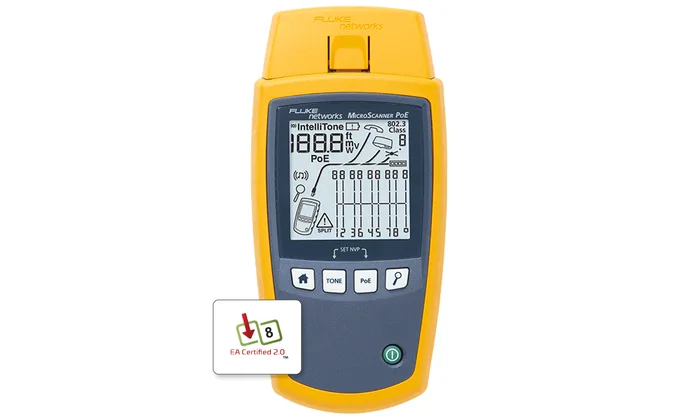
The verification tester that answers the most questions per press of the button, including the ones about the switch at the far end.
Best for: Anyone who installs or troubleshoots PoE cameras, access points and phones and wants one tool that rules out both the cable and the switch port.
- Fluke lists detection of single wire faults, shorts, miswires and split pairs, and draws the wiremap with proportional length so a fault's rough position is visible on screen.
- Reports the advertised speed of the far end Ethernet port at 10 Mbps, 100 Mbps, 1 Gbps, 2.5 Gbps, 5 Gbps and 10 Gbps, so you can see what the switch is actually offering.
- Solicits and detects 802.3af, at and bt plus Cisco UPOE, reports PoE class 0 to 8, and is Ethernet Alliance certified to the IEEE 802.3 PoE standards.
- No coax support: Fluke lists coaxial testing for the MicroScanner2 only, so an F connector run needs the other model or a different tool.
- It is a verification tester, so it will not certify a link to a category limit and cannot back a cabling manufacturer warranty.
- The digital IntelliTone probe is a separate purchase, which pushes the real cost up if you also need to trace cable in walls.
- Only the wiremap adapter is in the base box; the numbered remote IDs come in a kit or as an add on.
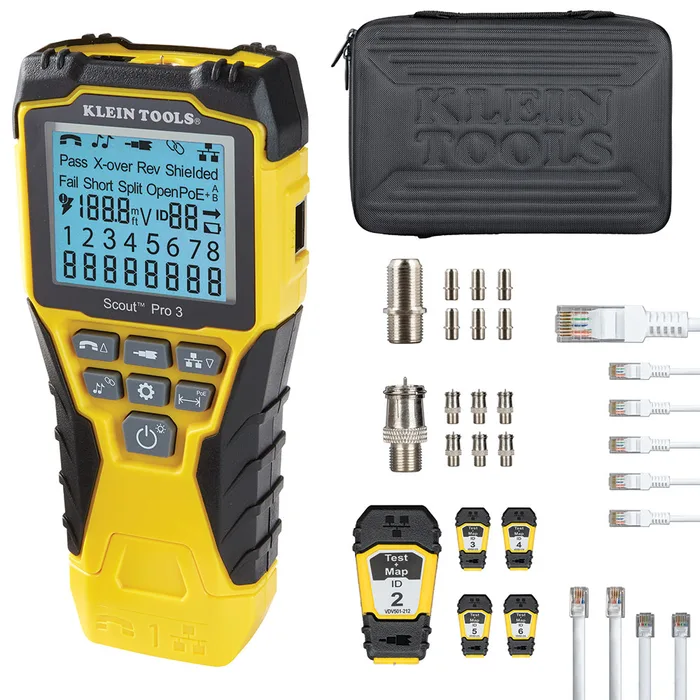
The best value if you are wiring a house, because it tests data, telephone and coax and comes with six remotes so you can map six drops in one trip to the panel.
Best for: Homeowners and low voltage installers terminating a structured wiring panel who need voice, data and video on one instrument.
- Klein lists wiremap testing for miswires, split pairs, short faults, open faults and shield, which is the fault set that matters and one that cheaper testers often leave out.
- Tests RJ11 and RJ12 voice, RJ45 data on shielded or unshielded CAT3 through CAT7, and RG59 and RG6/6Q coax, so one tool covers a whole structured wiring panel.
- Ships with a self storing remote plus remotes 2 to 6, coax barrel adapters, jumper cables, a case and a 9V battery, so nothing else is needed on day one.
- Length is specified to 2000 feet at plus or minus 5 percent, which is fine for finding a break but not a precise measurement.
- Tone generation needs the VDV500-123 probe, sold separately, so cable tracing is an extra purchase.
- Klein lists PoE, PoE+, A and B wiring and voltage identification, but not PoE class reporting or 802.3bt detection.
- Like every tester here, it verifies rather than certifies, so it proves nothing about compliance with a category limit.
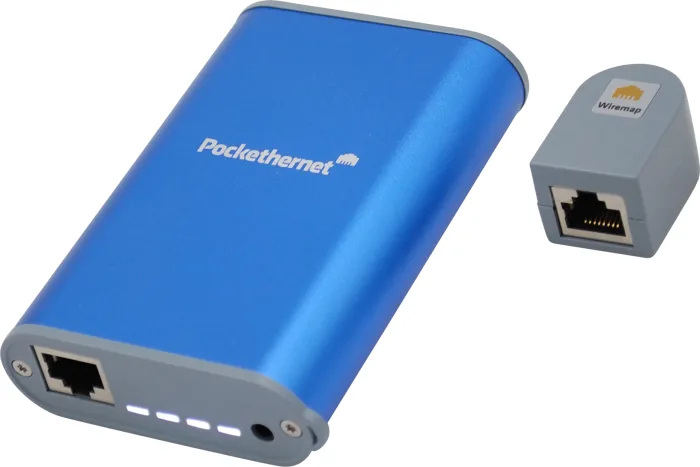
A pocket sized analyzer that hands the screen job to your phone and, in exchange, tests the network as well as the cable.
Best for: The person who is as likely to be chasing a DHCP or VLAN problem as a bad crimp and would rather carry one small device than two.
- Single ended TDR reports length, short circuits, split pairs and bad terminations, and draws a reflection and crosstalk graph across the full cable length.
- Goes past the cable into the link: autonegotiation advertisements from 10M to 10G, error rate testing, PoE PSE type and class, VLAN, DHCP, IPv6, CDP and LLDP.
- Test results export to PDF from the app, so a job record takes a tap rather than a photo of an LCD.
- No display of its own. The iOS and Android app is the interface, so a dead or unsupported phone means a dead tester.
- The base package includes one wiremap and loopback dual adapter; the Wiremap ID set for identifying multiple drops is a separate purchase.
- It ships with a USB-C charging cable but no power adapter, and a rechargeable tool is one more thing to keep topped up on a job.
- It is still a verification and qualification class tool, so it does not produce a standards compliant pass or fail.
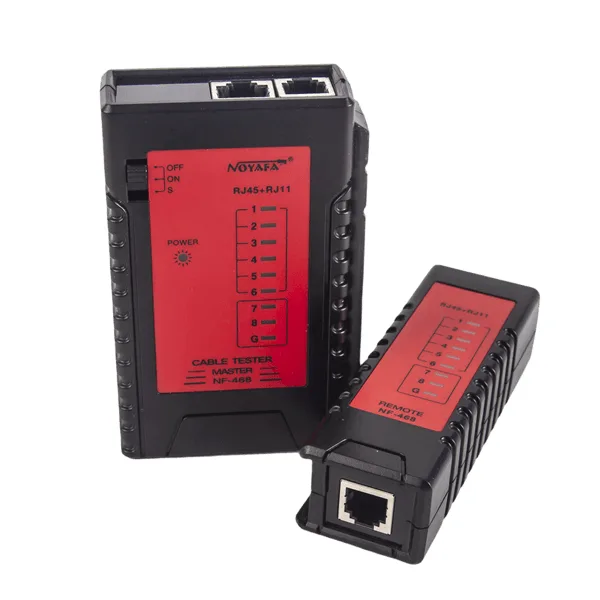
The classic nine LED continuity tester: it will tell you the wires are connected, and almost nothing else you actually wanted to know.
Best for: Someone who only ever checks freshly crimped short patch cords and already owns a better tester for anything installed in a wall.
- It does the one job it claims: NOYAFA lists automatic checks for continuity, opens, shorts and crossed wire pairs on RJ45 and RJ11.
- The remote separates from the main unit, so you can test a run that is already pulled through a wall.
- Cheap enough to keep in a drawer purely as a sanity check after crimping a patch cord.
- Split pair detection is not in the feature list, and Fluke Networks notes that in a split pair the conductors line up one to one at both ends, so a plain LED wiremap shows a perfect result on a cable that will not carry gigabit cleanly.
- No length measurement and no distance to fault, so a break in a wall run tells you nothing about where to open the drywall.
- No tone generation, so it cannot help you find which cable in a bundle is the one you are testing.
- No PoE detection and no far end switch detection, so it cannot separate a cable problem from a switch port problem.
| Criteria | MicroScanner PoE Cable Verifier Top pick | Scout Pro 3 Tester with Test + Map Remote Kit (VDV501-853) | Pockethernet 2 | NF-468 Network/Telephone Cable Tester |
|---|---|---|---|---|
| Verdict | Buy it | Buy it | It depends | Skip it |
| Best for | Anyone who installs or troubleshoots PoE cameras, access points and phones and wants one tool that rules out both the cable and the switch port. | Homeowners and low voltage installers terminating a structured wiring panel who need voice, data and video on one instrument. | The person who is as likely to be chasing a DHCP or VLAN problem as a bad crimp and would rather carry one small device than two. | Someone who only ever checks freshly crimped short patch cords and already owns a better tester for anything installed in a wall. |
| Price tier | $$$ · premium | $$ · mid-range | $$$ · premium | $ · budget |
| Tester class | Verification | Verification | Verification plus link and network tests | Continuity and basic wiremap |
| Split pair detection | Yes, listed | Yes, listed | Yes, via TDR | Not listed |
| Wiremap display | Graphical LCD, proportional length | Backlit LCD wiremap | Phone app, T568A or T568B colors | Nine LEDs on each unit |
| Length measurement | To 460 m (1500 ft), 4% plus 0.3 m | To 2000 ft, plus or minus 5% | TDR length with reflection graph | None |
| Cable types | UTP, FTP, SSTP; RJ45 and RJ11 | CAT3 to CAT7 shielded or unshielded, RG59 and RG6/6Q coax, RJ11/RJ12/RJ45 | RJ45 twisted pair plus shield continuity | RJ45 and RJ11 |
| Far end unit | Wiremap adapter, up to seven remote IDs | Self storing remote #1 plus remotes #2 to #6 | Wiremap and loopback dual adapter; ID set extra | Separable remote included |
| Tone generation | IntelliTone digital plus four analog tones, probe extra | Five tone styles, probe sold separately | Tone with selectable style and volume | None |
| Power | 2 AA alkaline, 20 h typical use | 9V alkaline, included | Rechargeable, USB-C cable included | Battery powered |
Which one is right for you?
- Anyone who installs or troubleshoots PoE cameras, access points and phones and wants one tool that rules out both the cable and the switch port. Buy it Fluke Networks MicroScanner PoE Cable Verifier
- Homeowners and low voltage installers terminating a structured wiring panel who need voice, data and video on one instrument. Buy it Klein Tools Scout Pro 3 Tester with Test + Map Remote Kit (VDV501-853)
- The person who is as likely to be chasing a DHCP or VLAN problem as a bad crimp and would rather carry one small device than two. It depends Pockethernet 2
- Someone who only ever checks freshly crimped short patch cords and already owns a better tester for anything installed in a wall. Skip it NOYAFA NF-468 Network/Telephone Cable Tester
How we judged the field
Five things separate a useful cable tester from a paperweight. First, fault coverage: opens and shorts are easy, and the tests worth paying for are split pairs and shield faults, because those are the ones that let a bad cable look fine. Second, distance information, because knowing a break sits 40 feet down a 90 foot run is the difference between a patch and a re-pull. Third, media coverage, since a structured wiring panel usually has coax and telephone alongside data. Fourth, what the tester can tell you about the far end, meaning whether a switch is there, what speed it advertises and whether PoE is present. Fifth, what actually comes in the box, because remotes and probes are where the cost quietly doubles.
The field splits into three tiers that are frequently sold under the same two words. Verification tools check that the cabling is connected correctly. Qualification tools check whether a link will support a specific application, which Fluke Networks describes as simulating the application and watching attributes such as bit error rates. Certification tools measure to the TIA or ISO limits and return a pass or fail, and they are what a contractor needs to claim a cabling manufacturer warranty. We stayed in the verification tier and its immediate neighbourhood, because that is what a home or small office buyer should own, and we picked four units that bracket it: the most capable mainstream verifier, the best value multimedia kit, an app driven analyzer that reaches into the link layer, and the LED tester that everybody buys first and should not.
Fluke Networks MicroScanner PoE Cable Verifier
Buy itThe MicroScanner PoE is the tester that turns “the drop is dead” into a sentence with a noun in it. Fluke lists detection of single wire faults, shorts, miswires and split pairs, and draws the wiremap proportionally so the picture itself hints at where the trouble sits. Length runs to 460 m (1500 ft) with 0.3 m resolution and 4 percent plus 0.3 m accuracy, and results land on one screen rather than across four modes. The part that earns the price is the far end reporting: it reads the advertised port speed at 10 Mbps through 10 Gbps, solicits 802.3af, at and bt plus Cisco UPOE, reports PoE class 0 to 8, and flags HIGH ohm when cable resistance exceeds 12.5 ohms. It runs on two AA cells for about 20 hours of typical use. The trade is media coverage: coax testing is listed for the MicroScanner2, not this model, and the IntelliTone probe is separate. For anyone whose problems involve powered devices, that trade is worth making.
Klein Tools Scout Pro 3 Tester with Test + Map Remote Kit (VDV501-853)
Buy itThe Scout Pro 3 kit is the one to buy if the job is a house rather than a rack. Klein lists wiremap testing for miswires, split pairs, short faults, open faults and shield, so it clears the bar that matters, and it covers a wider spread of media than the Fluke: RJ11 and RJ12 voice, RJ45 data on shielded or unshielded CAT3 through CAT7, and RG59 and RG6/6Q coax. Length reads to 2000 feet at plus or minus 5 percent, which is a locating tool rather than a measurement, and hub blink flashes a switch port so you can find the right one without a second person. PoE reporting covers PoE, PoE+, A and B wiring and voltage. The kit is genuinely complete: a self storing remote plus remotes 2 to 6, coax barrel adapters both ways, RJ45, RJ11 and RJ12 jumpers, a case and a 9V battery. The tone generator offers five styles but needs the VDV500-123 probe, sold separately. For a structured wiring panel, this is the most capability per unit of spend here.
Pockethernet 2
It dependsPockethernet 2 is a different shape of tool and it will suit a minority of buyers very well. There is no screen. The device is a slab that goes in a pocket and the free iOS and Android app is the entire interface, which is why it can be so small and why some people will hate it. What you get in exchange is reach: single ended TDR that reports length, shorts, split pairs and bad terminations along with a reflection and crosstalk graph, plus a whole second category of tests that no other unit here attempts. It reads autonegotiation advertisements from 10M to 10G, runs an error rate test with the loopback adapter, reports PSE type and maximum PoE class, and pulls DHCP, IPv6, VLAN, CDP and LLDP detail from the port. Reports export to PDF with a tap. The base package includes the wiremap and loopback dual adapter and a USB-C cable but no power adapter, and the numbered wiremap ID set is extra. Buy it if your faults are as often network as cable.
NOYAFA NF-468 Network/Telephone Cable Tester
Skip itThe NF-468 is the tester almost everyone buys first, and it is the reason so many people believe a cable tester proves more than it does. NOYAFA’s own description is honest about the scope: it automatically checks continuity, opens, shorts and crossed wire pairs across conductors 1 through 8 plus ground, on RJ45 and RJ11, with nine LEDs on the main unit and nine on the separable remote. What is absent is the whole rest of the category. No split pair detection appears in the feature list, and Fluke Networks explains why that omission matters: in a split pair the conductors line up one to one at each end, so a plain LED wiremap lights up in perfect sequence on a cable that will crosstalk badly at gigabit. There is also no length, no distance to fault, no tone generation and no far end switch or PoE detection. As a post crimp sanity check on a short patch cord it is fine. As the tester you own, it is not enough.
Sources
Specs in this review come from these pages.
- Fluke Networks: Importance of Cable Verification, Qualification and Certification (flukenetworks.com)
- Fluke Networks: Split Pair Identification (LinkIQ knowledge base) (flukenetworks.com)
- Fluke Networks: DSX CableAnalyzer Series certification parameters and ANSI/TIA-568.2-D categories (flukenetworks.com)
- Fluke Networks: MicroScanner Cable Verifier Series specifications (flukenetworks.com)
- Klein Tools: Scout Pro 3 Tester with Test + Map Remote Kit, VDV501-853 (kleintools.com)
- NOYAFA: NF-468 Network/Telephone Cable Tester (noyafa.com)
Fluke Networks MicroScanner PoE Cable Verifier vs Klein Tools Scout Pro 3 Tester with Test + Map Remote Kit (VDV501-853): which should you buy?
The MicroScanner PoE and the Scout Pro 3 kit are both verification testers that detect split pairs, and either one will do the core job of proving a run is wired correctly. They diverge on what else they look at. The Fluke points outward at the far end: port speed advertisements up to 10 Gbps, PoE solicited across 802.3af, at and bt plus UPOE with class 0 to 8 reported, and a HIGH ohm warning when the cable’s resistance exceeds 12.5 ohms. Its wiremap is graphical and drawn to proportional length. What it does not do is coax, which Fluke lists for the MicroScanner2 instead.
The Klein points sideways at the other media in a house. It tests telephone on RJ11 and RJ12, data on shielded or unshielded CAT3 through CAT7, and coax on RG59 and RG6/6Q, and it arrives with five extra numbered remotes so you can identify six drops in one walk to the panel. Its PoE reporting is coarser and its length spec of plus or minus 5 percent is a locating figure rather than a measurement. So the rule is simple: if your cables end in powered devices such as cameras, access points and phones, buy the Fluke. If your cables end in a structured wiring panel with coax and phone jacks in it, buy the Klein kit and spend the difference on the probe.
What to look for
- Split pair detection: this is the one specification that separates a real wiremap tester from an LED toy, because a split pair reads as correct on any tester that only checks pin to pin continuity.
- Distance to fault, not just length: knowing a run is 90 feet is mildly useful, and knowing the open sits at 41 feet is what stops you re-pulling the whole cable.
- Media you actually have: data only testers are cheaper, but a structured wiring panel usually mixes RJ45, RJ11 or RJ12 and coax, and adapters for the missing one add up fast.
- Far end intelligence: a tester that reports whether a switch is present, what speed it advertises and whether PoE is available lets you separate a cable problem from a switch problem without a second trip.
- Remotes included versus sold separately: one remote tests a cable, numbered remotes identify drops, and the difference between a bare tester and a kit is usually the difference between one trip and six.
- Whether the tone probe is in the box: several testers here generate tone but need a matching probe bought separately, so price the pair rather than the tester.
Our final take
Buy a verification tester and be clear about what it proves. It will tell you that you crimped the plug correctly, that the pairs are true pairs, that nothing is open or shorted, and roughly how far down the run a fault sits. It will not tell you why a link is slow, and it will not produce a warranty document. For most people the Fluke Networks MicroScanner PoE is the right answer, because it also reads the far end switch and its PoE offering. The Klein Scout Pro 3 kit is the better value when coax and telephone are part of the job. Pockethernet 2 is the specialist pick for someone chasing network faults as often as cable faults. The LED tester is the one to skip.
Questions, answered
Will a cheap cable tester tell me why my network is slow?
No, and this is one of the most common misunderstandings in the category. A wiremap or continuity tester checks that each conductor reaches the right pin at both ends and is not open or shorted. It does not measure attenuation, crosstalk, return loss or noise, which are the things that actually degrade a gigabit link. Fluke Networks is direct about this: verification testing alone will not verify the ability of the cabling to support specific applications. If a run is wired correctly and still slow, the answer is a qualification tester that simulates the application, or a certification tester that measures to the standard.
What is a split pair, and why does it break gigabit?
A split pair is a wiring error where one leg of a pair is terminated on a pin belonging to a different pair. Fluke Networks describes the effect as hard to spot because the conductors line up one to one at each end of the cable while not actually being in pairs. Twisting is what cancels interference between conductors, so when two signals share pins that are not twisted together you get significant crosstalk. The link may still come up, then fall over or run slowly at gigabit. It is a classic fault a very cheap tester misses, and it is exactly why split pair detection is the feature to check for before you buy.
Do I need a certification tester for my house?
Almost certainly not. Certification testers measure a defined set of parameters across a frequency range and compare them to TIA or ISO limits to produce a pass or fail, and Fluke Networks lists that set as wire map, length, propagation delay, delay skew, DC loop resistance, resistance unbalance, insertion loss, return loss, NEXT, FEXT, ACR-N, ACR-F and their power sum variants. They exist because cabling manufacturers require that record before issuing a warranty, and because a commercial contract usually demands it. A homeowner has no warranty to claim and no client to satisfy. Buy the verification tester, and hire certification if you ever genuinely need the report.
How many remotes do I actually need?
One remote is enough to test a single cable, because you only need something at the far end to complete the loop. Numbered remotes matter when you are identifying drops rather than testing them: you plug a differently numbered remote into each wall outlet, then walk to the patch panel once and read off which port is which. The Klein Scout Pro 3 kit ships with a self storing remote plus remotes 2 to 6 for exactly this. The Fluke MicroScanner supports up to seven far end adapter IDs, and Pockethernet sells a wiremap ID set separately. If you are labelling a house, buy the kit with the extra remotes; if you are checking patch cords, do not.
Can a tester tell me whether a run will do 2.5 Gb or 10 Gb?
Two different things get confused here. A verification tester such as the MicroScanner PoE can report the advertised speed of the Ethernet port at the far end, up to 10 Gbps, which tells you what the switch is offering rather than what the cable can carry. Establishing whether the cabling itself supports a given speed is qualification testing, which Fluke describes as simulating the application and looking at attributes such as bit error rates. Pockethernet 2 sits closer to that line, since it will try to establish a link at different speeds and run an error rate test. Neither approach produces a standards compliant result, but for a home run either one answers the practical question.
Deciding between the top two? See our head-to-head: Fluke Networks MicroScanner PoE Cable Verifier vs Klein Tools Scout Pro 3 Tester with Test + Map Remote Kit (VDV501-853).
More Tech & Gadgets reviews
 The Best Camera Straps: 4 Compared (and One to Skip)
  The Best Camera Tripods: 4 Compared (and One to Skip)
  The Best Video Capture Cards: 4 Compared (and One to Skip)
  The Best Charging Stations: 4 Compared (and One to Skip)
  The Best Smart Christmas Lights: 4 Compared (and One to Skip)
  The Best Chromebooks: 4 Compared (and One to Skip)