Explained
Bike Tool Rolls, Explained
After reading, you'll know which type you need, whether your tube will fit, and what makes a roll last.
In this guide
A tool roll is fabric with pockets, rolled up and strapped. The reason choosing one is harder than that sounds is that the same words describe a 90 gram pouch for a jersey pocket and a 60 by 40 centimetre mat that unrolls into a workbench. They are bought for different reasons, judged on different numbers, and fail in different ways. Work out which one you want and the rest is straightforward.
The 30-second version
- The name covers two products, a ride roll measured in grams and a workshop roll measured in working surface.
- Tube size is the ride-roll spec, because a gravel tube is several times the packed volume of a road one.
- Rolls fail from the inside, worn through by the hex keys and levers they carry, which is why the material matters.
- Separation protects the spare, since a tube stored against a multi-tool is a tube that will have holes in it later.
- A rigid frame changes a workshop roll, presenting tools upright instead of leaving them flat on a mat to dig through.
The products this guide is about
Our verdict on each, with the full reasoning on the companion review.
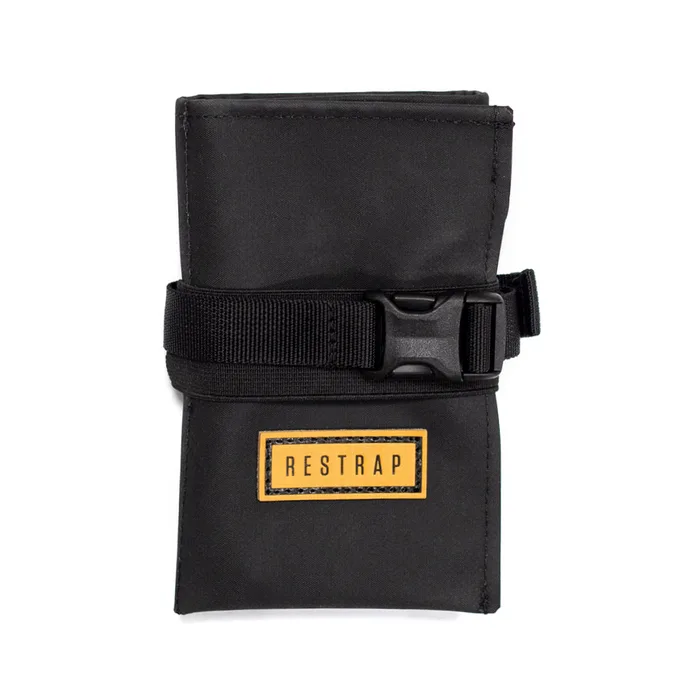
- Buy Restrap Tool Roll Ninety grams of Hypalon with four tool slots and a tube strap, that will ride on the saddle rails or in a jersey pocket.
- Buy Pedro's Burrito Tool Roll II A 23 by 16 inch working surface that becomes a rigid tool pallet, for the car boot and the minimalist home shop.
- It depends SILCA Seat Roll Asymmetrico An asymmetric shape that packs more into less, and the only roll here that tells you which tube will fit.
- Skip Wolf Tooth Travel Tool Wrap The longest feature list in the category attached to the shortest specification, with no size and no weight published.
What actually matters
- Roll type - a ride roll carried on the bike, or a workshop roll that unrolls into a work surface. Decides every other specification that matters.
- Weight - only meaningful on a ride roll, where 90 grams empty is a useful benchmark. Rarely published, which makes comparison hard.
- Tube capacity - the largest tube the roll will take, quoted as a tyre size such as 700x45. The single most useful ride-roll spec and the least commonly published.
- Unrolled dimensions - the working surface of a workshop roll, quoted in inches or centimetres. This is what you are actually buying.
- Material - Hypalon, coated nylon or waxed canvas. Determines how long the roll survives the tools inside it, and how it copes with water.
- Internal separation - dedicated straps and pockets that keep the tube away from metal, and small parts from being lost.
- Attachment - a saddle rail strap, a jersey pocket fit, a hanging loop, or a flap that shuts in a car door.
The specs, in plain English
Green flags vs red flags
Green flags
- A stated empty weight on a roll intended for riding.
- A stated maximum tube size.
- Unrolled dimensions on any workshop-style roll.
- The material named specifically rather than described as durable.
- A dedicated tube strap and a separate small-parts pocket.
Red flags
- A workshop wrap sold on its working surface with no dimensions published.
- No tube size given on a seat roll, which usually means it was designed around a road tube.
- No material named.
- A single open compartment, which is the arrangement that wears tubes through.
- No weight published on anything meant to be carried on a bicycle.
Who's who: the brands
- Restrap - Hand-made UK rolls in Hypalon, publishing empty weights and building in separate tube straps and small-parts pouches.
- Pedro's - Workshop-focused rolls with published unrolled dimensions, reinforced pockets and frame systems that make them rigid.
- SILCA - Premium seat rolls designed around packing efficiency, and unusually willing to publish the largest tube that will fit.
- Wolf Tooth - Feature-led travel wraps designed around the brand's own tools, with flaps for car doors and ground workspaces.
How to read a listing without getting fooled
Work out which product the page is describing before reading anything else, because a weight in grams and a dimension in inches signal different categories. For a ride roll, look for the empty weight and the maximum tube size, and treat a missing tube size as a sign the roll was designed around a road tube. For a workshop roll, find the unrolled dimensions, because that surface is what you are buying and its absence is a real gap. Then check the material by name, since tool rolls wear from the inside and the fabric choice is the durability story. Finally look at the internal layout for a dedicated tube strap and a small-parts pocket.
How much should you spend?
Budget rolls are simple fabric strips with sewn pockets and they carry tools perfectly well, though they tend to wear through where the hex keys sit and rarely separate the tube from the metal. The mid-range is where named materials, published weights and proper internal organisation appear, and it is where a ride roll is worth buying. Premium splits by type: a light seat roll with a stated tube capacity and abrasion-resistant fabric, or a workshop roll with a published working surface and a frame system. Since a ride roll's real job is protecting a spare tube that costs a fraction of the roll, the sensible test is whether the layout keeps the tube away from the tools.
Questions, answered
How do I pack a seat roll so it stays small?
Put the tube in first and let it define the shape, then lay the tools along it rather than across it, and roll from the end with the tube. Tools laid across the roll make it fat and stop it sitting between the saddle rails. Most makers with an unusual shape, such as an asymmetric cut, have a specific packing order in mind, and it is worth following theirs once rather than fighting it.
Will a tool roll rattle?
Much less than a bag, which is the main reason people switch. A roll wraps the contents tightly against each other so nothing can move, whereas a bag lets items shift in the space around them. If a packed roll still rattles, it is not tight enough: repack with the tube against the tools rather than beside them, and cinch the closure strap properly.
Should the roll go under the saddle or in a pocket?
Under the saddle if you have the rails free and do not want weight on your back, which is most riders. In a jersey pocket if you swap between bikes often, since the roll then travels with you rather than staying with one bike. Rolls designed for both, like the Restrap, are the flexible option. Racers often prefer the pocket to keep the bike clean.
How often should I check what is inside?
Twice a year is enough, and the thing to look at is the tube. Check it for shiny rub marks where it has been against metal, and replace it if you see any, because a worn spare fails exactly when you need it. Also check that the quick link is still there and the multi-tool has not seized with corrosion, which happens surprisingly fast under a saddle in winter.
Or jump to the head-to-head: Restrap Tool Roll vs Pedro's Burrito Tool Roll II.