Explained
Baby Walkers, Explained
After reading this you will know the three product types that share the name baby walker, why the wheeled sit-in version is the one to avoid, and which specs genuinely change how safe and useful the thing is.
In this guide
Search for a baby walker and you get three completely different products under one label: a push walker the baby leans on and shoves, a stationary activity center that holds baby upright in one place, and a sit-in walker that suspends a baby in a seat over wheels. That last one is the reason this category has a reputation. The American Academy of Pediatrics recommends against sit-in wheeled walkers and has called for a ban since the 1990s, and Canada made them illegal to sell in 2004, so the first decision you make is not which brand but which type.
The 30-second version
- Three products, one name. Push walkers and stationary activity centers keep a baby's weight on their own feet; sit-in wheeled walkers put a pre-walking infant on castors, and that difference drives everything else.
- The sit-in walker is the category to skip. The AAP advises against them, Canada banned their sale outright in 2004, and stair falls are the injury that dominates the record because a seated baby can move faster than an adult can react.
- No walker makes a baby walk sooner. Independent research has failed to show any acceleration in walking, and some studies point the other way, since time strapped upright is time not spent on the floor building trunk and hip strength.
- Speed control is the spec that matters most in a push walker. A two-speed wheel switch or resistance wheels stop the toy from skating away on hardwood, which is the single most common complaint owners raise.
- Buy for a second life. The walking window is short, so the products worth their shelf space convert into a toddler table, a toy wagon, or a detachable floor panel.
The products this guide is about
Our verdict on each, with the full reasoning on the companion review.
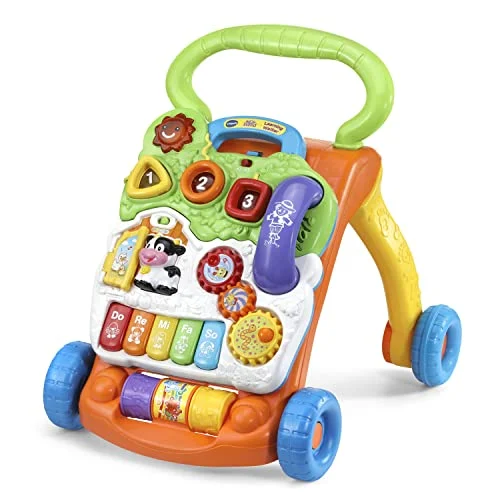
- Buy VTech Sit-to-Stand Learning Walker The default push walker for good reason: a two-speed wheel brake, a detachable play panel, and a price in the budget tier. Amazon
- Buy Bright Starts Around We Go 2-in-1 Walk-Around Activity Center & Table A stationary center that turns cruising practice into play, then converts into a toddler activity table when the seat comes off. Amazon
- It depends Radio Flyer Classic Push Walker Wagon A heavy wooden push wagon that looks great and hauls toys for years, but still rolls quicker than a brand-new walker wants on hard floors. Amazon
- Skip Joovy Spoon Walker Activity Center A well-made sit-in walker from a product category pediatricians have spent thirty years asking parents to avoid. Amazon
What actually matters
- Product type. This is the whole decision. A push walker suits a baby who can already pull to stand; a stationary activity center suits a younger baby who cannot; a sit-in wheeled walker suits nobody, in our view.
- Speed control on hard floors. Push walkers live or die here. Look for a two-speed wheel switch, rubber resistance wheels or clickers, or simply enough weight that the child has to work to move it. A free-rolling walker on tile will put a beginner on their face.
- Handle height and grip. Baby should stand with elbows slightly bent and shoulders relaxed, not reaching overhead or hunching. A handle that is too high forces them onto their toes and up onto the balls of their feet.
- Flat-foot standing position. In any upright activity center, the seat height should let the whole foot rest on the floor. Toe-standing is the posture pediatric physical therapists complain about most in this category.
- Stability and tip resistance. A wide base and low center of gravity matter because toddlers climb on handles. Light plastic walkers tip; heavy wooden wagons do not, but they are harder to move between rooms.
- Footprint and storage. Stationary centers are large and most do not fold. Measure the corner it will occupy before you buy, because it will occupy that corner for months.
- Play value that outlasts the stage. Detachable panels, convertible tabletops, and open wagons keep earning use after walking is sorted. Fixed toy panels get explored and abandoned fast.
The specs, in plain English
Green flags vs red flags
Green flags
- The product keeps baby's feet flat on the floor and their weight on their own legs, whether standing behind a push bar or inside a stationary ring.
- A wheel-speed switch, resistance wheels, or real mass that stops the walker running away on hard floors.
- Height adjustment with several positions, so the fit is right at nine months and still right at fourteen.
- A clear second use after walking: a detachable play panel, a toddler activity table, or a toy wagon.
- Wide, stable base with a low center of gravity, and a handle at about chest height for a standing baby.
- Machine-washable seat pad or a wipe-clean tray, because this stage is messy.
Red flags
- A seat suspended over wheels. This is the sit-in walker format the AAP advises against and Canada banned, regardless of brand, price, or build quality.
- Listings that promise the product will help a baby walk sooner. There is no independent evidence for that claim, and some evidence points the other way.
- Free-rolling hard plastic wheels with no brake, drag, or ballast, which is a fall waiting to happen on tile or hardwood.
- Secondhand or vintage sit-in walkers from marketplace listings, which may predate current width and stair-braking rules entirely.
- Screens, app pairing, or remote controls that add cost and nothing developmental at this age.
- A fixed toy panel with no conversion mode on a large, non-folding frame, which means a big object you stop using in a few months.
Who's who: the brands
- VTech - The default in electronic push walkers, known for detachable learning panels and a two-speed wheel switch.
- Bright Starts - Broad range of stationary activity centers and walk-around rings, often with a convert-to-toddler-table mode.
- Radio Flyer - The classic wagon maker, whose wooden push walkers trade learning panels for solid build, weight, and long-term toy-hauling use.
- Fisher-Price - Wide, familiar range spanning push walkers, jumperoos, and activity centers, generally aimed at the value end.
- Joovy - Higher-end juvenile gear that includes a sit-in walker; the build is solid but the format is the one pediatric bodies advise against.
- Skip Hop - Design-led nursery brand, a reasonable place to look for neutral-toned push toys that fit the living room.
How to read a listing without getting fooled
Start with the photo, not the title, because the word walker is used for all three formats. If the picture shows a seat with wheels underneath, that is a sit-in walker no matter how the listing is worded, and phrases like activity walker, walker activity center, or baby's first walker are all used for them. Next, look for the mechanism that controls speed: a genuine two-speed wheel switch is usually mentioned in the bullets, while vaguer language like smooth-rolling wheels means it will free-roll. Check the stated age or developmental range and translate it plainly. Marketing often starts at six months, but a push walker only works once a baby can pull to stand, which is typically closer to nine months, and a stationary center is the one that fits earlier. Look for adjustable height with a stated number of positions rather than just the word adjustable. Confirm the folded and unfolded dimensions, because stationary centers are much larger in person than in a styled photo. Finally, discount claims about developmental benefit: no walker of any kind has independent evidence behind a claim that it teaches walking, and a listing leaning hard on that promise is telling you what it does not have.
How much should you spend?
This is a category where spending more buys materials and looks rather than safety. The single most protective choice, picking a push walker or a stationary center over a sit-in walker, costs nothing extra, and the most useful mechanical feature, a wheel brake or speed switch, shows up on some of the least expensive plastic push walkers on the shelf. Moving up a tier generally gets you solid wood instead of plastic, quieter operation, neutral styling that blends into a room, and a heavier frame that a toddler is less likely to tip. Those are real benefits, but they are comfort and aesthetics, not protection. Where paying more genuinely pencils out is convertibility: a product that becomes a toddler activity table or a toy wagon spreads its cost across years rather than the four-month walking window, and that is the calculation worth making. Where it does not pencil out is electronics. Screens, app connectivity, and remote controls add cost and no developmental value at this age. And the premium end of the sit-in walker market is the clearest example of price failing to fix a product: a well-built version of a format pediatricians warn about is still a format pediatricians warn about. Budget instead for a gate at the top of any stairs and a padded stretch of open floor, which do more for a new walker than any product in this category.
Questions, answered
Are baby walkers safe?
It depends entirely on which kind. Sit-in wheeled walkers, the ones with a seat over castors, carry the bad record: the American Academy of Pediatrics recommends against them, Canada banned their sale in 2004, and injury surveillance has tied hundreds of thousands of US emergency visits to them, mostly head and neck injuries from falling down stairs. Push walkers and stationary activity centers keep the child's feet under their own body and are widely treated as the safer alternatives, though both still need supervision, a gate at the top of any stairs, and short sessions. This page is general product information, not medical advice. Talk to your pediatrician about what suits your child, especially if there are any questions about their development.
Do baby walkers help a baby learn to walk sooner?
No. Independent research has repeatedly failed to find any acceleration in walking from walker use, and several studies point the other way, suggesting that time spent supported in a walker replaces the floor time that builds trunk, hip, and core strength. The most useful setup for a pre-walker is an open padded stretch of floor with sturdy furniture at grab height, bare feet or grippy socks, and plenty of tummy time earlier on.
What is the difference between a push walker, a sit-in walker, and an activity center?
A push walker is a weighted toy on wheels that a standing baby leans on and shoves forward, so the baby supplies the balance and the steps. A sit-in walker suspends a baby in a fabric seat over a wheeled base, so the baby is carried rather than walking. A stationary activity center holds baby upright in one spot, either in a rotating seat or a spring-suspended one, with toys arranged around them and no wheels involved. The first and third are the ones worth buying.
Can you still buy sit-in walkers in the United States?
Yes. They are legal to sell in the US and regulated rather than banned. The federal rule requires a walker to be too wide to fit through a standard doorway and to stop at the edge of a step, along with parking-brake and stability testing. Those requirements cut the worst of the stair risk but do not eliminate it, which is why the pediatric recommendation is still to avoid the category. Canada goes further and makes it illegal to sell, import, advertise, or even give away a baby walker, secondhand ones included.
When is a baby ready for a push walker?
When they can already pull themselves up to standing and hold that position while holding on, which for most babies lands somewhere around nine to twelve months, though the range is wide. Boxes often say six months because the play panel is usable on the floor that early, but the walking function needs a baby who can support their own weight. If you want something for a younger baby, a stationary activity center at the right height is the product that actually fits that stage.
How long should a baby spend in an activity center or jumper each day?
Keep it short. The common guidance from pediatric physical therapists is around fifteen to twenty minutes at a time and not much more than twice a day, with the height set so the whole foot rests flat on the floor rather than the child pushing up onto their toes. These products are a safe place to put a baby down for a few minutes, not somewhere to spend the afternoon.
Or jump to the head-to-head: VTech Sit-to-Stand Learning Walker vs Bright Starts Around We Go 2-in-1 Walk-Around Activity Center & Table.