Explained
Bottle Drying Racks, Explained
After reading, you'll understand what CDC actually recommends for drying bottles, why antimicrobial plastic is not a cleaning shortcut, and which three lines on a product page tell you whether a rack will stay clean.
In this guide
Most first-time buyers shop this category on capacity and looks, then discover six weeks later that the pegs smell and the tray has a film in it. The specs that predict that outcome are boring and easy to miss: the care instruction, whether the rack comes apart, and where the water sits while things dry. It also helps to know that the official guidance does not recommend a rack in the first place, which changes what you should expect from one.
The 30-second version
- CDC prefers a towel, saying air-drying feeding items on a clean, unused dish towel or paper towel is probably more hygienic than using a drying rack.
- The rack is a dish too, and CDC says to wash it, sanitize it and dry it thoroughly every few days if you use one.
- Dishwasher safe is the headline spec, because it is what turns that cleaning schedule from a chore into a load.
- Antimicrobial protects the plastic, not the bottles and not your baby, and EPA's guidance on treated consumer products says exactly that.
- Drainage beats capacity, since a rack that holds ten bottles above a puddle dries worse than one that holds six and sheds water.
The products this guide is about
Our verdict on each, with the full reasoning on the companion review.
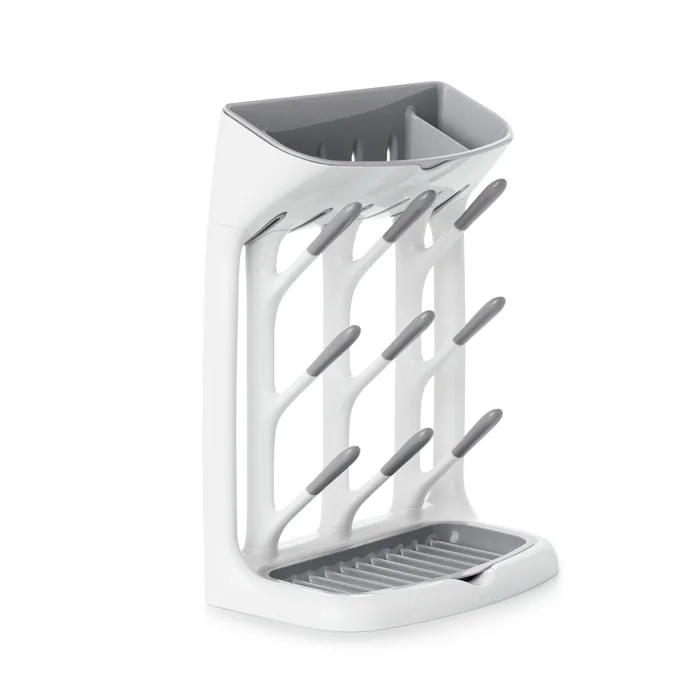
- Buy OXO Tot Space Saving Drying Rack An upright rack with angled pegs and two lift-out trays, and the only pick here that OXO lists flatly as dishwasher safe. Amazon
- Buy Dr. Brown's Folding Baby Bottle Drying Rack A cheap, top-rack dishwasher safe folding rack that does the boring parts right and disappears when you need the counter. Amazon
- It depends Munchkin Silicone Drying Rack & Mat The best-looking rack here and the one that stores flattest, but Munchkin does not publish the cleaning guidance you need to use it well. Amazon
- Skip Boon LAWN Countertop Drying Rack The famous grass rack, sold on an antimicrobial tray, and its own care label says hand wash only and do not sterilize. Amazon
What actually matters
- Care instruction - the single line that decides whether you can keep the rack clean. A rack marked hand wash only, or one that says do not boil or sterilize, cannot follow the routine CDC describes without significant manual effort.
- Drainage path - whether water leaves the drying zone or collects under it. Racks that drain into a lower tray or over raised ribs keep items out of standing water, while a flat mat holds the runoff right beneath everything.
- Removable trays and parts - the difference between cleaning a rack and rinsing it. Lift-out trays let you reach the seams and undersides where films and mold start, which is a common complaint about racks.
- Peg design - how bottles are held and how easily the holders themselves get cleaned. Angled pegs drain bottles better than vertical ones, but peg bases molded into a frame are harder to clean than parts that pull out.
- Footprint and clearance - how much counter the rack takes when open and whether it fits under your cabinets. Upright racks buy back counter space at the cost of height, and several makers do not publish dimensions at all.
- Storage behavior - what happens when the rack is not in use. Folding racks are excellent in small kitchens but recreate the trapped-moisture problem if you fold a damp rack into a cupboard, so they need to dry open first.
- Published information - whether the maker states dimensions, materials and cleaning method. In this category, a product page that says nothing about dishwasher use or materials is telling you something, and it is worth weighting.
The specs, in plain English
Green flags vs red flags
Green flags
- The product page states dishwasher safe, ideally without a top-rack restriction.
- Trays or components are described as removable for cleaning, not just wipeable.
- Bottles are held at an angle or above raised ribs so they are not sitting in runoff.
- The maker publishes dimensions, so you can check counter and cabinet clearance before buying.
- Materials are listed explicitly rather than summarized as a chemical-free claim.
Red flags
- Care instructions say hand wash only, or explicitly rule out boiling and sterilizing.
- Antimicrobial is used as the headline feature rather than a footnote.
- Many narrow blades, slots or textured surfaces that no brush will reach.
- No dishwasher, sanitizing or material information published anywhere on the product page.
- A drip tray molded into the body so you can never lift it out and scrub underneath.
Who's who: the brands
- OXO Tot - The kitchen-tools brand's baby line. It lists its Space Saving rack as dishwasher safe.
- Dr. Brown's - A bottle brand first, so its racks are designed around bottle parts, with a top-rack dishwasher label on its folding rack.
- Munchkin - Design-led baby gear that leans into looks and material trends like silicone, sometimes at the cost of detailed cleaning guidance on the product page.
- Boon - Best known for the grass and lawn style blade racks that defined the category's look, and now sold with antimicrobial tray claims.
How to read a listing without getting fooled
Start at the bottom of the listing, not the top. Find the care or cleaning line and read it before anything else, because hand wash only quietly rewrites how much work the product is. Then look for the word removable next to tray or base, which tells you whether you can reach the surfaces that get grim. Next find the dimensions, both open and folded if it folds, and compare them against the actual strip of counter you intend to give up and the height under your cabinets. Only then read the capacity claim, and mentally halve it, since bottle counts are quoted with bottles alone and your rack will be carrying nipples, rings, valves and pump parts too. Treat any antimicrobial badge as a footnote about the plastic. If a page lists none of this, that absence is a real data point in a category where the competition does publish it.
How much should you spend?
This is an inexpensive category with a narrow spread, which is good news: you are not paying much for the features that matter. Budget racks are usually simple folding or blade designs, and at that tier the thing to check is whether the maker states dishwasher use, because plenty of budget racks do and plenty do not. Mid-range gets you removable trays, better small-part organization, more published information and, in a few cases, silicone instead of plastic. Above that you are mostly paying for materials and appearance rather than better drying or easier cleaning. Since CDC's own guidance is that a clean dish towel is probably more hygienic than any of these, spending up is a decision about your counter and your patience, not about your baby's safety. Pick the cheapest rack that is dishwasher safe and comes apart, and put the difference toward more bottle parts so you wash less often.
Questions, answered
What is the difference between cleaning and sanitizing bottles?
Cleaning removes milk residue and most germs with soap, water and a dedicated bottle brush. Sanitizing is an additional step for extra germ removal, using boiling, steam, a dishwasher's hot water and heated dry cycle, or a bleach solution. CDC says to clean feeding items daily, and to sanitize daily or more often if your baby is under 2 months old, was born prematurely, or has a weakened immune system. It also notes that a dishwasher run hot with a heated drying cycle makes a separate sanitizing step unnecessary.
Is silicone better than plastic for a drying rack?
Not inherently. Silicone tolerates heat well and feels nicer, and it appeals to people avoiding hard plastics, but the properties that keep a rack clean are drainage, removability and whether the maker sanctions a dishwasher run. A silicone rack with no published dishwasher guidance is harder to maintain than a polypropylene one that is explicitly dishwasher safe. Judge the design and the care label first, then treat material as a preference.
Can I put a drying rack in the dishwasher?
Only if the maker says so, and they are not consistent about it. Some racks are fully dishwasher safe, some are top-rack only because the lower rack sits nearer the heating element, and some are labeled hand wash only with boiling and sterilizing also ruled out. Running a hand-wash-only rack through a hot cycle risks warping the pegs or the tray. Check the product page or the instruction sheet before the first wash, not after.
Do I need a separate rack just for baby items?
CDC says that if you use a drying rack, you should use it to dry only your infant's feeding items. The reasoning is straightforward: sharing a rack with adult dishes brings in food residue and germs that end up on the surfaces your bottle parts rest on. That is one more argument for a compact rack rather than a big one, since it will be doing a single job. It is also a reason not to buy a rack so large that it displaces your regular dish rack.
Or jump to the head-to-head: OXO Tot Space Saving Drying Rack vs Dr. Brown's Folding Baby Bottle Drying Rack.