Explained
Baby Thermometers, Explained
After reading, you'll understand what each measurement site actually measures, why the child's age changes which device is defensible, and how to read an accuracy or clearance claim without being impressed by it.
In this guide
First-time buyers usually shop this category on speed and on how pleasant the device looks, which are the two least important variables. What actually decides whether a reading is worth anything is where on the body it is taken and how old the child is. The second trap is treating 'FDA cleared' and 'clinically proven' as if they were the same kind of statement, when one is a regulatory pathway and the other is a marketing summary of studies you cannot see from the shelf. The third is assuming one device will serve from newborn to school age.
The 30-second version
- The site beats the brand, because rectal, ear, forehead and armpit readings differ in how closely they track core temperature no matter whose logo is on the case.
- Age decides the device, and the youngest babies are the group where guidance is strictest and where infrared convenience is least well supported.
- Fast is not the same as accurate, so a one-second infrared reading taken at a bad angle is worth less than a ten-second contact reading taken properly.
- Published numbers beat adjectives, and a manufacturer that states an accuracy tolerance in degrees is being more useful than one that says its device is proven.
- Clearance is a floor, not a grade, because a 510(k) shows equivalence to an already-cleared device rather than certifying how precise this model is.
The products this guide is about
Our verdict on each, with the full reasoning on the companion review.
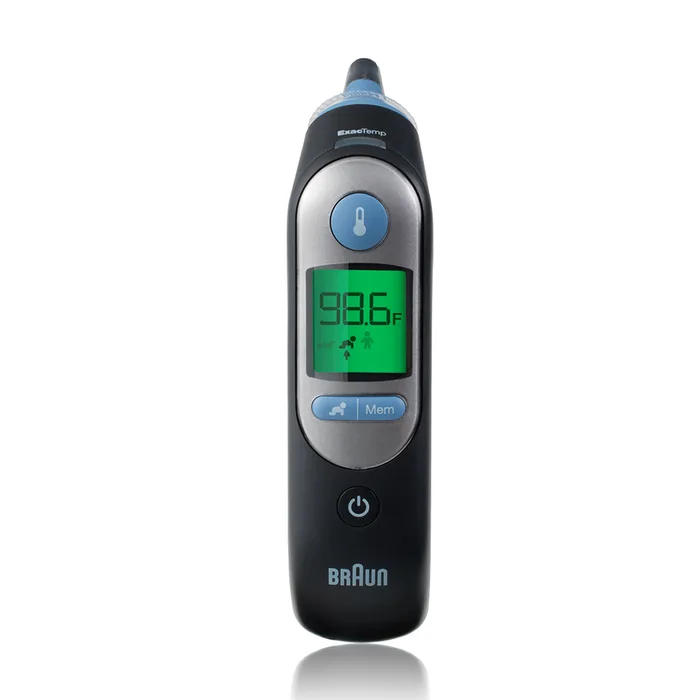
- Buy Braun ThermoScan 7 Ear Thermometer (IRT6520) An infrared ear thermometer whose age-based color coding does the interpreting for you. Amazon
- Buy Frida Baby Quick-Read Digital Rectal Thermometer The cheapest thing on this list and the one that performs the measurement guidance ranks most accurate for young infants. Amazon
- It depends Exergen TemporalScanner TAT-2000C+ Temporal Artery Thermometer The home version of a temporal artery scanner design used in clinical settings, which rewards good technique and quietly punishes a rushed one. Amazon
- Skip Kinsa QuickCare Smart Thermometer A capable eight-second oral, underarm and rectal stick thermometer with a Bluetooth app bolted on, sold at a premium the measurement itself does not earn. Amazon
What actually matters
- Measurement site - Where the sensor reads sets how closely the number tracks core body temperature. Rectal sits closest, armpit sits furthest away, and ear and forehead land in between depending on technique.
- The child's age - Guidance changes sharply across the first year, and a device that is perfectly sensible for a four-year-old may be the wrong tool for a four-week-old. Manufacturers state age ranges for a reason, and those ranges are the claim they will defend.
- Technique sensitivity - Some devices give the same answer however clumsily you use them, and others do not. Infrared methods in particular respond to angle, sweat, hair, hats and room conditions in ways a contact probe does not.
- Published accuracy - A tolerance stated in degrees over a stated temperature range is a real specification. Phrases like clinically proven or hospital grade are summaries of evidence, not specifications, and they do not tell you how far a single reading can drift.
- Consumables - Ear thermometers commonly need disposable lens filters, and some contact thermometers use probe covers. They are hygienic and cheap, but they are a recurring cost and a thing to be out of stock of at 3am.
- Display and speed - A backlit display and an audible confirmation matter more than the spec sheet suggests, because most readings happen in a dark room on an unhappy child. Speed matters most for older babies who will not hold still.
- Cleaning and materials - Water resistance decides whether you can clean the probe properly, and BPA-free or latex-free labelling matters for a device that goes in a mouth or a rectum. Check the manufacturer's cleaning instructions before reaching for alcohol wipes.
The specs, in plain English
Green flags vs red flags
Green flags
- The manufacturer states an accuracy tolerance in degrees over a stated temperature range.
- A model-specific FDA clearance number is published, or the model is easy to find in the public 510(k) database.
- The stated age range matches the age of the child you are buying it for, rather than a vague claim about all ages.
- A rectal thermometer has a flexible tip and a moulded stopper rather than a bare probe.
- The instructions describe technique in detail, which is a sign the maker knows the reading depends on it.
Red flags
- Marketing leans on hospital grade or clinically proven without a single number or a citation anywhere on the page.
- The age range is stated only as all ages, with no detail about infants.
- The device's main advantage is an app, especially one with a subscription tier attached.
- A forehead device is sold for newborns with no mention of the technique or conditions the reading depends on.
- There is no cleaning guidance, or the guidance conflicts with the materials the probe is made from.
Who's who: the brands
- Braun - The long-running name in infrared ear thermometry, now owned by Helen of Troy per the product page, known for the ThermoScan line and age-based fever coding.
- Exergen - A specialist in temporal artery thermometry with a professional line used in clinical settings and a home model derived from it.
- Frida Baby - A baby-care brand that focuses on unglamorous problems, and whose thermometer is a plain rectal digital with the safety details filled in.
- iProven - A value-focused home medical brand selling digital sticks and dual-mode ear and forehead thermometers.
- Vicks - A drugstore staple covering budget digital sticks and no-contact forehead models.
- Kinsa - The connected-thermometer brand, best known for pairing readings to a phone app and aggregating anonymised data into illness maps.
How to read a listing without getting fooled
Start at the bottom of the listing rather than the top. Find the measurement site and the stated age range first, because those two lines decide whether the device is relevant to your child at all, and everything above them is presentation. Then look for a tolerance stated in degrees over a temperature range; if there is not one, note that the maker has chosen not to publish it and treat any accuracy language as marketing. Check what the device consumes, meaning lens filters, probe covers and battery type, since those are the costs that show up later. Finally, search the model or brand in the FDA's public 510(k) database. If you cannot find a record, that is not proof of anything on its own, but a brand that publishes its K number has made your job easier and a brand that shouts about clearance without naming one has not.
How much should you spend?
This is one of the rare categories where spending more can buy you a worse fit. At the budget tier you get plain digital contact thermometers, which are slow by modern standards but are performing the measurement guidance ranks highest for young infants, and the good ones add a flexible tip and a rectal stopper for almost nothing. The mid tier covers most infrared ear and temporal artery devices, along with connected thermometers whose premium is largely software, and this is where you should be most careful about what the extra money is actually buying. The premium tier buys interpretation and refinement rather than raw accuracy: age-based fever coding, positioning confirmation, better displays and silent operation. A sensible budget for most families is one budget contact thermometer plus one mid or premium infrared device, bought at different times, rather than one expensive gadget asked to cover every age.
Questions, answered
Can I use one thermometer for the whole family?
Usually yes, provided the device covers the ages involved and you can keep it hygienic between users. Ear thermometers with disposable lens filters and contact sticks with probe covers are designed for exactly that. What does not travel well is the interpretation, since the temperature that counts as concerning changes with age, which is why age-based coding is a genuinely useful feature on a shared device.
Why do two thermometers give me different numbers?
Because they are measuring different things in different places. A rectal reading, an ear reading and a forehead reading are not expected to agree to a tenth of a degree, and normal ranges differ by site. Comparing a reading against a previous reading from the same device at the same site tells you much more about a trend than comparing two devices against each other.
Do I need probe covers or lens filters?
For ear thermometers, follow the manufacturer's instruction, because the filter is part of the optical path and using the device without one can affect the reading as well as hygiene. For contact sticks, probe covers are mostly a hygiene convenience and are worth using if the same thermometer is shared or used at more than one site. Never reuse a disposable cover between people.
Are smart or connected thermometers worth it?
They are worth it if you will genuinely use the logging, and not otherwise. The sensor in a connected stick thermometer is usually ordinary, so the money goes on Bluetooth, the app and whatever guidance the software layers on top. Since apps and the companies behind them change faster than thermometers wear out, treat the connected features as a bonus rather than the reason to buy.
Or jump to the head-to-head: Braun ThermoScan 7 Ear Thermometer (IRT6520) vs Frida Baby Quick-Read Digital Rectal Thermometer.