

Baby & Family
The Best Baby Thermometers: 4 Compared (and One to Skip)
We compared four thermometers parents actually buy on the question that decides the purchase: what does each one measure, and at what age does its maker say it works? Read time, consumables, published accuracy claims and FDA clearance records all fed into the ranking.
The short version
The Braun ThermoScan 7 is the best all-round pick for a household with children of mixed ages, mainly because its Age Precision color coding turns a number into an answer without you having to remember which fever threshold applies to which age. The value pick is the Frida Baby Quick-Read Digital Rectal Thermometer, which performs the one measurement the American Academy of Pediatrics ranks most accurate, in ten seconds, with a stopper on the tip so it cannot go in too far. The Exergen TemporalScanner TAT-2000C+ depends: it is the home version of a scanner design used in clinical settings and Exergen states it is for all ages, but temporal artery readings reward careful technique, which suits a patient parent and a sleeping toddler more than a first-timer at 3am. We would skip the Kinsa QuickCare Smart Thermometer, a competent eight-second stick thermometer whose premium buys a Bluetooth app rather than a better measurement. The awkward truth in this category is that the cheapest device here is the one guidance points to for the youngest babies, and no amount of infrared changes that. Buy for the age your child is now, not the age they will be in two years. Best for: parents who want the right tool for a specific age rather than one gadget claiming to cover everyone.
Our picks at a glance
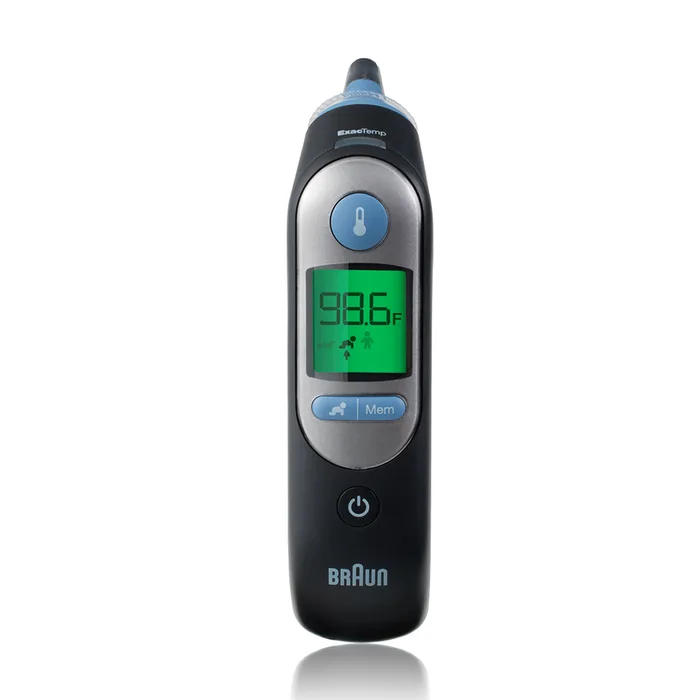
- Braun ThermoScan 7 Ear Thermometer (IRT6520) - Buy. An infrared ear thermometer whose age-based color coding does the interpreting for you.
- Frida Baby Quick-Read Digital Rectal Thermometer - Buy. The cheapest thing on this list and the one that performs the measurement guidance ranks most accurate for young infants.
- Exergen TemporalScanner TAT-2000C+ Temporal Artery Thermometer - It depends. The home version of a temporal artery scanner design used in clinical settings, which rewards good technique and quietly punishes a rushed one.
- Kinsa QuickCare Smart Thermometer - Skip. A capable eight-second oral, underarm and rectal stick thermometer with a Bluetooth app bolted on, sold at a premium the measurement itself does not earn.
The verdict in 30 seconds
What mattered most
- Measurement site
- Manufacturer's stated age range
- Stated read time
- Numeric accuracy tolerance published
- FDA 510(k) record found
- Ongoing consumables
Baby thermometers are sold on speed and gadgetry, but the useful question is narrower. What does this device actually measure, and at what age does its manufacturer say that measurement holds up? Health bodies do not fully agree with each other here, and none of them agree with the marketing, so we looked at four common choices spanning the three main approaches: infrared ear, plain digital rectal, and temporal artery forehead. Every spec below came from the manufacturer's own page or the FDA's public clearance database, and where a number is not published we say so.
An infrared ear thermometer whose age-based color coding does the interpreting for you.
Best for: Households past the newborn stage who want a fast reading and a device that interprets it by age.
- Age Precision color coding shows green, yellow or red against the fever threshold for the age group you select, so you are not doing mental math in the middle of the night.
- The ExacTemp positioning system uses a light and a beep to confirm the probe is aimed correctly, which is the single thing that most often ruins an ear reading.
- Braun states the device is clinically proven to be as accurate as rectal measurements in newborns and footnotes the published comparisons behind that claim.
- It uses disposable lens filters, so there is a consumable you have to keep stocked and remember to fit.
- Braun publishes no numeric accuracy tolerance on the product page, only the rectal-equivalence claim.
- AAP guidance says ear thermometers are not reliable for younger babies whose ear canals are too narrow, which sits awkwardly beside the manufacturer's newborn claim.
- It is the priciest option here and it measures at one site only, so a newborn still calls for a second device.
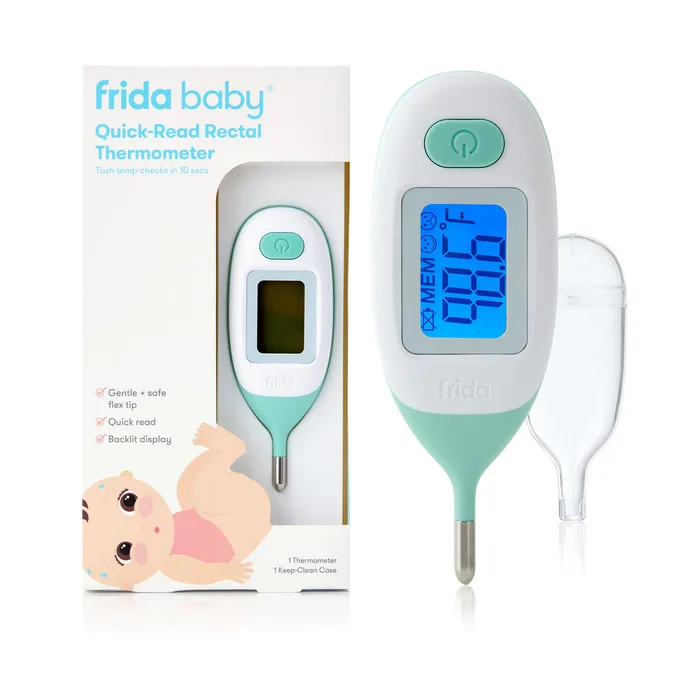
The cheapest thing on this list and the one that performs the measurement guidance ranks most accurate for young infants.
Best for: Newborns and infants, where the reference measurement matters more than convenience.
- Frida states a ten-second read, which is short enough to matter when the person being measured objects loudly to the whole process.
- The flexible tip carries a rectal stopper that keeps it from being inserted too far, a safety detail generic digital sticks routinely leave off.
- It is water-resistant, BPA-free and latex-free, with a backlit display and memory for up to ten previous readings.
- It is a rectal thermometer, and plenty of parents will avoid using it even when it is the right tool.
- Frida publishes no numeric accuracy tolerance and no FDA clearance number on the product page.
- There is no age-based interpretation on the display, so you have to know the relevant threshold yourself.
- Its usefulness fades as your child gets older and less willing to hold still for a rectal reading.
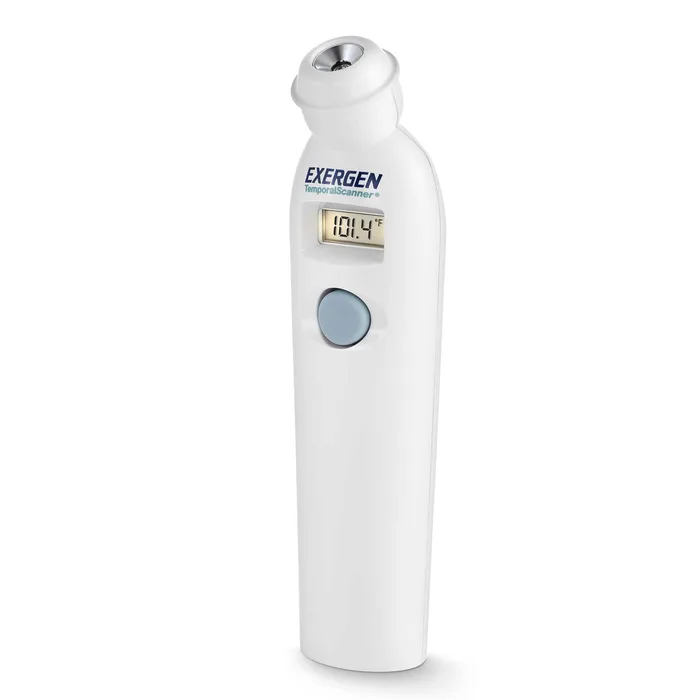
The home version of a temporal artery scanner design used in clinical settings, which rewards good technique and quietly punishes a rushed one.
Best for: Parents who will read the technique instructions once and follow them, especially for a child who wakes at the slightest touch.
- Exergen states it is for use on all ages from newborns to elderly, and points to more than 100 published clinical studies of temporal artery thermometry.
- Silent mode and a soft-glow display make it one of the few options here that is genuinely usable on a sleeping child.
- Exergen holds an FDA 510(k) clearance for the TemporalScanner design, K011291, and lists ASTM, ISO 13485 and UL among the specifications met.
- Temporal artery readings depend on technique and on the skin being dry and uncovered, so a hurried scan across a sweaty forehead can mislead you.
- Whether temporal artery scanning matches rectal measurement in newborns is still contested, and Exergen publishes no numeric accuracy tolerance on the product page.
- It runs on a 9V battery, a less common cell to keep spare than the AA or coin cells the others use.
- There is no age-based fever interpretation on the display, so the number arrives without context.
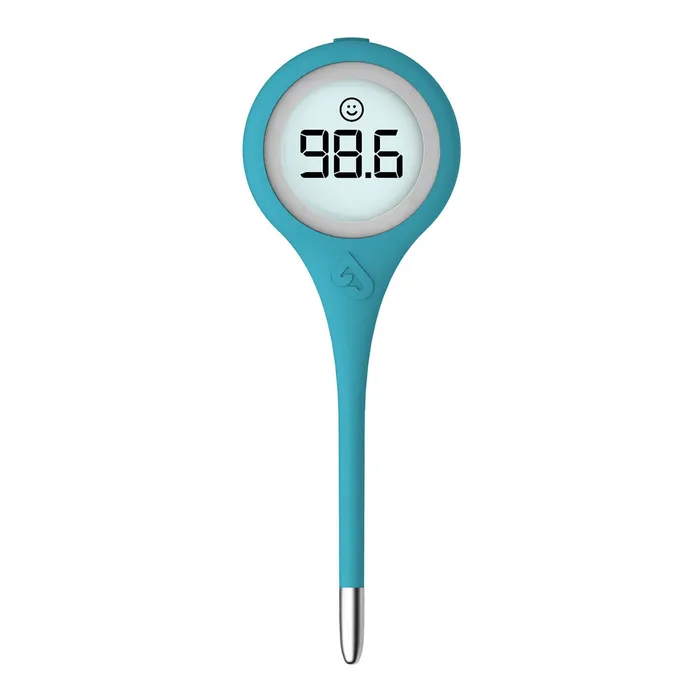
A capable eight-second oral, underarm and rectal stick thermometer with a Bluetooth app bolted on, sold at a premium the measurement itself does not earn.
Best for: Households already using Kinsa's app who want another device paired to the same profiles.
- Eight-second readings, three measurement sites and a large backlit display cover the basics competently.
- It carries a model-specific FDA 510(k) clearance, K173730, which is more than several competitors publish.
- Kinsa says the app is optional, so the thermometer works standalone on a replaceable CR2032 cell.
- The premium over a plain digital stick buys the app layer, not a faster or better-documented measurement.
- Kinsa's page does not list a rectal stopper, which matters given the company suggests rectal use for babies under six months.
- Part of the app's promised value, including physician access, sits behind a separate Kinsa Clinic subscription.
- Kinsa's own site states the company is now part of the Healthy Together family, so the software features you paid extra for depend on a service in transition.
| Criteria | ThermoScan 7 Ear Thermometer (IRT6520) Top pick | Quick-Read Digital Rectal Thermometer | TemporalScanner TAT-2000C+ Temporal Artery Thermometer | QuickCare Smart Thermometer |
|---|---|---|---|---|
| Verdict | Buy it | Buy it | It depends | Skip it |
| Best for | Households past the newborn stage who want a fast reading and a device that interprets it by age. | Newborns and infants, where the reference measurement matters more than convenience. | Parents who will read the technique instructions once and follow them, especially for a child who wakes at the slightest touch. | Households already using Kinsa's app who want another device paired to the same profiles. |
| Price tier | $$$ · premium | $ · budget | $$ · mid-range | $$ · mid-range |
| Measurement site | Ear (tympanic) | Rectal | Forehead (temporal artery) | Oral, underarm or rectal |
| Manufacturer's stated age range | All ages, with age-group fever guidance | Infants and young children | All ages, newborn to elderly | All life stages, rectal under 6 months |
| Stated read time | Seconds, no figure published | 10 seconds | No figure published | 8 seconds |
| Numeric accuracy tolerance published | No, rectal-equivalence claim only | No | No, cites 100+ clinical studies | No |
| FDA 510(k) record found | Line-level, not model-specific | None published | K011291 (TemporalScanner) | K173730 (QuickCare) |
| Ongoing consumables | Disposable lens filters | None listed | None required, optional caps sold | None listed |
| Power | 2 AA, included | Not published | 9V, included | CR2032, replaceable |
| Memory and app | Onboard memory, no app | Up to 10 readings, no app | 8 readings, no app | Optional Bluetooth app |
Which one is right for you?
- Households past the newborn stage who want a fast reading and a device that interprets it by age. Buy it Braun ThermoScan 7 Ear Thermometer (IRT6520)
- Newborns and infants, where the reference measurement matters more than convenience. Buy it Frida Baby Quick-Read Digital Rectal Thermometer
- Parents who will read the technique instructions once and follow them, especially for a child who wakes at the slightest touch. It depends Exergen TemporalScanner TAT-2000C+ Temporal Artery Thermometer
- Households already using Kinsa's app who want another device paired to the same profiles. Skip it Kinsa QuickCare Smart Thermometer
How we judged the field
Five things separate a baby thermometer that earns its place from one that sits in a drawer. The first is measurement site, because that alone sets the ceiling on how much the reading can be trusted for a given age. The second is the age range the manufacturer actually states, which is often narrower or vaguer than the box art suggests. The third is technique sensitivity, meaning how much the number moves when a tired parent uses the device slightly wrong at 3am. The fourth is what the maker publishes: a specific accuracy tolerance and a model-level FDA clearance number are both rarer in this category than you would expect, and their absence is worth noticing. The fifth is running cost and friction, which covers lens filters, probe covers, battery type and whether the thing needs a phone.
The field splits cleanly into three camps and one hybrid. Contact digital sticks are cheap, slow by modern standards and the closest thing to a reference measurement at home. Infrared ear thermometers are fast and family-friendly but need an ear canal wide enough to aim into. Temporal artery scanners promise the convenience of the forehead with a much deeper clinical literature than the strip-and-gadget end of that category. The hybrid camp adds Bluetooth and an app to a device that would otherwise be an ordinary stick. We picked one strong representative of each, plus the connected one, because the honest recommendation in this category is not a single product but a match between the device and the age of the child.
Braun ThermoScan 7 Ear Thermometer (IRT6520)
Buy itThe ThermoScan 7 is the device most families will reach for most often, and the reason is Age Precision rather than the infrared sensor. You tell it the age group, and the reading comes back color coded against the threshold for that age: green, yellow or red. That converts a number you would otherwise have to interpret at 3am into an answer, which is a real feature and not a gimmick. The ExacTemp system helps with the other half of the problem, using a light and a beep to confirm the probe is actually pointed at the eardrum before it commits to a reading. Braun states the device is clinically proven to be as accurate as rectal measurements in newborns and footnotes the studies, though AAP guidance takes a more cautious line on ear readings in babies whose ear canals are still narrow. Disposable lens filters are an ongoing chore, and Braun publishes no numeric accuracy figure. For a household with a toddler and a school-age child, it is still the one we would buy first.
Frida Baby Quick-Read Digital Rectal Thermometer
Buy itFrida Baby’s Quick-Read is unglamorous and correct. It does the measurement that AAP guidance ranks most accurate, it does it in a stated ten seconds, and it costs a small fraction of everything else here. The detail that justifies choosing it over an anonymous digital stick is the stopper moulded onto the flexible tip, which physically prevents inserting it too far. That is a safety feature you will appreciate the first time you use it one-handed on a squirming newborn at 4am, and plenty of cheap thermometers omit it. The display is backlit for night use and it holds up to ten previous readings, which is more useful than it sounds when you are tracking a fever across a night. Frida publishes no accuracy tolerance and no clearance number, so you are trusting the category rather than the datasheet. Its window is also finite: somewhere in the second or third year it becomes the thermometer you no longer reach for. Buy it for the first year.
Exergen TemporalScanner TAT-2000C+ Temporal Artery Thermometer
It dependsThe Exergen TAT-2000C+ is the most interesting device here and the hardest to recommend flatly. It is the home version of a temporal artery scanner design that hospitals and clinics use, Exergen states it is for all ages from newborns to elderly, and the company points at more than 100 published clinical studies of the underlying method. In the right hands it is lovely: silent mode and a soft-glow display mean you can take a sleeping child’s temperature without waking them, which no rectal thermometer will ever manage. The catch is that temporal artery readings are technique-dependent in a way that ear and rectal measurements are not, and how well the method tracks rectal measurement in newborns is still argued over. Exergen publishes no numeric tolerance on its product page, and the 9V battery is an odd cell to keep spare. If you will read the instructions properly, it earns its place. If you want a device that forgives sloppy use, it is not this one.
Kinsa QuickCare Smart Thermometer
Skip itThe Kinsa QuickCare is a perfectly decent thermometer and a poor purchase. Strip away the branding and you have an eight-second stick thermometer usable orally, under the arm or rectally, running on a replaceable coin cell, with a model-specific FDA clearance under K173730 that is genuinely more than some rivals publish. The trouble is what the premium buys. It does not buy a faster reading, a published accuracy figure or a rectal stopper, which Kinsa’s page does not list even though the company suggests rectal use for babies under six months. It buys Bluetooth and an app, with some of the promised value, including physician access, gated behind a separate Kinsa Clinic subscription. Kinsa’s own site now says the company is part of the Healthy Together family, which means the software half of the proposition is a service in transition. Pay less for a plain digital thermometer, or pay more for a device that improves the measurement.
Sources
Specs in this review come from these pages.
- American Academy of Pediatrics, How to Take a Child's Temperature (healthychildren.org)
- NICE guideline NG143, Fever in under 5s: assessment and initial management (nice.org.uk)
- NHS, Fever in children (nhs.uk)
- FDA 510(k) Premarket Notification Database (accessdata.fda.gov)
- FDA, 21 CFR 880.2910 Clinical electronic thermometer (accessdata.fda.gov)
- Braun Healthcare, ThermoScan 7 Ear Thermometer product page (braunhealthcare.com)
- Exergen, TAT-2000C+ Temporal Artery Thermometer product page (exergen.com)
Braun ThermoScan 7 Ear Thermometer (IRT6520) vs Frida Baby Quick-Read Digital Rectal Thermometer: which should you buy?
The two picks are not really competitors, which is the point. The Braun ThermoScan 7 is a convenience-and-interpretation device: it is fast enough to use on a child who will not cooperate, and the Age Precision coding removes the step where you try to remember whether 100.6 is a problem for a fifteen-month-old. The Frida Baby rectal thermometer is an accuracy device: slower, less pleasant, and the one that guidance points to for the youngest babies. Buying the Braun does not make the Frida redundant, and buying the Frida does not solve the problem of measuring a screaming two-year-old.
If you are choosing only one right now, let the age decide. Under three months, buy the rectal thermometer and nothing else, because that is the window where the reading carries the most weight and where infrared methods are least well supported. From six months onward the ear thermometer becomes the practical default and the rectal one becomes a backup you keep for confirmation. Between those points, either works, and the deciding factor is usually whether you would rather spend money once on the Braun or spend it on the Frida now and the Braun later. Most families we would advise end up owning both, and that costs less combined than several single-device options on the shelf.
What to look for
- Match the site to the age: rectal for the first months, ear from around six months, oral from around four years, because the site sets the ceiling on how much the number is worth.
- Check the stated age range, not the picture: a smiling baby on the box is marketing, while the age range in the manufacturer’s own specification is the claim they will stand behind.
- Look for a published accuracy tolerance: a device that states a figure in degrees is telling you something specific, and one that only says ‘accurate’ or cites studies is telling you less than it appears.
- Prefer a rectal stopper if you will measure rectally: it costs the manufacturer almost nothing and it removes the one genuine risk in the procedure.
- Count the consumables: disposable lens filters and probe covers are fine, but they are an ongoing cost and a thing to run out of at the worst moment.
- Be sceptical of app-tethered value: a thermometer is a ten-year device and an app is not, so weigh the connected features as a bonus rather than as the reason to buy.
Our final take
There is no single best baby thermometer, and any list that names one is quietly ignoring the age question. For the first months, the cheap digital rectal thermometer with a stopper is the right answer, and the Frida Baby Quick-Read does that job as well as anything. Once your child is old enough for an ear reading, the Braun ThermoScan 7 becomes the device you will actually use, with age-based color coding that saves you interpreting a number while half asleep. The Exergen suits a specific parent who will follow the technique. The Kinsa is a good thermometer wrapped in a value proposition that has not aged well. Buy for the age in front of you, and expect to own two.
Questions, answered
What kind of thermometer should I buy for a newborn?
The American Academy of Pediatrics ranks rectal measurement as the most accurate and calls it the best reading, especially for infants under three months. A plain digital thermometer with a flexible tip and a rectal stopper does that job for very little money. It is worth knowing that guidance is not identical everywhere: the UK's NICE guideline for under-5s says not to routinely use the oral or rectal routes at all, and recommends an electronic thermometer in the armpit for infants under four weeks. Both approaches share the same underlying point, which is that an infrared gadget aimed at a newborn's forehead or ear is the least defensible of the options. If you buy one thermometer before the birth, buy the cheap contact one.
Are forehead and no-contact thermometers accurate enough?
It depends on which type you mean and how carefully you use it. Electronic temporal artery scanners like the Exergen are backed by a large published literature and the AAP lists forehead thermometers as usable for all ages, ranking them behind rectal but ahead of oral and ear. Simple chemical strips you press to the forehead are a different product entirely, and NICE states plainly that forehead chemical thermometers are unreliable and should not be used by healthcare professionals. For any infrared device, technique and conditions do a lot of the work: sweat, hair, a hat, a cold room or a scan taken at the wrong angle all push the reading around. Treat a surprising infrared result as a prompt to confirm with a contact measurement rather than as the final word.
What counts as a fever, and when does it become urgent?
The AAP and the NHS use effectively the same threshold, describing a fever as a temperature of 100.4 degrees Fahrenheit or 38 degrees Celsius and above. The age of the child changes what that number means far more than the number itself does. AAP guidance says to contact a pediatrician right away for an infant younger than three months with a temperature of 100.4 Fahrenheit or higher, which is why accuracy matters most in exactly the age group where the fanciest devices are least well supported. Older children with the same number are usually assessed on how they look and behave rather than on the reading alone. None of this is a substitute for talking to your own clinician about your own child.
Do I need a different thermometer as my child gets older?
Most families end up owning two, and that is a reasonable outcome rather than a failure of shopping. The cheap rectal thermometer covers the first months, when the measurement has to be right and the child cannot object effectively. Once ear canals are big enough, an infrared ear or temporal artery device becomes far more practical, because getting a usable reading from a two-year-old is mostly a speed problem. AAP guidance puts ear thermometers at six months and up, and moves to oral measurement from around age four. Buying one device to cover the whole span means accepting a compromise at one end or the other.
Does FDA clearance mean a thermometer is accurate?
It means less than the packaging implies. Clinical electronic thermometers sit in FDA device class II under 21 CFR 880.2910, and most reach the market through a 510(k) submission showing they are substantially equivalent to a device already cleared. That is a real regulatory bar, but it is a comparison to a predicate rather than a published accuracy grade for the model in your hand. Clearance also says nothing about the app, the fever guidance or the advice a connected thermometer displays. When a brand advertises clearance without publishing a numeric tolerance, treat the clearance as table stakes and judge the device on the measurement site and the technique it demands.
Deciding between the top two? See our head-to-head: Braun ThermoScan 7 Ear Thermometer (IRT6520) vs Frida Baby Quick-Read Digital Rectal Thermometer.
More Baby & Family reviews
 The Best Baby Walkers: 4 Compared (and One to Skip)
  The Best Balance Bikes: 4 Compared (and One to Skip)
  The Best Bassinets: 4 Compared (and One to Skip)
  The Best Book Nook Kits: 4 Compared (and One to Skip)
  The Best Baby Bottle Drying Racks: 4 Compared (and One to Skip)
  The Best Baby Bottle Sterilizers: 4 Compared (and One to Skip)