Explained
Baby Swaddles, Explained
After reading this you will be able to read any swaddle listing, tell a hip-healthy design from a risky one, and know exactly when to stop using it.
In this guide
A swaddle is a garment that keeps a newborn's arms snug so the startle reflex stops jerking them awake. It is one of the few baby purchases where the safety rules narrow the field more than the features do, and the listings rarely lead with those rules. Most confusion comes from three places: parents wrap the legs too tightly, they keep swaddling the arms past the point where it is safe, and they assume a marketed feature such as added weight has been shown to be safe when it has not.
The 30-second version
- Swaddling the arms stops at the first sign of rolling. Not at a set age, not at a milestone on the box. The first roll or even an attempt to roll ends arms-in swaddling, because a swaddled baby who ends up face down cannot push up or reposition.
- Snug at the chest, roomy at the hips. Hips need to bend up and spread apart freely, which is what hip-healthy design means. Straight-leg tight wrapping is associated with hip dysplasia, so any product that pins the legs is out.
- Nothing weighted. Weighted swaddles, weighted pads and weighted sleep sacks are the feature US pediatric safe sleep guidance advises against for infants, and the claimed benefit is soothing rather than safety.
- Buy a design with a built-in way out. An arms-out mode or a zip-off transition design means the day rolling starts does not leave you with an unusable garment and an unsettled baby.
- The swaddle never replaces safe sleep basics. Back sleeping, a firm flat surface, and a bare crib or bassinet with nothing loose in it are the parts that actually matter, and they cost nothing.
The products this guide is about
Our verdict on each, with the full reasoning on the companion review.
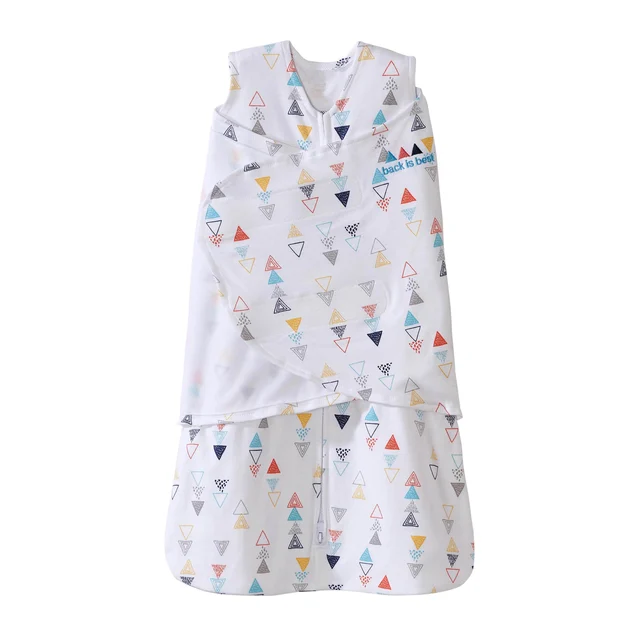
- Buy HALO SleepSack Swaddle 100% Cotton The forgiving default: a roomy sack bottom, adjustable wings, and an arms-out mode that carries you into the transition. Amazon
- Buy Love to Dream Swaddle Up Original For the baby who fights an arms-down wrap: hands stay near the face while the startle reflex is still damped. Amazon
- It depends ergoPouch Cocoon Swaddle Sack One garment with arms-in, hands-up and arms-out modes and the clearest fabric-weight labelling here, at a premium price and a fit you cannot tune. Amazon
- Skip Nested Bean Zen Swaddle Classic Well made, but the weighted chest pad that defines it is the feature safe sleep authorities advise against.
What actually matters
- Hip room in the lower half. The legs should be able to bend up and spread out in the frog-like position babies naturally hold. Sack, pouch and cocoon bottoms all do this; a tight leg wrap does not. This is the single criterion that should knock products off your list.
- A real transition mode. Arms-in swaddling ends at the first sign of rolling, so the design needs an arms-out setting, or a wings-fold-back option. Otherwise you are buying a second product on the worst possible night.
- Closure strength and adjustability. Hook-and-loop wings can be tuned tighter or looser for your particular baby; stretch pouches cannot. Both work, but adjustability is more forgiving with an unpredictable newborn, and a closure that pops open repeatedly means it is time to size up or move to arms out.
- Documented fabric weight. A stated TOG value or a plain fabric description tells you what to dress the baby in underneath. Marketing words like cozy or breathable tell you nothing, and overheating is a real risk.
- Ease of use at 3am. A zip you can close half asleep beats a clever wrap you fasten wrong when exhausted. It also matters that a partner, grandparent or sitter can get it right without a tutorial.
- Correct size right now. A swaddle bought big to last longer loses the snugness that calms the baby and adds loose fabric near the face. Size for the baby you have this month.
- Wash reality. Spit-up and leaks mean constant laundry, so machine washable and affordable enough to own two matters more than it sounds.
The specs, in plain English
Green flags vs red flags
Green flags
- A roomy sack, pouch or cocoon bottom that lets the legs bend and spread, described in the listing rather than left to your imagination
- A stated arms-out mode built into the same garment
- A published TOG value, or at minimum a clear fabric description, plus dressing guidance for room temperature
- Bottom-opening or two-way zip for diaper changes
- Clear sizing guidance tied to the baby's current weight or stage, with the brand telling you to size for now
- Explicit instructions to stop swaddling the arms at the first sign of rolling
Red flags
- Any weighted pad, weighted panel or weighted filling; this is the one feature safe sleep authorities advise against
- A design that wraps the legs straight and tight, or listing photos showing legs pinned together
- No arms-out or transition option, meaning the product ends abruptly the day rolling starts
- Claims that the product improves safety, prevents rolling, or lets a baby sleep in a position guidance advises against
- Bundled crib accessories such as positioners, wedges, pillows or bumpers, none of which belong in a safe sleep space
- Vague warmth language with no TOG or fabric detail, which pushes you into guessing layers underneath
Who's who: the brands
- HALO - Best known for the SleepSack line, the wearable-blanket-plus-wings format which is hard to fasten wrong.
- Love to Dream - The arms-up specialist. Its zip-up wing design exists for babies who fight having their arms pinned, with a separate transition version sold for the handover.
- ergoPouch - Australian brand with the clearest fabric-weight labelling in the category, selling items in stated TOG values from 0.2 to 3.5.
- Nested Bean - Built its reputation on lightly weighted chest pads. Well made, but weight is precisely the feature safe sleep guidance advises against, which is why we skip it.
- Aden + Anais - Muslin blankets and lightweight wraps. Good breathable fabric, but a plain blanket wrap puts the technique on you, so the hip-room rule is yours to enforce.
- SwaddleMe - Hook-and-loop wraps in the budget tier. Fine for a cheap trial of arms-in swaddling, with less generous room in the lower half than sack designs.
How to read a listing without getting fooled
Start at the bottom of the product, not the top. Find out what shape the lower half is: a sack, pouch or cocoon that leaves the legs free, or a wrap that could be pulled tight around straight legs. If the listing will not tell you, assume the worse answer. Next, look for the exit: an arms-out setting, unzippable arm sections, or wings that fold back. If the transition needs a different product, price that in now rather than discovering it at 2am. Then check the fabric weight, either a stated TOG or a specific fabric name, and ignore adjectives like breathable or cozy that carry no information. Read the sizing chart against your baby's current weight, never their projected weight. Finally, scan the whole page for the word weighted, in any form, including phrases like gently weighted or a parent's touch, and treat a hit as a reason to close the tab. Photos are worth checking too: a good listing shows a baby with legs bent and spread and hands either at the sides or up near the face, on their back on a bare flat surface. Listing photos showing loose blankets, propped positions or padded bumpers signal a brand that is not thinking carefully about safe sleep.
How much should you spend?
Swaddles are a cheap category with a hidden multiplier: you will buy several, across sizes and because laundry never keeps up. That makes the price of a single unit less important than the total. The budget end buys a perfectly good adjustable-wing swaddle over a sack bottom, and it does the whole job, so there is no need to spend up on your first purchase before you know whether your baby prefers arms in or arms up. Paying more can buy an arms-up design if your baby refuses arms-in wrapping, clear TOG labelling, or a garment with several wear modes. Each is genuinely worth it to the parent who needs it and worthless to the parent who does not. What extra money does not buy is more safety. A premium swaddle and a budget swaddle both depend on you keeping the hips free, stopping the arms-in wrap at the first sign of rolling, and putting the baby down on their back on a firm flat bare surface. The most sensible approach is to start cheap, learn which style your baby settles in within the first week or two, then spend deliberately on the one feature that solved the problem. Owning two of whatever works beats owning one expensive item you are washing at midnight.
Questions, answered
When do I have to stop swaddling my baby's arms?
At the first sign of rolling, including an attempt. For many babies that comes somewhere around two to four months, but it can be considerably earlier, so watch the baby and not the calendar. Once it arrives, switch to an arms-out mode or a sleeveless sleep sack and keep using that for warmth. The reason the rule is firm: a baby with wrapped arms who ends up face down cannot push up or turn their head clear. This guide is general product information, not medical advice. Follow your pediatrician and your country's national safe sleep guidance ahead of anything you read here.
What actually makes a swaddle hip-healthy?
Room in the lower half, nothing more complicated than that. Babies naturally hold their legs bent up and turned out, and hips develop properly when they can keep moving into that position. Wrapping the legs straight and tight is associated with hip dysplasia. That is why sack, pouch and cocoon bottoms are the shape to look for: the snugness belongs around the chest and arms, never around the hips and legs. If you swaddle with a plain blanket instead of a garment, keep the bottom loose and never straighten the legs to pull the wrap tighter.
Are weighted swaddles and weighted sleep sacks safe?
They are contested, and we would not use one. US pediatric safe sleep guidance advises against weighted swaddles, weighted blankets, and weighted objects placed on or within an infant's sleep clothing, because added chest weight has not been established as safe for a sleeping newborn. Weighted infant sleep products have also drawn criticism from consumer advocates. The claimed benefit is soothing rather than safety, and unweighted swaddles calm babies through fit alone, so it is a tradeoff you do not need to take. If your own pediatrician recommends one for your specific baby, follow them.
Does using a swaddle change any of the other safe sleep rules?
No. A swaddle is a garment, not a safety device. The baby still goes down on their back for every sleep, on a firm flat surface, in a crib or bassinet meeting current safety standards, with no loose blankets, pillows, bumpers or positioners in it. Room sharing without bed sharing is recommended for the early months. Keep the room at a comfortable temperature and avoid overdressing underneath the swaddle, since overheating carries its own risk. What a swaddle does help with is removing the temptation to put a loose blanket in the crib.
Arms in or arms up: which should I buy first?
Try arms in first, because it is the cheaper way to find out you were wrong. Arms-in wrapping damps the startle reflex that jerks newborns awake, and most babies settle with it. A real subset, though, fight it hard, keep working a hand up toward the face, and sleep worse wrapped than unwrapped. Those babies do better in an arms-up design, where the startle reflex is still cushioned but the hands can reach the face for self-soothing. A few nights is usually enough to tell which camp you are in.
Do I need a swaddle at all, or will a blanket do?
A plain muslin blanket wrapped properly works, and generations of parents have done it. The catch is technique: a blanket wrap depends on you getting it snug at the chest, loose at the hips, and secure enough that it cannot come free near the face, at the end of a long night. A purpose-made swaddle bakes those decisions into the garment, which is why we recommend one for most parents. If you do use a blanket, learn the wrap from a qualified source, keep the bottom loose, and never straighten the legs to tighten it.
Or jump to the head-to-head: HALO SleepSack Swaddle 100% Cotton vs Love to Dream Swaddle Up Original.