Explained
Baby Swings, Explained
After reading this, you'll be able to look at any baby swing listing and know whether its motion, footprint, and features fit your baby and your home - and which claims to ignore.
In this guide
A powered baby swing is a soothing seat: a motor moves your baby in a rhythm that mimics being rocked, buying you a shower or a meal with your hands free. The catch is that you can't know in advance which motion your baby will accept, and listings bury that one crucial question under speed counts, song libraries, and app features. This guide decodes the jargon so you can shop for the things that actually predict success.
The 30-second version
- Motion variety beats speed settings. More speeds on a motion your baby hates are worthless; different motion types - sway, glide, arc - are what rescue you when one fails.
- Swings are for supervised awake time, never sleep. Safe-sleep guidance and manufacturer instructions agree: if your baby dozes off, move them to a firm, flat sleep surface like a crib or bassinet.
- The usage window is short. Most babies age out behaviorally around six to nine months - once they sit up or try to climb out - so weigh cost against months of use, not years.
- Motor reliability is the failure point that matters. The most common way a swing dies is a motor that weakens over weeks or months; recent owner reports are your best early-warning system.
- Measure your room before you buy. Full-size swings claim real floor space and can look smaller online than they are in a living room.
The products this guide is about
Our verdict on each, with the full reasoning on the companion review.
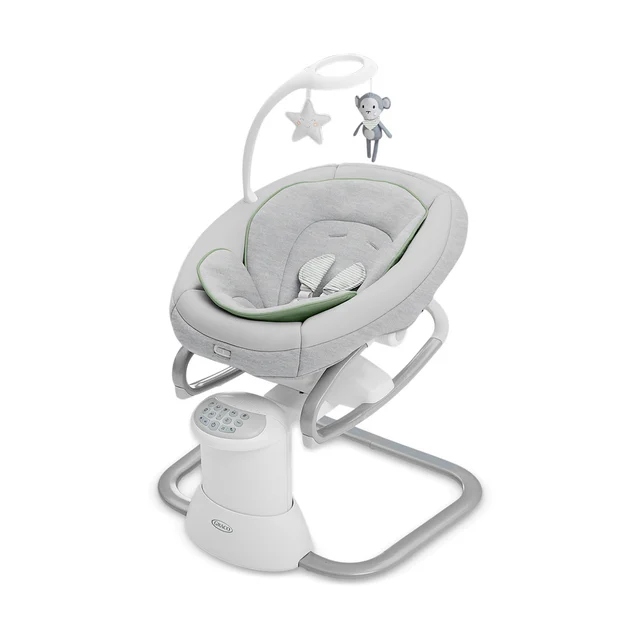
- Buy Graco Soothe My Way Swing with Removable Rocker Sixteen ways to soothe plus a seat that pops off and becomes a carry-anywhere rocker - the most versatility per dollar in the category. Amazon
- Buy UPPAbaby Mamaroo Smart Swing The famous multi-motion glider, now under the UPPAbaby name - unmatched motion variety and app smarts, if your baby takes to it. Amazon
- It depends Munchkin Bluetooth Enabled Baby Swing A sleek, quiet sway in a small footprint - lovely for small homes, too gentle for some babies. Amazon
- Skip Ingenuity SimpleComfort Soothing Swing The rotating seat and low price look tempting, but too many of these motors die within months to recommend one. Amazon
What actually matters
- Motion types and directions - the single biggest predictor of success. A swing offering several distinct motions (side-to-side sway, head-to-toe arc, gliding bounce) gives you more chances to find the one your baby responds to than a single motion with many speeds.
- Power source - swings run for hours a day, so plug-in (AC) power is strongly preferable. Battery-only models drain fast, weaken as batteries fade, and get expensive to feed.
- Motor noise - the swing does its work while your baby is drowsy, so a quiet motor matters. A clicking, whining, or grinding mechanism defeats the whole purpose, and noise that grows over time is an early sign of motor wear.
- Footprint and portability - full-size frames are larger than photos suggest. Compact swings, split-apart frames, or seats that detach into a portable rocker let the swing live where you actually are.
- Harness design - a five-point or secure three-point harness you can buckle one-handed, every time. You'll be doing this dozens of times a day, often while holding the baby.
- Washability - spit-up is not optional. Look for machine-washable fabrics with a removal process simple enough to face on four hours of sleep.
- Reliability track record - read recent owner reports specifically for motor complaints. A swing that powers on but stops swinging, or can't move a slightly heavier baby, is the category's signature failure.
The specs, in plain English
Green flags vs red flags
Green flags
- Several genuinely distinct motion types, not just one motion with many speeds
- Plug-in power with a motor that owners consistently describe as quiet
- Recent owner reports praising motor strength months into ownership, including with bigger babies
- A one-hand-buckle five-point harness and machine-washable seat fabric
- A seat that detaches as a rocker or a frame that splits apart - versatility that stretches the short usage window
Red flags
- A recurring pattern in owner reports of motors weakening or dying within weeks to months
- Battery-only power on a full-size swing
- Reviewers noting the mechanism gets louder as it wears - an early sign of a failing motor
- Marketing that leads with songs, lights, and app features while saying little about the motion itself
- 'Underpowered with heavier babies' complaints - a swing that can't move a five-month-old was never going to last
- Any language implying the swing is a sleep space - no swing is; sleep belongs on a firm, flat surface
Who's who: the brands
- Graco - Baby-gear mainstay known for feature-rich, reliable swings at sane prices - including multi-motion models whose seats detach into portable rockers.
- UPPAbaby - Premium stroller and gear brand that now sells the famous multi-motion Mamaroo glider (originally from 4moms) - the category's flagship smart swing.
- 4moms - The tech-forward brand that invented the mamaRoo's gliding, parent-inspired motions; its swing line was folded into UPPAbaby, so current models carry that name.
- Munchkin - Design-led baby brand whose compact Bluetooth swing is the go-to for small homes - elegant, but limited to one gentle sway.
- Ingenuity - Budget-tier brand with clever ideas like rotating seats, but a mixed reliability reputation - owner reports of early motor failures are a recurring theme.
- Fisher-Price - The classic mass-market name in cradle swings; broad availability and low prices, with model quality varying line to line - check recent owner reports for the specific model.
How to read a listing without getting fooled
Start with the motion, because it's the only thing that soothes a baby: look for how many distinct motion types the swing has and in how many directions, and mentally discount big speed counts and song libraries - those are garnish. Next find the power source; if you can't find the word 'plug-in' or 'adapter included', assume batteries and factor in the cost and fading power. Check the weight range but read it skeptically: the behavioral limits (sitting up, climbing out) end swing time long before most maximums. Then leave the listing entirely and read recent owner reports, filtering for the word 'motor' - a pattern of weakening or dying motors is the category's defining failure, and no spec sheet will admit to it. Finally, ignore any photo or phrase that suggests a sleeping baby in the swing; that's a marketing red flag, not a feature.
How much should you spend?
What drives price in this category is motion sophistication and smart features: budget swings give you one or two basic motions on a simple frame, mid-range adds quieter motors, better fabrics, and compact or convertible designs, and flagship models offer gliding multi-motion platforms with app control. The value sweet spot for most families sits in the upper-middle of the range - enough motion variety to give you real odds of finding what your baby likes, plug-in power, and a proven motor, without paying for smart features that don't soothe anyone. Spending up to the flagship tier makes sense mainly when classic swinging has already failed your baby and you want the one motion style pendulum swings can't offer. Spending down to the cheapest tier is a false economy if it buys a motor with a weak reliability record - a swing that dies at month two with a fussy newborn in the house is expensive at any price. Throughout, remember the short usage window: this is a months-long product, and a well-checked secondhand unit from a reliable brand can be the smartest spend of all.
Questions, answered
Is it safe for my baby to sleep in a swing?
No. Swings are for supervised awake time only. Safe-sleep guidance is consistent: babies should sleep on their backs on a firm, flat surface such as a crib or bassinet - not in an inclined seat. Babies will absolutely doze off in a swing; when yours does, move them to their crib or bassinet as soon as you reasonably can. Keep sessions supervised, buckle the harness every time, and place the swing on the floor, never on a table or counter. This is general product guidance, not medical advice - talk to your pediatrician about your baby's sleep.
What's the difference between a swing, a bouncer, and a glider?
A swing has a motor that moves the seat for you, usually in an arc or a side-to-side sway. A bouncer is powered by your baby's own kicks or your foot, sometimes with an added vibration motor - cheaper, lighter, and useful longer into babyhood. A glider (the style the Mamaroo made famous) is a motorized seat that moves in flatter, multi-directional paths meant to mimic a parent's natural bouncing and swaying. Motorized options soothe very young and fussy babies best; many families end up with a swing in one room and a bouncer in another.
How do I know which motion my baby will like?
You mostly can't - that's the category's central gamble. The practical hedges: notice how you instinctively calm your baby (fast bouncing? slow side-to-side rocking?) and pick a swing whose motion resembles it; favor swings with multiple distinct motion types so you have fallbacks; and keep the receipt, because some babies reject every motorized motion. Second-time parents who already know their soothing style can shop much more precisely.
How long can my baby stay in the swing at a time?
Think of a swing as a short-session tool - long enough to shower or eat - not a place your baby lives. Extended daily time in any container-style seat crowds out the floor time and tummy time babies need for motor development. Keep sessions brief and supervised, and use the swing's timer if it has one.
When do babies outgrow swings?
Most swings are rated from around five pounds up to twenty or twenty-five, but babies usually age out behaviorally first: once yours can sit up unassisted, roll purposefully, or try to climb out - often somewhere around six to nine months - swing time is over per manufacturer instructions. That short window is worth remembering when you decide how much to spend.
Is a secondhand swing a good idea?
It can be a genuinely smart buy given the short usage window, if you do three checks. First, search the exact model against the manufacturer's site and official government recall listings - several popular infant swings and inclined sleepers have been recalled in recent years. Second, inspect the frame, harness, and fabric for damage and confirm nothing is missing. Third, run the motor through every speed with weight in the seat: a swing whose motion has weakened is on its way out. When in doubt, pass.
Or jump to the head-to-head: Graco Soothe My Way Swing with Removable Rocker vs UPPAbaby Mamaroo Smart Swing.