

Cycling
The Best Bike Tire Sealants: 4 Compared (and One to Skip)
We compared four tubeless sealants on the things makers actually publish: base chemistry, ammonia content, claimed maximum seal size, stated service life, cold rating and CO2 guidance.
The short version
Silca Ultimate Tubeless Sealant is our overall pick because it publishes the fullest set of figures and backs them with a natural and synthetic latex blend, a 6mm-plus claimed seal size and a stated 6-plus month life. Stan's Original is the value pick and still the reference formula, rated to 6.5mm and 2 to 7 months, with a safety data sheet that tells you exactly what is in it. Muc-Off's No Puncture Hassle Road and Gravel version is the depends pick: zero natural latex, zero ammonia and a 7mm claimed seal size, which suits latex-allergic riders and high-pressure tires, but the stated life is only 3 to 6 months. Finish Line FiberLink is the skip, not because Kevlar-reinforced latex is a bad idea but because Finish Line publishes no seal size, no temperature figure and no refresh interval. Whichever you pick, no sealant here claims to fix a sidewall cut, so a plug kit and a spare tube still travel with you. Best for: riders who want to choose sealant on published specs instead of bottle copy.
Our picks at a glance
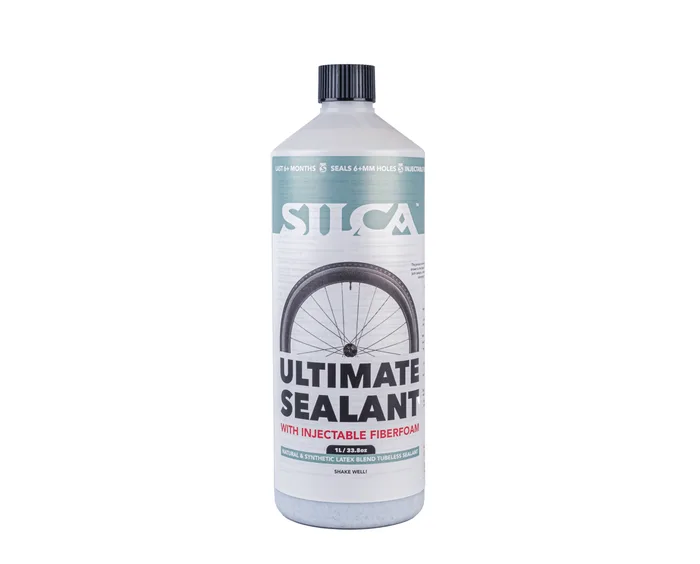
- Silca Ultimate Tubeless Sealant - Buy. A natural and synthetic latex blend with carbon fiber strands, and the most complete spec sheet in the group.
- Stan's Original Tubeless Sealant - Buy. The formula the whole category is measured against, still rated to 6.5mm and still the cheapest per fill.
- Muc-Off No Puncture Hassle Road & Gravel Tubeless Sealant - It depends. Synthetic latex with zero natural latex and zero ammonia, rated to 7mm and up to 110 psi.
- Finish Line FiberLink Tubeless Sealant - Skip. Kevlar-reinforced natural latex with almost none of the numbers you would use to compare it.
The verdict in 30 seconds
What mattered most
- Base chemistry
- Ammonia
- Claimed max seal size
- Stated service life
- Cold rating
- Pressure guidance
Tubeless sealant is sold on adjectives and bought on faith, which is odd for a product where the makers publish real numbers. Most of it is natural latex suspended in water, it seals by coagulating at the hole, and it dries out on a schedule that decides your actual running cost. A smaller group of formulas use synthetic latex instead and skip natural rubber entirely. We picked four that between them cover both chemistries, the widest published seal sizes and the clearest and the murkiest spec sheets in the category.
A natural and synthetic latex blend with carbon fiber strands, and the most complete spec sheet in the group.
Best for: Riders who want one sealant for road, gravel and trail and would rather not think about it for half a year.
- Publishes a claimed seal size of 6mm and larger plus a stated 6-plus month service life.
- Listed as ammonia free and tested to seal punctures down to -15C (5F).
- Injectable through the valve, so you can top up without unseating the tire.
- Silca's only CO2 advice is to deflate and re-inflate with a pump once you are home.
- Not injectable in Reserve valves, per Silca's own note.
- The injector is sold separately rather than bundled.
- Only three bottle sizes, so there is no tiny single-fill option beyond the 65ml.
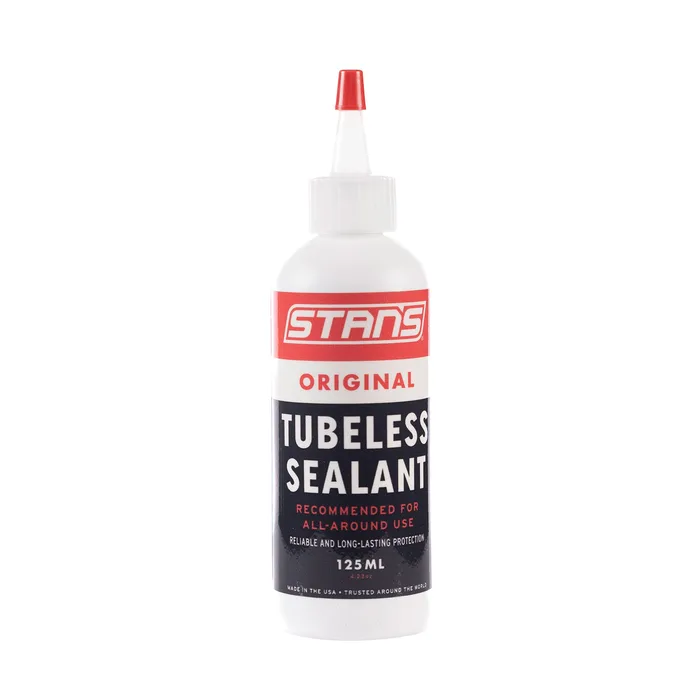
The formula the whole category is measured against, still rated to 6.5mm and still the cheapest per fill.
Best for: Anyone who wants a proven, widely stocked sealant and does not mind checking levels a few times a season.
- Rated to seal punctures up to 6.5mm, the second largest claim of our four.
- Anti-freezing agents are stated to allow use down to -20F.
- Stan's publishes a full safety data sheet, so the chemistry is not a mystery.
- Stated liquid life of 2 to 7 months is a very wide window, and arid climates land at the low end.
- Contains natural rubber latex and is classified as a skin sensitiser, which matters if you have a latex allergy.
- No published CO2 guidance and no published rim tape statement.
- Dries into skins and clumps that need peeling out at tire changes.
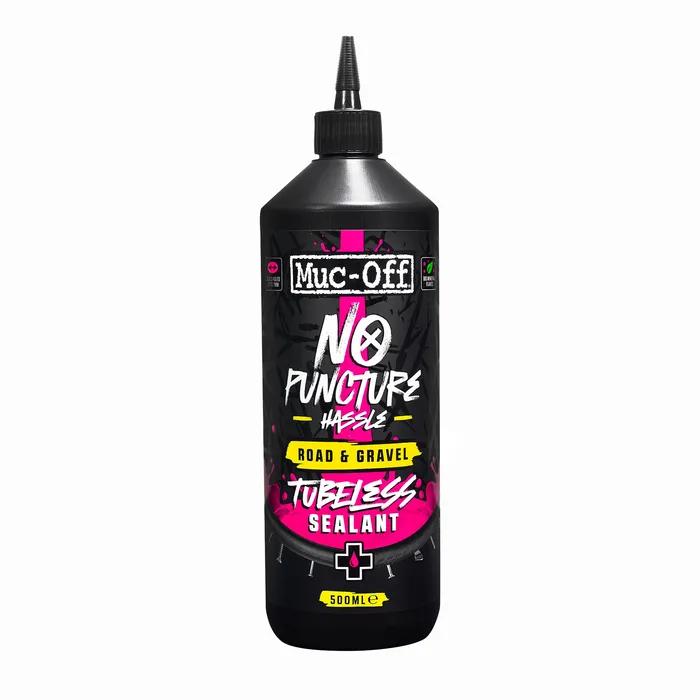
Synthetic latex with zero natural latex and zero ammonia, rated to 7mm and up to 110 psi.
Best for: Riders with a latex allergy, or anyone running high-pressure road tires who wants the biggest published seal size.
- Stated to seal holes up to 7mm, the largest claim among our four.
- Listed as zero ammonia and zero natural latex, which removes the allergy question.
- Muc-Off publishes actual CO2 guidance rather than staying silent on it.
- Stated life of 3 to 6 months tops out below Silca's and Stan's figures.
- Muc-Off also asks you to check roughly every 750 miles, which is a real maintenance cadence.
- The road and gravel formula is rated to 110 psi, so Muc-Off sells a separate MTB version instead of one bottle for everything.
- Harder to find on a shop shelf than Stan's.
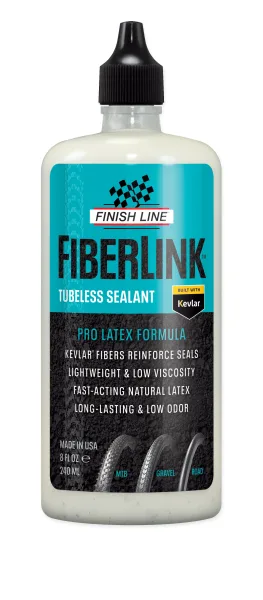
Kevlar-reinforced natural latex with almost none of the numbers you would use to compare it.
Best for: Someone already running Finish Line's range who wants a Kevlar-reinforced latex and will refresh it on feel rather than on a schedule.
- Listed as biodegradable and made in the USA, formulated without PFAS chemicals.
- Kevlar fibers are described as interlinking with cured latex to reinforce the seal.
- Low viscosity that Finish Line pitches at race conditions.
- No published maximum hole size, so you cannot compare its sealing claim to anything.
- No published temperature or freezing figure.
- No stated refresh interval; the page says only to refresh as needed.
- No CO2 guidance and no ammonia statement on the product page.
| Criteria | Ultimate Tubeless Sealant Top pick | Original Tubeless Sealant | No Puncture Hassle Road & Gravel Tubeless Sealant | FiberLink Tubeless Sealant |
|---|---|---|---|---|
| Verdict | Buy it | Buy it | It depends | Skip it |
| Best for | Riders who want one sealant for road, gravel and trail and would rather not think about it for half a year. | Anyone who wants a proven, widely stocked sealant and does not mind checking levels a few times a season. | Riders with a latex allergy, or anyone running high-pressure road tires who wants the biggest published seal size. | Someone already running Finish Line's range who wants a Kevlar-reinforced latex and will refresh it on feel rather than on a schedule. |
| Price tier | $$ · mid-range | $ · budget | $$ · mid-range | $$ · mid-range |
| Base chemistry | Natural and synthetic latex blend, carbon fiber strands | Natural rubber latex, water based | Synthetic latex, stated zero natural latex | Natural latex with Kevlar fibers |
| Ammonia | Stated ammonia free | Not stated; SDS gives pH about 7 | Stated zero ammonia | Not stated |
| Claimed max seal size | 6mm and larger | 6.5mm (1/4 in) | 7mm | Not published |
| Stated service life | 6 months and beyond | Liquid 2 to 7 months | 3 to 6 months, or about 750 miles | Not published |
| Cold rating | Tested to seal at -15C (5F) | Anti-freezing agents down to -20F | Will not freeze down to -15C | Not published |
| Pressure guidance | Not published | Not published; listed for road, gravel and MTB | Works up to 110 psi | Not published |
| CO2 guidance from the maker | Re-inflate with a pump once home | Not published | Can be used; apply from the top of the wheel | Not published |
| Sizes | 65ml, 500ml, 1L | 60ml, 125ml, 250ml, 500ml, 1000ml | 80ml, 140ml, 500ml, 1L, 5L | 8oz, 32oz, 1 gallon |
Which one is right for you?
- Riders who want one sealant for road, gravel and trail and would rather not think about it for half a year. Buy it Silca Ultimate Tubeless Sealant
- Anyone who wants a proven, widely stocked sealant and does not mind checking levels a few times a season. Buy it Stan's Original Tubeless Sealant
- Riders with a latex allergy, or anyone running high-pressure road tires who wants the biggest published seal size. It depends Muc-Off No Puncture Hassle Road & Gravel Tubeless Sealant
- Someone already running Finish Line's range who wants a Kevlar-reinforced latex and will refresh it on feel rather than on a schedule. Skip it Finish Line FiberLink Tubeless Sealant
How we judged the field
Five things decide whether a sealant is worth its bottle. First, base chemistry: most sealants are natural latex suspended in water and seal by coagulating at the hole, while a smaller group use synthetic latex and behave differently as they age. Second, stated service life, because that interval is the real ongoing cost of running tubeless and the published figures range from about a month to more than six. Third, claimed maximum seal size, which tells you where the product gives up. Fourth, cold performance, since latex behaves badly near freezing and only some makers publish a number. Fifth, what the maker says about CO2 inflators, because the industry does not agree and silence is not the same as approval.
The field splits cleanly. On one side are the natural latex formulas that everybody knows: Stan’s, Orange Seal, Peaty’s and Finish Line all build on natural rubber latex plus a suspension of fibres, flakes or crystals to bridge bigger holes. On the other side are the newer blends, either partly synthetic like Silca’s natural and synthetic mix or fully synthetic like Muc-Off’s road and gravel formula, which carries zero natural latex. We picked four that cover both camps and that also happen to bracket the category’s transparency: Silca and Muc-Off publish nearly everything, Stan’s publishes most of it plus a full safety data sheet, and Finish Line publishes almost none of it.
Silca Ultimate Tubeless Sealant
Buy itSilca publishes more numbers than most, and that is the main reason it wins here. The spec sheet calls the formula a proprietary natural and synthetic latex blend with optimized carbon fiber strands and foaming agents whose job is to carry those strands to a puncture. Silca claims it seals 6mm and larger punctures, lasts 6 months and beyond, and has been tested to seal down to -15C, which is 5F. It is listed as ammonia free and injectable through the valve, though Silca notes it is not injectable in Reserve valves and sells the injector separately. The synthetic fraction is the interesting part. Silca says its older all-natural latex formula needed a two-step process to stay liquid longer, and that the new blend removed that step. On CO2, Silca’s advice is to deflate and re-inflate with a hand or floor pump once you are home. Bottles come in 65ml, 500ml and 1L. It suits the rider who wants one sealant covering road, gravel and trail without a short refresh clock.
Stan’s Original Tubeless Sealant
Buy itStan’s is the reference point, and it is still the sealant most shops pour. The company calls it the world’s first tubeless sealant, and the current Original formula is rated to seal punctures up to 6.5mm, remain liquid inside the tire for 2 to 7 months, and work down to -20F thanks to anti-freezing agents. It is unambiguously a natural rubber latex product. Stan’s own safety data sheet lists natural rubber latex at 10 to 20 percent as the only declared hazardous ingredient, gives the mixture a pH of about 7, and carries a skin sensitisation warning, which is worth knowing if you have a latex allergy. That near-neutral pH is also relevant to the ammonia argument, since heavily ammoniated latex sits far higher. Stan’s publishes no CO2 guidance and no rim tape statement. The 2 to 7 month spread is honest but wide, and dry climates land at the bottom of it. It suits anyone who wants a proven, cheap, universally stocked sealant.
Muc-Off No Puncture Hassle Road & Gravel Tubeless Sealant
It dependsThis is the genuinely different chemistry in the group. Muc-Off lists it as an advanced synthetic latex, water-based sealant with zero natural latex and zero ammonia, using biodegradable mineral flakes and bamboo fibre particles to plug larger holes fast. The claimed seal size is 7mm, the largest of our four, and Muc-Off says it works up to 110 psi, which is why this is the road and gravel version rather than the mountain one they sell alongside it. Stated life is 3 to 6 months, or roughly every 750 miles, and Muc-Off says it will not freeze down to -15C. It also gives the most specific CO2 advice here: you can use CO2, but apply it from the top of the wheel so the gas is not injected straight into the pool of sealant at the bottom. The trade-offs are a stated life that tops out at 6 months and thinner shop availability. It suits latex-allergic riders and high-pressure setups.
Finish Line FiberLink Tubeless Sealant
Skip itFiberLink is not a bad product so much as an under-documented one. Finish Line describes it as a pro latex formula in which Kevlar fibers work with fast-acting natural latex, cure into an adhesive seal, and give the low viscosity they say suits race conditions. That is close to the whole technical story. There is no published maximum hole size, no temperature or freezing figure, no stated refresh interval beyond refresh as needed, and no ammonia or CO2 statement. Every other sealant here publishes at least three of those. The page says only that tire porosity and climate affect longevity. That is fair, but a sealant you cannot compare on paper is hard to choose over ones you can. It suits an existing Finish Line customer, and few others.
Sources
Specs in this review come from these pages.
- Silca - Ultimate Tubeless Sealant product page (silca.cc)
- Stan's - Original Tubeless Sealant product page (stans.com)
- Stan's - Tubeless Sealant Safety Data Sheet (PDF) (cdn.shopify.com)
- Muc-Off - No Puncture Hassle Road & Gravel Tubeless Sealant (muc-off.com)
- Finish Line - FiberLink Tubeless Sealant product page (finishlineusa.com)
- Orange Seal - Sealant product information sheet (PDF) (orangeseal.com)
Silca Ultimate Tubeless Sealant vs Stan’s Original Tubeless Sealant: which should you buy?
Silca Ultimate and Stan’s Original are closer than the marketing suggests, and the deciding factor is how often you want to think about sealant. Silca claims 6 months and beyond of service life against Stan’s 2 to 7 months, and the difference is not just a number: Stan’s explicitly warns that arid conditions need more frequent monitoring, while Silca’s partly synthetic blend is sold on staying liquid without the two-step routine the old all-natural version needed. Silca also states ammonia free and gives a tested cold-sealing figure of -15C. Stan’s answers with a slightly larger claimed seal size, 6.5mm against Silca’s 6mm and larger, plus the most transparent ingredient documentation in the category.
Choose Stan’s if you run a lot of wheels, refresh sealant as a routine part of servicing anyway, and want the cheapest per-fill option that any shop in the country can resupply. Choose Silca if your bike sits between rides, if you would rather check sealant twice a year than five times, or if you want an ammonia-free formula on aluminium rims and are willing to buy the injector to top up through the valve. Neither is a wrong answer, and both are natural latex products at heart, so both will eventually dry into a skin you have to peel out at the next tire change.
What to look for
- Base chemistry first: natural latex seals fast and dries out on a schedule, while synthetic latex formulas are sold on longer liquid life and remove the allergy question entirely.
- A published service life: the stated interval is your real ongoing cost, and it ranges from Orange Seal’s 30 to 45 days for Regular up to the 6-plus months claimed by Silca, Muc-Off’s MTB formula and Peaty’s.
- An ammonia statement: Silca and Muc-Off both advertise ammonia-free formulas, which tells you the industry takes the concern seriously even though we found no rim maker publishing a documented warning.
- A claimed maximum hole size: the published numbers sit between 6mm and 7.8mm, and a maker who will not print one is asking you to buy on faith.
- A cold-weather figure if you ride in winter: Stan’s names -20F, Silca names -15C, Muc-Off names -15C and Orange Seal sells a dedicated Subzero formula, so buy the bottle that names your temperature.
- Explicit CO2 guidance: Muc-Off says apply it from the top of the wheel, Silca says re-inflate with a pump once home, Peaty’s says its water-based formula defrosts without losing performance, and Stan’s and Finish Line say nothing, which is itself information.
Our final take
Buy Silca Ultimate if you want the fullest set of published specs and the longest claimed interval between top-ups, and Stan’s Original if you want the reference formula at the lowest cost per fill with the best-documented ingredients. Muc-Off’s road and gravel sealant is the one to reach for if natural latex is a problem for you or you run high pressures, accepting a shorter stated life in return. Skip Finish Line FiberLink, not because Kevlar-reinforced latex is a bad idea but because Finish Line will not tell you what hole it seals, what temperature it survives or how long it lasts. Whatever ends up in your tires, keep a plug kit and a tube in the pack.
Questions, answered
How often do I actually have to replace tubeless sealant?
Follow the maker's number rather than a rule of thumb, because the published intervals differ widely. Stan's says Original stays liquid for 2 to 7 months and warns that arid conditions need more frequent checks. Silca and Peaty's both claim 6 months or more, while Muc-Off's road and gravel formula is stated at 3 to 6 months or roughly every 750 miles. Orange Seal goes further and publishes an average sealant life in days on its own comparison sheet: 30 to 45 for Regular, 60 to 120 for Endurance and 60 to 180 for Subzero. Heat and dry air shorten all of those, so the honest approach is to unseat a bead or pull a valve core and look, rather than to trust the calendar.
Does CO2 from an inflator ruin latex sealant?
The makers genuinely disagree, and that is the useful answer. Silca says that if you use CO2 on a ride, you should deflate the tire and re-inflate it with a hand or floor pump when you get home. Muc-Off lists its sealant as CO2 compatible but adds a caveat: apply the CO2 from the top of the wheel so the gas is not injected directly into the pool of sealant sitting at the bottom. Peaty's explains that CO2 leaves the inflator head at around minus 50 degrees and will freeze any sealant it touches, but says its water-based formula defrosts without a performance loss. Stan's and Finish Line publish nothing on the subject. Given that, a CO2 cartridge is a fine roadside rescue and a poor everyday inflation method.
Will sealant corrode my aluminium rims or lift my rim tape?
This one deserves care, because what is repeated online is ahead of what is documented. Ammonia is used as a stabiliser in some latex products and is the ingredient the corrosion worry attaches to, and several makers now advertise ammonia-free formulas: Silca lists Ultimate as ammonia free and Muc-Off lists zero ammonia on both of its sealants. Orange Seal's own product sheet marks its sealants as not corrosive, and Stan's safety data sheet gives the mixture a pH of about 7 with natural rubber latex as the only declared hazardous ingredient. What we could not find was a rim manufacturer publishing a documented ammonia corrosion warning, so treat the concern as taken seriously by chemists rather than proven by wheel makers. None of our four publishes an explicit rim tape compatibility spec either.
What size hole will sealant really seal?
The published claims cluster between 6mm and 7mm: Silca says 6mm and larger, Stan's Original says 6.5mm, Muc-Off's road and gravel formula says 7mm, and Stan's separate Rolled Gold formula claims 7.8mm at 100 psi. Those figures are for clean tread punctures at the pressures the makers tested. A sidewall cut is a different problem, because the casing there is thin, flexes constantly and pulls the drying latex apart before it can bridge the gap. Peaty's says as much on its own product page, pointing riders at a plug kit when the hole is too big for sealant. Carry a plug kit and a spare tube, and treat the sealant number as the ceiling rather than the expectation.
Does sealant still work in freezing weather?
It depends on the formula, and the good news is that more makers publish a cold figure than you would expect. Stan's says anti-freezing agents allow Original to be used down to -20F. Silca says Ultimate has been tested to seal punctures down to -15C, which is 5F. Muc-Off states its road and gravel sealant will not freeze down to -15C, and Peaty's gives an operating range of -20C to +50C. Orange Seal publishes a temperature rating for each of its three formulas and sells Subzero specifically for the coldest end. If you ride below freezing regularly, buy the formula that names your temperature instead of assuming a general-purpose bottle will cope.
Deciding between the top two? See our head-to-head: Silca Ultimate Tubeless Sealant vs Stan's Original Tubeless Sealant.
More Cycling reviews
 The Best Bike Tool Rolls: 4 Compared (and One to Skip)
  The Best Chain Breakers: 4 Compared (and One to Skip)
  The Best Chain Checkers: 4 Compared (and One to Skip)
  The Best Chain Lubes: 4 Compared (and One to Skip)
  The Best Chain Whips: 4 Compared (and One to Skip)
  The Best Clipless Pedals: 4 Compared (and One to Skip)