Explained
Wrist Wraps, Explained
After reading, you'll know which length and stiffness suit your lifting, how to wrap correctly, and what claims to ignore.
In this guide
Under a bar held above the wrist, the joint wants to extend backwards, and once it does the load stops travelling cleanly through the forearm. A wrist wrap is elastic wound around the joint to resist that extension. Length, width and stiffness are the three variables, and between them they explain every meaningful difference in the category.
The 30-second version
- A wrap resists extension, keeping the wrist closer to neutral under a bar.
- Length trades support against convenience, with 60 centimetres the usual middle ground.
- Stiff immobilises, flexible supports, and they suit different lifts.
- Width is regulated and rarely published, with 8 centimetres the common maximum.
- Wraps do not build strength, and a page claiming they do is overreaching.
The products this guide is about
Our verdict on each, with the full reasoning on the companion review.
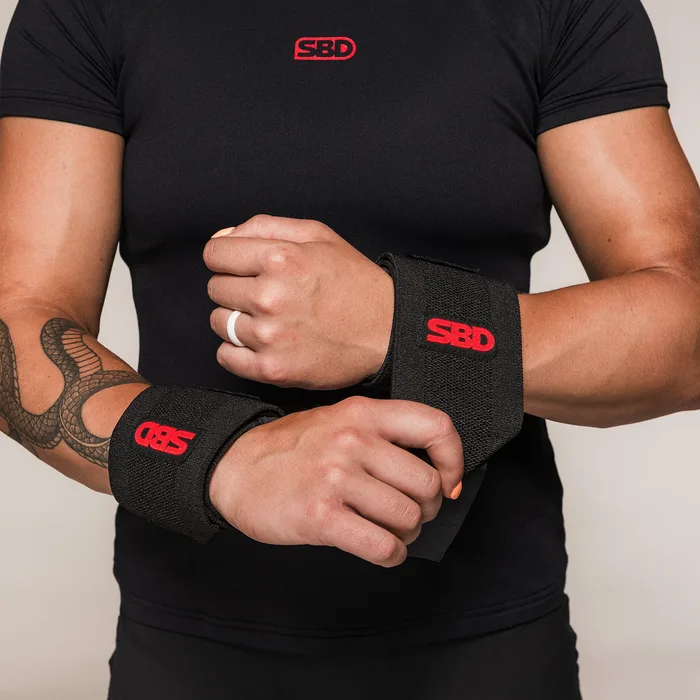
- Buy SBD Wrist Wraps Two stiffnesses, three lengths, left and right specific, and the only published width here.
- Buy Strength Shop Thor Heavy Wrist Wraps Three lengths with the trade explained for each, and the dimensions of the hardware published.
- It depends Gymreapers Wrist Wraps, 18 inch Four federation approvals and one length, with a durability claim instead of a specification.
- Skip Bear KompleX Wrist Wraps Sticky Velcro, eighteen inches, and claims a strip of elastic cannot support.
What actually matters
- Stiffness - flexible wraps support while allowing controlled movement; stiff wraps cast the joint and resist flexion entirely.
- Length - roughly 30 to 100 centimetres. Longer means more turns, more support, more time to put on and take off.
- Width - the vertical dimension of the wrap, capped by federation rules, typically at 8 centimetres.
- Elastic construction - whether the elastic is specified or generic, and whether it is woven for wrist support or repurposed.
- Fastening - the hook and loop strap and its width, which is the component most likely to stop gripping first.
- Thumb loop - used to hold the wrap while you wind it, then usually taken off the thumb before lifting. Width and durability matter.
- Federation approval - IPF, IPL, USPA and USAPL each publish equipment rules covering wrap dimensions and construction.
The specs, in plain English
Green flags vs red flags
Green flags
- Two or more stiffness options, described by what each is for.
- Several lengths with the support trade explained.
- The wrap width published in centimetres.
- Named federation approvals.
- The elastic or fastening specified rather than described as high-grade.
Red flags
- Claims that the wrap increases strength or builds muscle memory.
- No width published on a product sold as competition legal.
- One length presented as suiting everything.
- Material given only as premium or high-grade.
- No federation approval where competitors list several.
Who's who: the brands
- SBD - British maker offering flexible and stiff versions in three lengths, IPF approved at the maximum width, with handed left and right construction.
- Strength Shop - UK brand whose Thor wraps come in 30, 60 and 90 centimetre lengths with the support trade explained, IPF approved.
- Gymreapers - Value American brand with IPF, IPL, USPA and USAPL approval on a single 18 inch length, focused on stitching and thumb loop durability.
- Bear KompleX - Cross-training accessory brand selling 18 inch wraps in several patterns with heavy-duty hook and loop fastening.
- Inzer - Long-established powerlifting manufacturer producing wrist wraps in several stiffnesses and lengths alongside its belts.
How to read a listing without getting fooled
Look for a stiffness option first, because it is the variable that determines what the wrap is for and the one most makers quietly decide for you. Then read the lengths and see whether the maker explains the difference: a page offering three lengths with a sentence each about support and speed is far more useful than one offering a single length with no comment. Find the width in centimetres and check it against your federation's limit if you compete, remembering that most pages simply do not give it. Note which approvals are listed and how many. Then look at the fastening and the thumb loop, because those are the parts that wear out, and at whether the elastic is described as purpose-made or simply as high-grade. And read the claims sceptically: a wrap limits joint extension, and that is all it does.
How much should you spend?
Wrist wraps are inexpensive and long-lived, which makes this a category where the budget option is genuinely good. At the low end you get federation-approved wraps in a single length with durable stitching and fastening, which covers most people's training permanently. The value tier adds a choice of lengths and published hardware dimensions, which materially improves the chance of buying the right pair first time and is the sensible place for most lifters to shop. The premium tier buys a choice between flexible and stiff construction, purpose-developed elastics, handed left and right wraps, a width built to the competition maximum and domestic manufacture. That is worth paying for if you compete or if you train both Olympic lifting and maximal pressing, since the alternative is owning two cheaper pairs anyway.
Questions, answered
How tight should I wrap them?
Tight enough to resist your wrist bending back, and loose enough that your hand does not go numb or change colour. Wrap over the joint itself rather than up the forearm, keep the tension even through each turn, and fasten with the wrist in the position you want to hold. Many people wrap too far up the arm, which feels secure and does nothing for the joint. Take them off between sets rather than leaving them fastened, because sustained compression on the wrist is not something to maintain for an hour.
Are wrist wraps the same as lifting straps?
No, and it is the most common confusion in this corner of the gym. Wrist wraps support the wrist joint against extension under a bar you are pushing. Lifting straps are loops of fabric that wind around the bar and tie your hands to it so grip does not limit a pull. They solve opposite problems, they are used on opposite lifts, and they are not interchangeable. Several brands here sell both, and the product names are similar enough to be worth reading carefully.
Do I need to take the thumb loop off?
Yes, for anything heavy. The thumb loop exists to hold the wrap in place while you wind it on, not to bear load, and leaving it around your thumb during a heavy press puts force through the thumb joint in a direction it does not like. Most federations also require it to be off during competition lifts. Wind the wrap, slip the loop off the thumb, and tuck it under the wrap or leave it free.
Will wraps fix wrist pain?
They may relieve it during a lift and they do not treat the cause. Wrist pain under pressing loads can come from mobility limitations, poor bar positioning, previous injury or several clinical conditions, and a wrap masks the discomfort while the underlying problem stays. If pain persists beyond a session, recurs, or appears outside lifting, that is a reason to see a clinician. Using wraps sensibly on heavy sets alongside proper advice is fine; using them to train through pain is not.
Or jump to the head-to-head: SBD Wrist Wraps vs Strength Shop Thor Heavy Wrist Wraps.