Explained
Wireless Chargers, Explained
After reading, you will understand what makes a wireless charger fast, reliable, and worth its price, so you can pick the right one for your phone.
In this guide
Wireless charging sounds simple, but the labels on the box do not. Terms like Qi2, MagSafe, and 15W get thrown around as if everyone knows what they mean, and the biggest mistake buyers make is chasing a high wattage number their phone cannot actually use. This guide decodes the jargon so you buy for the things that matter: magnets, certification, form factor, and the power brick.
The 30-second version
- Magnets matter more than watts. A magnetic charger aligns the coils automatically, so charging starts reliably and runs cooler, which is more useful day to day than a bigger wattage number.
- Qi2 is the standard to look for. It brings MagSafe-style magnetic alignment to the whole ecosystem, and certification guarantees the safety and thermal handling that cheap pads skip.
- Peak speed depends on your phone. The fastest 25W speeds only apply to the newest iPhones on Qi2.2 hardware, so most people should not overpay for wattage their phone cannot reach.
- Match the shape to your life. A folding station travels, an upright stand anchors a desk, and a single puck covers a phone-only user for the least money.
- The power brick is part of the deal. A 15W charger fed by a weak adapter is just a slow charger in disguise, so check whether a capable adapter is included.
The products this guide is about
Our verdict on each, with the full reasoning on the companion review.
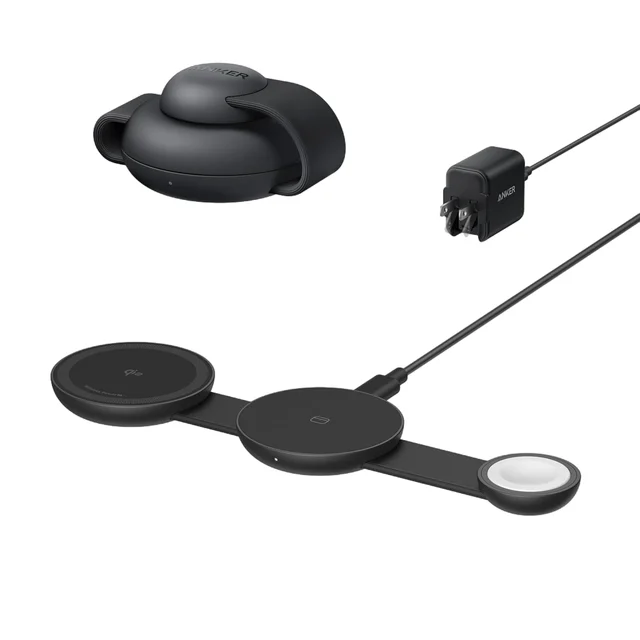
- Buy Anker MagGo 3-in-1 Foldable Wireless Charging Station A folding Qi2 station that charges three Apple devices and still fits in a coat pocket. Amazon
- Buy CHOETECH T611-F Qi2 Tri-Fold Magnetic Charger An upright Qi2 tri-fold stand that keeps your phone at a readable angle on the desk.
- Buy ESR HaloLock Qi2 Mini Magnetic Charger A single Qi2 magnetic puck with strong magnets and a built-in kickstand for phone-only users. Amazon
- Skip CHOETECH T535-S Dual Wireless Charging Pad A non-magnetic flat pad that caps iPhones near 7.5W, and it is outdated next to a Qi2 puck.
What actually matters
- Magnetic alignment decides whether charging is reliable. Magnets snap the phone's coil onto the charger's coil, so you never wake up to a phone that barely charged overnight.
- Qi2 certification guarantees the magnetic profile plus the safety and thermal handling. Uncertified pads can run hotter and slower and give you no such assurance.
- Your phone's peak speed sets a real ceiling. Older iPhones cap at 15W and only iPhone 16 and 17 models reach 25W, so wattage above your phone's limit is wasted.
- Form factor should fit how you charge: a folding station for travel, an upright stand for a desk or nightstand, or a single puck for a phone alone.
- Number of devices matters if you own a smartwatch or earbuds. A three-in-one station is wasted money and space if you only charge a phone.
- The included adapter determines whether the rated speed is real. Multi-coil chargers need a capable brick, and only some ship with one.
- Viewing angle is worth considering. An upright stand keeps the screen readable for standby clocks and video calls while it charges.
The specs, in plain English
Green flags vs red flags
Green flags
- Explicitly Qi2 certified, with the magnetic profile named on the box
- Strong magnets, often quoted as a gram hold rating, so the phone stays aligned
- A capable power adapter included, or a clear statement of what brick you need
- A form factor that matches your use: folding for travel, upright for a desk, puck for phone-only
- A detachable cable, so a worn cord does not mean replacing the whole charger
Red flags
- A non-magnetic flat pad sold for an iPhone in 2026, where alignment is fiddly and slow
- Built to the older Qi standard only, capping an iPhone near 7.5W
- No certification claimed, which usually signals weaker thermal and safety handling
- A dated USB-A adapter in the box that quietly limits charging speed
- A big three-pad station pitched at someone who only owns a phone
- Wattage claims marketed loudly without saying which phones can actually reach them
Who's who: the brands
- Anker - Widely trusted charging brand known for well-built multi-device stations that ship with capable adapters.
- ESR - Value-focused accessory maker known for strong-magnet Qi2 pucks and stands at accessible prices.
- CHOETECH - Budget-to-mid charging brand offering both current Qi2 stands and older flat pads, so read the spec carefully.
- Belkin - Premium accessory maker that was an early MagSafe partner, known for polished, Apple-certified stands and stations.
- Apple - Maker of the original MagSafe charger and the reference point the whole Qi2 magnetic ecosystem is built around.
How to read a listing without getting fooled
Start by ignoring the biggest number on the box. Wattage claims are often the peak the hardware can theoretically deliver, not what your phone will accept, so first find your phone's real ceiling: older iPhones stop at 15W and only iPhone 16 and 17 models reach 25W on Qi2.2 gear. Next, confirm the word "Qi2" and, ideally, "certified" rather than just "magnetic" or "compatible", because an uncertified magnetic pad is not the same guarantee. Check whether a power adapter is included and what kind: a listing that ships with a USB-A brick, or a cable only, is quietly telling you the rated speed may be hard to hit. Finally, match the shape to your routine and count your devices honestly, since a three-in-one station is only a bargain if you actually own a watch and earbuds.
How much should you spend?
Spend based on shape and device count, not on chasing the highest wattage. The value sweet spot is a certified Qi2 charger with genuine magnets, because that single feature fixes the alignment and speed problems that make cheap pads frustrating, and it usually costs only a little more than a bare flat pad. A single magnetic puck is the least you should spend for a phone-only user and does the job correctly. Stepping up to a multi-device station is worth it only if you own a smartwatch and earbuds, and part of that premium buys the capable adapter that makes the speed real. Paying the most for a 25W-capable pad makes sense only if you own one of the newest phones that can use it; for everyone else, the extra outlay buys speed the phone will never reach.
Questions, answered
Is Qi2 the same as MagSafe?
Not exactly. MagSafe is Apple's magnetic standard, and Qi2 is the industry version that borrows the same magnetic ring and 15W profile. A Qi2-certified charger snaps to an iPhone and aligns just like MagSafe, and newer Qi2.2 pads can reach 25W on the latest iPhones.
Do I really need magnets, or is a flat pad fine?
For an iPhone, magnets are worth it. They align the coils automatically so charging starts reliably and runs cooler, while a non-magnetic flat pad makes you position the phone by hand and often settles near 7.5W, which iOS flags as slow. The small price difference usually pays for itself in fewer failed overnight charges.
Will a 25W charger charge my phone faster?
Only if your phone supports it. Peak 25W requires a recent iPhone on a Qi2.2 charger with a strong enough adapter. Older iPhones cap at 15W no matter what charger you use, so for most people a certified 15W Qi2 charger is the practical ceiling and there is no reason to overpay for more.
Why does the power adapter matter so much?
Because the charger can only deliver what the wall brick feeds it. A multi-coil station needs a capable adapter to run all its coils at full speed, and a weak or older USB-A brick throttles everything. If a charger ships with a cable only, budget for a proper adapter or the rated speed will stay out of reach.
Do I need a three-in-one station?
Only if you own the extra devices. A three-in-one is convenient when you charge a phone, a smartwatch, and earbuds together, but if you only carry a phone it is wasted money and desk space. A single magnetic puck does the job for far less.
Or jump to the head-to-head: Anker MagGo 3-in-1 Foldable Wireless Charging Station vs CHOETECH T611-F Qi2 Tri-Fold Magnetic Charger.