Explained
Under-Desk Ellipticals, Explained
After reading this, you'll know which specs decide whether an under-desk elliptical fits under your desk, stays quiet, and stays put.
In this guide
An under-desk elliptical is a small, seated leg-glider that lets you keep moving while you work, without standing up or taking over the room. The category looks simple, but it mixes genuinely good machines with cheap pedal exercisers that bang the underside of your desk and slide across the floor. The trick is knowing which two or three numbers actually decide whether one will work at your desk.
The 30-second version
- Pedal height decides everything. so measure your floor-to-desk clearance before you look at any other spec, because a machine your knees can't clear is useless no matter how good it is.
- Magnetic resistance is the quiet kind, and it's what keeps the unit inaudible on video calls; avoid friction or fan-style resistance for desk use.
- Weight is a feature, not a downside, because a heavier base stays planted while a light one creeps forward across a hard floor as you pedal.
- Elliptical glide beats bike-style pedaling at a desk, since a circular pedal motion forces a high knee lift that most desks simply can't accommodate.
- More resistance levels and an app are nice-to-haves, not the thing to buy on; a low, quiet, stable unit with modest resistance serves the core job better.
The products this guide is about
Our verdict on each, with the full reasoning on the companion review.
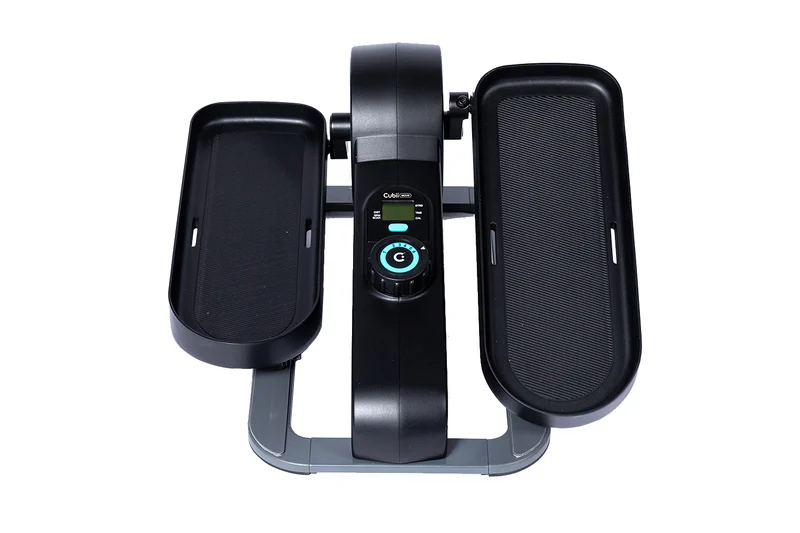
- Buy Cubii Move The quiet, low-slung under-desk elliptical that actually disappears under a desk while you work. Amazon
- Buy Sunny Health & Fitness Smart Portable Magnetic Under-Desk Elliptical (SF-E323017) The value pick: a smooth magnetic elliptical with an app and a built-in carry handle for less than the premium picks. Amazon
- It depends Cubii Total Body Plus A 2-in-1 seated elliptical that adds upper-body pulleys, at the cost of being awkward directly under a desk.
- Skip Sunny Health & Fitness Magnetic Mini Exercise Pedal Cycle (SF-B020026SMART) A capable little pedal exerciser, but circular pedaling is the wrong motion for most office desks. Amazon
What actually matters
- Pedal (step) height is the make-or-break spec: it's the vertical distance your knees travel, and if it exceeds your desk clearance the machine can't be used while seated.
- Motion type determines how high your knees rise. An elliptical glide keeps a low, forward-back oval path; a bike-style circular pedal forces a much taller knee lift.
- Resistance system shapes noise and smoothness. Magnetic resistance is quiet and stepless-feeling; other systems tend to be louder and rougher, which gets a machine unplugged fast.
- Base weight and grip decide whether the unit stays put. Heavier frames with rubber feet stay planted; light units wander, especially on hard floors during faster pedaling.
- Resistance range separates a token leg-mover from something you can push against. Enough levels matter if you're fit; too few and you'll top out immediately.
- Tracking and connectivity cover the onboard readout and any app. Useful for motivation, but rarely worth paying a premium for if you'll only glance at time and calories.
The specs, in plain English
Green flags vs red flags
Green flags
- Low, clearly stated pedal or step height, so you can check it against your desk before buying
- Magnetic resistance described as quiet or whisper-quiet by owners on calls
- A heavier base and rubber feet that reviewers say stays planted instead of walking
- True elliptical glide motion rather than a circular, bike-style pedal path
- A sensible spread of resistance levels plus a simple onboard readout you'll actually use
Red flags
- A tall pedal stack or unstated step height, especially paired with a low desk
- A light frame that owners report creeping forward or needing to be braced against a wall
- Circular pedal-cycle motion marketed for desk use, which forces a high, desk-banging knee lift
- Resistance described as noisy, rattly, or squeaky, or a non-magnetic system
- Paying a premium mainly for an app or extra cords you won't use at a desk
Who's who: the brands
- Cubii - The category's best-known name, focused specifically on low-profile, quiet seated ellipticals designed to disappear under a desk.
- Sunny Health & Fitness - A value-oriented home-fitness brand offering magnetic under-desk ellipticals and pedal exercisers, usually with more features per dollar.
- DeskCycle / 3D Innovations - Known for very low-profile under-desk pedal machines built around fitting under standard desks.
- Vaunn / generic pedal exercisers - A cluster of affordable pedal-cycle brands aimed at seated leg movement in front of a TV more than focused desk work.
How to read a listing without getting fooled
Start with one number: pedal or step height, and compare it to the clearance you measured from the floor to the underside of your desk or keyboard tray. If a listing hides that number or buries it, treat that as a warning. Next, confirm the motion is an elliptical glide, not a circular bike-style pedal, since marketing loves to blur the two; look for a flat, oval foot path in the photos and the word 'glide' rather than 'cycle.' Read 'magnetic resistance' as the quiet promise, and check the base weight, counterintuitively, heavier is better here because it means the unit will stay put. Treat resistance-level counts and app features as tie-breakers, not headline reasons to buy, and skim owner comments specifically for the words 'noisy,' 'slides,' and 'knees,' which surface the three problems specs alone won't tell you about.
How much should you spend?
Spend based on your desk and your goal, not on the longest feature list. The value that matters most, low pedal height, quiet magnetic resistance, and a base heavy enough to stay put, tends to sit in the mid-range, and it's worth paying up from the cheapest units to get it. Rock-bottom pedal exercisers are tempting but usually fail the desk on motion and stability, so they cost you more in frustration than they save. At the top end you're mostly paying for extras like upper-body cords, larger displays, and more resistance levels; those are worth it only if you'll actually use the machine for dedicated full-body sessions rather than quiet all-day leg movement. If you just want to move while you work, the sweet spot is a plain, well-built low-profile elliptical, not the flagship.
Questions, answered
How do I know if one will fit under my desk?
Measure from the floor to the underside of your desk, or to your keyboard tray if it sits lower, then compare that to the machine's pedal or step height. Low-profile ellipticals clear more desks; taller units and any bike-style pedal exerciser need noticeably more room because your knees travel higher. If your desk is on the low side, prioritize pedal height over every other spec.
What's the difference between an under-desk elliptical and a pedal exerciser?
An elliptical moves your feet in a low, flat oval so your knees stay down and you sit in a neutral posture. A pedal exerciser (or mini bike) moves your feet in a circle, which forces a much higher knee lift and tends to push you forward in your seat. For working at a desk, the elliptical glide is almost always the better fit; the circular pedal is better suited to gentle movement in front of a TV.
Will coworkers hear it on video calls?
Magnetic-resistance ellipticals are quiet, and owners generally report they're inaudible on calls at moderate speeds. Most noise actually comes from the unit sliding on a hard floor or from pedaling fast, so a heavier, stable base and a mat underneath keep things silent. Light pedal exercisers that wander around are the most likely to make noise.
Do these give a real workout, or just keep my legs moving?
Expect light, low-impact activity rather than a replacement for structured cardio. Their real value is breaking up long stretches of sitting and adding gentle movement across the day, which owners find helps with energy and stiffness. If you want a harder session, choose a model with more resistance levels and use it in focused bursts rather than continuously while you type.
Do I need the app, or is the onboard screen enough?
For most people the onboard monitor, showing time, strides, and estimated calories, is all they ever check. An app adds trend tracking and sometimes guided sessions, which some people find motivating, but it's a nice-to-have, not a reason to pay a large premium. Buy for a low, quiet, stable machine first and treat connectivity as a tie-breaker.
Are these safe if I have circulation or joint concerns?
This is general product information, not medical advice. Seated ellipticals are low-impact and are often chosen for gentle movement, but if you have a circulation condition, a joint injury, or any medical concern, consult a qualified professional before starting. They can advise whether seated pedaling is appropriate for you and at what intensity.
Or jump to the head-to-head: Cubii Move vs Sunny Health & Fitness Smart Portable Magnetic Under-Desk Elliptical (SF-E323017).