Explained
Two-Way Radios, Explained
After reading, you'll know which radio service you actually need, why the range number on the box is fiction, and which specs are worth paying for.
In this guide
Two-way radios promise simple, phone-free communication, but the marketing is loud and the specs are confusing. Box claims like "36-mile range" almost never happen on the ground, and shoppers get tripped up by acronyms (FRS, GMRS, MURS) that determine both how far a radio reaches and whether you need a license to use it. This guide breaks down what actually drives performance, so you can read a spec sheet instead of a marketing headline.
The 30-second version
- Ignore the mileage claim. it's a line-of-sight best case measured mountaintop to mountaintop, and on the ground you can expect roughly 1 to 5 miles.
- GMRS beats FRS for reach. higher legal power and repeater access mean GMRS radios go farther, but they require a simple, no-test FCC license.
- Privacy codes aren't privacy. they filter what you hear on a shared channel, they don't encrypt anything, so anyone with a compatible radio can still listen in.
- Waterproof and splash-resistant are different worlds. an IP67 radio survives a dunk, while a splash-resistant one only tolerates light rain.
- Battery chemistry matters more in the cold. rechargeable packs lose capacity fast in freezing temps, so a radio with an AA fallback can save a trip.
The products this guide is about
Our verdict on each, with the full reasoning on the companion review.
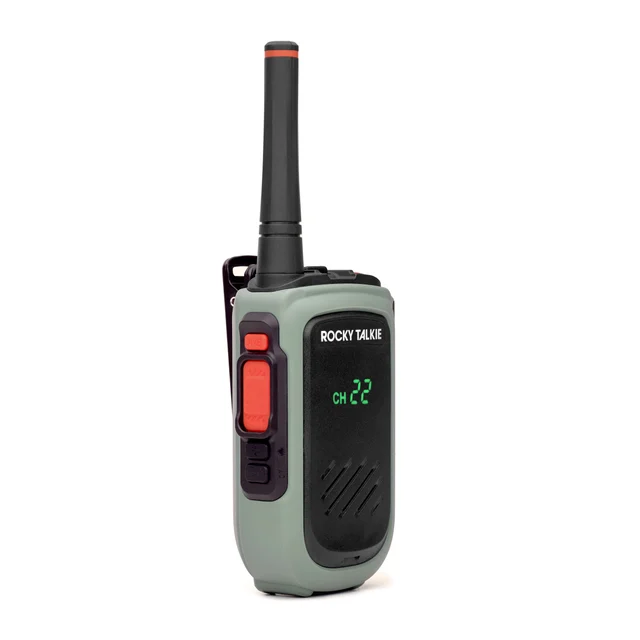
- Buy Rocky Talkie 5 Watt Radio The rugged, waterproof backcountry radio that survives drops, cold, and dunkings while staying dead simple to use.
- Buy Midland GXT1030VP4 The capable GMRS pair that packs weather alerts, high power, and loads of features for a sensible mid-range price.
- It depends Motorola Talkabout T480 A friendly, familiar consumer radio for casual use, but its low power and light sealing cap what it can do.
- Skip Baofeng UV-9G GMRS A powerful, waterproof GMRS handheld that most families should skip because the setup and controls fight beginners.
What actually matters
- Radio service (FRS, GMRS, MURS): this determines legal power output, channel access, repeater use, and whether you need a license before you can transmit.
- Real-world range: the number that matters is how far the radio reaches through trees, buildings, and hills, not the line-of-sight figure printed on the box.
- Wattage: more watts generally means more range and a better chance of punching through obstacles, but only within the legal limit for that radio's service.
- Water and dust resistance (IP rating): decides whether the radio survives rain, snow, and drops, or needs to stay in a dry pocket.
- Battery type and cold-weather performance: rechargeable packs are convenient but fade in freezing temps, and AA compatibility is a useful backup.
- Repeater capability: routing your signal through a fixed repeater station can turn a few miles of range into dozens, if repeaters exist in your area.
- Ease of use: big buttons, simple menus, and glove-friendly controls matter more than a long feature list once you're actually outdoors.
The specs, in plain English
Green flags vs red flags
Green flags
- Range claims are given with a caveat like "line-of-sight" or "open terrain," not just a bare mileage number
- IP rating is stated as a specific number (IP54, IP67) rather than a vague word like "water-resistant"
- GMRS radios openly mention repeater access and the license requirement, rather than staying quiet about it
- Battery specs include cold-weather or AA-fallback detail, not just "long battery life"
- Controls and menus are described as simple or glove-friendly on radios aimed at outdoor use
Red flags
- A single huge mileage number ("36 miles!") with no mention of terrain or conditions
- "Waterproof" claimed with no IP rating attached anywhere in the listing
- No mention of FRS vs GMRS at all, leaving you unsure whether a license is required
- Owner reports describe fiddly menus or needing a video to program a radio marketed as beginner-friendly
- Bundled extras (cases, clips, straps) padding the listing in place of actual spec detail
Who's who: the brands
- Rocky Talkie - A newer outdoor-focused brand built around rugged, waterproof GMRS radios for skiing, climbing, and backcountry use, prioritizing simplicity and durability over feature count.
- Midland - A long-running consumer radio brand known for feature-rich GMRS and FRS radios with weather alerts, aimed at families, campers, and road-trippers.
- Motorola - A familiar consumer electronics name selling approachable, easy-to-use FRS radios for casual and short-range use.
- Baofeng - A budget radio maker known for packing high power and advanced features into inexpensive handhelds, popular with hobbyists willing to deal with complex programming.
How to read a listing without getting fooled
When you're scanning a product listing, look past the headline mileage number and find three things: the service (FRS or GMRS, sometimes listed as a "GMRS/FRS combo"), the IP rating written as a number rather than an adjective, and whether the radio ships as a single unit or a pair. A high wattage figure only matters if it's paired with real GMRS operation, since FRS radios are capped regardless of what a listing implies. Watch for listings that lean on adjectives ("rugged," "waterproof," "long-range") without a spec to back them up, that's usually where the compromises are hiding. And if a radio is marketed for group or family use, check whether chargers and a second unit are actually included, or whether you're pricing one radio and need to buy two.
How much should you spend?
Radio pricing tracks a few real drivers, not marketing dressing: legal transmit power, ruggedness (waterproofing, shock resistance, glove-friendly controls), and whether the radio ships as a ready-to-use pair with chargers. Budget FRS radios are the cheapest way to keep a casual group in touch at close range, and they're a reasonable choice if your use is a campground or a neighborhood. Stepping up to a full-featured GMRS pair with weather alerts and higher power is where most buyers land the best value, since you get meaningfully more range and capability without paying for extremes. Spending at the premium end mostly buys toughness (real waterproofing, cold-weather battery performance, drop resistance) built for people who depend on the radio in genuinely harsh conditions; it's worth it if you're actually skiing, climbing, or working outdoors, and overkill if you're mostly car camping.
Questions, answered
What's the difference between FRS, GMRS, and MURS?
FRS is low-power, license-free, and built into fixed-antenna radios, best for casual, close-range use. GMRS allows higher power, detachable antennas, and repeater access for real extra range, but needs an inexpensive FCC license with no test required; one license covers your immediate family. MURS is a separate license-free VHF service on a handful of set frequencies; it shows up occasionally in radios built for hobbyists or small businesses, but it's rarely the default option in consumer two-way radios.
Do I actually need a license to use a GMRS radio?
Yes, if you want to transmit legally. The FCC requires a GMRS license for any GMRS radio, but there's no test, you file paperwork and pay a modest fee, and the license covers your immediate family for a multi-year term. Plenty of people use GMRS radios without licensing and never get caught, but it's a quick, low-cost step if you want to do it by the book.
Why don't I get anywhere near the range printed on the box?
Because that number is a line-of-sight best case, typically measured between two elevated points with nothing in between, like mountaintop to mountaintop. On the ground, buildings, trees, hills, and your own body absorb and block the signal. Realistic range for most handheld two-way radios lands around 1 to 5 miles, and it drops fast in cities or dense forest. Judge a radio by independent testing and owner reports of real-world range, not the headline figure.
Do privacy codes mean nobody else can hear me?
No. Privacy codes (also called CTCSS or DCS tones) are sub-channels that filter out other chatter so you only hear people using the same code; they're a convenience feature, not encryption. Anyone else with a radio set to your channel and code, or a scanner, can still hear everything you say. Don't transmit anything on a consumer radio that you wouldn't want a stranger to overhear.
What does an IP rating like IP67 actually tell me?
It's a two-digit code for dust and water protection. The first digit covers dust, the second covers water, and for radios the second digit is what matters: a 4 or 5 means it can handle splashes and light rain, while a 7 means it can survive being fully submerged for a short time. "Waterproof" or "water-resistant" without a number attached is marketing language, not a spec you can compare.
Rechargeable battery or AA batteries, which is better?
It depends on how you use the radio. Rechargeable packs are more convenient day to day and usually last longer per charge, but they lose capacity in cold weather and leave you stuck if you can't recharge. Radios that also accept standard AA batteries give you a backup you can buy anywhere, which matters for emergency kits, road trips, or multi-day trips away from power. Some radios offer both, which is the most flexible option if you can find one.
Or jump to the head-to-head: Rocky Talkie 5 Watt Radio vs Midland GXT1030VP4.