Explained
Via Ferrata Sets, Explained
After reading, you'll understand why a via ferrata set has a certified weight window and an expiry date, what type K means on a carabiner, and which numbers on a spec sheet are worth reading twice.
In this guide
Most first-time buyers treat a via ferrata set like a pair of boots: pick the one that feels nice and looks well made. It is not that kind of purchase. This is certified personal protective equipment with a defined user weight range, a mandated connector type, a single-use energy absorber and a fixed maximum service life measured from the date it was manufactured. Get any of those wrong and the set will still look perfect on the shelf while failing to do its one job.
The 30-second version
- The weight window is real, and it runs from 40 kg without equipment to 120 kg including equipment on every currently certified set.
- The absorber is single use, so a set whose absorber has started to tear should be retired.
- Service life runs from manufacture, as set in each maker's instructions, even for a set that was never taken out of the bag.
- Only type K carabiners are allowed, because they self-lock and have a gate opening wide enough for the cable and anchor hardware.
- The lanyard is one third of the system, and an EN 12277 harness and an EN 12492 helmet are not optional extras.
The products this guide is about
Our verdict on each, with the full reasoning on the companion review.
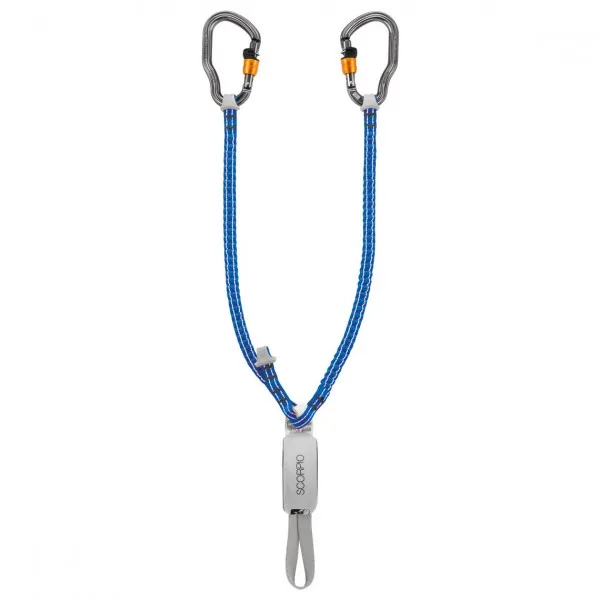
- Buy Petzl SCORPIO VERTIGO The lightest set of the four at 365 g, with keylock wire-lock gates and both CE EN 958 and UIAA marking. Amazon
- Buy Edelrid Cable Kit VI Edelrid states the absorber conforms to EN 958:2024, and the 92 cm arms plus an absorber-mounted rest loop make it the most complete set for the money.
- It depends Black Diamond Easy Rider Via Ferrata Set Extra-large-gate carabiners and a steel swivel aimed at easy clipping and untangled arms, at 585 g. Amazon
- Skip Climbing Technology Top Shell Compact Twist A well-made Italian set that is the heaviest here at 640 g, has the shortest reach at 70 cm extended, and rests on a webbing loop rather than a metal one.
What actually matters
- Certified user weight range - EN 958:2024 covers users from 40 kg without equipment to 120 kg including equipment. Outside that window the set is not certified to arrest a fall, and Petzl, for one, tells you to belay a child under 40 kg on a dynamic rope instead.
- Standard version - EN 958:2024 superseded EN 958:2017 in 2024. A maker that names the 2024 version is telling you which rules the set was actually tested against.
- Connector type - the connectors are EN 12275 type K, the klettersteig category, which lock automatically and open wide enough for the cable. That is what lets you clip a thick cable one-handed without ever screwing a sleeve shut.
- Energy absorber design - the modern design is a folded strip of stitched webbing inside a pouch that tears progressively. Edelrid recalled its older rope-brake sets in 2013 after industry testing showed used examples may fail.
- Set weight - published weights across the sets in our comparison run from 365 g to 640 g. It hangs off your harness for the whole route, so the spread between the lightest and heaviest is worth caring about.
- Arm length and elasticity - elasticated arms retract so they do not dangle and trip you, then stretch when you need reach. Published extended lengths vary from 70 cm to over 100 cm, and short arms make clipping past anchors harder.
- Rest attachment point - this is the point on the set intended for clipping yourself to an anchor to rest. Some makers restrict which carabiner type you may use on it, and most do not include that carabiner.
The specs, in plain English
Green flags vs red flags
Green flags
- The maker names EN 958:2024 explicitly rather than just EN 958.
- The set carries the UIAA mark as well as the CE mark.
- The carabiners are marked as EN 12275 type K with an automatic locking mechanism.
- The absorber sits in a pouch you can open to inspect the original folded position before every use.
- The maker publishes a maximum service life and tells you where the date of manufacture is stamped.
Red flags
- No user weight range printed anywhere on the listing or the product.
- The set is sold as used, vintage, or ex-rental with no documented history.
- The absorber pouch is sealed shut so you cannot check the folded webbing inside.
- The carabiners have screw sleeves rather than an automatic locking device.
- The listing shows a friction brake with a rope running through a plate, a design Edelrid recalled in 2013 after industry tests on used sets.
Who's who: the brands
- Petzl - French maker whose Scorpio line includes the Scorpio Vertigo, the lightest set in our comparison, listed with both CE EN 958 and UIAA marks.
- Edelrid - German maker that is unusually explicit on its product pages about which version of EN 958 the absorber meets.
- Black Diamond - American brand whose Easy Rider set pairs extra-large-gate carabiners with a steel swivel.
- Climbing Technology - Italian hardware maker known for the Top Shell family and for anti-wear shells on its klettersteig carabiners.
- Mammut - Swiss brand that also sells via ferrata sets; check its safety notices for your exact model.
How to read a listing without getting fooled
Start at the bottom of the spec box, not the top. Find the certified user weight range and check it against your own weight with a full pack, because that single line decides whether the set is appropriate for you at all. Then find the standard: a listing that says EN 958:2024 is telling you more than one that just says EN 958, and one that says EN 958:2017 is telling you it predates the current revision. Look for UIAA next, which is optional and signals a tighter impact-force limit at the light end. Then read the connector name and confirm it is described as type K with an automatic or double-action gate. Only after that should you compare the numbers everyone leads with: set weight, arm length retracted and extended, and whether the rest loop needs a carabiner you do not own yet.
How much should you spend?
Via ferrata lanyards cluster tightly. Budget models are rare because the certification cost is the same for everybody, so most current sets land in the mid-range tier, with the ultralight and swivel-equipped models sitting in the premium tier. Paying more buys you grams saved, a swivel, bigger carabiners or an anti-wear shell, not a higher safety rating: every certified set has to clear the same EN 958 requirements. Two places the extra spend is defensible are a genuinely lighter set if you have long approaches, and a set carrying the UIAA mark if you or someone in your party is near the bottom of the weight window. Budget separately for the harness, the helmet and, on some sets, the extra carabiner the rest loop needs. And remember the set has a fixed service life, so treat it as a purchase you will repeat rather than a one-off.
Questions, answered
Can I share one via ferrata set between two people on the same route?
No. Both climbers need their own set clipped to the cable at all times, because the whole point is that you are never disconnected. Sharing also means you cannot know whether the absorber has already been loaded when the other person had a slip. If cost is the issue, guided operators and mountain huts near popular routes rent complete kits, which is a reasonable way to try the activity before buying.
What is the difference between a via ferrata set and a work-at-height lanyard?
They are certified to different standards for different fall scenarios. A via ferrata set is certified to EN 958 for a climber sliding down a fixed cable between anchor points, and is tuned to keep impact force low across a 40 to 120 kg range. Industrial lanyards are certified to fall-arrest standards written around a different anchor geometry and different assumed loads. Some products look similar and even share carabiner shapes, so check for the EN 958 marking specifically.
How do I check my set before a route?
Open the absorber pouch and confirm the webbing is still folded in its original position with no torn stitching at the start of the absorber. Check the arms for cuts, abrasion and frayed fibres, especially where they enter the absorber. Work each carabiner gate several times and confirm it closes and locks under its own spring. Check the date of manufacture against the maker's stated lifespan, and follow its periodic inspection schedule.
Is a stiffer or a softer catch better?
Softer, within limits. The absorber exists to lower the peak force your body sees, and the standard sets ceilings rather than targets, such as 4 kN with a 40 kg test mass under EN 958:2024. A set carrying the UIAA 128 label has to stay under 3.5 kN at 40 kg, which is a meaningfully gentler catch for a light rider. What you cannot do is trade force for distance without limit, and UIAA 128 also caps braking length at 2200 mm in its 40 kg test so you do not simply hit the anchor below you.
Or jump to the head-to-head: Petzl SCORPIO VERTIGO vs Edelrid Cable Kit VI.